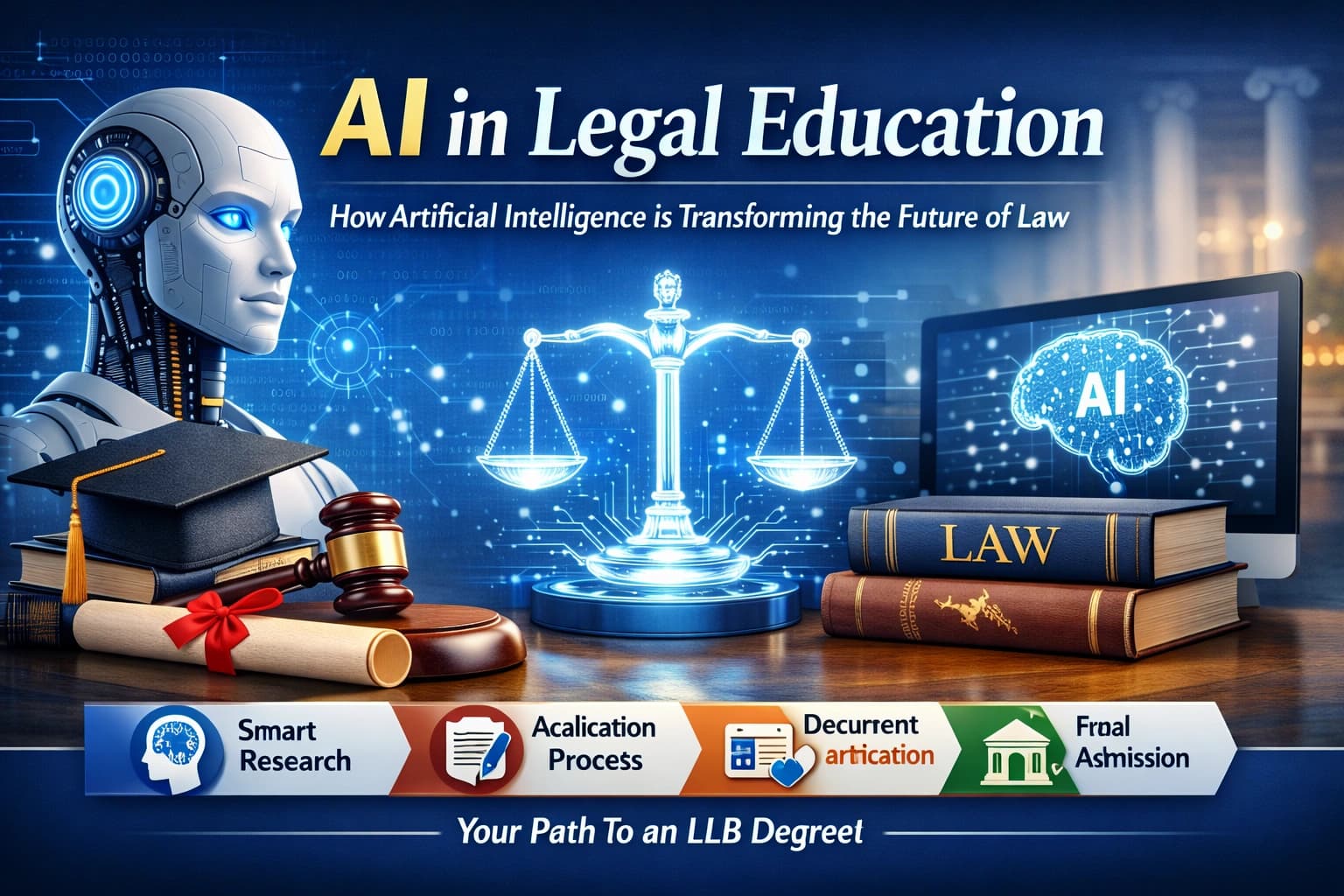
The Legal Industry is Entering a New Era
Artificial Intelligence (AI) is changing industries across the globe, and the legal profession is no exception. Tasks that once required hours of legal research can now be completed more efficiently using AI-powered legal tools. From contract analysis to legal document review and case research, technology is reshaping the way legal professionals work.
For students planning to pursue LLB, BA LLB, BBA LLB, or LLM, understanding AI is becoming just as important as understanding legal principles. Rather than replacing lawyers, AI is transforming how legal services are delivered and creating demand for professionals who can combine legal expertise with technology.
What is AI in Legal Education?
AI in legal education refers to the use of artificial intelligence tools to support learning, legal research, document drafting, and practical legal training. Many universities and legal institutions are integrating technology into their teaching methods to help students develop industry-relevant skills.
Students can use AI to:
- Summarise legal judgments
- Understand complex legal concepts
- Conduct preliminary legal research
- Draft legal documents
- Organise study materials
- Improve legal writing
AI should be viewed as a learning assistant rather than a replacement for critical thinking or legal analysis.
Why Law Students Should Learn About AI
The legal profession is evolving rapidly, and employers increasingly value candidates who are comfortable working with legal technology.
Benefits of learning AI include:
- Faster legal research
- Improved productivity
- Better document management
- Enhanced legal drafting
- Exposure to legal technology
- Preparation for modern workplaces
Combining legal knowledge with digital skills can strengthen long-term career prospects.
How AI is Transforming Legal Practice
AI is already being used in several areas of legal practice, including:
Legal Research
AI-powered platforms can help identify relevant statutes, judgments, and legal commentary more efficiently.
Contract Review
Technology assists legal teams by highlighting clauses, identifying inconsistencies, and organising contract information.
Compliance Management
Businesses increasingly use AI to monitor regulatory changes and support compliance processes.
Litigation Support
AI tools can help organise case files, review documents, and assist with legal analysis.
E-Discovery
Technology enables faster review of large volumes of digital evidence during legal proceedings.
While AI enhances efficiency, legal professionals remain responsible for applying legal reasoning, ethics, and professional judgment.
Skills Future Lawyers Need
The future lawyer will need more than legal knowledge.
Students should focus on developing:
- Legal Research Skills
- Critical Thinking
- Communication
- Legal Drafting
- Digital Literacy
- Data Privacy Awareness
- Problem Solving
- Ethical Decision-Making
- Technology Adaptability
These competencies complement legal education and support career growth in a technology-driven environment.
Emerging Career Opportunities
As legal technology expands, new career opportunities are emerging.
Students may explore roles such as:
- Legal Technology Consultant
- Compliance Specialist
- Data Privacy Professional
- Legal Operations Manager
- AI Policy Advisor
- Technology Law Specialist
- Cyber Law Expert
- Corporate Legal Advisor
These fields combine legal expertise with innovation and are expected to continue growing.
Can AI Replace Lawyers?
One of the most common questions among students is whether AI will replace lawyers.
The answer is no.
AI can automate repetitive tasks, but it cannot replace essential human qualities such as:
- Legal reasoning
- Advocacy
- Negotiation
- Client relationships
- Ethical decision-making
- Courtroom representation
- Strategic judgment
The future belongs to lawyers who know how to use technology effectively while maintaining strong legal expertise.
How Universities Are Adapting
Many institutions are gradually introducing technology-focused learning through:
- Legal Technology Workshops
- Digital Research Training
- Cyber Law Programmes
- AI Ethics Discussions
- Practical Technology Modules
- Online Learning Platforms
Students who embrace these developments may gain valuable practical exposure alongside traditional legal education.
Tips for Law Students in the AI Era
To stay competitive, students should:
- Build strong legal fundamentals.
- Learn responsible use of AI tools.
- Improve legal writing and research skills.
- Stay informed about legal technology trends.
- Participate in internships and workshops.
- Understand data privacy and cyber laws.
- Continue learning throughout their careers.
Technology should enhance—not replace—professional judgment.
Why Choose Vidyapun?
Choosing the right university is the first step toward a successful legal career.
Vidyapun helps students by providing:
- Law Admission Guidance
- University Comparison
- Career Counselling
- Course Selection Support
- Documentation Assistance
- Higher Education Guidance
- Admission Support
Our goal is to help students prepare for both today's legal profession and tomorrow's technology-driven legal landscape.
Frequently Asked Questions
Is AI important for law students?
Yes. Understanding AI and legal technology can improve research efficiency, productivity, and readiness for modern legal workplaces.
Will AI replace lawyers?
AI can assist with repetitive tasks, but legal reasoning, advocacy, ethical judgment, and client representation continue to require human expertise.
Which legal specializations are growing with AI?
Cyber Law, Data Privacy, Intellectual Property Rights, Technology Law, Corporate Law, and Compliance are among the areas experiencing increased demand.
Should law students learn legal technology?
Developing familiarity with legal technology can complement traditional legal education and prepare students for evolving workplace expectations.
How can Vidyapun help?
Vidyapun provides guidance on admissions, university selection, course planning, and career development for students pursuing legal education.
Author's Note
Reviewed by the Vidyapun Education Team
This article is intended for educational purposes and reflects current developments in legal technology. AI tools should be used responsibly and do not replace professional legal advice, ethical responsibilities, or independent legal judgment.
Conclusion
Artificial Intelligence is transforming legal education and the legal profession by improving efficiency and creating new opportunities. Students who combine strong legal knowledge with digital literacy, ethical awareness, and practical skills will be better prepared for the future.
Rather than viewing AI as a challenge, aspiring lawyers can embrace it as a valuable tool for learning, research, and professional development.
Contact Us
Looking for expert guidance on law admissions and future-ready legal education?
Vidyapun helps students choose recognised universities, compare programmes, and plan successful legal careers with confidence.
🌐 Website: www.vidyapun.com
📞 Call / WhatsApp: +91 96438 02216
Connect with Vidyapun today and take the first step toward a future-ready legal career.