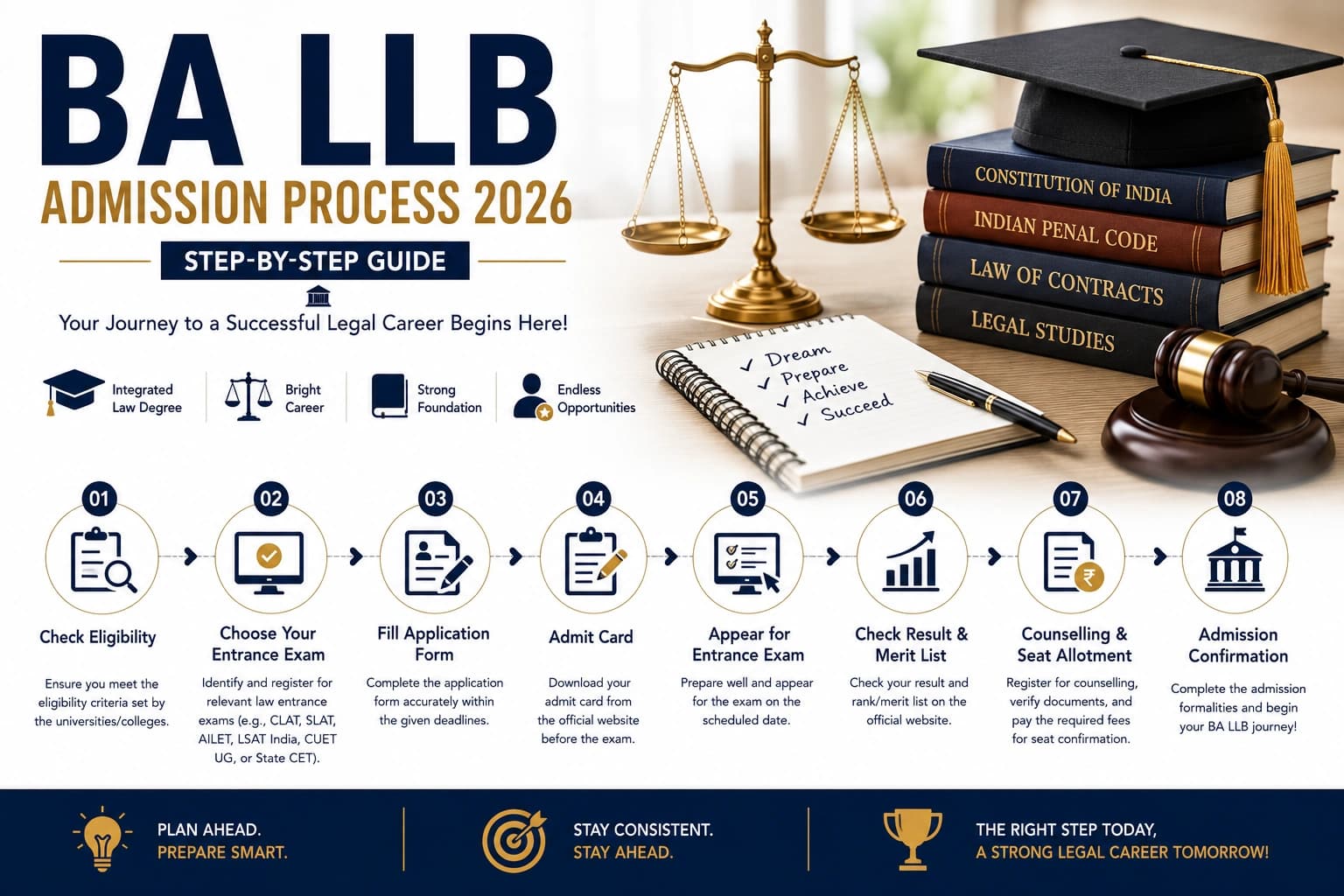
If you've just finished Class 12 and law feels like the right path, the BA LLB admission process can look confusing at first glance — CLAT, state-level exams, direct admission, counselling rounds, document verification. It's a lot to track, especially if no one in your family has gone through it before.
This guide breaks the entire BA LLB admission process down into five clear steps, from checking your eligibility to what happens after you get your seat. By the end, you'll know exactly what to do next and in what order.
What Is the BA LLB Admission Process in India?
The BA LLB admission process is how students enter India's 5-year integrated law degree — a program that combines a Bachelor of Arts with a Bachelor of Laws, letting you study subjects like political science, sociology, and economics alongside core legal subjects from year one. It's the most common route into a legal career for students coming straight out of school.
BA LLB Course Overview
Unlike the 3-year LLB (which is meant for students who already hold a bachelor's degree), BA LLB is designed for 12th-pass students. It runs for five years, split into ten semesters, and ends with you eligible to enrol as an advocate with your State Bar Council after clearing the All India Bar Examination (AIBE).
Who Should Consider BA LLB
BA LLB suits students who are fairly confident about pursuing law early, since it locks you into a 5-year commitment right after school. If you're unsure whether law is for you, some students prefer completing a regular bachelor's degree first and applying for the 3-year LLB later — but BA LLB does save two years overall if law is a clear choice for you now. If you're still weighing the two options, this comparison of BA LLB vs LLB breaks down the trade-offs in more detail.
Step 1: Check Your Eligibility
Before you start filling any forms, confirm you actually qualify. Eligibility criteria vary slightly by university, but most follow a similar pattern.
Age and Academic Criteria
You'll generally need to have passed Class 12 (in any stream — Arts, Commerce, or Science) from a recognized board, with a minimum aggregate score that most institutions set somewhere in the 45-50% range (often relaxed for reserved categories). Some universities also apply an upper age limit, though several top institutions have removed age caps in recent years following regulatory changes — always check the specific university's latest notification rather than assuming a blanket rule applies everywhere. For a fuller breakdown of marks, age limits, and category relaxations, see our detailed guide on BA LLB eligibility criteria.
Common Eligibility Mistakes to Avoid
Two mistakes trip up applicants every year: assuming a specific stream (like Commerce or Science) is required when it usually isn't, and missing category-specific relaxations they're actually entitled to. Always read the official eligibility notification of each university or exam body directly rather than relying on hearsay from friends or forums.
Step 2: Choose Your Entrance Exam Route
This is the step that shapes everything after it. Most BA LLB seats in India are filled through entrance exams, though a smaller number of private universities offer merit-based or direct admission.
National-Level Exams
The Common Law Admission Test (CLAT) is the most widely recognized entrance exam, used by National Law Universities and a large number of other law colleges. LSAT India is another national-level option accepted by a range of private and deemed universities. Each exam has its own pattern, syllabus, and application timeline, so it's worth deciding early which one (or both) you'll prepare for. Our full rundown of top BA LLB entrance exams in India compares syllabus and difficulty across all the major options.
State-Level and University-Level Exams
Beyond the national exams, many states run their own law entrance tests (often referred to as state CETs), and several private universities conduct their own entrance exams or admit students through merit-based counselling using Class 12 marks. If you're targeting a specific state or a particular private university, check whether they require CLAT, their own test, or accept your board marks directly — this affects how you plan your preparation months in advance. If you'd rather skip entrance exams altogether, this guide to BA LLB admission without entrance exam covers merit-based routes and which colleges accept them.
Step 3: Application Process
Once you know which exam or admission route you're pursuing, the actual application follows a fairly standard pattern across institutions.
Registration and Documents
You'll typically register online on the exam or university's official portal, fill in your personal and academic details, and upload scanned copies of your Class 10 and 12 mark sheets, a passport-size photograph, signature, and category certificate if applicable. Keep digital copies of every document ready in advance — mismatched formats or last-minute scanning is one of the most common causes of application delays.
Application Fees and Deadlines
Application fees vary by exam and category, and typically range from a few hundred to a couple of thousand rupees. Deadlines are usually announced months ahead, with many national exams opening applications by the end of the previous year for a mid-year test date. Set calendar reminders — late fees or missed windows are avoidable problems that catch out otherwise well-prepared students every year.
Step 4: Counselling, Seat Allotment & Verification
Clearing the entrance exam (or qualifying via merit) is only half the process. What follows determines which specific college and seat you actually get.
How Counselling Works
Most exams run their admission process through centralized counselling: based on your rank or score, you fill in college and course preferences, and seats are allotted in rounds. Some private universities skip formal counselling and instead conduct direct interviews or interactions before confirming an offer. Read the specific counselling schedule for your exam carefully, since missing a preference-filling window can cost you a round entirely. Before you fill preferences, it helps to shortlist options using Vidyapun's College Finder and Compare Colleges tools, or browse our guide to top BA LLB colleges in India for a starting shortlist.
Document Verification and Admission Confirmation
Once a seat is allotted, you'll need to complete document verification — either online or at a designated centre — followed by fee payment to confirm your admission. Keep originals and photocopies of all your academic certificates, identity proof, and category/income certificates (if applicable) ready for this stage, as incomplete verification is a common reason seats are cancelled and reallotted to the next candidate.
Step 5: After Admission — What Comes Next
Getting the seat confirmed isn't the finish line — a little preparation before your course starts will make the transition much smoother.
Orientation and Fee Payment
Most universities hold an orientation week before classes begin, covering everything from campus facilities to academic expectations. Make sure your fee payments (tuition, hostel, and any one-time charges) are completed within the deadlines communicated by the university to avoid late penalties or seat forfeiture. If cost is a concern, check our list of scholarships for BA LLB students before your first fee deadline.
Planning Your First Semester
Your first semester will typically mix foundational law subjects (like Legal Methods or Constitutional Law basics) with general BA subjects. It helps to get a head start by understanding your syllabus structure and picking up basic reading habits — case briefing and legal terminology take some getting used to, and starting early makes the first few months far less overwhelming. Our year-wise BA LLB syllabus breakdown is a good place to preview what's ahead.
Frequently Asked Questions
1. Is CLAT compulsory for BA LLB admission? No. CLAT is widely used, but it isn't the only route. Many state-level exams and private university entrance tests or merit-based systems also lead to BA LLB admission — it depends on which universities you're targeting.
2. Can a Commerce or Science student apply for BA LLB? Yes. BA LLB admission is open to students from any stream in Class 12 — Arts, Commerce, or Science — as long as they meet the minimum aggregate marks required.
3. What is the minimum percentage required for BA LLB admission? It varies by university, but most set the minimum aggregate somewhere around 45-50% in Class 12, often with relaxations for reserved categories. Always confirm the exact cutoff with your target institution.
4. Is there an age limit for BA LLB admission? Some universities apply an upper age limit, while others have removed it in recent years. This differs by institution, so check the current admission notification rather than assuming a fixed rule applies everywhere.
5. What documents are needed for BA LLB admission? Typically your Class 10 and 12 mark sheets, a passport-size photo, signature, and category or income certificate if applicable. Keep both digital scans and physical photocopies ready for application and verification stages.
6. What happens if I miss a counselling round? Depending on the exam, you may still be eligible for subsequent rounds or spot admission rounds, though your choice of colleges may narrow. It's best to track the official counselling schedule closely and respond within every window.
Not sure where you actually stand for BA LLB admission this year? Use Vidyapun's Admission Chances Predictor to get an instant, data-based read on your prospects, or explore full course details on the BA LLB course page before you finalize your exam and college shortlist. For more BA LLB guides on eligibility, careers, and exam prep, browse the Vidyapun blog.
Still have questions about your BA LLB admission? Reach out to our counsellors directly.
🌐 Website: www.vidyapun.com 📞 Call / WhatsApp: +91 96438 02216