"Syllabus" and "curriculum" often get used interchangeably, but they're not quite the same thing — and understanding the difference matters once you're actually choosing your path through BA LLB. The curriculum is the overall design: what's compulsory, what's optional, how much weight each area carries, and how it all fits together across five years.
Getting a clear picture of this structure early helps with more than just academic planning — it shapes how you think about your eventual specialization, your internship choices, and even which universities you shortlist, since elective offerings can differ meaningfully from one college to another.
This guide explains how the BA LLB curriculum is structured — core subjects versus electives, how credits work, and how to choose electives that genuinely serve your career goals rather than picking randomly in your final years.
What Does "Curriculum" Mean in BA LLB?
The curriculum is the broader academic framework a university designs for a degree program — it defines which subjects are compulsory (core), which are optional (electives), how many credits each carries, and how they're sequenced across semesters.
Curriculum vs Syllabus: What's the Difference
Syllabus refers to the specific content and topics covered within a single subject — essentially the detailed reading list and unit breakdown for one paper. Curriculum is the bigger picture: the full structure of subjects, credits, and choices across your entire program. Knowing this distinction helps when you're comparing universities, since two colleges might have a similar curriculum structure but noticeably different syllabus depth within individual papers.
Who Designs the BA LLB Curriculum
The Bar Council of India (BCI) sets broad minimum requirements that every recognized BA LLB program must meet — certain core subjects, minimum practical training hours, and moot court components, for instance. Within that framework, individual universities design their own specific curriculum, deciding exact subject sequencing, elective offerings, and credit weightings, which is why curriculum structure can vary meaningfully between institutions even though they're all technically BA LLB degrees. This is also why comparing curricula, not just brand reputation, is worth doing when you're shortlisting colleges — a university with a broader elective bench in the specialization you want can matter more to your career than its general ranking.
Core (Compulsory) Subjects in BA LLB
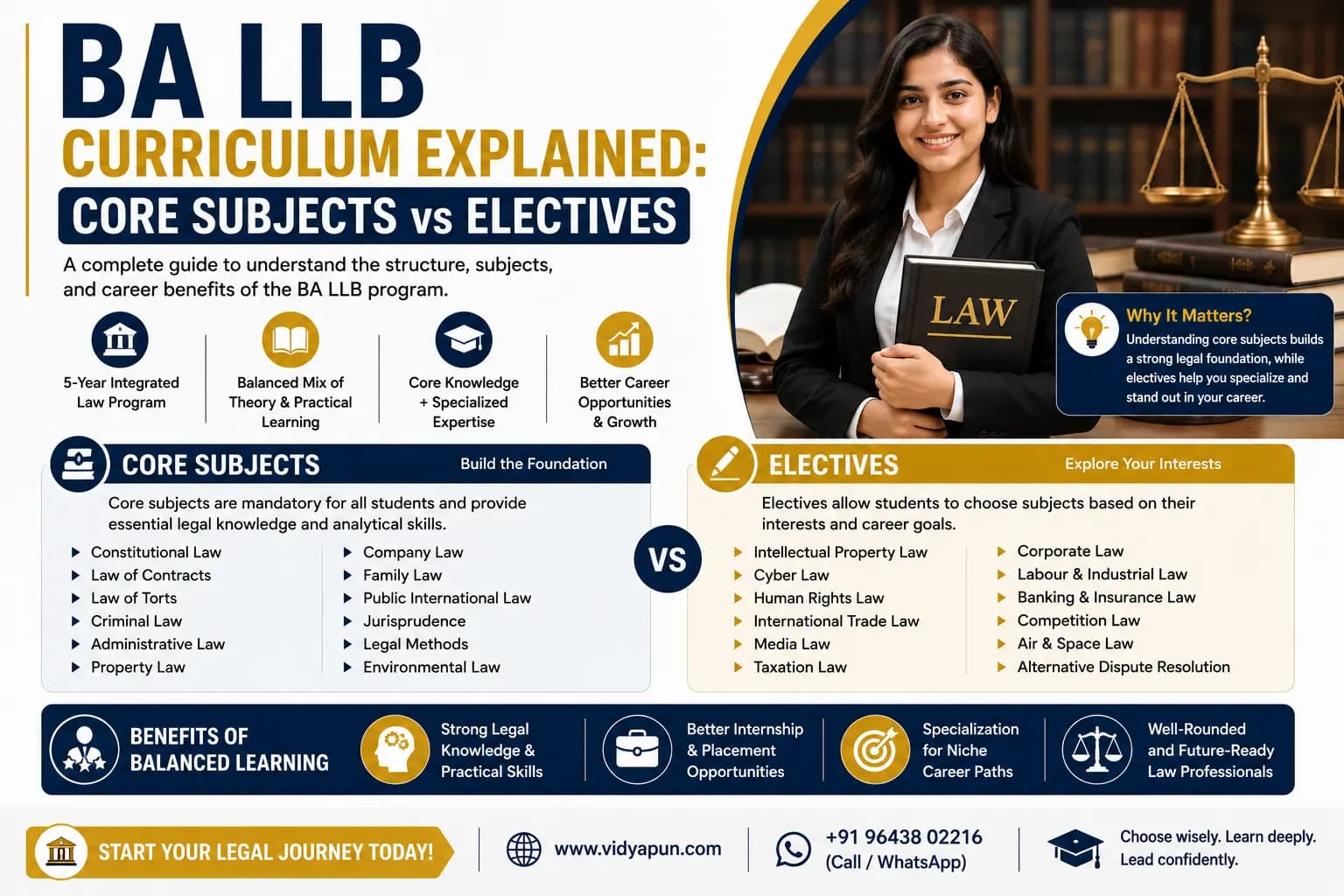
Core subjects are the non-negotiable backbone of the degree — every student takes these regardless of elective choices.
Foundational Law Subjects
These typically include Constitutional Law, Law of Contracts, Law of Torts, Criminal Law, Property Law, Family Law, Civil Procedure Code, Criminal Procedure Code, Evidence Law, and Jurisprudence, among others. These subjects exist across virtually every recognized BA LLB program because they form the baseline legal knowledge the Bar Council expects every law graduate to have, regardless of what they specialize in later. They're also the subjects most heavily tested in judiciary exams and the All India Bar Examination, so a strong grasp of core subjects pays off well beyond your college years.
BA (Humanities) Subjects
Alongside core law papers, BA LLB also carries compulsory BA subjects — commonly Political Science, Economics, Sociology, and History — usually concentrated in the earlier years of the program. These aren't "extra" or lesser subjects; they're a deliberate part of the curriculum's design, intended to build the broader analytical and contextual foundation a well-rounded lawyer needs. Many practicing lawyers point back to these subjects as genuinely useful — Economics for corporate and taxation practice, Political Science for constitutional and policy work, Sociology for family and criminal law contexts.
What Are Electives in BA LLB?
Electives are where the curriculum gives you genuine choice, letting you shape your degree around your own interests and career direction.
How Electives Differ from Core Subjects
While core subjects are fixed and identical for every student in a batch, electives let you choose from a menu of specialized subjects — meaning two students graduating from the same BA LLB program can have meaningfully different subject profiles by the time they finish, depending on the electives they picked. This is a deliberate design choice: it acknowledges that legal careers branch out in very different directions, and a one-size curriculum wouldn't serve every student equally well.
When Electives Are Introduced
Most universities introduce electives gradually from the third year onward, with the widest range of choice typically available in the fourth and fifth years, once you've built a solid grounding in the compulsory core subjects. This sequencing is deliberate — electives generally assume some baseline legal knowledge that the earlier core subjects provide, which is why you won't usually see specialized electives like Taxation Law or Cyber Law offered in the first year.
Popular BA LLB Elective Areas
Elective offerings vary by university, but most curricula draw from a fairly similar pool of specialization areas.
Corporate and Commercial Law Electives
Common options here include Company Law, Banking Law, Competition Law, Insurance Law, and Taxation Law — popular among students eyeing corporate law firms or in-house counsel roles after graduation. These electives tend to be in high demand at universities with strong corporate law placement records, so seat availability can sometimes be limited.
Emerging and Niche Electives
Many curricula now also offer electives in areas like Cyber Law, Intellectual Property Law, Environmental Law, Human Rights Law, and International Law — reflecting how the legal profession itself has diversified. Some universities have also started introducing electives around Legal Technology and AI in Law, given how quickly these areas are growing in relevance to legal practice. If a particular niche area genuinely interests you, it's worth checking a university's specific elective list before applying, since not every institution offers every specialization.
Credit System: How BA LLB Courses Are Weighted
Most Indian universities now run BA LLB on a credit-based system, similar to how many undergraduate programs are structured globally.
Understanding Credit Hours
Each subject — whether core or elective — is assigned a certain number of credits based on its instructional hours and weightage in your overall degree. Practical and clinical papers (like moot court or internships) often carry credits too, even though they don't follow a traditional lecture format, reflecting their importance in your overall training. A typical BA LLB program requires accumulating a set total number of credits across all ten semesters to graduate, similar in structure to how most modern undergraduate degrees are designed.
How Credits Affect Your Workload
Your total credit load per semester determines how many contact hours, assignments, and assessments you're managing at once. Understanding your university's credit structure early helps you plan realistically — a semester with a heavier core-subject credit load leaves less room for taking on extra electives or external commitments like internships during that period. It's worth reviewing your credit distribution at the start of each academic year so you can plan internships, moot court commitments, and personal study time around your heaviest semesters rather than being caught off guard.
How to Choose the Right Electives for Your Career Goals
Since electives genuinely shape your specialization, choosing them thoughtfully rather than reactively pays off later.
Aligning Electives with Career Interests
If you're leaning toward corporate law, prioritize electives like Company Law, Competition Law, and Taxation. If litigation or judiciary exams interest you more, procedural and core-adjacent electives (and strong performance in compulsory procedural subjects) tend to matter more than niche specialization electives. There's no universally "best" elective set — it depends entirely on the direction you're heading.
Common Mistakes When Choosing Electives
Two common mistakes: picking electives purely because friends are taking them rather than based on genuine interest or career direction, and ignoring how an elective's timing overlaps with internship or moot court commitments in the same semester. It's worth planning your elective choices at least a semester in advance rather than deciding at the last minute.
Frequently Asked Questions
1. What is the difference between core subjects and electives in BA LLB? Core subjects are compulsory for every student and form the foundational legal knowledge base. Electives are optional specialized subjects you choose from a menu, usually starting from the third year onward, letting you shape your degree around specific interests.
2. How many electives can I choose in BA LLB? This varies by university and by year, but most programs offer a set number of elective slots (often two to four per semester in the later years) that you select from a broader list of available options.
3. Do elective choices affect job opportunities after BA LLB? They can, particularly for specialized roles — for example, corporate law electives can strengthen a corporate law firm application. That said, overall academic performance, internships, and skills matter at least as much as your specific elective choices.
4. Can I change my elective after selecting it? Policies vary by university — some allow a short window to switch electives early in the semester, while others lock choices in once registered. Check your specific institution's academic policy before finalizing your selection.
For a full year-by-year view of how core subjects and electives fit together, see our BA LLB syllabus breakdown. If you're still confirming your eligibility or admission route, revisit our BA LLB eligibility criteria and admission process guides.
Not sure which colleges offer the electives you're interested in? Use Vidyapun's Admission Chances Predictor for a data-based estimate, or explore full course details on the BA LLB course page.
Still have questions about the BA LLB curriculum or elective options? Reach out to our counsellors directly.
🌐 Website: www.vidyapun.com 📞 Call / WhatsApp: +91 96438 02216