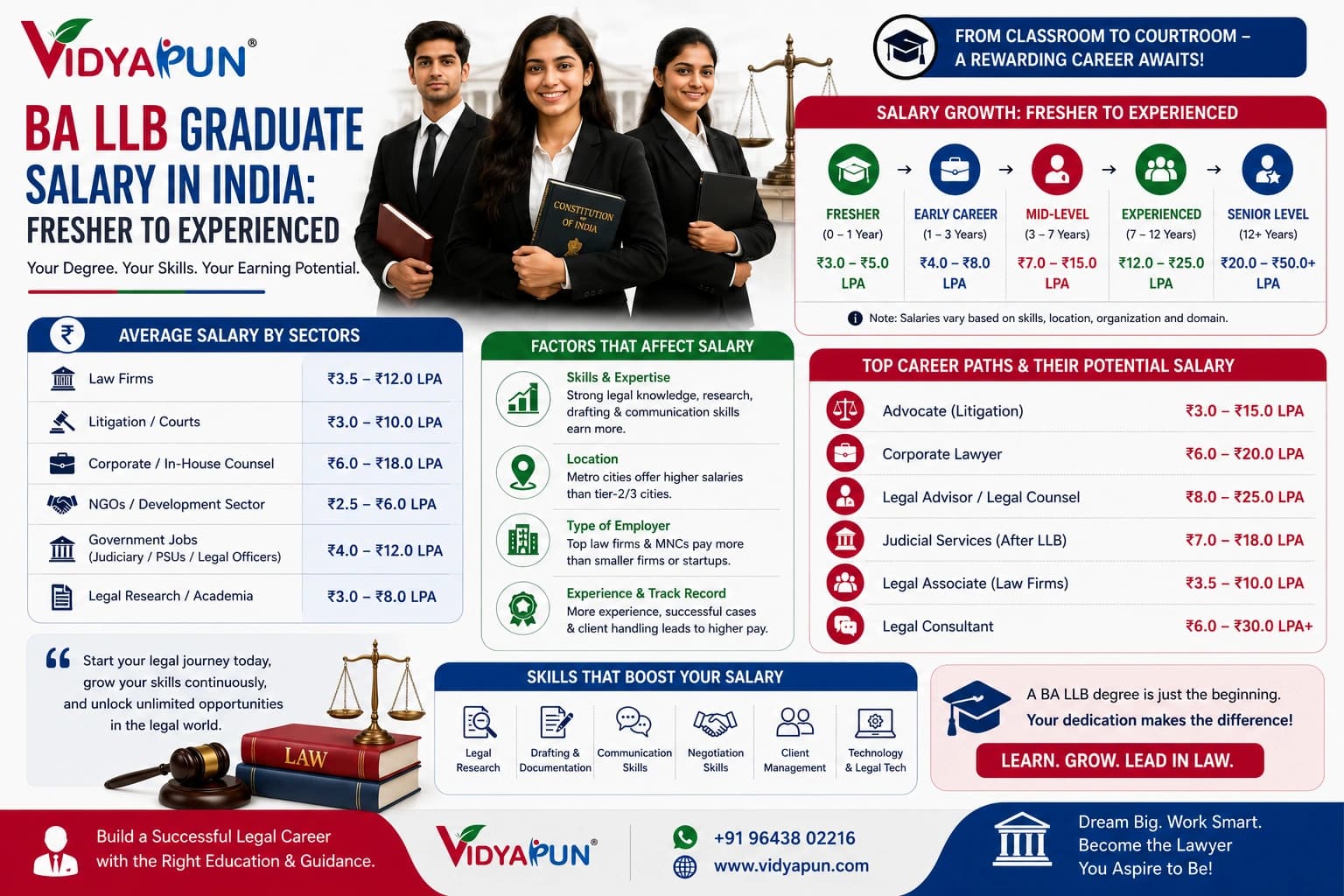
"What will I actually earn after BA LLB?" is one of the most searched — and most inconsistently answered — questions among law aspirants. Salary figures online range anywhere from ₹2 lakh to ₹16 lakh a year for freshers, which isn't a contradiction so much as a reflection of how much sector, city, and college genuinely change the picture.
This guide breaks down what BA LLB graduates can realistically expect to earn, from your first job through several years of experience, and what actually moves the needle on your starting package.
BA LLB Graduate Salary in India: What to Expect
Before looking at specific numbers, it helps to understand why the range is so wide in the first place.
Why Salary Ranges Vary So Widely
Your starting salary depends heavily on which sector you enter (litigation, corporate law firms, in-house counsel, government), which city you work in, your college's placement reputation, and your own performance during internships. A fresher joining a top-tier corporate law firm in a metro city can earn several times what a fresher starting independent litigation practice earns in the same year.
How to Read Salary Data Realistically
Most published "average" BA LLB salary figures cluster in the ₹3-6 lakh per annum range for freshers, though this masks significant variation — entry-level litigation and smaller firm roles often start lower, while top national law firms and strong corporate placements can start considerably higher. Treat any single average figure as a rough midpoint rather than a reliable prediction for your specific situation.
Fresher Salary: Your First Job After BA LLB
Your very first role sets the tone, though it's rarely your ceiling.
Law Firm and Litigation Roles
Junior associate roles at law firms and independent litigation chambers commonly start in the ₹3-6 lakh per annum range at most institutions, though this can be lower in smaller cities or with less established chambers, and considerably higher — sometimes ₹14-16 lakh per annum — at a small number of top national law firms that recruit primarily from a handful of premier law schools.
Corporate and In-House Legal Roles
Corporate and in-house legal roles, including junior legal advisor or compliance positions, often start somewhat higher than pure litigation roles, commonly in the ₹4-8 lakh per annum range depending on the company size and city, reflecting the more structured, salaried nature of in-house corporate legal work compared to fee-based litigation practice.
Salary by Sector: Law Firms vs Corporate vs Government
Where you choose to work shapes your income trajectory as much as your degree does.
Law Firm Salaries
Law firm salaries vary enormously by firm tier — a small local firm and a large national corporate law firm can differ by several multiples in starting pay, largely tied to the type and scale of clients each firm serves.
Corporate/In-House Salaries
In-house corporate legal roles tend to offer more predictable salary growth and structured appraisal cycles compared to law firm or independent practice, though the ceiling for very senior in-house counsel is generally lower than what top law firm partners or highly successful independent litigators can eventually earn.
Government and Judiciary Salaries
Government legal roles follow a different structure entirely, worth understanding separately.
Civil Services and Legal Officer Roles
Government legal positions — public prosecutor roles, legal officer posts in various departments, and similar government roles — typically follow standardized government pay scales, which can be competitive with or exceed typical private-sector fresher salaries, alongside the job security and benefits associated with government employment.
Judiciary Salaries
Clearing judiciary exams and becoming a civil judge typically starts at a pay scale that compares favorably with, and in several cases exceeds, typical private-sector fresher salaries, with clear, structured promotion pathways through the judicial hierarchy over a career. Exact current pay scales are revised periodically by respective state governments, so check current figures if judiciary is a specific goal.
How College Reputation Affects Starting Salary
This is one of the most significant, and sometimes underappreciated, factors in your starting package.
Top Law Schools vs Other Colleges
Graduates from premier National Law Universities and other top-tier institutions are disproportionately represented among the highest starting packages, largely because top national and international law firms concentrate their campus recruitment at a relatively small number of institutions. This doesn't mean strong outcomes are impossible from other colleges, but the recruitment pipeline for the very highest packages is genuinely narrower.
The Role of Internships and Placements
Regardless of which college you attend, a strong internship track record — quality chambers, firms, or organizations you've worked with during BA LLB — meaningfully influences your starting offers, sometimes as much as your college's overall brand. Building a genuinely strong internship portfolio during your final two years is one of the most direct ways to influence your own starting salary.
Mid-Career and Experienced Salary Growth
Your starting salary is a beginning point, not a fixed trajectory — growth patterns differ meaningfully by path.
3-5 Years Experience
With three to five years of relevant experience, salaries in corporate law and specialized practice areas commonly grow into the ₹10-20 lakh per annum range, particularly for lawyers who've built expertise in high-demand areas like corporate transactions, taxation, or intellectual property.
Senior and Partner-Level Earnings
Senior lawyers, law firm partners, and established independent practitioners can earn substantially more than mid-career figures — often exceeding ₹20-30 lakh per annum, and considerably more for highly successful practitioners — though this level of earning typically reflects many years of reputation-building rather than a standard career milestone.
How to Maximize Your Earning Potential After BA LLB
A few concrete choices during and after your degree meaningfully influence your long-term earning trajectory.
Specialization Choices That Pay More
Corporate law, taxation, intellectual property, and mergers and acquisitions consistently rank among the higher-paying specializations, largely because they're tied closely to business transaction volume, which tends to command premium compensation compared to some other practice areas.
Building a Strong Placement Profile
Beyond specialization, building strong research and writing skills, securing internships at reputable organizations, participating seriously in moot court, and networking during your final years all contribute meaningfully to your starting offers — often more directly within your control than your college's overall brand reputation.
Frequently Asked Questions
1. What is the average starting salary for a BA LLB graduate in India? Most published figures cluster in the ₹3-6 lakh per annum range for freshers, though this varies significantly by sector, city, and college — top law firms and premier institutions can see considerably higher starting packages.
2. Do corporate lawyers earn more than litigation lawyers in India? Generally, yes, particularly at the entry and mid-career stages, since corporate legal work tends to offer more structured, higher starting salaries. However, highly successful independent litigators can eventually earn substantially more over a long career.
3. Does college reputation affect BA LLB starting salary? Yes, significantly. Premier law schools attract concentrated campus recruitment from top law firms, meaning graduates from these institutions are disproportionately represented among the highest starting packages, though strong individual outcomes are possible from other colleges too.
4. How much do judiciary roles pay compared to private sector jobs? Judiciary roles typically offer a starting pay scale that compares favorably with, and in several cases exceeds, typical private-sector fresher salaries, alongside long-term job security and structured career progression.
5. How much can an experienced BA LLB graduate earn after 5 years? With three to five years of experience, particularly in corporate law or specialized practice areas, salaries commonly grow into the ₹10-20 lakh per annum range, with senior and partner-level earners often exceeding this considerably.
6. Which legal specialization pays the highest salary in India? Corporate law, taxation, intellectual property, and mergers and acquisitions consistently rank among the higher-paying specializations, largely due to their close ties to business transaction volume.
Curious how your college choice might affect your earning potential? Explore full details on the BA LLB course page, use Vidyapun's Admission Chances Predictor to see where you stand, or browse Best Colleges in India to compare placement outcomes across institutions.
Still have questions about career paths and salary expectations after BA LLB? Reach out to our counsellors directly.
🌐 Website: www.vidyapun.com 📞 Call / WhatsApp: +91 96438 02216