
Search "lawyer salary in India" and you'll find numbers ranging from ₹3 lakh to over ₹1 crore — and all of them are technically correct, just for completely different career paths. This guide breaks down how BA LLB graduate salaries actually progress by path, so you can set realistic expectations for your specific track rather than an average that doesn't apply to you.
For a deep, level-by-level breakdown specifically on corporate law, see our companion post, Corporate Lawyer Salary in India — this article covers the fuller picture across litigation, in-house, and government paths too.
Why "Average Lawyer Salary" Is a Misleading Number
The legal profession in India has one of the widest pay ranges of any career. A fresher joining a small-town litigation chamber might earn ₹15,000-25,000 a month, while a classmate from the same BA LLB batch who joins a Tier-1 corporate firm can start at ₹12-18 lakh a year. Averaging these two numbers tells you almost nothing useful — which is why this guide breaks progression down by path instead.
Litigation: The Slowest Start, the Highest Ceiling
0-2 Years (Junior Under a Senior Advocate)
Often the leanest phase financially — many juniors earn a modest monthly stipend rather than a formal salary, commonly in the range of ₹15,000-40,000 a month depending on the chamber, city, and senior advocate.
3-5 Years (Building Independent Practice)
Income becomes more variable as you start taking on your own briefs, but is still generally modest and inconsistent compared to corporate paths at the same experience level.
6-10 Years (Established Independent Practice)
Lawyers with a growing independent practice or specialisation can see meaningfully higher and steadier income, though this varies enormously based on reputation, city, and practice area.
Senior Advocate / Designated Counsel (Long-Term)
This is where litigation's ceiling becomes genuinely exceptional — senior advocates and designated counsel at the Supreme Court and High Courts can command very high fees per appearance, with top names earning well into crores annually. Reaching this tier typically takes over a decade of sustained practice and reputation-building.
Corporate Law: Faster Early Growth, Structured Progression
Corporate law salaries generally start higher than litigation and grow more predictably in the early years — but with a lower long-term ceiling for most practitioners compared to a highly successful independent litigator or senior partner. See our detailed corporate lawyer salary breakdown for exact figures across firm tiers and experience bands.
In-House Counsel: Steadier Growth, Better Work-Life Balance
Many BA LLB graduates move in-house (to companies, banks, or MNCs) after a few years in a law firm or litigation. In-house roles are generally reported to offer more predictable hours and steady salary growth, though typically slower long-term upside compared to top-tier law firm partnership or a thriving independent litigation practice.
Government and Judiciary: Stability Over Ceiling
Government legal roles — public prosecutor, government pleader, PSU legal officer, or a judicial service position after clearing the relevant exam — offer a structured, government-scale pay progression with strong job security and defined promotional milestones, rather than the high-variance income of litigation or the faster early growth of corporate law. Exact pay scales are set by the relevant state or central pay commission and revised periodically, so check the current official notification for your target role rather than relying on any single online figure, including this one.
What Actually Drives the Pay Gap Between Two BA LLB Graduates
- College and network: Graduates from NLUs or well-regarded private law schools generally have meaningfully easier access to top-tier corporate firm placements
- City: Delhi NCR and Mumbai generally command the highest corporate law salaries; litigation income is more tied to court reputation and clientele than city alone
- Specialisation: Niche areas like tax, IP, arbitration, and insolvency often command a premium over generalist practice
- Path chosen in the first 2 years: Corporate vs. litigation vs. government sets a very different early trajectory, though movement between paths later in your career is common
A Realistic Way to Think About This
If your priority is faster early income and predictable growth, corporate law or in-house counsel roles are generally the more reliable route. If you're comfortable with a financially lean early period in exchange for a potentially much higher long-term ceiling and independence, litigation is worth genuinely considering rather than dismissing as "unpaid struggle" — the outcomes at the top are real, but they take years, not months, to materialise.
Frequently Asked Questions
1. What is the starting salary for a BA LLB graduate in India? It varies enormously by path — commonly ₹15,000-40,000/month in litigation chambers, versus ₹12-18 lakh/year at Tier-1 corporate law firms, with everything in between depending on college, city, and specialisation.
2. Do corporate lawyers earn more than litigators? In the early years, generally yes. Over a full career, top litigators (senior advocates, designated counsel) often exceed even senior corporate partner incomes, though reaching that tier takes considerably longer.
3. Is litigation a financially risky career choice? The early years are genuinely lean for most, and income stays variable for longer than in corporate law — but describing it as simply "risky" misses that a substantial share of India's highest legal earners are litigators, not corporate lawyers.
4. How much do in-house counsel roles pay compared to law firms? Generally more predictable and often comparable to mid-tier law firm pay at similar experience levels, typically with better work-life balance but a lower ceiling than a top law firm partnership track.
5. Does which law college you attend affect starting salary? Significantly, particularly for corporate law firm placements — NLU and top private law school graduates generally have an easier path to Tier-1 firm offers.
6. How long does it typically take to reach a high income in law? Corporate law can offer meaningful income within a few years; litigation and independent practice typically take considerably longer — often 7-12 years — before income becomes substantial and stable.
7. Are government legal jobs lower paying than private practice? Usually lower on ceiling but higher on stability and structured growth, with defined pay scales set by the relevant pay commission rather than the high-variance income of private practice.
8. Can a litigation lawyer eventually earn more than a corporate lawyer? Yes — established senior advocates and designated counsel can significantly exceed most corporate lawyer incomes, though this typically requires many more years to achieve than corporate law's faster early trajectory.
Related Reading
For an in-depth, level-by-level corporate law breakdown, see Corporate Lawyer Salary in India. Explore the BA LLB Course page or check your Admission Chances.
🌐 Website: www.vidyapun.com 📞 Call / WhatsApp: +91 96438 02216
Free admission guidance
Tell us what you are looking for. A counsellor will call you.
Read next

BA LLB Campus Placements: What to Expect
A realistic guide to BA LLB campus placements — how the process works, what placement statistics actually mean, typical recruiters, and how to prepare.
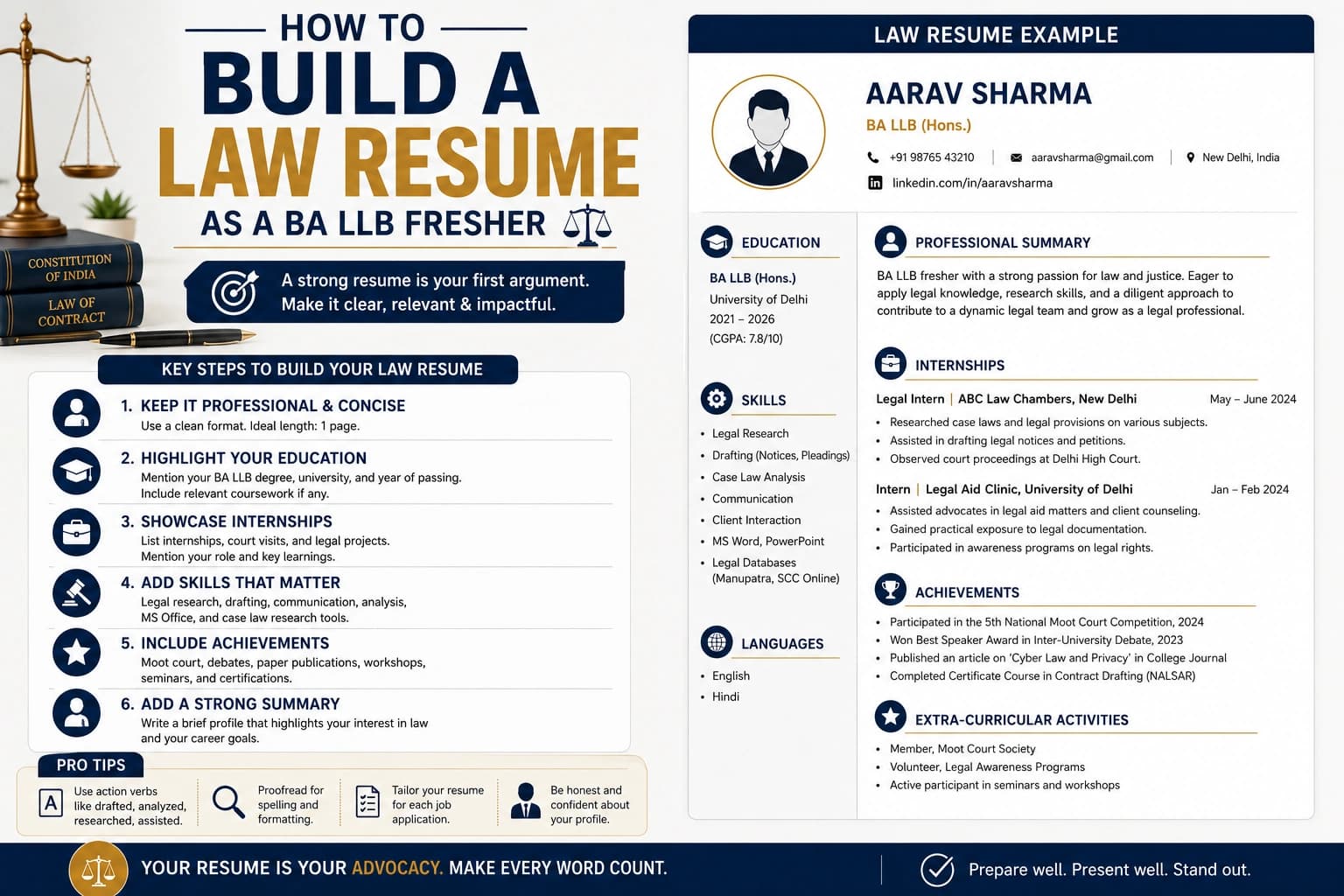
How to Build a Law Resume as a BA LLB Fresher
A practical, section-by-section guide to building a strong law resume as a BA LLB fresher — structure, internships, moot court, formatting, and mistakes to avoid.

How to Crack Law Firm Interviews After BA LLB
A practical, step-by-step guide to preparing for and cracking law firm interviews after BA LLB — common questions, technical rounds, and mistakes to avoid.
Most read on Vidyapun
Comments
0No comments yet
Be the first to share your thoughts!