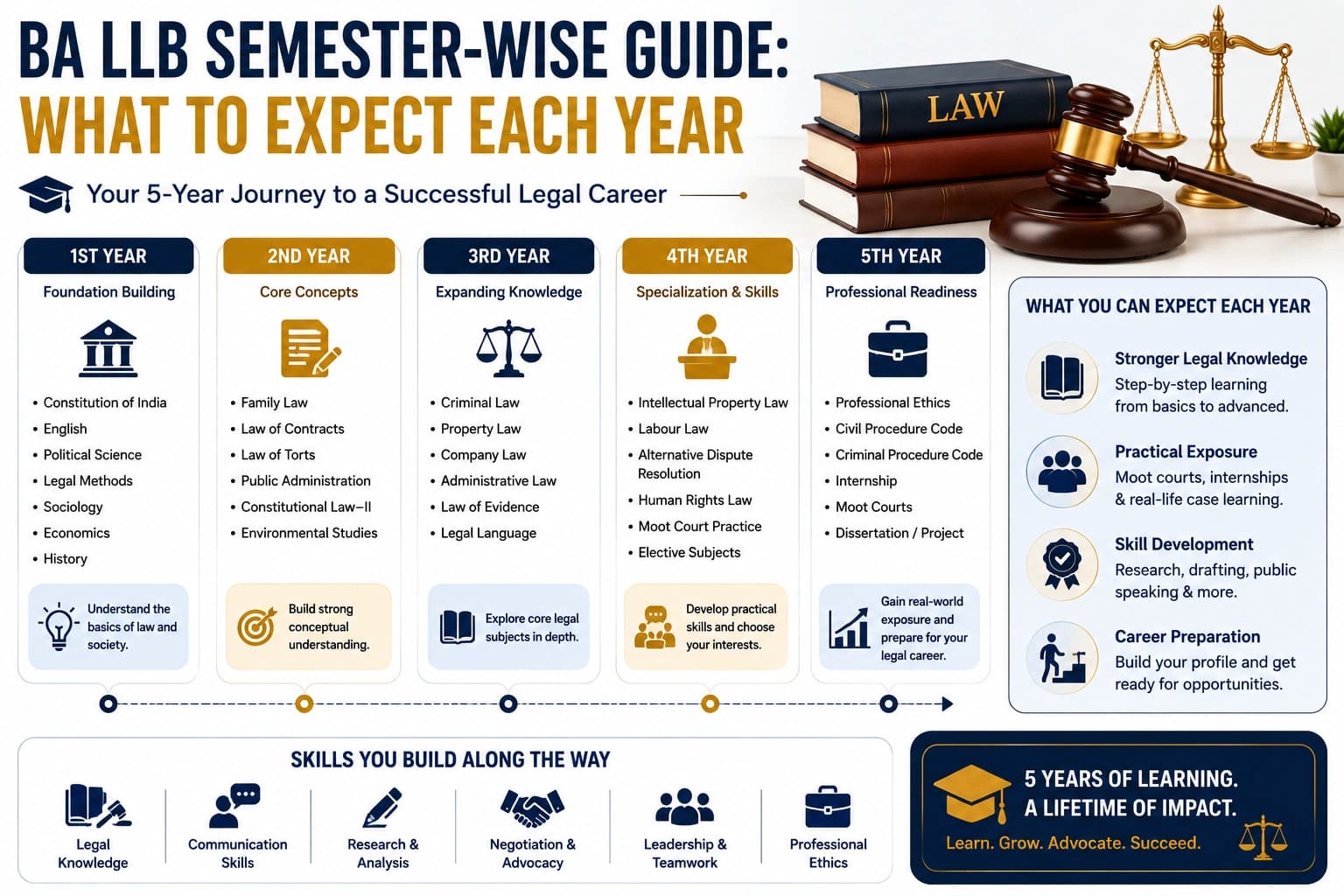
Starting BA LLB, most first-year students know roughly what subjects are coming, but few know how the actual experience shifts from year to year — how the workload changes, when moot court and internships start mattering, and when the course stops feeling like an extension of Class 12 and starts feeling like genuine legal training.
Knowing this progression in advance helps with more than just academic planning. It shapes when you start thinking seriously about specialization, when to expect internships to become time-consuming, and when the heaviest semesters are likely to fall — so you can plan your personal life, part-time commitments, and even moot court participation around them rather than being caught by surprise each year.
This guide walks through what to expect in each year of BA LLB, semester by semester, so you can mentally prepare for the shifts ahead rather than being caught off guard by them.
Why a Semester-Wise Guide Helps First-Year Students
Knowing what's coming — not just academically, but in terms of workload and expectations — makes the five-year journey considerably less overwhelming.
How BA LLB Semesters Are Structured
Most universities split the 5-year BA LLB into 10 semesters, two per academic year, each combining lecture-based subjects with (increasingly, in later years) practical and clinical components like moot court and internships.
What Changes Year to Year
The broad pattern across almost every university is consistent: early years lean more on general BA subjects and foundational law, middle years introduce heavier core law subjects and initial practical exposure, and the final years shift almost entirely to specialization, internships, and placement or judiciary preparation.
Year 1: Settling Into Law School
The first year is generally the gentlest transition, designed to ease you into legal thinking without overwhelming you immediately.
Semester 1 – Foundation Building
Your first semester typically introduces Legal Methods, an initial Political Science paper, and basic legal language and communication skills. The workload here is usually manageable, and the biggest adjustment is learning to read and brief material more carefully than Class 12 required — building habits like structured note-taking and basic legal citation that make later, heavier years far more manageable.
Semester 2 – Building Momentum
The second semester usually deepens your first-semester subjects while introducing an early look at the Indian Constitution. Many students find this the point where genuine legal reasoning — rather than just memorization — starts being expected of them, even if the overall academic pressure is still relatively light compared to what's ahead.
Year 2: Core Law Subjects Take Over
By the second year, the balance shifts noticeably toward substantive law subjects.
Semester 3 – Deeper Legal Concepts
Semester 3 commonly introduces the Law of Contracts and continues Constitutional Law in greater depth, alongside remaining BA subjects like Economics or Sociology. This is often where students first feel the course genuinely "become" law school rather than an extension of general studies, as the volume of case law and legal terminology increases noticeably.
Semester 4 – First Practical Exposure
Semester 4 typically adds Family Law and Law of Torts, and this is commonly when many universities introduce your first real practical exposure — an introductory moot court exercise or basic legal drafting assignment, giving you an early, low-stakes taste of what practical legal work actually involves.
Year 3: The Turning Point
Most students describe the third year as the point where BA LLB starts feeling meaningfully different from a standard undergraduate degree.
Semester 5 – Specialization Begins
Semester 5 often introduces Criminal Law and Property Law, and this is typically when elective options start appearing for the first time, letting you sample specialized areas before committing more fully in later years. It's worth paying attention to which electives genuinely interest you here, since this early exposure often shapes your final specialization choice.
Semester 6 – Balancing Moot Court and Core Subjects
Semester 6 usually adds Jurisprudence and Company Law, alongside a more structured moot court component. Many students find this semester genuinely demanding, since balancing conceptually difficult core subjects with practical commitments for the first time takes some adjustment — good time management habits built here tend to carry through the rest of the program.
Year 4: Advanced Law and Practical Training
The fourth year is where the practical, real-world dimension of legal education becomes central.
Semester 7 – Procedural Law Focus
Semester 7 typically introduces the Civil Procedure Code and Evidence Law — procedural subjects considered essential for litigation practice, and generally treated as some of the more demanding papers in the entire program, since they require translating theoretical knowledge into precise, rule-based application.
Semester 8 – Internships Intensify
Semester 8 usually adds the Criminal Procedure Code and Human Rights Law, alongside a noticeably heavier internship expectation. Many students begin more targeted internships during this year, applying classroom learning in real law firm, chamber, or NGO settings for the first time, which often meaningfully shapes their eventual career direction.
Year 5: Final Stretch Before Graduation
The final year brings together everything you've built, with a much heavier practical and independent-work component.
Semester 9 – Electives and Dissertation
Semester 9 typically focuses on advanced electives (Corporate Law, Cyber Law, International Law, or others depending on your specialization interest) and often marks the start of dissertation or research project work, which requires a different kind of independent, self-directed effort compared to earlier coursework-heavy semesters.
Semester 10 – Placements and Final Exams
The final semester usually combines Professional Ethics, Alternative Dispute Resolution, and the completion of your dissertation, alongside intensified moot court participation, campus placements, and — for many students — preparation for judiciary exams or further studies. This is typically the busiest semester of the entire program, balancing academic completion with the transition into your career, so it helps to plan your final-year commitments realistically rather than assuming you can handle everything at full intensity simultaneously.
Frequently Asked Questions
1. What subjects are covered in BA LLB first year? First year typically covers Legal Methods, Political Science, an introduction to the Indian Constitution, and basic legal language and communication, alongside general BA subjects like Sociology or Economics.
2. When does moot court start in BA LLB? Most universities introduce an initial moot court exercise around the second year, with more structured participation building through the third and fourth years.
3. What is the toughest year in BA LLB? Many students find the third and fourth years the most demanding, since core law subjects deepen significantly and practical commitments (moot court, internships) increase alongside them.
4. When do internships become compulsory in BA LLB? Internship requirements typically intensify from the fourth year onward, though many universities encourage or require some internship exposure earlier as well. Exact requirements vary by institution.
5. What happens in the final semester of BA LLB? The final semester usually combines Professional Ethics and Alternative Dispute Resolution coursework, dissertation completion, intensified moot court participation, and campus placements or exam preparation.
6. Does the BA LLB semester structure differ between universities? The broad progression (general subjects early, core law subjects building up, specialization and practical training later) is fairly consistent, but exact paper names, sequencing, and semester-wise credit distribution vary by university — always check your specific institution's official syllabus.
For a full subject-by-subject breakdown rather than a year-wise overview, see our BA LLB syllabus guide. If you're still finalizing your admission, revisit the BA LLB admission process and eligibility criteria guides.
Not sure which colleges match your profile? Use Vidyapun's Admission Chances Predictor for a data-based estimate, or explore full course details on the BA LLB course page.
Still have questions about what each year of BA LLB involves? Reach out to our counsellors directly.
🌐 Website: www.vidyapun.com 📞 Call / WhatsApp: +91 96438 02216