Every year, thousands of Class 12 students start researching law as a career — and almost every one of them eventually lands on the same question: should I do BA LLB or wait and do a 3-year LLB after graduation?
If you're at that crossroads right now, this guide is going to make that decision a lot clearer.
The BA LLB course is India's most popular integrated law programme — and for good reason. It combines a bachelor's degree in Arts with a full law degree in five years, letting you enter the legal profession earlier, with a broader academic foundation, and without the detour of doing a separate undergraduate degree first. In 2026, with legal careers in higher demand than ever, understanding exactly what this programme involves has never been more important.
Let's get into the details — the real ones, not the vague overview you'll find on most college websites.
What Is the BA LLB Course?
BA LLB — Bachelor of Arts and Bachelor of Legislative Law — is a five-year integrated undergraduate programme that combines humanities and social science subjects with comprehensive legal education. It's designed for students who want to enter the legal field directly after Class 12, without spending three years on a separate undergraduate degree before starting their law education.
The "BA" component covers subjects like Political Science, Sociology, Economics, History, and English — disciplines that provide context and depth for understanding law in its social, political, and historical setting. The "LLB" component covers the full range of core legal subjects required by the Bar Council of India for professional legal practice.
Upon completing the five years and clearing the All India Bar Examination (AIBE), graduates can enrol with a State Bar Council and practise as advocates anywhere in India.
It's worth knowing that the BA LLB is different from the BBA LLB (which combines Business Administration with Law) and the BSc LLB (which combines Science with Law). All three are five-year integrated programmes, but the subject combination and career orientation differ.
BA LLB Course Duration and Structure
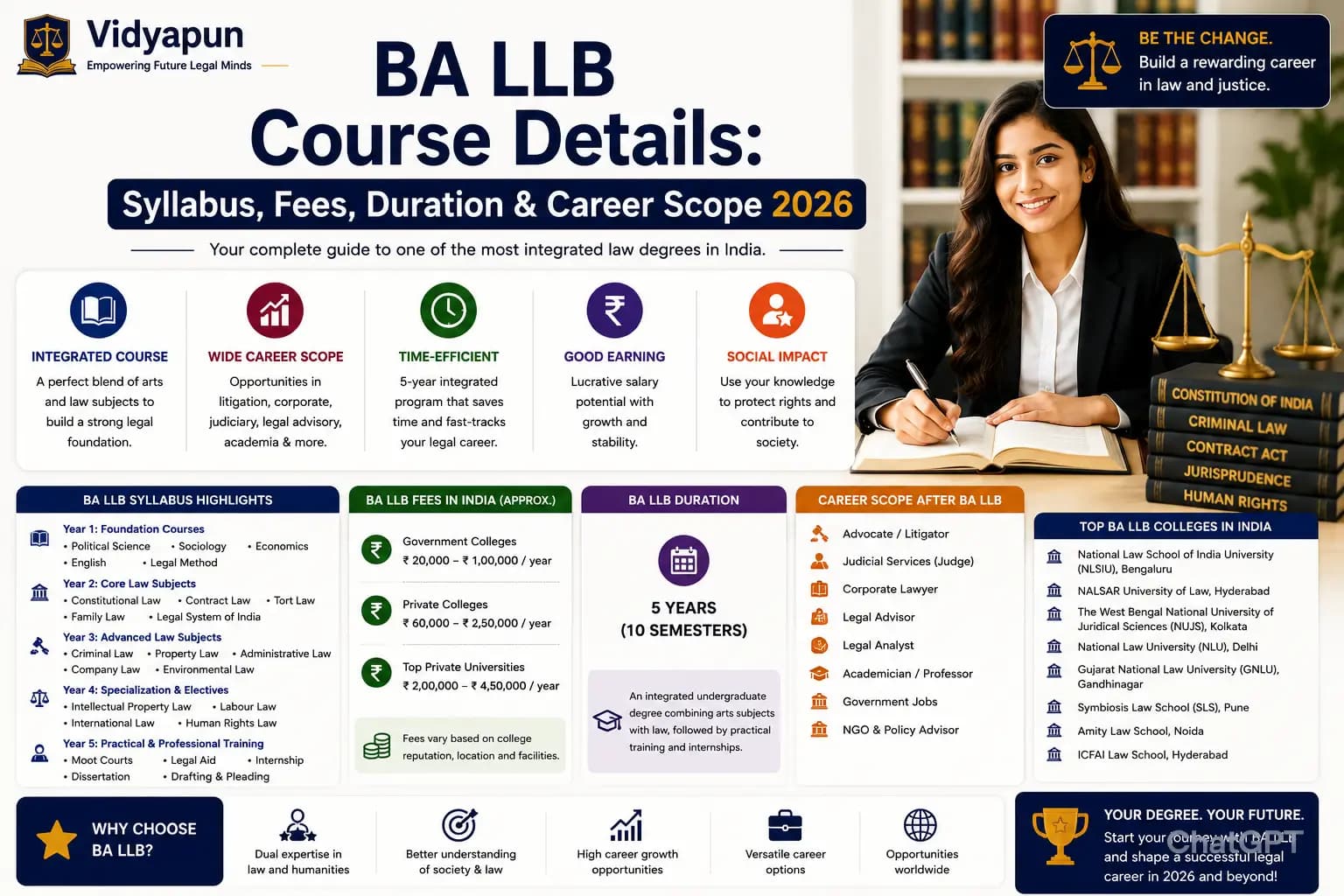
Duration: 5 years, divided into 10 semesters (some universities use an annual system with 5 academic years).
Mode: Full-time, regular. The Bar Council of India does not recognise distance or correspondence BA LLB programmes for the purpose of advocate enrollment — so if you want to practise law, a full-time programme from a BCI-approved institution is non-negotiable.
Each year broadly covers:
- Year 1–2: Foundation subjects — both humanities (Political Science, History, Economics, Sociology) and core law papers (Law of Contract, Constitutional Law basics, Legal Methods)
- Year 3: Intermediate law subjects — Criminal Law, Law of Torts, Family Law, Property Law
- Year 4: Advanced law subjects — Corporate Law, Administrative Law, Labour Law, Taxation Law
- Year 5: Specialised electives, Moot Court, Internship, and Dissertation
The final year typically includes practical training components — moot courts, client counselling exercises, drafting and pleading practice — that are designed to bridge the gap between academic learning and actual legal practice.
BA LLB Full Syllabus: Year-Wise Breakdown
Here's a realistic look at what you'll study across the five years. Keep in mind that syllabi vary slightly between universities, but the core subjects remain largely consistent as per BCI guidelines.
First Year
- Law of Contract – I
- Constitutional Law – I
- Legal Methods and Legal Reasoning
- Political Science – I
- History – I
- English and Legal Language
Second Year
- Law of Contract – II (including Specific Relief)
- Constitutional Law – II
- Law of Torts and Consumer Protection
- Political Science – II
- Sociology
- Economics – I
Third Year
- Criminal Law (IPC and CrPC)
- Family Law – I and II (Hindu, Muslim, Christian Personal Laws)
- Property Law and Transfer of Property Act
- Administrative Law
- Economics – II
- Environmental Law
Fourth Year
- Company Law
- Labour and Industrial Law
- Taxation Law (Direct and Indirect)
- International Law
- Law of Evidence
- Intellectual Property Rights
Fifth Year
- Alternative Dispute Resolution (ADR)
- Banking and Insurance Law
- Cyber Law and IT Act
- Human Rights Law
- Elective Specialisation (varies by university)
- Moot Court and Trial Advocacy
- Internship and Dissertation
The breadth of this curriculum is one of the strongest arguments for the BA LLB. By the time you graduate, you'll have studied constitutional law, criminal law, corporate law, taxation, international law, IP, environmental law, and family law — a foundation that supports almost any legal career direction.
BA LLB Eligibility Criteria 2026
Educational Qualification: 10+2 or equivalent from a recognised board in any stream — Arts, Commerce, or Science. You do not need to have studied any particular subjects at Class 12 level.
Minimum Marks: Most universities require a minimum of 45% aggregate marks in Class 12. Top NLUs and private law schools typically require 50% or higher. Some institutions have higher cut-offs in practice due to competition.
Age Limit: As per Bar Council of India guidelines, candidates must be under 20 years of age for general category at the time of admission (22 for SC/ST/OBC, and some additional relaxations apply). This age limit has been subject to legal challenge — always verify the current BCI guidelines before applying.
Entrance Exam: Admission to most reputed BA LLB programmes requires clearing a law entrance examination — CLAT (Common Law Admission Test) for NLUs, AILET for NLU Delhi, LSAT India for various private universities, and institution-specific exams for others like Symbiosis (SET) and Banaras Hindu University.
Top Colleges for BA LLB in India (2026)
The college you choose for your BA LLB will shape your career in meaningful ways — through faculty quality, placement opportunities, peer network, and the reputation your degree carries. Here are institutions consistently recognised for their BA LLB programmes:
National Law Universities (NLUs) The NLU system is the gold standard for integrated law education in India. NLSIU Bangalore, NALSAR Hyderabad, NLU Delhi, WBNUJS Kolkata, NLIU Bhopal, GNLU Ahmedabad, and RMLNLU Lucknow are among the top-ranked. Admission is through CLAT, which makes them highly competitive but also ensures a peer cohort of serious, well-prepared students.
Private Law Schools
- Symbiosis Law School, Pune — well-structured curriculum, strong placements, SLAT entrance exam
- Jindal Global Law School, Sonipat — internationally oriented, strong faculty, higher fees
- Amity Law School, Delhi/Noida — wide placement reach, accessible private option
- Christ University, Bangalore — good infrastructure, professional environment
Government and Central University Law Faculties
- Faculty of Law, BHU, Varanasi — strong academic tradition, affordable fees
- Faculty of Law, University of Delhi — highly respected, Delhi-based advantage
- Aligarh Muslim University (AMU) — strong research culture, affordable
- Osmania University, Hyderabad — established reputation in South India
BA LLB Course Fees in India
Fees vary significantly based on whether the institution is a government, NLU, or private college:
| Institution Type | Approximate Annual Fees (INR) |
|---|---|
| Government / Central University | ₹5,000 – ₹30,000 |
| National Law Universities (NLUs) | ₹1,00,000 – ₹2,50,000 |
| Private Law Schools (mid-range) | ₹1,50,000 – ₹3,00,000 |
| Premium Private Colleges (Jindal etc.) | ₹3,00,000 – ₹5,00,000+ |
Total 5-Year Cost Estimate:
- Government colleges: ₹25,000 – ₹1,50,000
- NLUs: ₹5,00,000 – ₹12,50,000
- Top private colleges: ₹15,00,000 – ₹25,00,000+
Education loans for law programmes are available through most nationalised banks. Several NLUs and private colleges also offer merit-based scholarships that can significantly reduce the financial burden.
Career Scope After BA LLB in 2026
This is the question that matters most. What can you actually do with a BA LLB?
The honest answer is: quite a lot, across a surprisingly wide range of fields.
Legal Practice / Litigation The most traditional path — enrolling as an advocate and building a practice in courts. Litigation takes time to build financially, but experienced litigators in India can earn very well. Specialising early (criminal litigation, commercial litigation, constitutional practice) accelerates the process.
Corporate Law and In-House Counsel One of the fastest-growing career paths for law graduates. Companies across sectors — tech, finance, pharma, real estate, media — need lawyers who can handle contracts, regulatory compliance, mergers, and legal risk. In-house roles offer stability, structured growth, and competitive salaries.
Judicial Services Clearing state judicial services examinations (Civil Judge / Judicial Magistrate level) to enter the judiciary. Constitutional law, civil procedure, and criminal law are heavily tested — the BA LLB provides a strong foundation for these exams.
Civil Services (UPSC) Many BA LLB graduates appear for the UPSC Civil Services Examination, where the legal background provides an advantage in GS Paper II (Polity and Governance) and optional subjects like Law or Political Science.
Legal Process Outsourcing (LPO) India's LPO industry employs thousands of law graduates in document review, contract lifecycle management, legal research, and compliance work for international law firms and corporations.
Academics and Research Pursuing an LLM followed by a PhD and building an academic career in law. Constitutional Law, Criminal Law, IP, and International Law are particularly active research areas.
Law Firms Top-tier law firms in India — AZB & Partners, Cyril Amarchand Mangaldas, Trilegal, Shardul Amarchand Mangaldas — hire BA LLB graduates from NLUs and top law schools for corporate practice. These are highly competitive roles with excellent salaries and steep learning curves.
Public Sector and Government Legal Roles Roles with government departments, PSUs, enforcement agencies, the Income Tax Department, and bodies like the Competition Commission of India (CCI) or Securities and Exchange Board of India (SEBI).
BA LLB Salary in India: What to Expect
| Career Path | Starting Salary (INR per annum) |
|---|---|
| Junior Associate – Top Law Firm | ₹8–18 LPA |
| Corporate Legal / In-House | ₹5–12 LPA |
| Judicial Services (Civil Judge) | ₹8–12 LPA |
| LPO / Legal Analyst | ₹3–7 LPA |
| Government Legal Officer | ₹6–10 LPA |
| Litigation (Junior) | ₹2–5 LPA (builds over time) |
NLU graduates placed at top-tier law firms can start at ₹12–18 LPA — some elite placements go even higher. The variance in early salaries is high in law, but the ceiling is also very high for those who build strong expertise and reputation over time.
FAQs: BA LLB Course Details 2026
Q1. What is the difference between BA LLB and LLB? BA LLB is a 5-year integrated programme for Class 12 pass-outs combining Arts and Law. LLB is a 3-year programme for students who have already completed a bachelor's degree. Both lead to the same professional qualification, but the BA LLB lets you enter the legal field two years earlier.
Q2. Is CLAT compulsory for BA LLB admission? CLAT is compulsory only for National Law Universities. Many other colleges — both private and government — have their own entrance tests or admission processes. LSAT India, AILET, and institution-specific exams are other commonly accepted tests.
Q3. Can Science or Commerce students apply for BA LLB? Yes. The BA LLB programme is open to students from any stream — Arts, Commerce, or Science. Your Class 12 subject combination does not restrict your eligibility for law admission.
Q4. Is BA LLB better than BBA LLB? It depends on your career goals. BA LLB with its focus on Political Science, History, and Sociology is better suited for constitutional law, litigation, and civil services. BBA LLB with its business orientation is better for corporate law, M&A, and commercial practice. Neither is objectively superior — choose based on where you want to go.
Q5. What is the AIBE and is it mandatory after BA LLB? The All India Bar Examination (AIBE), conducted by the Bar Council of India, is mandatory for all law graduates who wish to practise as advocates. It's a qualifying exam (not a competitive one) that tests basic legal knowledge. Most graduates clear it comfortably with adequate preparation.
Q6. Can I do LLM after BA LLB? Yes. After completing BA LLB, you're fully eligible to apply for LLM programmes in India or abroad. Many graduates pursue an LLM in a specialised area — corporate law, IP, constitutional law, international law — to deepen their expertise and enhance career prospects.
Q7. Which subject combination in BA LLB is most useful for civil services? Political Science and History — both typically part of the BA LLB curriculum — are directly useful for UPSC preparation. Constitutional Law, which you'll study in depth during BA LLB, is also highly relevant for GS Paper II and for Law as an optional subject.
Your Legal Career Begins With the Right Foundation
The BA LLB course is more than just a degree — it's a five-year journey that builds the intellectual foundation for one of the most versatile and respected professional careers in India. Whether your goal is to argue cases before the Supreme Court, advise a multinational on a billion-dollar deal, sit on the bench as a judge, or serve the country through the civil services, this programme gives you the tools to get there.
In 2026, with India's legal sector expanding rapidly and the demand for qualified law professionals at an all-time high, there's never been a better time to start building that foundation seriously.
If you're preparing for CLAT or another law entrance exam, start now — every month of focused preparation makes a difference. If you're still comparing colleges, use the framework in this guide to evaluate institutions based on what genuinely matters: faculty, placement history, and the kind of legal career you want to build.
The path to becoming a great lawyer starts long before your first day in court. It starts with the college you choose and the seriousness with which you approach these five years.
Have questions about BA LLB admissions, CLAT preparation, or choosing between colleges? Leave your question in the comments — we'll help you figure out the right next step.
Website: www.vidyapun.com
Call / WhatsApp: +91 96438 02216