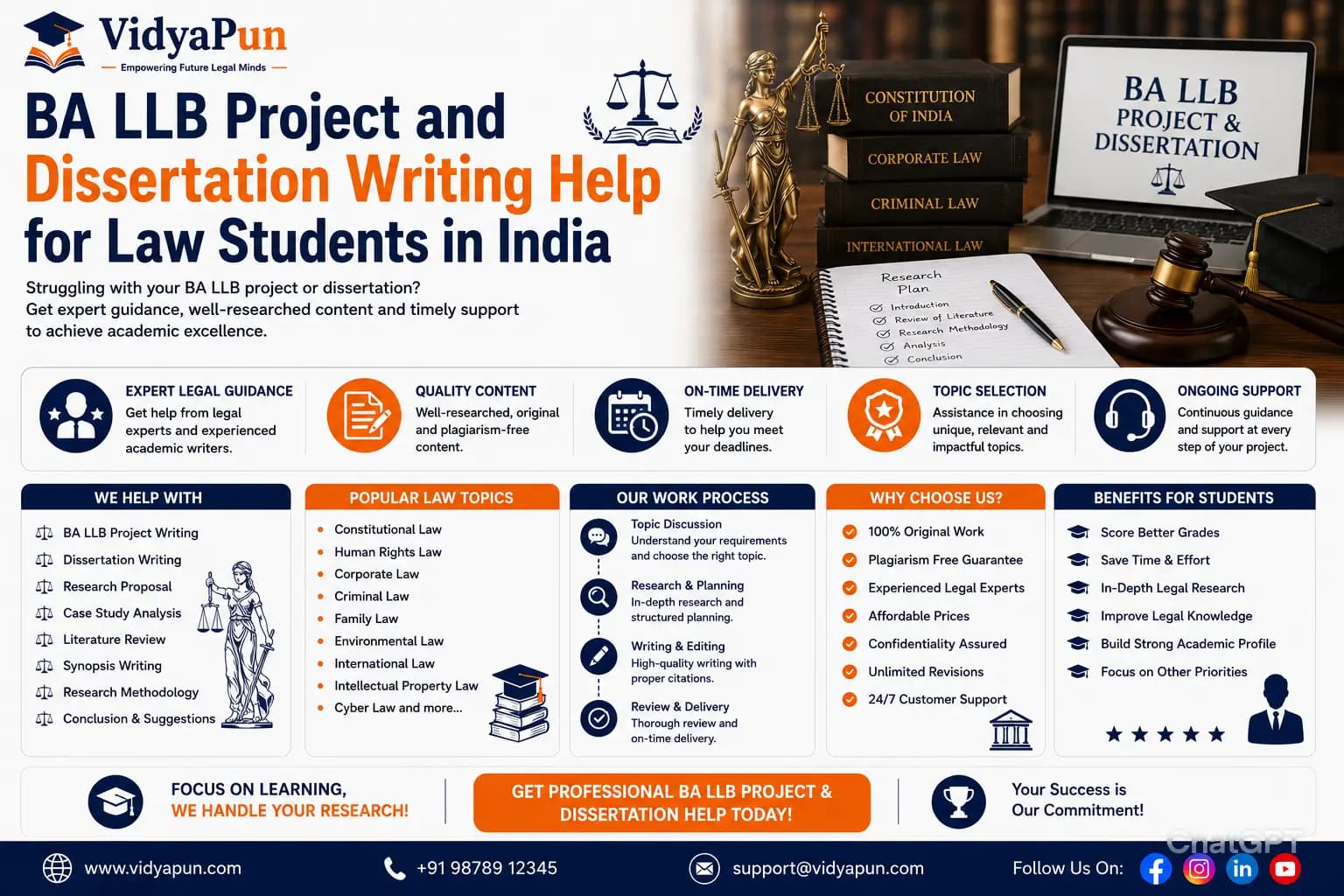
Every BA LLB student reaches that one semester where the project submission feels more terrifying than any end-semester exam. You've survived five years of case law, constitutional provisions, and moot court submissions — but somehow, sitting down to write a full-length law dissertation feels like an entirely different challenge.
And honestly? That reaction is completely normal.
The dissertation or final project in a BA LLB program is unlike any assignment you've done before. It's not a case comment. It's not a short essay on legal principles. It asks you to identify a legal problem, build an original argument around it, engage with existing scholarship, and present a structured, well-researched piece of writing that reflects five years of legal education.
That's a lot. And most BA LLB students get very little guidance on how to actually do it.
This guide is here to fix that. Whether you're just starting to think about your dissertation topic or you're halfway through and feeling stuck — this is a practical, honest resource for BA LLB project and dissertation writing in India.
What Is a BA LLB Dissertation or Project?
Depending on your university, the final research component of your BA LLB degree may be called a dissertation, project report, research paper, or thesis. The structure and word count vary — some universities require 8,000 words, others go up to 20,000 — but the core expectation is the same across institutions.
You're expected to:
- Identify a specific legal issue or gap in the law
- Review existing literature, case law, and statutory frameworks
- Develop and defend an original argument or analytical position
- Present your findings in a structured, well-cited academic format
Many universities in India require this in the fourth or fifth year of the BA LLB program. Some institutions spread it across two semesters — a proposal in semester 9 and the final submission in semester 10.
Why Do BA LLB Students Struggle With Dissertation Writing?
Before jumping into the how-to, it's worth understanding why this feels so hard for most students — because the struggle is very specific.
No one teaches legal research methodology properly. Most BA LLB programs teach substantive law — contracts, torts, constitutional law — but very few devote dedicated time to teaching students how to research and write at a postgraduate level. You're expected to just figure it out.
The topic selection phase is paralyzing. Five years of law school exposes you to dozens of subjects. Narrowing all of that down to one focused dissertation topic feels impossible without proper guidance.
The jump from class notes to original research is massive. Writing a case brief and writing a 15,000-word original dissertation are two completely different skills. The transition is harder than most students expect.
Referencing and citation anxiety is real. OSCOLA, Bluebook, or the university's own citation style — getting it right across hundreds of footnotes is genuinely stressful.
Step-by-Step Guide to Writing a BA LLB Dissertation in India
Step 1 — Choose a Topic That Has a Research Gap
The single most important decision in your dissertation journey. A good BA LLB dissertation topic should be:
- Specific enough to argue meaningfully — not "Human Rights in India" but "Custodial Torture and the Inadequacy of Section 330 IPC as a Deterrent"
- Relevant to current legal developments — something courts, legislatures, or scholars are actively debating
- Supported by sufficient literature — case law, academic articles, Law Commission reports, parliamentary debates
- Connected to your career interests — if you're planning to practice criminal law, a dissertation on criminal procedure makes more strategic sense than one on maritime law
Quick tip: Browse recent issues of Indian law journals — NUJS Law Review, NALSAR Law Review, Indian Journal of Law and Technology — to spot debates that are ongoing and under-researched.
Step 2 — Write a Strong Research Proposal
Most Indian universities require you to submit a research proposal before beginning the dissertation. Don't treat this as a formality. A strong proposal actually makes writing the dissertation easier because it forces you to think through your argument before committing to it.
A good research proposal typically includes:
- Working title — can change later, but should be specific
- Research problem — what legal issue are you addressing and why does it matter?
- Research questions — usually 2–3 focused questions your dissertation will answer
- Research methodology — doctrinal, empirical, comparative, or mixed?
- Hypothesis — your preliminary argument or position
- Tentative chapter plan — how you'll organize the work
- Preliminary bibliography — 10–15 key sources you'll engage with
Step 3 — Understand Legal Research Methodology
This is the part most BA LLB students skip — and it shows in their final submissions.
Doctrinal research is the most common methodology in Indian law dissertations. It involves analyzing primary legal sources — statutes, case law, constitutional provisions — and secondary sources like academic commentary and law commission reports. It's desk-based research focused on what the law says and whether it's coherent.
Comparative legal research involves studying how different jurisdictions handle the same legal problem. Comparing India's approach to data privacy with the EU's GDPR, for instance, or comparing bail laws across common law countries.
Empirical legal research involves collecting original data — through surveys, interviews, or field studies — to understand how the law operates in practice. This is less common in Indian BA LLB dissertations but increasingly valued at progressive law schools.
Most BA LLB dissertations use doctrinal methodology, sometimes combined with comparative analysis. Be clear about your methodology in Chapter 1.
Step 4 — Structure Your Dissertation Properly
A well-structured BA LLB dissertation typically follows this format:
Chapter 1 — Introduction State your research problem, research questions, hypothesis, methodology, and chapter overview. This chapter should be written last even though it appears first — once you know what you've argued, you can introduce it properly.
Chapter 2 — Literature Review / Background Engage with existing scholarship. Who has written about this issue before? What are the dominant arguments? Where do the gaps lie? This is not a summary — it's a critical engagement with existing work.
Chapter 3 — Legal Framework Analysis Walk through the relevant statutes, constitutional provisions, and landmark judgments that form the legal backdrop of your topic. This is the foundation on which your analysis builds.
Chapter 4 — Critical Analysis The heart of your dissertation. This is where you develop your original argument, expose contradictions or inadequacies in the law, apply your research questions to the legal material, and build toward your conclusions.
Chapter 5 — Comparative Study (if applicable) If your dissertation involves comparison with another jurisdiction, dedicate a chapter to it. Show what India can learn — or how the compared jurisdiction's approach differs and why.
Chapter 6 — Conclusion and Recommendations Summarize your findings chapter by chapter, restate your hypothesis in light of your research, and offer concrete, realistic recommendations for legal reform or further research.
Bibliography / References List all sources cited in the dissertation. Follow your university's prescribed citation style consistently.
Step 5 — Cite Everything Correctly
Citation is not optional in legal research — it's foundational. Every legal claim, judicial quote, and statutory reference must be properly footnoted. The two most common citation styles for Indian law dissertations are:
OSCOLA (Oxford University Standard for Citation of Legal Authorities) — widely used in Indian NLUs and top law schools. Footnote-based.
Bluebook — common in American-influenced law schools and used in some Indian institutions.
Always check your university's dissertation handbook for the prescribed style. Inconsistent citation is one of the most common reasons for grade deductions in law dissertations.
Common Mistakes BA LLB Students Make in Dissertation Writing
Knowing what to avoid is just as important as knowing what to do.
Choosing a topic that's too broad. "Fundamental Rights in India" is a textbook, not a dissertation topic. Narrow it down to a specific right, a specific context, and a specific legal problem.
Describing the law instead of analyzing it. A dissertation is not a summary of statutes and cases. It's a critical argument. Every chapter should be advancing your thesis, not just explaining what the law says.
Leaving the writing to the last two weeks. Dissertations cannot be written in a rush. Research takes time. Arguments develop through drafting and redrafting. Start early — even rough notes and partial drafts are better than a blank document.
Ignoring the supervisor's feedback. Your dissertation supervisor has seen dozens of dissertations. Their feedback — even when it feels harsh — is the most valuable input you'll get. Engage with it seriously.
Padding word count without substance. Examiners can tell the difference between a well-argued 14,000-word dissertation and a bloated 18,000-word submission full of unnecessary definitions and repetitive paragraphs. Quality over quantity.
Good BA LLB Dissertation Topic Ideas for 2026
Need some inspiration? Here are ten topic areas worth exploring:
- Triple Talaq judgment and its implementation gaps — a gender justice perspective
- Section 124A IPC (Sedition Law) — constitutional validity after Supreme Court's 2022 stay
- Live-in relationships in India — legal recognition, rights, and judicial inconsistency
- POCSO Act enforcement — conviction rates, procedural gaps, and child testimony issues
- Right to privacy as a fundamental right — post-Puttaswamy implications for surveillance law
- Marital rape exception in India — constitutional challenge and legislative inaction
- Bail jurisprudence in India — why undertrial imprisonment remains a systemic failure
- Animal rights and legal personhood — a comparative study of India and international trends
- Cyberbullying and legal remedies available to victims under Indian law
- Right to be forgotten under India's Digital Personal Data Protection Act 2023
FAQs — BA LLB Project and Dissertation Writing
Q1. How long should a BA LLB dissertation be in India? It varies by university. Most Indian law universities require between 8,000 to 20,000 words for a BA LLB dissertation or project. Always check your university's specific guidelines.
Q2. Can I change my dissertation topic after submitting the proposal? In most universities, minor changes to the title or focus are permitted after supervisor approval. A complete topic change is usually not allowed after the proposal is approved. Choose carefully.
Q3. What is the best research methodology for a BA LLB dissertation? Doctrinal research methodology is the most commonly used and accepted approach for Indian law dissertations. Comparative methodology is also popular and well-regarded, especially when combined with doctrinal analysis.
Q4. How do I find a good supervisor for my BA LLB dissertation? Approach faculty members whose research interests align with your topic. Come prepared with a rough topic idea and a few research questions. Most faculty appreciate students who show genuine intellectual curiosity.
Q5. Which citation style should I use for my BA LLB dissertation in India? OSCOLA is the most widely accepted citation style in Indian law schools. However, always check your university's dissertation handbook — some institutions have their own preferred formats.
Q6. How do I avoid plagiarism in my law dissertation? Cite every source you refer to, paraphrase carefully rather than copying text, and run your dissertation through plagiarism detection software like Turnitin or Unicheck before submission. Original analysis is your strongest defense against plagiarism.
Q7. When should I start writing my BA LLB dissertation? Ideally, start thinking about your topic at least one full semester before the submission deadline. Begin writing your literature review and chapter outlines as early as possible. The more time you give yourself, the better the final output.
Final Thoughts
A BA LLB dissertation is one of the most challenging — and rewarding — academic tasks you'll undertake in law school. It demands independent thinking, sustained research, and the ability to construct and defend an original legal argument. Skills, in other words, that define a good lawyer.
The students who do well aren't necessarily the most brilliant. They're the ones who start early, stay organized, engage seriously with their supervisor's feedback, and keep asking themselves: what is my argument, and am I actually making it?
Every chapter you write, every source you cite, every draft you revise — it's all building toward something that's entirely your own. That matters more than you think right now.
Need help getting started with your BA LLB dissertation — from topic selection to final submission?
Don't let the pressure of dissertation writing slow down your final year. Explore structured writing guides, topic idea banks, citation tutorials, and chapter-by-chapter research templates — designed specifically for Indian law students.
Website: www.vidyapun.com
Call / WhatsApp: +91 96438 02216