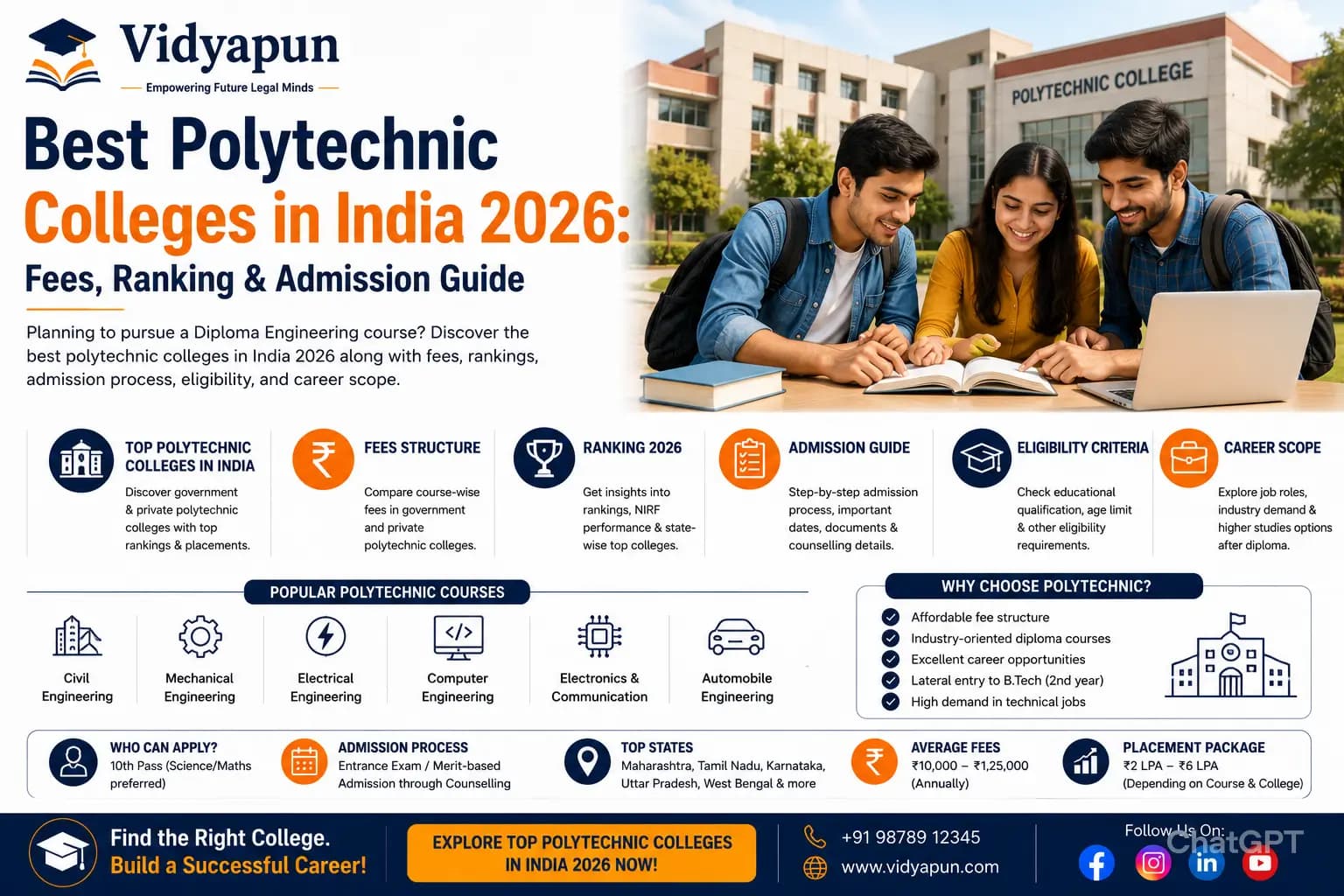
If you've just finished your Class 10 or Class 12 board exams and you're wondering whether a polytechnic diploma is the right move — you're asking exactly the right question. Every year, lakhs of students across India choose polytechnic education over traditional degree programs, and for genuinely good reasons: shorter duration, job-ready skills, and a much more affordable path to a stable career.
But with hundreds of government and private polytechnic institutes spread across every state, figuring out which ones are actually worth your time (and money) can feel overwhelming.
This guide breaks it all down — the best polytechnic colleges in India for 2026, their fee structures, rankings, admission process, and everything in between. Let's get into it.
What Is a Polytechnic Diploma and Why Does It Still Matter in 2026?
A polytechnic diploma is a 3-year technical program (2 years if you're a lateral entry student after Class 12) that gives you hands-on, industry-relevant training in engineering and technology fields. Think Civil Engineering, Mechanical Engineering, Electronics, Computer Science, Electrical, and more.
What makes polytechnic courses still relevant in 2026 is simple — India's infrastructure boom, manufacturing push under "Make in India," and growing IT/electronics sectors are creating real demand for skilled diploma holders at the ground level. Many public sector jobs through SSC, state boards, and even PSUs like BHEL, ONGC, and Railways actively recruit diploma engineers.
Plus, if you complete a polytechnic diploma, you can appear for lateral entry into the second year of B.Tech programs at many universities — giving you both options open.
Top Polytechnic Colleges in India 2026 — State-Wise Rankings
1. Government Polytechnic, Mumbai (Maharashtra)
- Established: 1952
- Affiliated to: Maharashtra State Board of Technical Education (MSBTE)
- Annual Fee: ₹8,000 – ₹15,000
- Key Courses: Civil, Mechanical, Electrical, Electronics, Computer Engineering
- Why It Ranks High: One of the oldest and most respected government polytechnic institutes in western India. Consistently produces students who go on to crack competitive exams and lateral entry B.Tech admissions.
2. Government Polytechnic College, Pune (Maharashtra)
- Annual Fee: ₹10,000 – ₹18,000
- Affiliated to: MSBTE
- Key Courses: Instrumentation, Chemical Technology, Civil, Electronics & Telecom
- Placement Record: Decent campus recruitment through MSBTE's industrial tie-ups
3. Bhopal Polytechnic College (Madhya Pradesh)
- Annual Fee: ₹12,000 – ₹20,000
- Affiliated to: Madhya Pradesh Vyavsayik Pareeksha Mandal (MP Vyapam)
- Admission: Through MP PPT (Pre-Polytechnic Test)
- Strengths: Strong faculty base, government recognition, good alumni network in central India
4. Government Polytechnic College, Lucknow (Uttar Pradesh)
- Annual Fee: ₹7,000 – ₹14,000
- Affiliated to: Board of Technical Education, UP (BTEUP)
- Admission: UP JEECUP (Joint Entrance Examination Council Uttar Pradesh)
- Courses Offered: Computer Science, Civil, Mechanical, Electrical, Electronics
- Why Consider It: One of the best polytechnic colleges in UP with a strong track record and some of the lowest fees in the country for government-aided programs
5. Thiagarajar Polytechnic College, Salem (Tamil Nadu)
- Annual Fee: ₹18,000 – ₹35,000
- Affiliated to: Directorate of Technical Education (DOTE), Tamil Nadu
- Admission: TNEA Counselling
- Reputation: Among the top-ranked polytechnic institutes in South India; excellent infrastructure and industry linkages in the manufacturing belt of Salem
6. Chandigarh Polytechnic College (Punjab)
- Annual Fee: ₹20,000 – ₹45,000
- Affiliated to: Punjab State Board of Technical Education (PSBTE)
- Key Strength: Modern labs, central location, and placement support from nearby industrial hubs in Mohali and Chandigarh
7. Government Polytechnic, Bangalore (Karnataka)
- Annual Fee: ₹8,000 – ₹16,000
- Affiliated to: Department of Technical Education, Karnataka
- Admission: Karnataka DCET (Diploma Common Entrance Test) for lateral entry
- Courses: Automobile, Electrical, Civil, Computer Science, Mechanical
8. Jamia Millia Islamia Polytechnic, Delhi
- Annual Fee: ₹15,000 – ₹28,000
- Location Advantage: Being in the NCR region, students have access to Delhi's industrial and IT corridors for internships and placements
9. Hi-Tech Institute of Technology (Polytechnic), Bhubaneswar (Odisha)
- Annual Fee: ₹30,000 – ₹55,000 (Private)
- Notable For: One of the better private polytechnic options in eastern India with decent infrastructure
10. Shree Swaminarayan Polytechnic College, Kalol (Gujarat)
- Annual Fee: ₹22,000 – ₹40,000
- Affiliated to: Gujarat Technological University (GTU)
- Admission: Through ACPDC Polytechnic Admission Gujarat
Polytechnic College Fees in India 2026 — What to Expect
Here's a realistic picture of what polytechnic education costs across different types of institutions:
| Type of College | Average Annual Fee Range |
|---|---|
| Government Polytechnic | ₹5,000 – ₹20,000 |
| Government-Aided Private | ₹15,000 – ₹40,000 |
| Unaided Private Polytechnic | ₹30,000 – ₹80,000 |
| Premium Private Institutes | ₹60,000 – ₹1,20,000 |
Important note: Many state governments offer fee waivers or scholarship schemes for SC/ST/OBC students. In UP, for instance, eligible students can get up to 100% fee reimbursement through the UP Scholarship portal. Always check your state's scholarship schemes before assuming you need to pay full fees.
How to Get Admission in Polytechnic Colleges in India — State-Wise Entrance Exams
Polytechnic admissions in India are primarily state-level, not national. Here's a quick breakdown by major states:
Uttar Pradesh → UP JEECUP (Joint Entrance Examination Council UP) Registration opens around February–March. Exam usually in April–May.
Maharashtra → MAH PAT (Maharashtra Polytechnic Admission Test) Conducted by MSBTE. Merit-based admission through centralized counselling.
Tamil Nadu → TNEA Polytechnic Counselling Based on Class 10 marks. No separate entrance test required.
Rajasthan → BTER (Board of Technical Education Rajasthan) Merit-based from Class 10 scores.
Karnataka → DCET for lateral entry; regular admission based on SSLC marks.
Delhi → Delhi CEE (Common Entrance Exam) by BTEUP equivalent Delhi board.
Madhya Pradesh → MP PPT (Pre Polytechnic Test)
Gujarat → ACPDC centralized admission process
West Bengal → JEXPO (Joint Entrance Examination for Polytechnic)
Which Polytechnic Branch Has the Best Scope in 2026?
This is the question students ask the most — and honestly, it depends on where you want to work. But based on current industry demand:
- Computer Science & IT Diploma — Still the highest-demand branch, especially for roles in data entry, junior developer, hardware support, and IT operations. Connects well with upskilling paths via certifications.
- Civil Engineering Diploma — With government infrastructure spending at an all-time high (highways, metro rails, smart cities), civil diploma holders are in strong demand for junior site engineer and surveyor roles.
- Electrical Engineering Diploma — Growing demand from renewable energy, EV manufacturing, and power sector PSUs.
- Mechanical Engineering Diploma — Traditional but stable. Manufacturing, automotive, and defence sectors hire mechanical diploma engineers steadily.
- Electronics & Communication Diploma — Good scope in telecom, semiconductor manufacturing (India's new chip push), and consumer electronics.
Polytechnic vs ITI vs B.Tech — Which One Should You Actually Choose?
| Factor | Polytechnic Diploma | ITI | B.Tech |
|---|---|---|---|
| Duration | 3 years | 1–2 years | 4 years |
| Entry Qualification | After Class 10 or 12 | After Class 8 or 10 | After Class 12 (PCM) |
| Scope | Mid-level technical roles | Skilled trades/technician | Engineering & management |
| Average Starting Salary | ₹15,000–₹25,000/month | ₹10,000–₹18,000/month | ₹25,000–₹50,000/month |
| Govt Job Eligibility | Yes (JE, technician posts) | Yes (operator, technician) | Yes (AE, officer posts) |
| Further Study Option | Lateral entry to B.Tech | Can pursue diploma then B.Tech | M.Tech, MBA |
If you're clear that you want to start working sooner, keep costs low, and still have a pathway to higher education — polytechnic is genuinely the sweet spot.
Frequently Asked Questions (FAQs)
Q1. Which is the best government polytechnic college in India?
There's no single national ranking body for polytechnic institutes like NIRF does for engineering colleges. However, Government Polytechnic Mumbai, Government Polytechnic Lucknow, Government Polytechnic Bangalore, and Thiagarajar Polytechnic Salem are consistently regarded among the best based on student outcomes, infrastructure, and industry connections.
Q2. What is the minimum fee for polytechnic colleges in India?
Government polytechnic colleges in states like UP, Bihar, and MP charge as low as ₹5,000–₹12,000 per year. After applicable scholarships, the net fee for eligible students can effectively come down to zero in many states.
Q3. Can I get a government job after polytechnic diploma?
Yes — many central and state government jobs specifically allow diploma engineers to apply. SSC JE (Junior Engineer), state PWD Junior Engineers, Railways (RRB), NTPC, BHEL, BEL, and defence PSUs actively recruit diploma holders. You can also sit for state-level Junior Engineer examinations.
Q4. Is AICTE approval necessary for polytechnic colleges?
Yes. Any polytechnic college you consider should be approved by AICTE (All India Council for Technical Education) and affiliated to the respective state's board of technical education. Always verify on the AICTE approval portal before applying to avoid degree validity issues.
Q5. What is lateral entry in polytechnic and B.Tech?
Lateral entry allows students who have already completed a related qualification to enter at an advanced year. If you pass Class 12 with PCM, you can directly enter the second year of a polytechnic diploma program. Similarly, after completing a diploma, you can enter the second year of a B.Tech program at many universities — saving you one full year.
Q6. What is the average salary after polytechnic diploma in India?
Freshers typically start between ₹12,000–₹25,000/month depending on the industry, location, and branch. With 3–5 years of experience, diploma engineers in civil, electrical, and IT domains often earn ₹30,000–₹60,000/month. Government sector salaries for Junior Engineers can go up to ₹50,000+ including allowances.
Q7. What documents are required for polytechnic admission?
Generally: Class 10 marksheet and certificate, Class 12 marksheet (if applicable), caste/category certificate (for reservation benefits), income certificate (for scholarship application), domicile certificate, passport-size photographs, and Aadhaar card. Requirements can vary by state, so check your state board's official website.
A Few Things Students Often Overlook
Before you finalize any polytechnic college — government or private — there are a few practical things worth checking:
Hostel facility: If you're moving from a different district or state, check if the college provides hostel accommodation and what the annual cost is. Some government polytechnics have very affordable hostels.
Industry proximity: Colleges located near industrial clusters or manufacturing hubs often have better informal placement opportunities. A mechanical diploma student near Pune's auto cluster has very different job prospects compared to one in a remote district.
Alumni network: Talk to students who graduated from the college 2–3 years ago. How many are employed in relevant fields? Did the placement cell actually help, or was it just on paper?
AICTE & State Board Approval: Non-negotiable. Check it yourself on aicte-india.org.
Final Thoughts — Make the Choice That Works for Your Life
Look — there's no universally "best" polytechnic college in India. The best one is the one that fits your budget, is geographically accessible, is properly approved, has decent infrastructure, and teaches the branch you're actually interested in.
Government polytechnic colleges remain the gold standard for value: low fees, recognized degrees, and government job eligibility. But a good private polytechnic in your city — especially if it has industry tie-ups — can be equally worthwhile if you're focused on private sector placements.
What matters most is what you do once you're enrolled. Certifications, internships, projects, competitive exam preparation — those are the things that separate diploma holders who thrive from those who struggle.
Ready to Start Your Polytechnic Journey in 2026?
If you found this guide helpful, here's what you should do next:
👉 Visit your state's official technical education board website to check the latest admission schedule, eligibility criteria, and application deadlines for 2026–27 admissions.
👉 Verify AICTE approval of any college you shortlist at aicte-india.org
👉 Apply for scholarships early — most state scholarship portals open applications right after admission confirmations.
And if you have questions about a specific state's polytechnic admission process, courses, or career options — drop them in the comments below. We'll get back to you with accurate, up-to-date information.
Your future in technical education starts with one good decision. Make it an informed one.
Website: www.vidyapun.com
Call / WhatsApp: +91 96438 02216