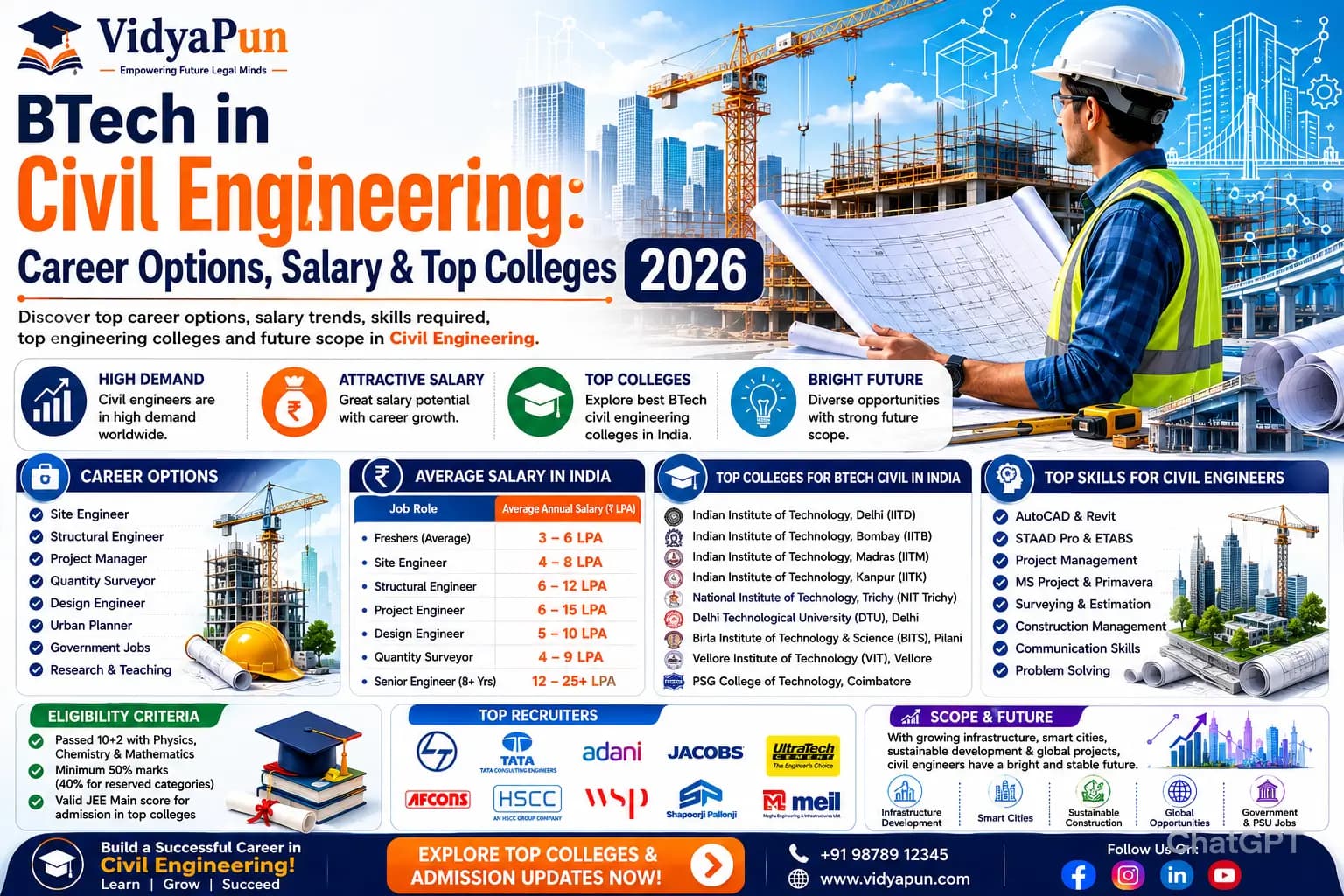
If you've ever looked at a flyover being built and thought, "I want to create something like that," — civil engineering might just be the path you're meant to take. It's one of those branches of engineering that literally shapes the world around us. Roads, dams, airports, metro systems, smart cities — behind every structure, there's a civil engineer who planned, designed, and executed it.
BTech in Civil Engineering remains one of the most in-demand undergraduate engineering programs in India, and in 2026, the demand for skilled civil engineers has only gone up. With large-scale government infrastructure projects like the PM Gati Shakti National Master Plan, Smart Cities Mission, and RERA-driven real estate growth, there's a real and growing need for trained professionals in this field.
Whether you're a student figuring out your stream or a parent researching options for your child, this guide covers everything — from what the BTech Civil Engineering course actually involves, to career paths after graduation, salary expectations, and the best colleges to consider in 2026.
What Is BTech in Civil Engineering?
BTech in Civil Engineering is a four-year undergraduate degree program that covers the planning, design, construction, and maintenance of physical and natural built environments. The curriculum typically includes subjects like structural engineering, fluid mechanics, geotechnical engineering, transportation engineering, environmental engineering, and construction management.
The program is designed to give students both theoretical understanding and practical skills — most colleges now include fieldwork, lab sessions, and industrial internships as part of the course structure.
Duration: 4 years (8 semesters) Eligibility: 10+2 with Physics, Chemistry, and Mathematics (PCM); minimum 50–60% marks depending on the institution Admission: JEE Main, JEE Advanced, state-level entrance exams (KCET, MHT CET, WBJEE, etc.)
BTech Civil Engineering Syllabus Overview
The curriculum covers a wide range of civil engineering subjects across eight semesters. Here's a snapshot of what students typically study:
First & Second Year (Foundation)
- Engineering Mathematics
- Engineering Physics & Chemistry
- Basic Civil Engineering & Engineering Mechanics
- Engineering Drawing and Computer-Aided Design (CAD)
- Environmental Science
Third & Fourth Year (Core + Specialization)
- Structural Analysis and Design
- Geotechnical Engineering (Soil Mechanics)
- Fluid Mechanics and Hydraulics
- Highway and Transportation Engineering
- Construction Technology and Management
- Water Resources and Irrigation Engineering
- Environmental Engineering
- Earthquake Engineering (in some colleges)
- BIM (Building Information Modeling) — now part of modern syllabi
Most colleges also include a final-year project and industrial training as compulsory components.
Career Options After BTech Civil Engineering
This is probably the question most students have — and the good news is, the career scope is genuinely broad. Civil engineers don't just work at construction sites. Here are some of the most promising career options available in 2026:
1. Structural Engineer
One of the most sought-after roles. Structural engineers design and analyze buildings, bridges, and other load-bearing structures to ensure they're safe and durable. With rapid urbanization, demand for structural engineers in India and abroad is consistently high.
2. Transportation and Highway Engineer
These professionals design road networks, highways, flyovers, and public transit systems. The government's National Infrastructure Pipeline (NIP) alone has allocated significant funds to road and transport development, making this one of the highest-growth civil engineering job roles right now.
3. Geotechnical Engineer
Geotechnical engineers study soil and rock behavior to support construction projects — particularly important for foundations, tunnels, and embankments. It's a niche but well-paying role, especially for infrastructure and mining projects.
4. Environmental Engineer
With increasing focus on sustainability, environmental engineers work on water treatment plants, sewage systems, pollution control, and sustainable construction practices. Green building certifications like LEED are making this role more relevant than ever.
5. Water Resources Engineer
Specializing in water supply systems, irrigation, dam construction, and flood management. India's push toward water conservation projects has made this a growing area of employment within the civil engineering sector.
6. Construction Project Manager
More of a managerial role, project managers oversee entire construction projects — from budgeting and scheduling to quality control and safety management. With large infrastructure projects being rolled out, this profile commands strong salaries.
7. Urban Planner (Town Planner)
Often requires a postgraduate qualification, but BTech Civil graduates make excellent urban planners who design and develop land use policies and infrastructure layouts for cities and towns.
8. Government Jobs in Civil Engineering
UPSC Engineering Services Exam (ESE), SSC JE, GATE-based PSU recruitments (NHAI, BHEL, ONGC, NHPC), PWD, and state engineering departments offer stable and well-respected government jobs for civil engineers.
9. Freelance Civil Consultant
Experienced civil engineers often work independently as consultants for private developers, housing projects, and government bodies. This is particularly common in real estate-heavy states.
10. Civil Engineering in Abroad
Canada, Australia, UAE, UK, and Germany have consistent demand for civil engineers. BTech graduates who pursue GRE/IELTS and apply to MS programs abroad often find excellent job markets waiting for them.
BTech Civil Engineering Salary in India 2026
Salary depends on several factors — your college, skillset, location, and the sector you join. Here's a realistic overview:
| Job Role | Entry-Level (0–2 yrs) | Mid-Level (3–7 yrs) | Senior Level (8+ yrs) |
|---|---|---|---|
| Structural Engineer | ₹3.5 – 5 LPA | ₹6 – 10 LPA | ₹12 – 20 LPA |
| Transportation Engineer | ₹3 – 4.5 LPA | ₹5 – 9 LPA | ₹10 – 18 LPA |
| Project Manager | ₹4 – 6 LPA | ₹8 – 14 LPA | ₹18 – 35 LPA |
| Environmental Engineer | ₹3.5 – 5 LPA | ₹6 – 10 LPA | ₹12 – 22 LPA |
| Government (PSU/PWD) | ₹4 – 7 LPA | ₹7 – 12 LPA | ₹12 – 20 LPA |
| Civil Engineer Abroad | $50K – $70K | $70K – $100K | $100K – $150K+ |
Key insight for 2026: Civil engineers with additional skills in BIM software (Revit, AutoCAD Civil 3D), project management certifications (PMP, PRINCE2), or sustainable design (LEED) are commanding 20–30% higher salaries than their peers.
Top Colleges for BTech Civil Engineering in India 2026
Choosing the right college matters — not just for education quality, but for placement networks, faculty expertise, and research opportunities.
IITs (Indian Institutes of Technology)
- IIT Bombay, IIT Delhi, IIT Madras, IIT Kanpur, IIT Kharagpur — these remain the gold standard for civil engineering education in India. Admission is through JEE Advanced.
NITs (National Institutes of Technology)
- NIT Trichy, NIT Warangal, NIT Surathkal, NIT Calicut — excellent public institutions with strong placement records. Admission via JEE Main.
Other Top Government Colleges
- Delhi Technological University (DTU)
- VNIT Nagpur
- College of Engineering Pune (COEP)
- BIT Mesra (Ranchi)
- Jadavpur University
Top Private Engineering Colleges
- VIT Vellore
- SRM Institute of Science and Technology
- Manipal Institute of Technology (MIT)
- Thapar Institute of Engineering and Technology
- Amity University
- PES University (Bangalore)
Things to check before applying: NAAC/NBA accreditation, placement percentage in civil engineering specifically (not overall), faculty-to-student ratio, tie-ups with construction companies, and availability of modern civil engineering labs.
Should You Do BTech Civil Engineering or Go for an M.Tech?
A question many students wrestle with. Here's a straightforward breakdown:
If you want to start earning quickly, go for BTech → join an entry-level role → upskill on the job. Most civil engineering roles hire fresh graduates actively.
If you're inclined toward research, design, or specialization (especially geotechnical or structural), M.Tech after BTech makes strong sense — particularly if you clear GATE. GATE-qualified M.Tech students often get stipends and better PSU placement chances.
For those interested in going abroad, BTech + GRE/IELTS + MS from a good foreign university is a solid combination.
FAQs — BTech Civil Engineering
Q1. What is the scope of BTech Civil Engineering in 2026? The scope is strong and expanding. With India's infrastructure investment projected to cross ₹111 lakh crore under the NIP by 2025–30, civil engineers are in high demand across roads, railways, housing, water supply, and urban development sectors.
Q2. What are the best job profiles for BTech Civil Engineering freshers? Good entry-level roles include site engineer, junior structural engineer, quantity surveyor, AutoCAD drafter, and graduate engineer trainee (GET) in government or private firms.
Q3. Is civil engineering a good career choice for girls? Absolutely. Many women civil engineers are thriving in roles like environmental engineering, urban planning, project management, and structural design. Field roles are increasingly accommodating, and office-based profiles are widely available.
Q4. Which entrance exam is used for BTech Civil Engineering admission? JEE Main is the primary national entrance exam. JEE Advanced is required for IIT admissions. State-level exams like MHT CET, KCET, WBJEE, and TANCET are used for state college admissions.
Q5. Can BTech Civil Engineering graduates work abroad? Yes. Countries like Canada, Australia, Germany, UAE, and the UK actively recruit civil engineers. However, some countries require additional certification or licensing (like P.Eng in Canada or PE in the USA).
Q6. What software should civil engineering students learn? AutoCAD, STAAD.Pro, ETABS, MATLAB, Civil 3D, Revit (BIM), Primavera (project management), and SAP2000 are highly valued. BIM proficiency is especially sought after in 2026.
Q7. What is the average salary of a civil engineer in India after BTech? Entry-level civil engineers in India typically earn between ₹3 to ₹5 LPA. With 5–7 years of experience and the right certifications, this can grow to ₹10–15 LPA and beyond.
Q8. Is BTech Civil Engineering tough? It has its challenging subjects — structural analysis, fluid mechanics, and geotechnical engineering require strong conceptual understanding. But with consistent study habits and practical exposure, most students manage well.
Final Thoughts
BTech Civil Engineering in 2026 is more than just a degree — it's an entry point into one of the most impactful industries in the world. As cities grow, climate challenges demand smarter infrastructure, and governments continue to invest in public works, civil engineers will find themselves at the center of it all.
The field rewards both those who love working hands-on on site and those who prefer the precision of design software. What you make of the degree depends heavily on the skills you build alongside it — especially in software tools, project management, and communication.
Whether you're aiming for a government job, a corporate role in a construction giant, or a future abroad — civil engineering has a path carved out for you.
Ready to take the next step toward your BTech Civil Engineering journey?
If you're comparing colleges, preparing for JEE, or trying to understand which specialization suits you best — don't leave it to guesswork. Explore detailed college rankings, entrance exam cut-offs, and career roadmaps to make an informed decision.
Website: www.vidyapun.com
Call / WhatsApp: +91 96438 02216