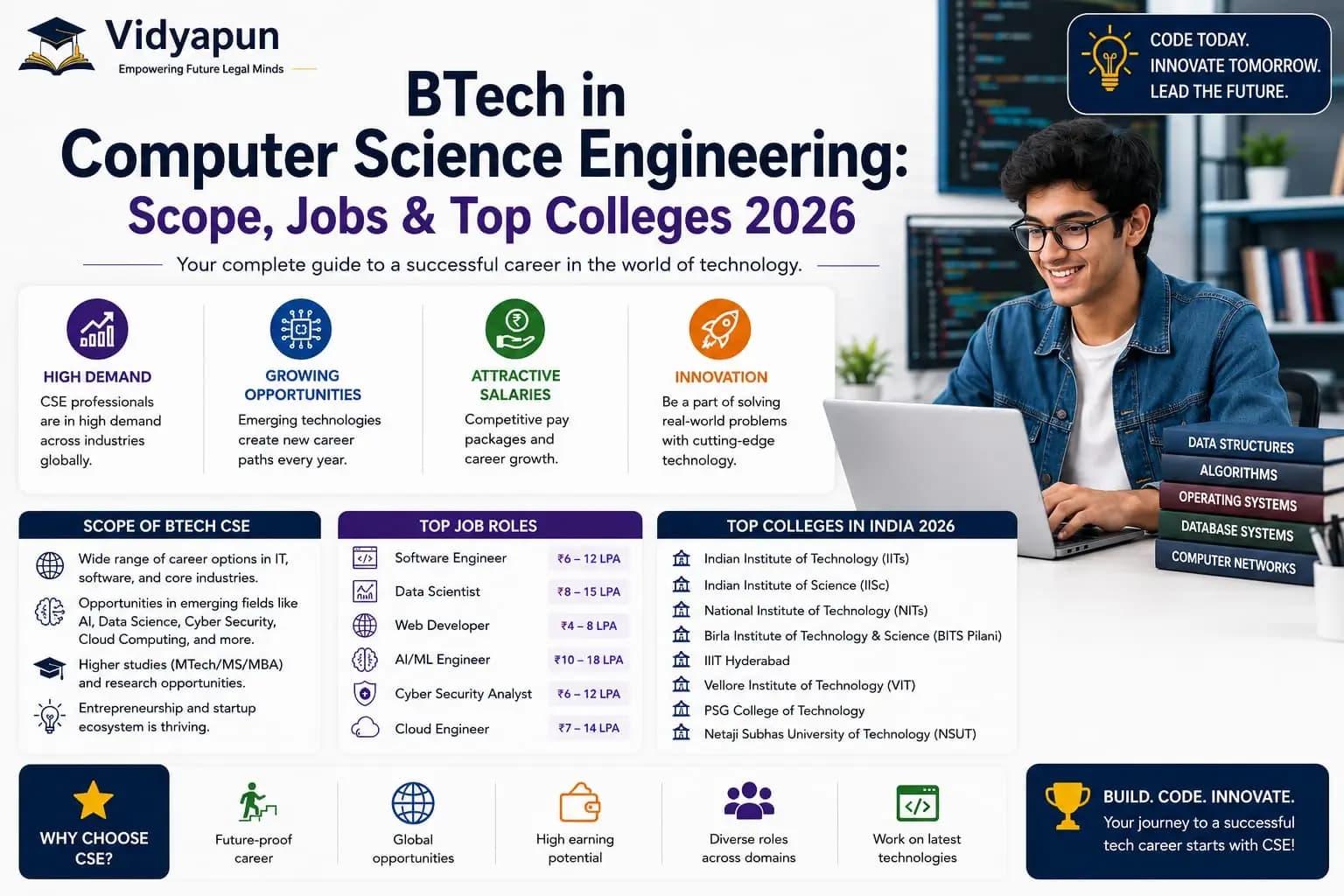
If you've been searching for a career that actually keeps up with the world, BTech in Computer Science Engineering might just be the best decision you'll ever make. And honestly? That's not an exaggeration.
Every industry today runs on software, data, and networks. From hospitals using AI diagnostics to banks deploying fraud-detection algorithms — the demand for CSE graduates has never been this intense. But with hundreds of colleges offering this program and dozens of specialisations to choose from, it's easy to feel overwhelmed.
This guide breaks it all down: what BTech CSE actually involves, its real career scope in 2026, the jobs you can land, expected salaries, and the top colleges you should seriously consider. Whether you're a Class 12 student making a pivotal choice or a parent trying to understand the landscape — this is the only resource you need.
What Is BTech in Computer Science Engineering?
BTech in Computer Science Engineering is a four-year undergraduate program that covers the fundamentals of computing — from programming languages and data structures to operating systems, artificial intelligence, and cloud computing. It's a blend of theoretical knowledge and practical, hands-on application.
The curriculum evolves every few years to stay relevant. In 2026, most top universities now include courses on machine learning, cybersecurity, full-stack development, and blockchain technology as core or elective modules.
The degree is recognised globally, which means your options aren't limited to India. Graduates regularly pursue postgraduate education or jobs in the US, Canada, Germany, and the UK.
BTech CSE Scope in 2026: Why It's Still the Smartest Choice
A common concern students have is — "is computer science still worth it in 2026, given all the automation?" The answer is a resounding yes, and here's why.
The digital economy is still expanding. According to NASSCOM, India's IT sector is on track to reach $500 billion by 2030. That kind of growth doesn't happen without a massive, skilled workforce. The irony of automation is that it creates more technical jobs — someone has to build, manage, and improve the systems doing the automating.
AI is an opportunity, not a threat. Students who understand how AI works are the ones building it. BTech CSE graduates with skills in Python, machine learning frameworks, and data analytics are among the most hired profiles in the country today.
Startup culture is booming. India now has over 100 unicorn startups, and most of them are tech-first. This creates an enormous demand for product engineers, backend developers, DevOps professionals, and data scientists — all roles that CSE graduates are perfectly positioned for.
The scope of BTech Computer Science Engineering in 2026 isn't just wide — it's deep. Every vertical, from healthcare to fintech to edtech, needs people who can write code, understand networks, and solve real problems with technology.
BTech CSE Specialisations Worth Considering
One of the biggest advantages of pursuing BTech CSE today is the ability to specialise. Most good universities offer specialisation tracks from the third year onward. Here are the most in-demand ones:
- Artificial Intelligence & Machine Learning (AI/ML): The hottest track right now. Covers neural networks, NLP, computer vision, and deep learning.
- Cybersecurity: With cyberattacks increasing globally, this specialisation leads to some of the highest-paying roles in tech.
- Data Science & Big Data Analytics: If you love patterns and numbers, this track covers data mining, statistical modelling, and business intelligence.
- Cloud Computing: AWS, Azure, and Google Cloud certifications combined with a CSE degree are a golden combination for employers.
- Internet of Things (IoT): Covers embedded systems, smart devices, and industrial automation — rapidly growing in India's manufacturing sector.
- Full-Stack Development: A more practical, placement-focused track that prepares you for web and mobile development roles.
Choosing a specialisation aligned with your interest early can significantly boost your placement prospects and long-term career trajectory.
Career Scope and Job Opportunities After BTech CSE
This is what everyone really wants to know — what jobs can you actually get?
The honest answer is: quite a lot, and across a much broader range than most people expect.
Core Technical Roles
- Software Developer / Software Engineer — The most common entry point. Building applications, writing clean code, debugging, and shipping products.
- Data Analyst / Data Scientist — Working with structured and unstructured datasets to derive actionable insights.
- Machine Learning Engineer — Designing and deploying ML models at scale.
- DevOps Engineer — Bridging development and operations teams, managing CI/CD pipelines and cloud infrastructure.
- Cybersecurity Analyst — Monitoring networks, identifying vulnerabilities, and protecting digital assets.
- Cloud Solutions Architect — Designing scalable cloud-based systems for enterprises.
- Product Manager (Tech) — A cross-functional role combining technical knowledge with business strategy. Often pursued after 2–3 years of engineering experience.
Emerging Roles in 2026
- Prompt Engineer — Designing and optimising prompts for large language models.
- AI Safety Researcher — Ensuring AI systems behave reliably and ethically.
- Blockchain Developer — Building decentralised applications and smart contracts.
Salary Expectations (India, 2026)
| Role | Fresher CTC (Per Annum) | Mid-Level (3–5 Years) |
|---|---|---|
| Software Engineer | ₹4 – ₹12 LPA | ₹15 – ₹35 LPA |
| Data Scientist | ₹6 – ₹14 LPA | ₹20 – ₹45 LPA |
| ML Engineer | ₹8 – ₹18 LPA | ₹25 – ₹60 LPA |
| Cybersecurity Analyst | ₹5 – ₹10 LPA | ₹12 – ₹30 LPA |
| DevOps Engineer | ₹6 – ₹15 LPA | ₹18 – ₹40 LPA |
These figures vary based on the college you graduate from, your internship experience, and the skill set you build alongside your degree.
Top Colleges for BTech Computer Science Engineering in 2026
Choosing the right college can make a 5x difference in your starting salary and career trajectory. Here's a curated list of the best institutions across categories.
Tier 1: Government / Premier Institutions
1. IIT Bombay, Delhi, Madras, Kharagpur, Kanpur, Roorkee The gold standard for BTech CSE in India. Admissions through JEE Advanced. Placement packages at these institutes routinely cross ₹30–50 LPA, with international offers going up to ₹1 crore and above. If you can get in, you should.
2. NIT Trichy, NIT Warangal, NIT Surathkal The top National Institutes of Technology offer world-class BTech Computer Science programs at a fraction of the private college cost. Admissions through JEE Main. Strong placement cells with consistent records.
3. IIIT Hyderabad Arguably the best IIIT in the country for CSE and AI research. Known for producing some of India's finest software engineers and researchers.
4. BITS Pilani (Pilani, Goa, Hyderabad campuses) A private university that punches well above its weight. Known for dual-degree programs, strong alumni network, and excellent industry connect.
Tier 2: Private Universities with Strong Placements
5. VIT Vellore & Chennai One of the largest engineering universities in Asia with a genuinely strong placement record. Regular recruiters include Microsoft, Amazon, Google, TCS, and Wipro.
6. SRM Institute of Science and Technology Strong industry-academia partnerships and a dedicated placement cell. Good choice for students looking for consistent placement support.
7. Manipal Institute of Technology Known for its autonomous curriculum, industry collaborations, and consistent placements in top IT firms.
8. Amrita Vishwa Vidyapeetham Particularly strong in research-oriented CSE programs, especially in AI and cybersecurity.
9. Thapar Institute of Engineering & Technology Excellent placement statistics, strong faculty, and a rigorous curriculum. One of the better private options in North India.
10. Chandigarh University Among the fastest-growing universities in terms of BTech CSE placements. Offers specialisations in AI, cybersecurity, and cloud computing.
Key Factors to Evaluate Before Choosing
When shortlisting colleges for BTech Computer Science Engineering, don't just look at rankings. Ask these questions:
- What is the average and median placement package? (Median matters more than a headline number)
- Does the college have active industry partnerships?
- Are there research labs or incubation cells?
- What internship opportunities are available in Years 2 and 3?
- Is the curriculum updated regularly or still stuck in 2015?
Higher Studies After BTech CSE
Not everyone wants to jump straight into a job — and that's perfectly fine. BTech CSE opens multiple postgraduate pathways:
- MTech / MS in Computer Science — At IITs, IISc, or abroad (US, Canada, Germany).
- MBA — Especially popular among those targeting product management, consulting, or tech leadership roles.
- MCA or M.Sc. in Data Science / AI — For those who want to deepen technical expertise.
- PhD in CS — For those passionate about research, with strong funding opportunities available globally.
GRE scores combined with a BTech CSE degree from a recognised institution can get you into top-ranked universities in the United States and Europe.
Frequently Asked Questions (FAQs)
Q1. What is the scope of BTech CSE in 2026? The scope is exceptionally strong. Digital transformation across all industries continues to drive demand for CSE graduates. Roles in AI, cloud, cybersecurity, and software development are growing faster than the talent pool, making it a candidate-driven market.
Q2. Which is better — BTech CSE or BTech IT? BTech CSE is generally considered more fundamental and broader. It covers hardware, software, algorithms, and systems. BTech IT is more application-focused. For long-term flexibility and research opportunities, CSE is typically the preferred choice.
Q3. What is the average salary for a BTech CSE fresher in India? Depending on the college and skillset, freshers can expect anywhere from ₹4 LPA to ₹18 LPA. Top IIT graduates with strong profiles often receive packages upward of ₹30 LPA even at entry level.
Q4. Can I get into a good company without being from an IIT? Absolutely. Many top companies — including Google, Microsoft, and startups — hire based on skills, problem-solving ability, and internship experience. Students from VIT, BITS, Manipal, and even lesser-known colleges regularly land top-tier packages by focusing on competitive programming, open-source contributions, and certifications.
Q5. What skills should I develop alongside my BTech CSE degree? Focus on: proficiency in Python, Java, or C++; data structures and algorithms (DSA); cloud platforms (AWS/Azure); GitHub and version control; and one domain specialisation such as ML, cybersecurity, or web development. Additionally, good communication skills and the ability to work in agile teams are highly valued by employers.
Q6. Is there scope for BTech CSE graduates in government jobs? Yes. Graduates can appear for UPSC (technical posts), SSC CGL, state PSC exams, DRDO, ISRO, and public sector undertakings like BSNL, BHEL, and NTPC. Government roles in IT security and e-governance are growing significantly.
Q7. What is the BTech CSE admission process in India? For IITs and NITs, admissions are through JEE Main and JEE Advanced. For private universities like VIT and SRM, most conduct their own entrance exams (VITEEE, SRMJEEE). Some institutions also accept JEE Main scores for direct admission.
Final Thoughts: Is BTech CSE the Right Choice for You?
Here's the honest truth — BTech in Computer Science Engineering is one of the most future-proof degrees you can pursue in 2026. It gives you the technical foundation to work across industries, the flexibility to specialise in areas you're passionate about, and the credibility to compete in a global job market.
But like any degree, what you put in determines what you get out. Students who supplement classroom learning with real projects, internships, open-source contributions, and continuous skill development are the ones who graduate with multiple offers — not just one.
The colleges listed here are proven pathways. The roles described above are real and growing. The only variable is you.
Website: www.vidyapun.com
Call / WhatsApp: +91 96438 02216