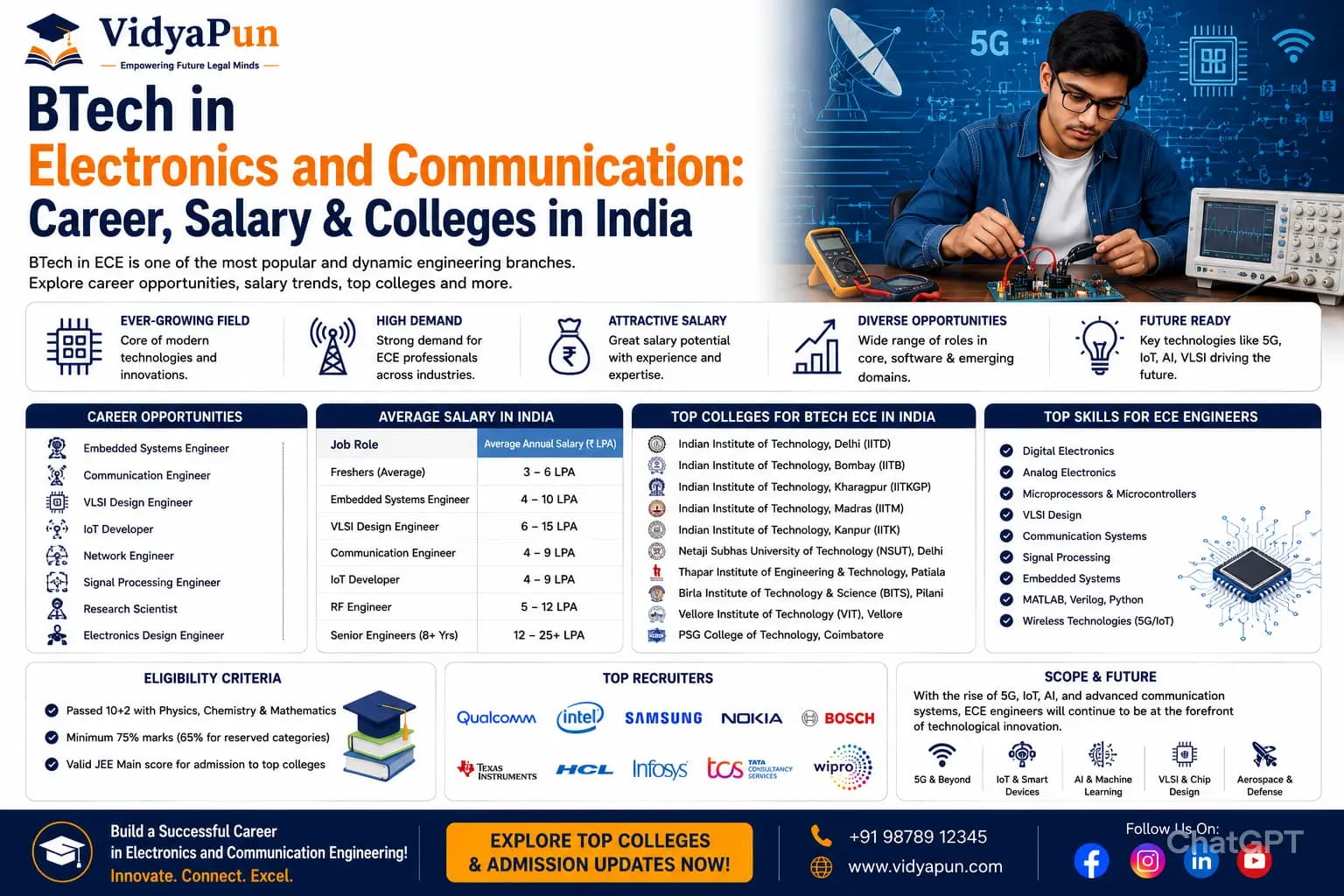
If you're a PCM student trying to decide between branches, there's a good chance someone in your circle has said "CSE is the only branch worth doing in 2026." That advice is well-meaning but incomplete — and for students genuinely interested in how devices work, how signals travel, and how communication systems function, it can lead to the wrong choice.
BTech in Electronics and Communication Engineering (ECE) is one of the oldest and most respected engineering branches in India. And in 2026, with India's semiconductor mission gathering pace, 5G infrastructure expanding rapidly, and defence electronics becoming a national priority — ECE is having something of a quiet comeback.
This guide covers everything you need to know about BTech ECE in India — career options, salary expectations, top colleges, fees, and whether it's the right branch for you.
What is BTech in Electronics and Communication Engineering?
BTech in Electronics and Communication Engineering (ECE) is a 4-year undergraduate engineering program that covers the design, development, and application of electronic systems and communication networks. The curriculum spans a wide range — from basic circuit theory and semiconductor devices to microprocessors, VLSI design, embedded systems, signal processing, wireless communication, and optical networks.
ECE sits at an interesting intersection: it's deeply hardware-rooted but increasingly software-connected. ECE graduates work on the physical systems that make everything else possible — the chips, antennas, signal processors, and communication networks that run the digital world.
It's technically demanding, mathematically rigorous, and genuinely rewarding for students who enjoy understanding how things work at a fundamental level — not just how to build applications on top of them.
BTech ECE Scope in India 2026 — Why It Still Makes Sense
Let's address this directly because it's the biggest concern students raise: "Is ECE still relevant in 2026 when everyone's doing CSE?"
Here's what's actually happening in the industry:
India's Semiconductor Mission: The Indian government has committed over ₹76,000 crore to building a semiconductor ecosystem in India. Companies like Micron, Tata Electronics, and CG Power are setting up chip manufacturing and design facilities. VLSI and chip design engineers are in high demand — and ECE is the primary feeder branch for these roles.
5G Infrastructure Rollout: India's 5G deployment is still deep in the infrastructure phase. Telecom companies, equipment manufacturers like Ericsson, Nokia, and Samsung Networks are actively hiring RF engineers, network planning engineers, and communication systems engineers — all ECE domain roles.
Defence Electronics: DRDO, BEL (Bharat Electronics Limited), HAL, and defence PSUs are expanding electronics R&D. ECE graduates are preferred for technical roles in radar systems, communication equipment, electronic warfare, and avionics.
IoT and Embedded Systems: Every smart device — from industrial sensors to consumer electronics to automotive systems — runs on embedded hardware that ECE engineers design and program.
Space Technology: ISRO and the growing private space sector in India (Agnikul, Skyroot, Pixxel) are building real demand for communication systems and satellite electronics engineers.
ECE isn't declining — it's evolving. The students who struggle are those who graduate with only theoretical knowledge. The ones who thrive combine ECE fundamentals with software skills in Python, C/C++, or hardware description languages like VHDL and Verilog.
Top Colleges for BTech ECE in India 2026
IITs (Admission via JEE Advanced):
1. IIT Madras
- Consistently ranked #1 in engineering by NIRF
- ECE department is among the strongest in India for research and placements
- Annual Fee: ~₹2,20,000
2. IIT Delhi
- Electrical Engineering with ECE focus — strong industry ties
- Annual Fee: ~₹2,20,000
3. IIT Bombay
- Electrical Engineering with strong communication systems research
- Annual Fee: ~₹2,30,000
4. IIT Kharagpur
- Electronics & Electrical Communication Engineering (EECE) department
- One of the oldest ECE programs in India
- Annual Fee: ~₹2,10,000
5. IIT Roorkee
- Electronics & Communication Engineering with strong placement record
- Annual Fee: ~₹2,20,000
Top NITs for BTech ECE (Admission via JEE Main + JoSAA):
6. NIT Trichy (Tamil Nadu)
- Among the best NITs for ECE — strong placements in core and IT sectors
- Annual Fee: ~₹1,40,000
7. NIT Warangal (Telangana)
- Excellent ECE department with industry-connected curriculum
- Annual Fee: ~₹1,35,000
8. NIT Surathkal (Karnataka)
- Strong research culture and good placement support
- Annual Fee: ~₹1,30,000
9. NIT Calicut (Kerala)
- Well-regarded ECE program, especially in embedded systems and communication
- Annual Fee: ~₹1,35,000
10. MNIT Jaipur (Rajasthan)
- Good ECE placement record, strong alumni network in North India
- Annual Fee: ~₹1,30,000
Top Private Colleges for BTech ECE:
11. BITS Pilani (Rajasthan)
- One of the most respected private engineering colleges in India
- ECE program is strong in both research and placements
- Admission: BITSAT
- Annual Fee: ~₹5,50,000
12. VIT Vellore (Tamil Nadu)
- Large intake, good placement cell, industry partnerships
- Admission: VITEEE
- Annual Fee: ~₹1,98,000
13. Thapar Institute of Engineering, Patiala
- One of the better private options for ECE in North India
- Annual Fee: ~₹3,40,000
14. PSG College of Technology, Coimbatore
- Excellent reputation in Tamil Nadu, strong core engineering placements
- Annual Fee: ~₹1,20,000 – ₹1,60,000
15. RV College of Engineering, Bangalore
- Among the best private colleges in Karnataka for ECE
- Annual Fee: ~₹1,80,000 – ₹2,20,000
BTech ECE Fees in India 2026 — Complete Overview
| College Type | Annual Fee | Total 4-Year Cost |
|---|---|---|
| IITs | ₹2,00,000 – ₹2,50,000 | ₹8–10 lakh |
| NITs | ₹1,25,000 – ₹1,75,000 | ₹5–7 lakh |
| IIITs | ₹2,00,000 – ₹3,50,000 | ₹8–14 lakh |
| Top Private (BITS, Thapar, VIT) | ₹2,00,000 – ₹5,50,000 | ₹8–22 lakh |
| State Govt Engineering Colleges | ₹25,000 – ₹80,000 | ₹1–3.2 lakh |
| Mid-tier Private Colleges | ₹1,00,000 – ₹2,50,000 | ₹4–10 lakh |
Government engineering colleges at the state level remain excellent value for money — especially in states like Tamil Nadu, Karnataka, Kerala, and Maharashtra where state government colleges have strong ECE departments and consistent placement records.
BTech ECE Syllabus — What You Actually Study
The ECE curriculum is broader than most students expect. Here's a realistic semester-wise overview:
Year 1 — Engineering Foundation: Engineering Mathematics, Basic Electronics, Programming in C, Physics (Semiconductor focus), Engineering Drawing
Year 2 — Core Electronics: Network Theory, Electronic Devices and Circuits, Signals and Systems, Digital Electronics, Electromagnetic Field Theory, Data Structures
Year 3 — Communication & Advanced Electronics: Analog and Digital Communication, Microprocessors and Microcontrollers, VLSI Design, Control Systems, Wireless Communication, Embedded Systems
Year 4 — Specialization & Industry: Optical Communication, Digital Signal Processing (DSP), RF and Microwave Engineering, IoT Systems, Major Project, Industry Internship
Students who go beyond the syllabus and build skills in MATLAB, Python for signal processing, Cadence or Synopsys tools for VLSI, and Arduino/Raspberry Pi for embedded projects are the ones who consistently land the best opportunities.
BTech ECE Career Options in India — Sector-Wise Breakdown
1. Core Electronics & Hardware Sector
- VLSI Design Engineer
- Embedded Systems Engineer
- PCB Design Engineer
- RF and Microwave Engineer
- Hardware Design Engineer
Top Recruiters: Intel, Qualcomm, Texas Instruments, MediaTek, Samsung Semiconductor, Cadence, Synopsis, STMicroelectronics, and Indian companies like VLSI System Design, Tessolve, Sankalp Semiconductor
2. Telecom & Communication Sector
- Network Planning Engineer
- RF Optimization Engineer
- Telecom Systems Engineer
- 5G Protocol Engineer
Top Recruiters: Ericsson, Nokia, Samsung Networks, Airtel, Jio, BSNL (government), Tejas Networks
3. Defence & Space Sector
- Electronics Research Scientist (DRDO)
- Communication Systems Engineer (ISRO)
- Avionics Engineer (HAL, ISRO)
- Electronic Warfare Engineer
Entry Route: GATE score for DRDO, BEL, HAL; ISRO Centralised Recruitment Board exam; UPSC Engineering Services Examination (ESE)
4. IT and Software Sector
- Many ECE graduates transition into software development, especially in domains like embedded software, IoT platform development, network software, and testing
- Companies like Wipro, TCS, Infosys, Accenture, and Capgemini regularly hire ECE graduates for software roles
5. Government Sector
- SSC JE (Junior Engineer) — Electronics stream
- RRB JE — Signal & Telecommunication
- UPSC Engineering Services Examination (ESE/IES)
- BEL, BHEL, DRDO, ISRO, HAL recruitment through GATE
- State Electricity Boards and telecom departments
BTech ECE Salary in India 2026
Here's a realistic salary picture across different roles and experience levels:
| Role / Sector | Fresher Salary (Annual) |
|---|---|
| VLSI Design Engineer | ₹6 LPA – ₹14 LPA |
| Embedded Systems Engineer | ₹4.5 LPA – ₹9 LPA |
| RF Engineer (Telecom) | ₹4 LPA – ₹8 LPA |
| Software Engineer (ECE to IT) | ₹3.5 LPA – ₹8 LPA |
| DRDO / BEL Scientist | ₹7 LPA – ₹10 LPA (with allowances) |
| ISRO Scientist/Engineer SC | ₹8 LPA – ₹12 LPA (with allowances) |
| IIT ECE Campus Placements | ₹12 LPA – ₹40 LPA (median/high) |
With 4–6 years of experience, VLSI and embedded systems engineers in India commonly earn ₹18–35 LPA. Senior roles in product companies like Qualcomm, Intel, or Texas Instruments in India can go significantly higher.
GATE After BTech ECE — A Path Worth Considering
GATE (Graduate Aptitude Test in Engineering) in the EC (Electronics and Communication) paper is one of the most competitive but rewarding GATE streams. A good GATE EC score opens:
- MTech at IITs and NITs (often with MHRD stipend of ₹12,400/month)
- PSU recruitment — BEL, DRDO, ISRO, NTPC, Power Grid, AAI (Airports Authority of India), and BSNL all recruit ECE engineers through GATE
- Research positions at IISc, IITs, and national labs
For ECE students who don't land their ideal job immediately after graduation, GATE preparation is one of the most productive uses of a gap year — the return on investment is genuinely high.
Frequently Asked Questions (FAQs)
Q1. Is BTech ECE a good choice in 2026?
Yes — BTech ECE is a strong choice in 2026, particularly for students interested in VLSI, embedded systems, semiconductor design, defence electronics, and 5G communication. India's semiconductor push and expanding tech manufacturing base are creating consistent demand for electronics engineers. Avoid it only if you dislike mathematics and circuit-level thinking.
Q2. Which is better — BTech ECE or BTech CSE?
BTech CSE offers broader IT job opportunities and generally higher starting packages at most colleges. BTech ECE is better for students targeting hardware, chip design, defence, or research careers. At IITs and top NITs, both branches offer excellent outcomes. At mid-tier colleges, CSE often has stronger placement infrastructure.
Q3. What is the starting salary for BTech ECE graduates in India?
Fresh BTech ECE graduates typically earn ₹3.5–8 LPA in India, depending on the college, role, and sector. VLSI and embedded roles command higher starting packages (₹6–14 LPA), while telecom and government roles have structured but often lower initial salaries with strong growth and allowances.
Q4. Can ECE graduates get into software companies?
Yes — many software companies including TCS, Infosys, Wipro, and Accenture recruit ECE graduates for software engineering roles. ECE graduates with programming skills in Python, Java, or C++ and relevant certifications are competitive candidates. Product companies like Qualcomm, Intel, and Texas Instruments also hire ECE graduates for technically specialized software roles.
Q5. Which government jobs are available after BTech ECE?
ECE graduates can apply for SSC JE (Electronics stream), RRB JE (Signal & Telecom), UPSC Engineering Services Exam (ESE/IES), and PSU recruitment through GATE — including BEL, DRDO, ISRO, HAL, AAI, NTPC, and Power Grid. These roles offer strong job security, good allowances, and structured career growth.
Q6. What is the JEE Main cutoff for ECE at top NITs?
JEE Main closing ranks for ECE at top NITs in 2026 (General category, approximate): NIT Trichy — 8,000–13,000; NIT Warangal — 9,000–15,000; NIT Surathkal — 10,000–16,000; NIT Calicut — 11,000–18,000. These figures vary by year — always check official JoSAA data during counselling.
Q7. Does BTech ECE require coding skills?
Yes — modern ECE increasingly requires programming skills. You'll need C and C++ for embedded programming, Python for signal processing and automation, MATLAB for simulations, and hardware description languages (VHDL, Verilog) for VLSI design. ECE graduates who develop strong coding skills alongside hardware knowledge are significantly more competitive in the job market.
What to Look for Before Choosing a BTech ECE College
Not all ECE programs are created equal. Before paying admission fees, check these specifics:
Lab Infrastructure: Does the college have working electronics labs — oscilloscopes, spectrum analysers, VLSI simulation tools like Cadence, and embedded development kits? Outdated lab equipment is a red flag.
Faculty Expertise: Look for faculty who have published research in communication systems, VLSI, or signal processing — not just degree holders who've never worked outside academia.
Industry Connections: Does the college have MoUs or active relationships with companies like Texas Instruments, Qualcomm, or Ericsson? Some colleges run TI University programs and similar partnerships that provide real tools and projects.
Placement Data for Core Roles: Ask specifically how many students from the ECE batch get placed in core electronics roles versus IT software jobs. A high overall placement percentage means little if every ECE student ends up in a generic IT support role.
AICTE Approval & NAAC Accreditation: Always verify at aicte-india.org before committing.
Ready to Take the Next Step?
BTech in Electronics and Communication Engineering remains one of the most technically rich and career-diverse programs in India. The field is evolving — moving from traditional telecom into semiconductors, embedded AI, 5G, and defence electronics — and that evolution is creating fresh opportunities every year.
The students who thrive in ECE aren't necessarily the ones who scored the highest in JEE. They're the ones who stay curious about how things work, build hands-on projects, develop software skills alongside hardware knowledge, and treat GATE or campus placements as something worth preparing for seriously — not something that happens automatically.
Here's your action plan:
👉 Shortlist colleges using NIRF rankings, AICTE approval, and ECE-specific placement data — not just overall ranking or brochure claims
👉 Start exploring core ECE skills now — YouTube channels on VLSI, embedded C, and Arduino projects will quickly tell you if this branch genuinely excites you
👉 Check GATE ECE previous year papers — if you're targeting PSUs or IIT MTech later, starting GATE awareness from Year 1 gives you a massive advantage
Have questions about a specific college's BTech ECE program, your JEE rank and ECE options, or which sector to target after graduation? Drop them in the comments — we'll give you honest, specific guidance based on your situation.
Electronics built the digital world. The engineers who understand it from the ground up will always have a place in shaping what comes next.