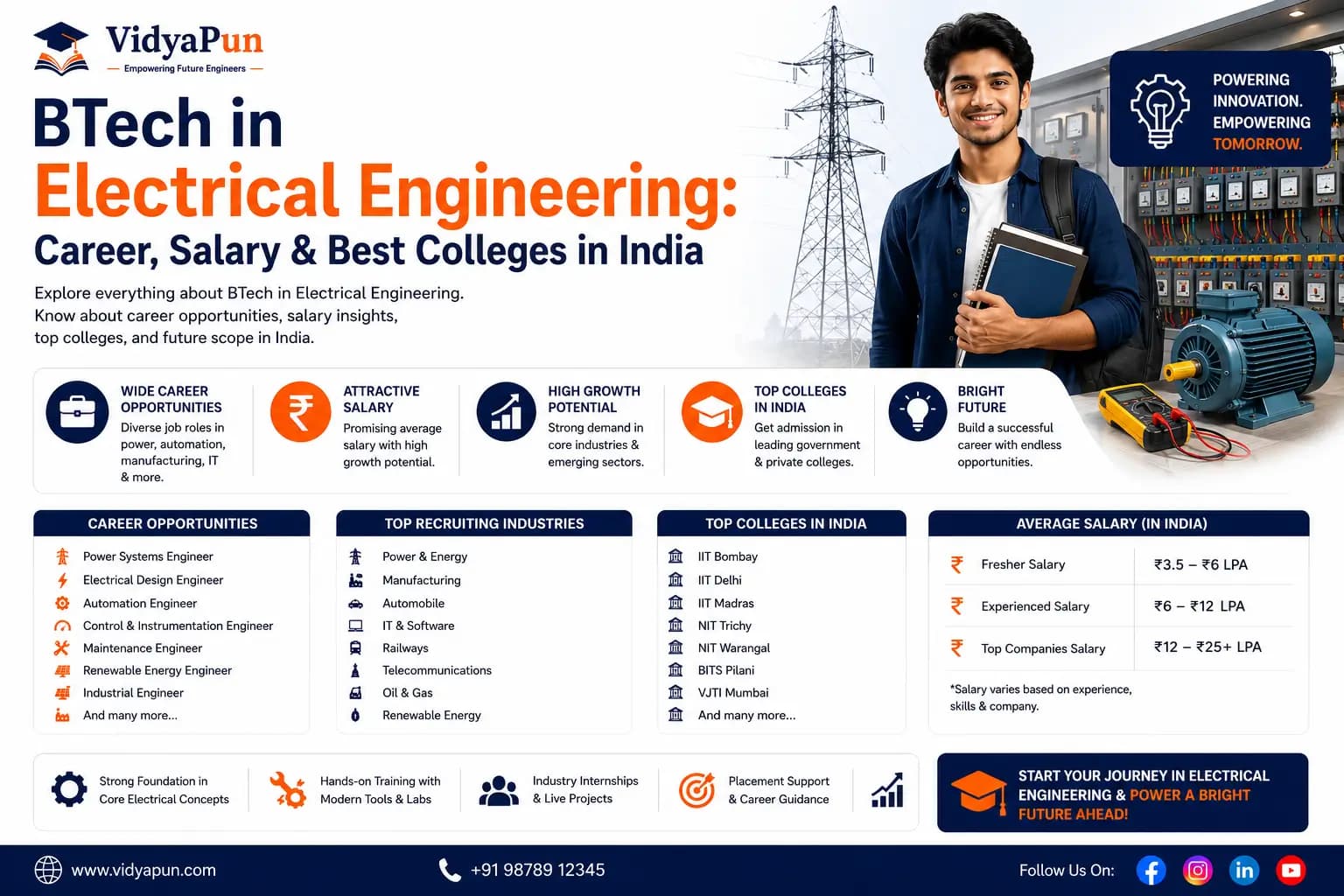
So you're thinking about a BTech in Electrical Engineering — or maybe someone at home pushed the idea, and now you're genuinely curious whether it's worth it. Either way, you've landed in the right place.
Let's have an honest, no-fluff conversation about what a BTech in Electrical Engineering actually means for your career in India — from the subjects you'll study and the colleges worth your time, to real salary numbers and the industries hiring right now.
What Is BTech in Electrical Engineering — And Why Does It Still Matter?
Electrical Engineering is one of the oldest and most foundational engineering disciplines. But don't let that fool you into thinking it's outdated. In 2026, electrical engineers are at the heart of some of the most exciting work happening globally — renewable energy, electric vehicles, smart grids, robotics, and semiconductor design.
A BTech in Electrical Engineering is a four-year undergraduate degree that covers the science and application of electricity, electronics, and electromagnetism. It blends strong fundamentals with practical problem-solving, preparing students for roles in power systems, embedded systems, automation, and more.
India's push toward 500 GW of renewable energy by 2030, the rapid growth of the EV sector, and massive infrastructure projects mean electrical engineers are not just in demand — they're essential.
BTech Electrical Engineering Syllabus: What You'll Actually Study
The curriculum across most top engineering colleges in India covers:
First & Second Year (Foundation):
- Engineering Mathematics and Physics
- Basic Electrical and Electronics Engineering
- Circuit Theory and Network Analysis
- Electromagnetic Field Theory
Third & Fourth Year (Core + Specialization):
- Power Systems Analysis
- Control Systems Engineering
- Electrical Machines (DC and AC motors, transformers)
- Power Electronics and Drives
- Digital Signal Processing
- Microprocessors and Embedded Systems
- High Voltage Engineering
- Renewable Energy Systems
Many colleges now offer electives in EV technology, smart grid systems, IoT applications, and VLSI design — which directly feeds into high-demand job roles.
The key here is that electrical engineering is inherently interdisciplinary. You'll touch mechanical systems, software (especially in automation), and even data analysis. That makes it one of the most versatile BTech degrees available.
Top BTech Electrical Engineering Colleges in India
Choosing the right college matters — not just for placements, but for the quality of faculty, lab infrastructure, and industry exposure you'll get. Here's a realistic breakdown:
Tier 1: IITs and NITs
| College | Location | NIRF Ranking (Engineering) |
|---|---|---|
| IIT Bombay | Mumbai, Maharashtra | 3 |
| IIT Delhi | New Delhi | 2 |
| IIT Madras | Chennai, Tamil Nadu | 1 |
| IIT Kharagpur | West Bengal | 5 |
| NIT Trichy | Tamil Nadu | 8 |
| NIT Warangal | Telangana | 9 |
| NIT Surathkal | Karnataka | 10 |
Getting into an IIT requires clearing JEE Advanced with a strong rank, while NITs admit through JEE Main. These institutions offer the best placement records and research opportunities in the country.
Tier 2: State Government and Private Universities
- BITS Pilani – Excellent for those who clear BITSAT; strong industry connections
- VIT Vellore – Known for campus placements and international tie-ups
- Manipal Institute of Technology – Good infrastructure and consistent placement performance
- Thapar Institute of Engineering – Particularly strong in Punjab and North India
- PES University Bengaluru – Good choice for South India, especially for electronics and EV sector
Tier 3: State Colleges (AKTU, RGPV, JNTU, etc.)
State technical universities across UP, MP, Andhra Pradesh, and Telangana have affiliated colleges where the quality of education varies widely. If you're going this route, look at placement data from the specific college — not just the university's brochure claims.
Pro tip: For electrical engineering specifically, prioritise colleges with well-equipped power systems labs, active industry MoUs, and a visible alumni network.
BTech Electrical Engineering Admission Process in India
Most admissions happen through national and state-level entrance exams:
- JEE Main → Admission to NITs, IIITs, and other central institutions
- JEE Advanced → IIT admissions
- BITSAT → BITS Pilani and its campuses
- State CETs → AP EAPCET, TS EAMCET, UPCET, GUJCET, MHT CET, etc.
- Management Quota / Direct Admission → Available at many private colleges
The typical eligibility requirement is 10+2 with Physics, Chemistry, and Mathematics — and a minimum of 75% marks (or 65% for reserved categories) for NITs and IITs.
BTech Electrical Engineering Career Options: What Can You Do After Graduation?
This is where most students get nervous — and understandably so. Let's break it down clearly.
Core Engineering Roles
Power Systems Engineer: Work with electricity generation, transmission, and distribution companies. NTPC, PGCIL, and state electricity boards actively recruit electrical engineers.
Electrical Design Engineer: Work on industrial electrical systems, wiring schematics, and load calculations. Heavy demand in construction, real estate, and infrastructure sectors.
Control and Automation Engineer: Work with PLCs, SCADA systems, and industrial automation. Siemens, ABB, Honeywell, and Rockwell Automation are major recruiters.
Embedded Systems Engineer: Design and program hardware-software systems for consumer electronics, automotive, aerospace, and IoT. Requires strong coding alongside circuit design knowledge.
VLSI/Chip Design Engineer: One of the highest-paying roles for electrical engineers. Companies like Intel, Qualcomm, Texas Instruments, and Cadence hire from top IITs and NITs.
Emerging High-Growth Sectors
- Electric Vehicle (EV) Industry: Battery management systems, motor controllers, charging infrastructure
- Solar and Wind Energy: Grid integration, inverter design, energy storage systems
- Smart Grid Technology: IoT-enabled power distribution, demand forecasting
- Defence and Aerospace: BEL, HAL, DRDO, and ISRO regularly recruit electrical engineers
Non-Core Roles
Many electrical engineering graduates go into:
- IT and software development (especially if they build coding skills during BTech)
- Data analysis and analytics roles
- Banking and finance (via competitive exams like IBPS SO or RBI Grade B)
- Management (MBA after BTech)
- Government services (GATE, IES/ESE, PSU exams)
BTech Electrical Engineering Salary in India: What to Expect
Let's talk real numbers. Salaries vary hugely based on your college, skill set, and the sector you enter.
Fresh Graduate Salary (0–2 Years Experience)
| Sector | Average Starting Salary (Per Annum) |
|---|---|
| Core PSU (via GATE) | ₹8 – ₹12 LPA |
| Private Power Sector | ₹3.5 – ₹6 LPA |
| IT/Software (non-core) | ₹4 – ₹8 LPA |
| VLSI/Chip Design | ₹8 – ₹15 LPA |
| EV Startups | ₹5 – ₹10 LPA |
| IIT/NIT Campus Placements (top offers) | ₹20 – ₹60 LPA (select roles) |
Mid-Level Salary (3–7 Years Experience)
Experienced electrical engineers with specialisations in power electronics, embedded systems, or VLSI can comfortably earn between ₹12 – ₹25 LPA. Professionals in the semiconductor or EV space often cross ₹30 LPA within 5 years.
Government Sector (PSU Jobs via GATE)
GATE-qualified electrical engineers can join PSUs like BHEL, NTPC, PGCIL, IOCL, and ONGC through direct recruitment. The CTC typically ranges from ₹9 – ₹14 LPA plus benefits (housing, medical, pension) — making the effective value significantly higher.
Higher Education After BTech Electrical Engineering
If you want to go beyond a BTech, here are your options:
MTech (Master of Technology): Pursue specialisations in Power Systems, Control Systems, VLSI, or Signal Processing via GATE. Many PSUs also prefer GATE-qualified candidates.
MS Abroad: Electrical Engineering remains one of the most accepted disciplines for MS programs in the USA, Germany, Canada, and Australia. Top universities include MIT, Stanford, ETH Zurich, and TU Delft.
MBA: If you're interested in management, an MBA from IIMs or top B-schools with a BTech EE background is a powerful combination for roles in infrastructure consulting, operations, and energy management.
Research and PhD: For those inclined towards academia or R&D, institutes like IISc Bengaluru, IIT Madras, and BARC offer excellent research environments.
Is BTech Electrical Engineering a Good Choice in 2026?
Honestly? Yes — if you have a genuine interest in how electrical systems work and a willingness to keep learning. The field is evolving fast. Someone who graduated with a BTech EE in 2010 and pivoted into EV technology or power electronics is today among the most sought-after professionals in the country.
The challenge is this: electrical engineering requires consistent effort during the degree. It's not a field where you can coast through on rote learning. Strong fundamentals in circuit theory, control systems, and mathematics will open more doors than a high CGPA alone.
If you're someone who gets excited about understanding how a power grid balances loads, how an inverter converts DC to AC, or how an electric motor is controlled — this branch is built for you.
Frequently Asked Questions (FAQs)
Q1. Which is better — BTech in Electrical Engineering or Electronics and Communication Engineering (ECE)?
Both are strong choices, but they serve different career paths. Electrical Engineering is stronger for power sector jobs, PSU recruitment, and industrial automation. ECE is better suited for telecom, consumer electronics, and software-adjacent roles. If you're interested in core electrical work, power systems, or VLSI design, Electrical Engineering is the right pick.
Q2. Can an electrical engineering BTech graduate get into IT companies?
Yes. Many IT companies like TCS, Infosys, Wipro, and Accenture recruit electrical engineers through campus placements. However, you'll need to build programming skills (Python, C, Java) alongside your core subjects to stay competitive.
Q3. What is the scope of BTech Electrical Engineering after 10 years?
Electrical engineers with 8–10 years of experience in specialised roles (power electronics, VLSI, EV technology, automation) often reach senior engineer or engineering manager positions earning ₹25 – ₹50+ LPA. Those who pivot into management, consulting, or start their own ventures can go significantly higher.
Q4. Is GATE necessary for a good career in Electrical Engineering?
GATE is not mandatory for a good career, but it's highly recommended if you're targeting PSU jobs or an MTech from an IIT or NIT. A strong GATE score can be a game-changer, especially if you're from a tier-2 or tier-3 college and want to break into top-tier organisations.
Q5. What are the best BTech Electrical Engineering colleges for placements in India?
IIT Madras, IIT Bombay, IIT Delhi, NIT Trichy, and BITS Pilani consistently report the best placement numbers for electrical engineering. Among private colleges, VIT Vellore and Manipal Institute of Technology have solid placement cells.
Q6. What skills should a BTech Electrical Engineering student develop alongside academics?
Beyond the core syllabus, focus on: MATLAB/Simulink for power systems simulation, Python for data-driven engineering, C/C++ for embedded systems, AutoCAD Electrical for design roles, and PLC programming (Ladder Logic) for automation. Any one of these can significantly boost your employability.
Q7. How does BTech Electrical Engineering help in government jobs?
Electrical engineers are eligible for IES/ESE (Engineering Services Examination conducted by UPSC), PSU recruitment through GATE, and state-level government jobs through electricity boards. The government sector offers strong job security, good salary packages, and structured career growth.
The Bottom Line
A BTech in Electrical Engineering is one of those degrees where your output depends heavily on what you put in. The fundamentals are rock solid, the career paths are diverse — from government PSUs to EV startups to VLSI companies — and the long-term salary trajectory is genuinely impressive when you specialise.
India's energy transition, the electric vehicle boom, and growing investments in smart infrastructure mean the demand for well-trained electrical engineers is only going upward. The question is whether you're ready to make the most of that opportunity.
Ready to take the next step in your BTech Electrical Engineering journey?
Whether you're a student figuring out entrance exam strategies, a parent comparing colleges, or a final-year student exploring career paths — don't leave it to guesswork. Start by identifying your area of interest within electrical engineering (power systems, embedded systems, VLSI, or automation) and build your preparation, internships, and projects around it from Day 1.
Website: www.vidyapun.com
Call / WhatsApp: +91 96438 02216`