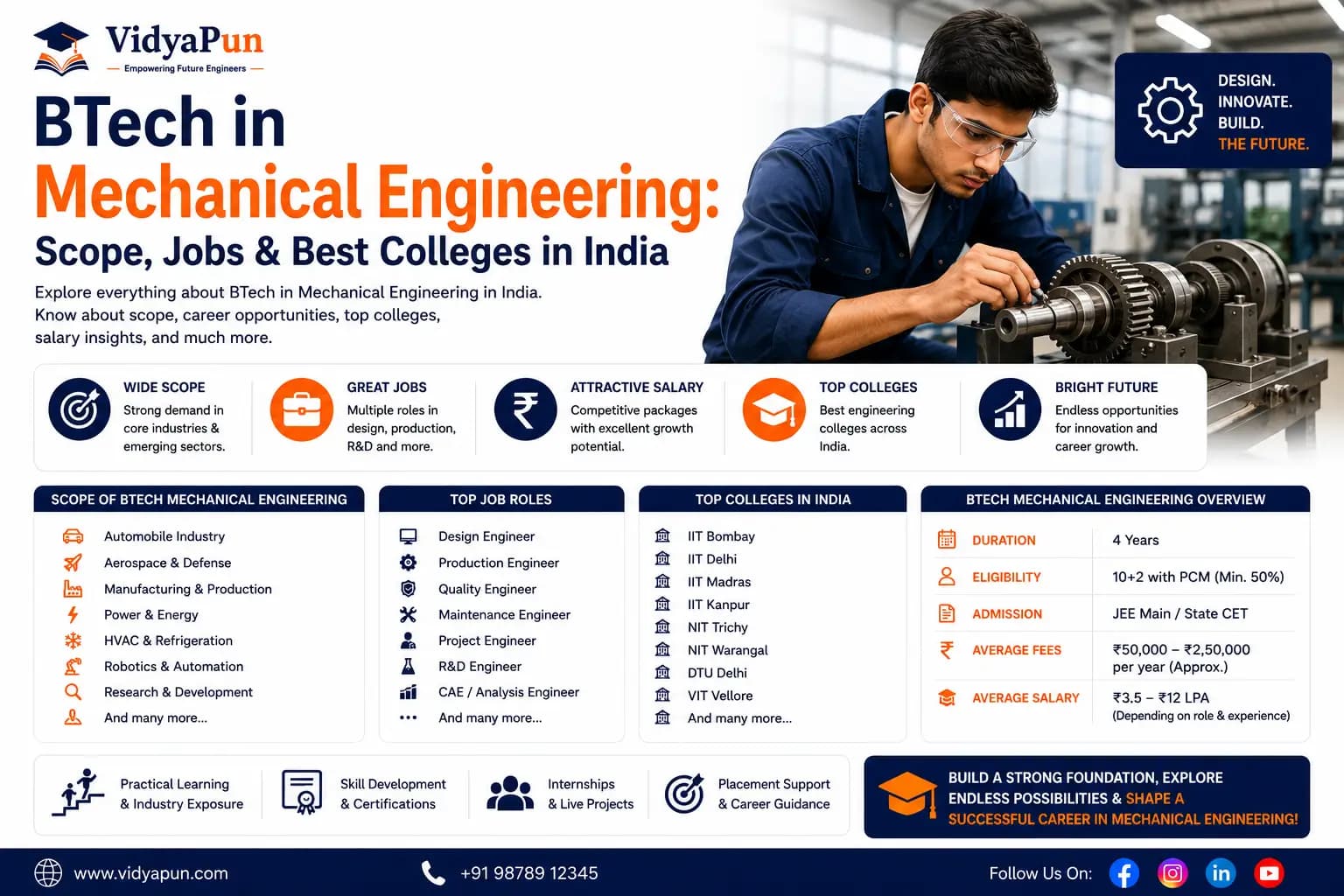
If you've ever taken apart something just to see how it works — a toy, a bicycle, maybe your dad's old radio — there's a decent chance mechanical engineering is meant for you.
But curiosity alone doesn't make a career decision. You need real answers. What does a BTech in Mechanical Engineering actually offer in 2026? Is the scope still strong or is it fading? What do top companies pay freshers? And which colleges are genuinely worth your four years?
This guide answers all of that — honestly, without the marketing fluff you'll find on most college websites.
What Is BTech in Mechanical Engineering?
A BTech in Mechanical Engineering is a four-year undergraduate degree that deals with the design, analysis, manufacturing, and maintenance of mechanical systems. It's one of the broadest engineering branches — covering everything from thermodynamics and fluid mechanics to robotics, CAD design, and production engineering.
Mechanical engineering is often called the "mother of all engineering branches" because its fundamentals touch almost every other discipline. Whether it's aerospace, automotive, energy, defence, or manufacturing — mechanical engineers are at the core of it.
In India, it remains one of the most popular BTech branches — and for good reason. The country's manufacturing sector, backed by initiatives like Make in India, PLI schemes, and a booming EV and defence industry, continues to create strong demand for skilled mechanical engineers.
BTech Mechanical Engineering Syllabus: What You'll Study
The four-year curriculum is structured to build you from the ground up — from basic physics to advanced machine design and simulation.
First & Second Year (Foundation Subjects):
- Engineering Mathematics (Calculus, Linear Algebra, Differential Equations)
- Engineering Physics and Chemistry
- Engineering Drawing and Graphics
- Basic Mechanical Engineering
- Material Science and Metallurgy
- Thermodynamics
Third & Fourth Year (Core + Electives):
- Fluid Mechanics and Machinery
- Heat Transfer
- Theory of Machines and Mechanisms
- Machine Design
- Manufacturing Processes and Technology
- Industrial Engineering and Management
- Finite Element Analysis (FEA)
- Robotics and Automation
- CAD/CAM (Computer-Aided Design and Manufacturing)
- Automobile Engineering / Aerospace Engineering (electives)
What makes mechanical engineering interesting — and a little demanding — is its mix of theoretical depth and hands-on application. You're not just solving equations on paper. You're designing components, running simulations, and understanding why things fail or succeed in real-world conditions.
Top BTech Mechanical Engineering Colleges in India
Not all colleges are equal — and in mechanical engineering, infrastructure really matters. Labs, machine shops, simulation software licenses, and industry projects make a tangible difference in how prepared you are when you graduate.
Tier 1: IITs and NITs
| College | Location | Known Strength |
|---|---|---|
| IIT Madras | Chennai, Tamil Nadu | Research, Automotive, Aerospace |
| IIT Bombay | Mumbai, Maharashtra | Design, Manufacturing, Robotics |
| IIT Delhi | New Delhi | Product Design, Automation |
| IIT Kharagpur | West Bengal | Oldest IIT; strong industry tie-ups |
| NIT Trichy | Tamil Nadu | Consistent placements, strong alumni |
| NIT Warangal | Telangana | Manufacturing, Core Engineering |
| NIT Surathkal | Karnataka | Strong in South India |
| MNIT Jaipur | Rajasthan | Good for North India aspirants |
IITs admit through JEE Advanced, NITs through JEE Main. Both are fiercely competitive — but the payoff in terms of placements and exposure is real.
Tier 2: Deemed and Private Universities
- BITS Pilani — Excellent for those who prefer a more flexible curriculum via BITSAT
- VIT Vellore — Strong placement cell; popular among mechanical engineering aspirants
- Manipal Institute of Technology — Good infrastructure, consistent placement record
- Thapar Institute of Engineering & Technology — Strong in Punjab; good industry connects
- SRM Institute of Science and Technology — Large campus, active placement activity
Tier 3: State Government Colleges
State-affiliated mechanical engineering colleges under universities like AKTU (UP), RGPV (MP), JNTU (Telangana/AP), Mumbai University, Anna University vary widely in quality. Before choosing, check placement records, faculty qualifications, and lab infrastructure — not just fees.
One honest note: A BTech in Mechanical Engineering from a tier-3 college is still valuable — but you'll need to supplement it more actively with internships, certifications, and projects to compete with tier-1 graduates.
BTech Mechanical Engineering Admission Process in India
Admissions happen primarily through national and state entrance exams:
- JEE Main → NITs, IIITs, GFTIs, and many state/private colleges
- JEE Advanced → All IITs
- BITSAT → BITS Pilani (Pilani, Goa, Hyderabad campuses)
- State CETs → MHT CET, AP EAPCET, TS EAMCET, UPCET, KCET, GUJCET
- University-level exams → VITEEE (VIT), SRMJEEE (SRM), MET (Manipal)
Eligibility: 10+2 with Physics, Chemistry, and Mathematics. Minimum 75% aggregate (65% for SC/ST) for NITs/IITs.
Many private colleges also offer management quota seats, though those typically come at a higher fee.
Scope of BTech Mechanical Engineering in India (2026 and Beyond)
Here's a question worth asking directly: Is mechanical engineering still relevant in 2026?
The answer is yes — but it's evolving. The scope of mechanical engineering has shifted. Traditional core manufacturing jobs are still very much there, but the biggest opportunities now sit at the intersection of mechanical engineering and modern technology.
Where the scope is growing:
Electric Vehicles (EV): India's EV market is exploding. Tata Motors, Mahindra Electric, Ola Electric, Ather Energy — all need mechanical engineers for chassis design, battery packaging, thermal management, and NVH (noise, vibration, harshness) engineering.
Aerospace and Defence: With ISRO, HAL, BEL, and India's growing private aerospace sector (Skyroot, Agnikul), mechanical engineers are in demand for structural design, propulsion, and manufacturing.
Renewable Energy: Wind turbine design, solar mounting systems, and energy storage infrastructure all need mechanical engineering expertise.
Robotics and Automation: Industry 4.0 is real. Smart factories, cobots (collaborative robots), and automated assembly lines need engineers who understand both mechanics and control systems.
Oil & Gas and Core Manufacturing: ONGC, L&T, Tata Steel, JSW, and hundreds of MSME manufacturers continue to hire mechanical engineers for operations, maintenance, and project engineering roles.
The scope isn't narrow — it's actually one of the widest of any engineering branch. The key is figuring out which direction you want to take it.
BTech Mechanical Engineering Career Options and Job Roles
After completing your BTech in Mechanical Engineering, here are the primary career paths available:
Core Engineering Roles
Design Engineer: Work on product and component design using CAD tools like SolidWorks, CATIA, or AutoCAD. Industries include automotive, consumer products, industrial machinery, and aerospace.
Production/Manufacturing Engineer: Oversee manufacturing processes, ensure quality standards, manage shop floor operations. Roles available in auto ancillaries, heavy engineering, and FMCG companies.
Thermal/HVAC Engineer: Work on heating, ventilation, air conditioning systems or thermal management in industrial settings. Good demand in construction, data centres, and process industries.
Maintenance Engineer: Responsible for the upkeep and reliability of industrial machinery. Power plants, refineries, and manufacturing plants are major employers.
Project Engineer: Manage engineering projects end-to-end — timelines, vendors, technical specifications. L&T, Tata Projects, and infrastructure companies hire heavily for this role.
High-Growth Modern Roles
- EV Powertrain and Chassis Engineer (Tata Motors, Mahindra, Ola Electric)
- Simulation / FEA Engineer (Ansys, Altair, Dassault Systèmes clients)
- Robotics and Automation Engineer (Fanuc, KUKA, ABB)
- R&D Engineer (in DRDO, ISRO, BARC, or private R&D labs)
Non-Core Career Options
A significant number of mechanical engineering graduates move into:
- IT and software roles (especially if they build coding skills during BTech)
- Management consulting (MBA route post-BTech)
- Government services via GATE (PSU jobs), IES/ESE, or SSC JE
- Entrepreneurship — many mechanical engineers go on to start manufacturing businesses, especially in the MSME sector
BTech Mechanical Engineering Salary in India: Real Numbers
Let's skip the vague "3 to 25 LPA" range you see everywhere and break it down properly.
Fresher Salary (0–2 Years)
| Sector | Average Starting Salary (Per Annum) |
|---|---|
| Core Manufacturing (Private) | ₹3 – ₹5.5 LPA |
| Automotive (Tier-1 Companies) | ₹4 – ₹7 LPA |
| EV Startups | ₹5 – ₹9 LPA |
| PSU via GATE (BHEL, ONGC, etc.) | ₹8 – ₹12 LPA |
| IT/Software (Non-Core) | ₹3.5 – ₹7 LPA |
| IIT/NIT Top Campus Placements | ₹15 – ₹50 LPA (select offers) |
| Aerospace / Defence R&D | ₹6 – ₹10 LPA |
Mid-Level Salary (4–8 Years Experience)
Mechanical engineers with solid domain experience — especially in EV, simulation, or automation — can expect ₹12 – ₹22 LPA. Senior engineers and project managers in heavy industries often cross ₹25 LPA within 7–8 years.
Government Sector Salaries
PSU jobs through GATE (BHEL, NTPC, ONGC, IOCL, SAIL) offer CTC between ₹9 – ₹14 LPA plus perks like housing, medical, and pension benefits. The IES/ESE route leads to Group A engineering services under the Central Government — prestigious and financially stable.
Higher Studies After BTech Mechanical Engineering
If you want to deepen your expertise or change direction, here are your options:
MTech via GATE: Specialise in Thermal Engineering, Machine Design, Production Engineering, or Robotics at IITs, NITs, or IISc. GATE score also unlocks PSU direct recruitment.
MS Abroad: Mechanical Engineering is widely accepted at top universities in the USA (MIT, Stanford, Georgia Tech), Germany (TU Munich, RWTH Aachen), and Canada. Specialisations in automotive, aerospace, and robotics are particularly popular.
MBA: A mechanical engineering background combined with an MBA from IIMs or top B-schools is excellent for roles in operations management, supply chain, and manufacturing strategy.
M.Des (Industrial/Product Design): If design thinking excites you more than core engineering, pursuing M.Des from NID, IDC IIT Bombay, or similar institutes is a natural progression.
Is BTech in Mechanical Engineering Worth It in 2026?
Here's the straight answer: yes — if you're genuinely interested in how things are designed, built, and made to work.
The biggest mistake students make with mechanical engineering is expecting the degree to automatically open doors without building relevant skills. It won't. A BTech in Mechanical Engineering gives you a powerful foundation — but what you do on top of that foundation (internships, software skills like CAD/FEA, domain projects, GATE preparation) determines where you end up.
The students thriving in this field are those who treated their BTech as a starting point, not a finish line. They picked a domain early, went deep on it, and built real projects that demonstrated their capabilities.
That's the honest picture.
Frequently Asked Questions (FAQs)
Q1. What is the scope of BTech Mechanical Engineering in India after 2026?
The scope remains strong and is actively expanding in new domains — EV technology, aerospace, robotics, renewable energy, and smart manufacturing. Traditional manufacturing roles are also stable. The key is aligning your specialisation with where the industry is heading.
Q2. Which is better — BTech Mechanical Engineering or Civil Engineering?
Both are solid choices but serve different career paths. Mechanical is better for manufacturing, automotive, aerospace, and R&D roles. Civil is more suited for construction, infrastructure, and real estate projects. Choose based on your interests, not just job market trends.
Q3. Can a mechanical engineering graduate get into software companies?
Yes. Many IT companies recruit mechanical engineering graduates through campus placements. However, you'll need to build programming skills (Python, C++, MATLAB) alongside your degree to remain competitive in software roles.
Q4. Is GATE compulsory for a good career in Mechanical Engineering?
GATE is not mandatory but strongly recommended if you're targeting PSU jobs, MTech from IITs/NITs, or research positions. For private sector roles, a strong portfolio, internships, and relevant software skills matter more.
Q5. What software skills are most important for mechanical engineering jobs?
The most in-demand tools are: SolidWorks / CATIA / AutoCAD (design roles), ANSYS / Abaqus (simulation and FEA), MATLAB (analysis and control systems), Mastercam / NX (manufacturing/CNC), and Python (for data-driven engineering and automation). Start learning at least one CAD and one simulation tool during your BTech itself.
Q6. What are the best government jobs for BTech Mechanical Engineering graduates?
Top options include: PSU jobs via GATE (BHEL, ONGC, NTPC, SAIL, IOCL), Indian Engineering Services (IES/ESE) via UPSC, SSC Junior Engineer (JE), and state PWD/electricity board recruitment. These offer job security, structured growth, and strong benefits.
Q7. How is the placement record for mechanical engineering in tier-2 colleges?
It varies significantly. Core mechanical placements from tier-2 colleges typically range between ₹3.5 – ₹6 LPA. IT sector placements can be higher if the college has a strong relationship with service companies. Research the specific college's placement data — not the university average.
Wrapping Up
A BTech in Mechanical Engineering remains one of the most versatile and future-ready degrees you can pursue in India. The field is no longer limited to factories and workshops — it spans electric vehicles, aerospace, smart manufacturing, renewable energy, and robotics.
The scope is wide. The career paths are many. The salaries are competitive — especially when you build the right skills and choose your domain with intention.
What separates a mechanical engineer who earns ₹4 LPA from one who earns ₹18 LPA five years down the line isn't always the college — it's the clarity of direction, the depth of skills, and the quality of experience they brought to the table.
Thinking about pursuing BTech in Mechanical Engineering — or trying to figure out which college to pick?
Don't rely on rankings alone. Talk to current students and recent alumni of the colleges you're considering. Ask them about lab quality, faculty engagement, internship support, and where their batch actually got placed — not just the highest package on the brochure.
That one conversation could save you four years of regret — or confirm that you've found exactly the right place.
Website: www.vidyapun.com
Call / WhatsApp: +91 96438 02216