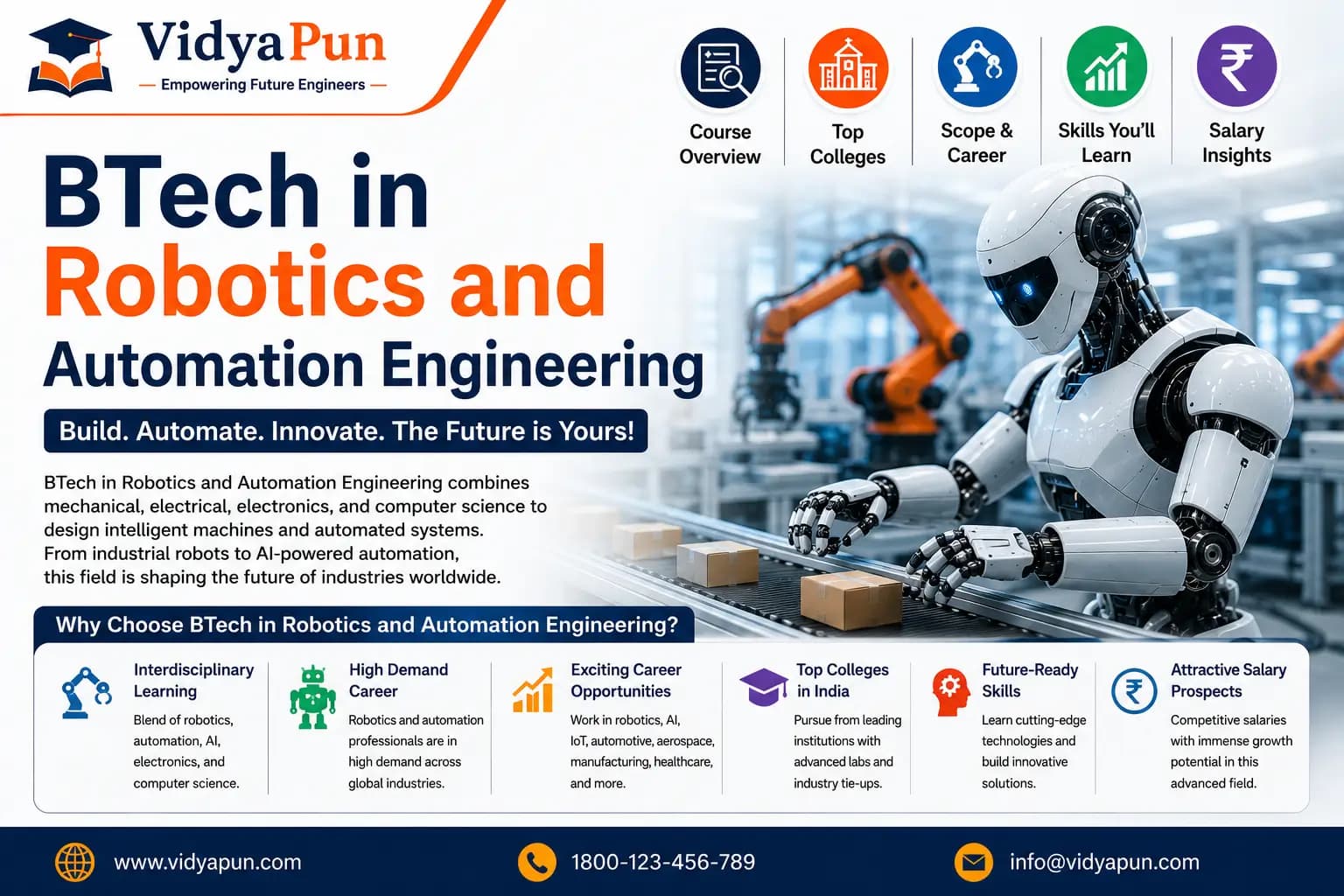
Walk into any modern car factory, warehouse, or even a hospital operation theatre today, and chances are a robot is doing part of the work. That shift isn't slowing down — if anything, it's accelerating faster than most people realise. Which is exactly why a growing number of students are now asking a very practical question: is BTech in Robotics and Automation Engineering actually worth it after 12th?
The honest answer is — for the right kind of student, absolutely yes. But like any specialized engineering branch, it helps to understand what you're signing up for before you commit four years to it.
This guide walks through what the course really involves, the genuine scope after BTech in robotics and automation, expected salary in this field, and how it stacks up against more traditional branches like mechanical or computer science engineering.
What Is BTech in Robotics and Automation Engineering?
BTech in Robotics and Automation Engineering is a four-year undergraduate program that blends mechanical engineering, electronics, and computer science into one specialized stream. Instead of studying these subjects separately, you learn how they come together to design, build, and program machines that can sense their environment and perform tasks with little or no human involvement.
The curriculum usually covers areas like robotic kinematics, control systems, sensors and actuators, machine vision, embedded systems, and industrial automation. Many colleges have also started adding modules on AI-based robotics and collaborative robots (often called "cobots") since these are becoming standard in modern factories.
Eligibility is fairly standard: a pass in 12th grade with Physics, Chemistry, and Mathematics, followed by admission through JEE Main, state-level engineering entrance exams, or a university's own entrance test. A few private universities also allow direct admission based on 12th-grade marks.
Why Robotics and Automation Is Becoming a High-Demand Field
A lot of people still picture robotics as something futuristic and distant, but the truth is it's already deeply embedded in everyday industry. The demand isn't coming from one single source — it's being pulled from multiple directions at once.
Manufacturing units across automotive, electronics, and FMCG sectors are automating repetitive tasks to cut costs and reduce human error. Warehouses and logistics companies, especially with the e-commerce boom, now rely heavily on automated sorting and material-handling systems. Even agriculture is slowly adopting robotic equipment for tasks like precision farming and crop monitoring.
A few concrete reasons this field keeps growing:
- Labour shortages in manufacturing are pushing companies toward automation faster than expected
- Indian government initiatives like "Make in India" and PLI schemes are encouraging local manufacturing, which in turn needs automated production lines
- Healthcare is increasingly using robotic systems for surgeries, rehabilitation, and hospital logistics
- Rising labour costs make automation a long-term cost-saving investment for businesses
In short, almost every industry that builds, moves, or assembles physical products eventually needs people who understand robotics and automation — which is what makes the scope after BTech in this field feel so broad compared to many narrower specializations.
Career Scope After BTech in Robotics and Automation Engineering
One of the underrated advantages of this degree is that it doesn't box you into a single job type. Because the curriculum touches mechanical design, electronics, and programming all at once, graduates often have the flexibility to move between hardware-focused and software-focused roles. Here are some common paths:
Robotics Engineer — Designs, builds, and tests robotic systems for industrial or research applications. Usually the most direct job title for fresh graduates.
Automation Engineer — Focuses on designing and maintaining automated production lines, often in manufacturing plants or process industries.
Control Systems Engineer — Works on the software and hardware that allows machines to respond accurately to sensor input, a role that blends electronics with programming.
Robotics Process Automation (RPA) Developer — A slightly different, software-heavy path that involves automating repetitive digital business tasks rather than physical machines, popular in IT and finance companies.
Research and Development Engineer — Works on next-generation robotics, often in collaboration with universities or innovation labs at larger companies.
Field Service Engineer — Installs, maintains, and troubleshoots robotic systems on-site for clients, a role with good entry-level demand across manufacturing hubs.
There's also rising demand in newer niches like agricultural robotics, medical robotics, and warehouse automation — areas that barely had dedicated job postings a few years ago and are now actively hiring fresh engineering talent.
Robotics Engineer Salary in India: What to Realistically Expect
Numbers always help bring clarity, so here's a general breakdown of salary after BTech in robotics and automation engineering based on current industry trends.
| Experience Level | Approximate Annual Salary (INR) |
|---|---|
| Fresher (0–1 year) | ₹3 – 5.5 LPA |
| Early career (2–4 years) | ₹5.5 – 10 LPA |
| Mid-level (5–8 years) | ₹10 – 18 LPA |
| Senior / Lead roles | ₹18 – 30+ LPA |
These numbers shift quite a bit depending on the company and city. Automotive hubs like Pune, Chennai, and parts of Gujarat tend to offer strong entry-level packages because of the concentration of manufacturing plants. Engineers who pick up additional skills in PLC programming, robotic simulation software, or industrial IoT often see faster salary growth, since these are the specific tools companies look for during hiring.
It's also worth mentioning that robotics and automation rewards practical exposure more than most other engineering branches. A student who's done a solid internship at a manufacturing plant or built a working robotics project often stands out more during placements than one who's only studied the theory.
Top Colleges for BTech in Robotics and Automation Engineering in India
Picking the right college matters less for the brand name on your degree and more for the lab equipment, faculty industry experience, and internship tie-ups specific to robotics. A few well-regarded options currently offering this specialization include:
- Vellore Institute of Technology (VIT) — Known for strong robotics labs and active student robotics clubs
- SRM Institute of Science and Technology — Offers dedicated automation labs with decent industry partnerships
- Amrita Vishwa Vidyapeetham — Recognized for hands-on robotics research and student project culture
- Manipal Institute of Technology — Good infrastructure and consistent placement record in core engineering roles
- PSG College of Technology, Coimbatore — Strong reputation specifically within manufacturing and automation circles
- Karunya Institute of Technology and Sciences — Offers focused robotics and automation programs with practical lab work
Before settling on any college, it's worth checking three things: whether the syllabus includes hands-on robotics simulation software rather than just textbook theory, whether they have tie-ups with manufacturing companies for internships, and how many students from the robotics-specific batch actually landed core robotics or automation roles, rather than generic IT placements, in recent years.
BTech in Robotics vs Mechanical Engineering: Which Should You Choose?
This is a common dilemma, and the right choice really depends on what you enjoy more.
A traditional Mechanical Engineering degree gives you a broad foundation across thermodynamics, manufacturing, and design — robotics might just be one elective among many. A BTech in Robotics and Automation, on the other hand, dives deep into automation, control systems, and intelligent machines from the very first year.
If you already know you're drawn to building things that sense, think, and respond — rather than purely static mechanical design — the specialized degree gives you a head start with structured lab access that's harder to replicate through electives alone. That said, a mechanical engineering degree combined with robotics certifications later can still lead to similar roles, just with a slightly longer learning curve.
Skills That Matter Beyond the Classroom
A degree alone rarely seals the deal in this field — companies hiring robotics and automation engineers usually want to see applied skill, not just academic scores. A few things worth building during college:
- Hands-on practice with robotic simulation tools like RoboDK, ROS (Robot Operating System), or MATLAB/Simulink
- Basic programming comfort in Python or C++, since most modern robotics relies on code-driven control
- Exposure to PLC programming, which is still the backbone of most industrial automation setups
- Participation in robotics competitions or student clubs, which often double up as strong resume points during placements
Industries Actively Hiring Robotics and Automation Graduates
This field isn't limited to one type of company. A wide spread of industries now maintain dedicated automation or robotics teams.
Automotive Manufacturing — Still the largest employer for this branch, given how heavily car and component manufacturing relies on robotic assembly lines.
Electronics and Semiconductor Manufacturing — Precision assembly work in this sector depends almost entirely on automated and robotic systems.
Logistics and Warehousing — E-commerce growth has pushed companies to invest heavily in automated sorting, picking, and packing systems.
Healthcare and Medical Devices — Surgical robots, rehabilitation devices, and hospital automation are growing niches with steady hiring.
Agriculture Technology — Precision farming equipment and autonomous machinery are creating fresh demand for robotics-trained engineers in a sector that didn't traditionally need them.
This spread matters because it gives graduates a safety net. If hiring slows in automotive one year, logistics or healthcare automation might still be actively recruiting, which keeps career options reasonably stable compared to narrower, single-industry specializations.
Frequently Asked Questions
1. Is BTech in Robotics and Automation Engineering a good career choice in 2026? Yes. With manufacturing, logistics, and healthcare all investing heavily in automation, demand for trained robotics engineers continues to grow steadily across India.
2. What is the average salary after BTech in robotics and automation for freshers? Most freshers can expect somewhere between ₹3 LPA and ₹5.5 LPA, though candidates with strong internships or certifications in robotics simulation tools often land higher offers.
3. Is robotics and automation engineering better than mechanical engineering? Neither is strictly "better" — it depends on your interest. Robotics offers deeper, focused exposure to automation and intelligent systems, while mechanical engineering provides a broader core foundation.
4. Do I need coding skills for a robotics engineering career? Basic programming knowledge in Python or C++ is very helpful, especially for roles involving robot control systems, though it's not as code-heavy as a pure software engineering career.
5. Which industries hire the most robotics and automation graduates? Automotive manufacturing, electronics assembly, logistics, and increasingly healthcare and agriculture technology are the biggest current recruiters.
6. Are there government job opportunities after this degree? Yes, public sector manufacturing units, defense research organizations, and certain PSUs do hire automation and robotics engineers, typically through specific recruitment exams or drives.
Final Thoughts
Robotics and automation engineering sits at an interesting intersection — it's hands-on enough to satisfy people who like building physical things, yet technical enough to keep things intellectually engaging year after year. The scope is genuinely wide, salaries are climbing as automation adoption increases, and the skills you build rarely go out of date, since most industries are only just getting started with this shift.
If you're still comparing colleges, weighing this against mechanical or computer science engineering, or just want help figuring out which specialization fits your interests best, feel free to reach out — happy to help you map out a path that actually makes sense for your goals, not just the most popular choice on paper.
Website: www.vidyapun.com
Call / WhatsApp: +91 96438 02216