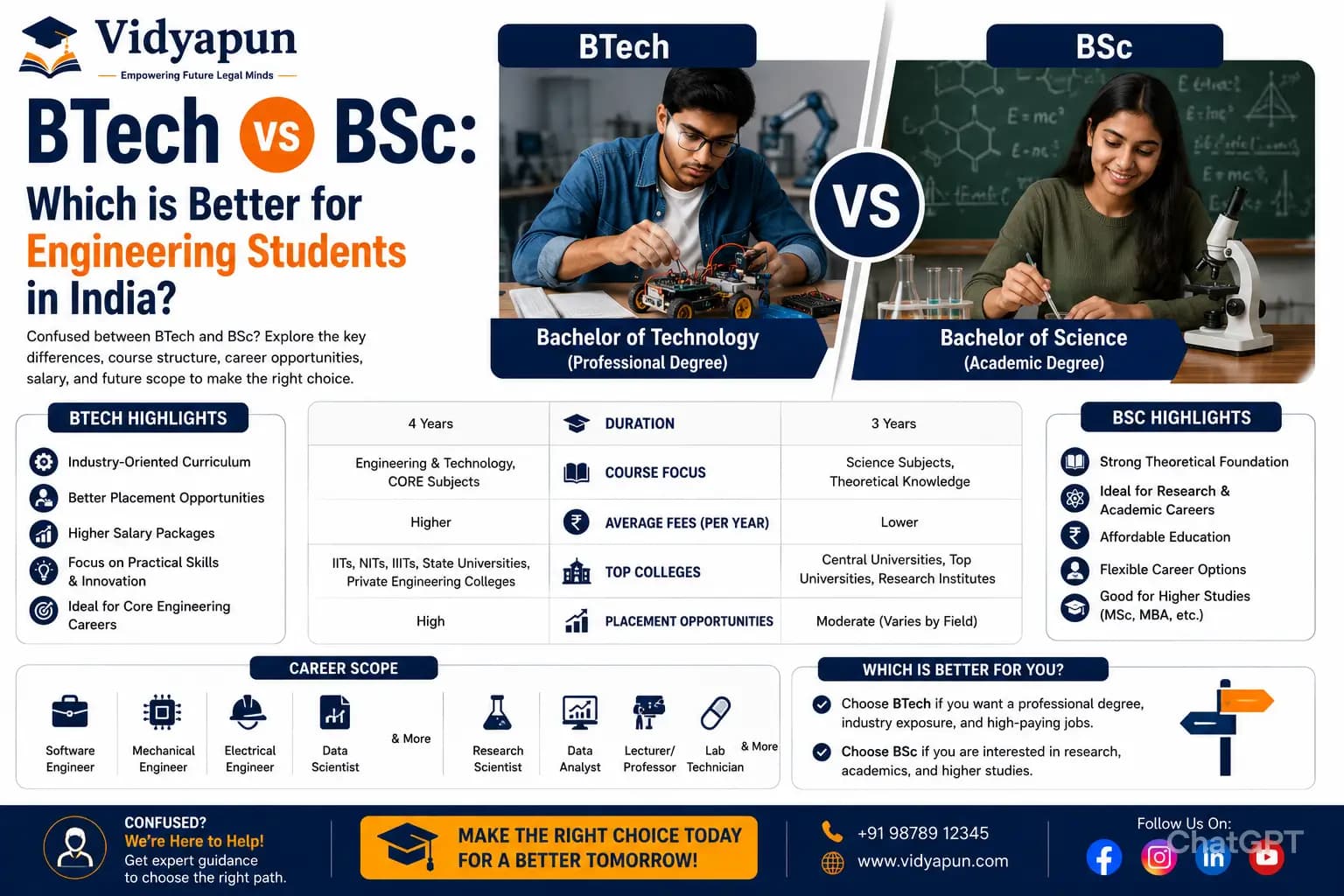
Every year, thousands of Class 12 students sit with their PCM marksheets in hand, staring at two paths that look similar on the surface but lead to very different places — BTech and BSc. Both are 3–4 year undergraduate programs. Both involve science. Both can lead to solid careers.
But they are NOT the same. And choosing the wrong one — simply because someone in your family said "do engineering" or a friend picked BSc because of lower fees — can cost you years of frustration.
So let's settle this properly. BTech vs BSc: which is actually better for engineering students in India, and more importantly, which one is better for you?
First, Let's Understand What Each Degree Actually Is
What is a BTech Degree?
BTech stands for Bachelor of Technology. It's a 4-year undergraduate engineering program approved by AICTE and offered by universities and deemed institutions across India. The curriculum is heavily application-oriented — you'll spend a significant portion of your time in labs, working on projects, doing internships, and learning how theoretical concepts translate into real-world systems.
BTech programs are structured to produce industry-ready engineers. The focus is on doing — designing, building, testing, troubleshooting.
What is a BSc Degree?
BSc stands for Bachelor of Science. It's typically a 3-year undergraduate science degree (some universities now offer a 4-year BSc with research options). The curriculum leans towards theory, fundamental sciences, and analytical thinking. You can pursue BSc in Physics, Mathematics, Computer Science, Electronics, Chemistry, and many other disciplines.
BSc programs are designed to build deep conceptual understanding. The focus is on knowing — theories, principles, and the science behind why things work.
BTech vs BSc: The Core Differences at a Glance
| Factor | BTech | BSc |
|---|---|---|
| Duration | 4 years | 3 years (4 years with research) |
| Focus | Applied/practical engineering | Theoretical/foundational science |
| Admission | JEE Main, state CETs, COMEDK, etc. | Class 12 merit or university entrance |
| Average Fees | ₹1.5 lakh – ₹15 lakh (total) | ₹30,000 – ₹3 lakh (total) |
| Approved by | AICTE | UGC |
| Career Path | Engineering, IT, PSU jobs, product companies | Research, teaching, MSc, civil services |
| Lateral Entry | Available (diploma holders) | Not common |
| Govt Job Eligibility | SSC JE, GATE, PSUs | GATE (some streams), civil services, teaching |
BTech vs BSc: Fees Comparison in India 2026
This is where most families make their first decision — often incorrectly.
BTech Fees:
- Government NITs/IITs: ₹80,000 – ₹2,50,000 per year
- State government engineering colleges: ₹30,000 – ₹80,000 per year
- Private engineering colleges: ₹1,00,000 – ₹4,00,000 per year
BSc Fees:
- Government colleges/central universities: ₹5,000 – ₹30,000 per year
- State universities: ₹10,000 – ₹50,000 per year
- Private universities: ₹40,000 – ₹1,50,000 per year
On paper, BSc is significantly cheaper. But here's the thing — if you're comparing a BSc from a regular state university with a BTech from a good government NIT or state engineering college, the return on investment for the BTech often works out far better over a 5–10 year career horizon.
The fee comparison only makes sense when you factor in what comes after graduation.
Career Scope: BTech vs BSc After Graduation
After BTech
A BTech degree opens direct doors to:
- Campus placements through college TPO (Training & Placement Officers)
- IT companies like TCS, Infosys, Wipro, Accenture, and product companies like Google, Microsoft, Amazon (for top rankers)
- Core engineering roles in manufacturing, civil, electrical, automotive, aerospace
- PSU recruitment through GATE — BHEL, ONGC, NTPC, IOCL, Power Grid
- Government jobs via SSC JE, RRB JE for diploma + BTech holders
- Higher studies — MTech, MBA, MS abroad
The average starting salary for BTech graduates from decent colleges in India in 2026 ranges between ₹3.5 LPA to ₹8 LPA. From NITs and IITs, it shoots significantly higher.
After BSc
A BSc degree opens doors to:
- MSc programs at top central universities, IITs (JAM), and IISc
- Research careers — CSIR labs, DRDO, ISRO (scientist positions after MSc/PhD)
- Teaching — after completing B.Ed or qualifying UGC NET
- Civil services — BSc graduates are eligible for UPSC, state PCS exams
- IT sector — BSc Computer Science graduates are increasingly hired by IT companies, though slightly fewer opportunities compared to BTech CSE
The starting salary for BSc graduates in India is generally lower — ₹2 LPA to ₹4.5 LPA for fresh graduates — unless they've pursued a specialized stream like Computer Science or pursued MSc from a reputed institution.
The GATE Factor — Does It Change the Equation?
GATE (Graduate Aptitude Test in Engineering) is one exam that bridges the BTech-BSc divide significantly. Both BTech and BSc graduates (in relevant science streams) can appear for GATE.
Clearing GATE with a good score opens up:
- MTech admissions at IITs, NITs, and central universities (often with stipend)
- PSU recruitment — dozens of top PSUs shortlist candidates based on GATE scores
- Research positions at IISc, CSIR labs, BARC
If your long-term goal involves research, PSUs, or MTech from IITs — both BTech and BSc can lead you there through GATE. The difference is in how you get there and what happens in the years before you crack it.
BTech vs BSc for Computer Science Students
This is the most common comparison parents and students ask about in 2026 — and for good reason. Both BTech CSE and BSc Computer Science are available everywhere, and the difference in fees is substantial.
Here's the honest take:
BTech CSE — Better for students who want direct industry placements, product-based company roles, and structured campus recruitment. The curriculum includes more engineering-focused subjects like Data Structures, Algorithms, OS, DBMS, Networks — exactly what software companies test in interviews.
BSc Computer Science — Better for students who want to understand computing deeply, pursue MSc or research, or get into government tech roles. Many BSc CS graduates also land IT jobs, but campus placement infrastructure at BSc colleges is typically weaker.
One thing that matters more than your degree in CS? Your skills. In 2026, a BSc CS graduate who has strong coding skills, a good GitHub profile, and relevant internships will consistently outperform a BTech CSE graduate from a mediocre college with no practical exposure.
Which is Better for Government Jobs in India?
Let's address this directly because it matters a lot for students from tier-2 and tier-3 cities.
BTech advantages for government jobs:
- SSC JE (Junior Engineer) — Eligible
- RRB JE — Eligible
- GATE PSU recruitment — Eligible
- State-level Junior Engineer exams — Eligible
- Defence technical roles (Indian Army, Navy, Air Force technical branch) — BTech often preferred
BSc advantages for government jobs:
- UPSC Civil Services — Both eligible, but BSc students often pursue this path more actively
- UGC NET — For teaching and research fellowships
- CSIR NET — For science research positions
- State PSC exams — Both eligible
If your primary goal is a government engineering job (SSC JE, RRB, PWD, PSU), BTech is the more direct route. If your goal is research, teaching, or civil services, BSc is equally valid — sometimes even more appropriate.
Honest Situations Where BSc Makes More Sense Than BTech
We'll be straight here — BSc is the smarter choice in these specific scenarios:
1. Your JEE rank isn't good enough for a decent government engineering college. Joining a low-ranked private BTech college for ₹8–12 lakh total fees when you could do BSc from a central university for ₹1–2 lakh total and then crack JAM for IIT MSc — is often the better financial and career decision.
2. You're genuinely interested in pure science research. If Physics, Mathematics, or Chemistry is your real passion and research excites you — BSc followed by MSc and PhD is the legitimate path. Forcing yourself into an engineering degree won't serve you well.
3. You want to prepare for UPSC or state civil services. Many serious civil services aspirants deliberately choose BSc because it leaves more mental bandwidth for exam preparation compared to the demanding BTech curriculum.
4. Cost is a real constraint. A BSc from a good university followed by an MSc from an IIT via JAM is a genuinely competitive and career-worthy path that costs a fraction of a private BTech.
Honest Situations Where BTech Makes More Sense Than BSc
1. You want direct campus placements and corporate jobs. BTech colleges — especially those with NAAC/NBA accreditation and active placement cells — offer structured corporate recruitment that BSc colleges rarely match.
2. You're targeting core engineering roles. Civil, Mechanical, Electrical, Chemical — these industries look specifically for BTech degrees. A BSc Physics graduate cannot apply for most core engineering vacancies.
3. You have a decent JEE/CET rank and can access a good government engineering college. In this case, don't choose BSc for cost reasons — a government BTech college at ₹50,000/year is excellent value.
4. You want to pursue MTech without taking the JAM route. BTech graduates can directly appear for GATE and pursue MTech. BSc graduates need to pursue MSc first in most cases before accessing engineering postgraduate programs.
What About IIT BSc Programs?
IISc Bangalore and several IITs now offer BS (Bachelor of Science) 4-year research programs that are arguably more prestigious than BTech degrees from average private colleges. IISc's BS Research program, IIT Bombay's BS programs, and similar offerings are highly competitive and produce outstanding research-oriented graduates.
If you can get into one of these — that's a completely different conversation from a regular BSc at a state university.
Frequently Asked Questions (FAQs)
Q1. Is BTech better than BSc for getting a job in India?
For direct corporate placements and industry jobs — yes, BTech typically has a stronger track record because of structured campus recruitment. However, BSc Computer Science graduates with strong coding skills are increasingly hired by IT companies, and BSc followed by MSc from IIT can lead to excellent opportunities.
Q2. Can a BSc student do MTech directly?
Not directly in most cases. BSc graduates typically need to complete an MSc first, then appear for GATE to pursue MTech. Some universities offer integrated MSc-PhD or allow direct PhD entry after MSc. BTech graduates can appear for GATE directly after their degree.
Q3. Which is better — BSc Computer Science or BTech CSE?
BTech CSE has stronger campus placement infrastructure. BSc CS costs significantly less and can lead to similar outcomes if the student builds strong programming skills and pursues MSc from a good institution. For product companies, BTech CSE from a ranked college is generally preferred.
Q4. Is BSc Physics good for engineering students?
BSc Physics is a solid foundation for students interested in research, GATE (Physics), CSIR NET, or transitioning into engineering through MSc programs. It's not a direct substitute for BTech for those targeting engineering industry jobs.
Q5. What is the salary difference between BTech and BSc graduates?
On average, fresh BTech graduates earn ₹3.5–8 LPA while fresh BSc graduates earn ₹2–4.5 LPA. However, after MSc from a top institution, BSc graduates can match or exceed BTech salary levels — especially in research, analytics, and data science roles.
Q6. Which degree is better for UPSC preparation — BTech or BSc?
Both are valid for UPSC Civil Services eligibility. However, BSc is often considered more manageable alongside serious UPSC preparation because the degree workload and exam stress is typically lower than BTech. Many successful IAS officers have BSc backgrounds.
Q7. Can BTech students appear for CSIR NET?
Generally no — CSIR NET is designed for MSc-level science graduates. BTech graduates can appear for GATE but not CSIR NET in most science disciplines. However, BTech graduates with specific science backgrounds may be eligible for some CSIR NET papers depending on subject.
The Bottom Line — Stop Comparing, Start Deciding
Here's the truth no one tells you when you're 17 and staring at admission forms: there's no universally better degree between BTech and BSc. There's only the better degree for your specific goals, financial situation, academic strengths, and career vision.
If you want to work in core engineering, get campus-placed in IT companies, or join PSUs through GATE — BTech is your path, preferably from a government or well-ranked accredited college.
If you're genuinely science-oriented, cost-conscious, targeting research, or planning for civil services — BSc followed by a strong MSc is a completely legitimate and often underrated path in India.
What you should absolutely avoid: joining a mediocre private BTech college for ₹10+ lakhs just because "everyone does engineering," when a good BSc + MSc route would serve your goals better at a third of the cost.
Ready to Make Your Decision?
Before you fill out any application form, do these three things:
👉 Write down your actual career goal — not what sounds impressive, but what you genuinely want to be doing at 28. That goal should drive your degree choice, not the other way around.
👉 Check NIRF rankings and NAAC accreditation of any BTech college you're considering. If it's a private college outside the top 200 NIRF, run the numbers honestly before committing.
👉 Explore BSc programs at central universities and state universities — DU, BHU, Hyderabad University, Jadavpur — these are seriously underrated options that punch well above their fee tag.
Still confused between BTech and BSc? Drop your specific situation in the comments below — stream, budget, career goal, and city — and we'll help you figure out the smarter choice. No generic advice, just practical guidance.
Your degree is a tool. Choose the one that builds what you actually want to build.
Website: www.vidyapun.com
Call / WhatsApp: +91 96438 02216