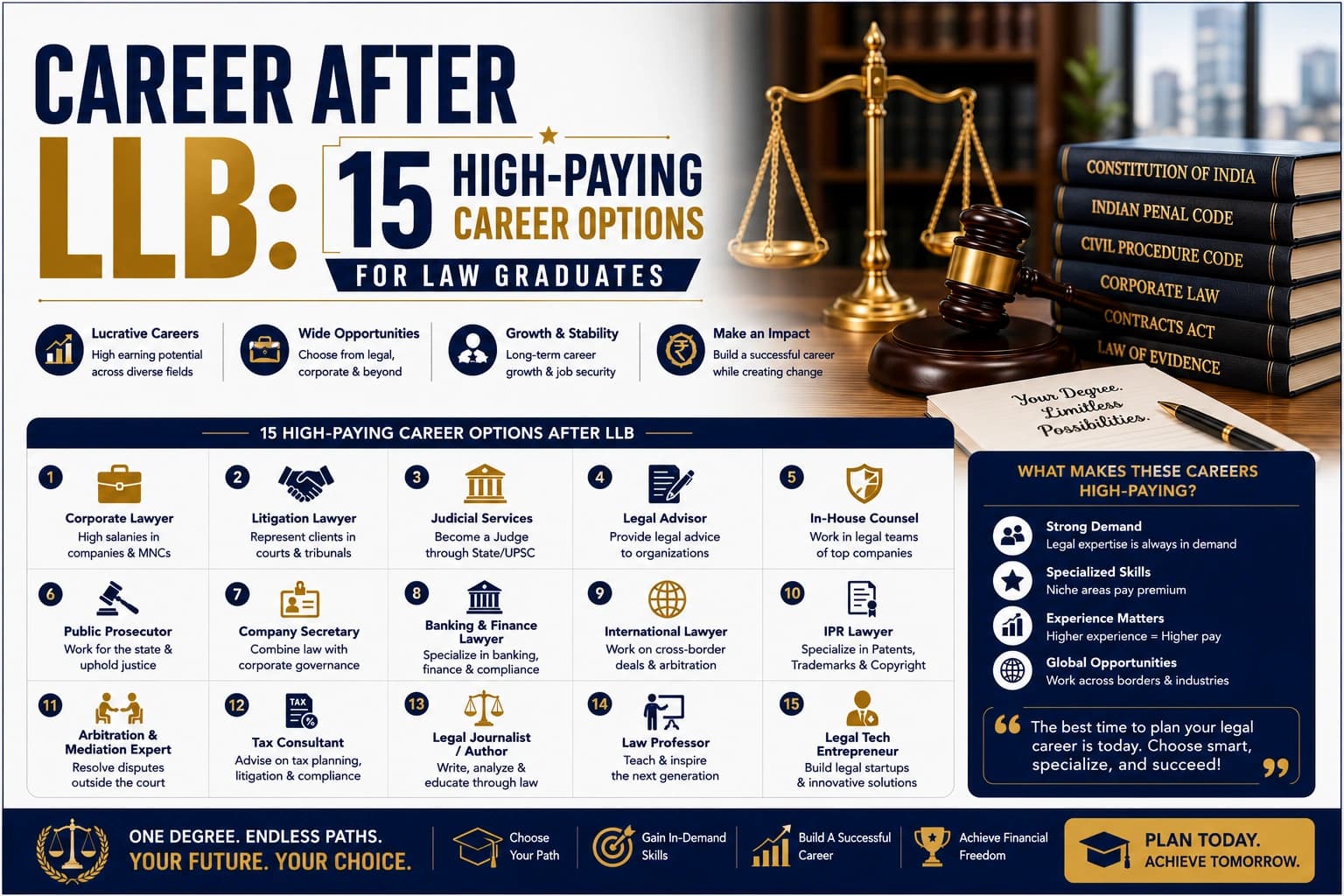
One of the biggest misconceptions about a Bachelor of Laws (LLB) is that it leads to exactly one career: courtroom litigation. In reality, an LLB opens up a genuinely wide range of paths — some inside a courtroom, many outside it entirely. This guide walks through 15 real, high-paying career options after LLB, grouped by the kind of work and lifestyle each one involves.
Career After LLB: What Determines Your Best-Fit Path
Before picking a direction, it helps to think about three things: whether you want to practice law directly or use your legal training in a different role, whether you prefer the private or public sector, and how much risk versus stability you're comfortable with early in your career. Keep these in mind as you go through the options below.
Litigation Practice Careers
For those drawn to courtroom work and client advocacy, litigation remains a foundational — and often highest-ceiling — career path.
Independent Litigation Practice
Building an independent practice under a senior advocate before eventually taking on your own clients is the traditional litigation route, with income that starts modest but can grow substantially as you build a reputation and client base.
Arbitration and Mediation Practice
As commercial disputes increasingly move toward alternative dispute resolution, arbitration and mediation practice has become a genuinely lucrative specialisation for lawyers who want courtroom-adjacent work with often shorter case timelines.
Corporate Law Careers
Corporate law is the most commonly chosen private-sector path for LLB graduates seeking strong starting compensation.
Corporate Law Firm Associate
Joining a corporate law firm as an associate gives you exposure to transactional work like mergers, contracts, and compliance, typically with a structured, if demanding, path toward seniority.
In-House Counsel
Moving in-house at a company — often after a few years at a law firm — trades some of the top-end compensation for more predictable hours and closer involvement in one organisation's business decisions.
Judiciary and Government Legal Careers
For those who value stability and public service, government legal roles remain a strong option.
Judicial Services (Civil Judge)
Clearing the judicial services exam and becoming a civil judge offers long-term career stability, a respected public role, and a clear promotion structure through the judiciary.
Government Legal Advisor or Public Prosecutor
Roles as a government legal advisor or public prosecutor combine courtroom work with public-sector job security, and are typically accessed through state or central government recruitment exams.
Non-Practicing Legal Careers
You don't have to appear in court — or even draft contracts — to build a strong career with an LLB.
Compliance Officer
Compliance roles, especially in banking, finance, and pharmaceuticals, are growing steadily as regulatory scrutiny increases, and they draw directly on legal training without requiring courtroom practice.
Legal Process Outsourcing (LPO) Analyst
LPO roles — supporting international law firms and companies with research, document review, and contract analysis — offer a structured, often remote-friendly entry point into the legal industry.
Emerging and Specialised Legal Fields
Newer areas of law are creating career paths that simply didn't exist a decade ago.
Intellectual Property (IP) Lawyer
IP law — covering patents, trademarks, and copyrights — has grown alongside India's startup and tech sector, and specialists in this field are increasingly sought after by both law firms and in-house teams.
Cyber Law Specialist
As data protection regulation expands, cyber law specialists who understand both the legal and technical sides of digital compliance are becoming one of the fastest-growing niches in the profession.
Alternative and Cross-Industry Careers
An LLB is also a strong foundation for careers that sit outside traditional legal practice altogether.
Legal Journalism
Legal journalism — covering court judgments, policy changes, and the legal industry itself — suits graduates who enjoy writing and want to stay close to the law without practicing it directly. Legal academia and teaching is a related path for those drawn to research and mentoring the next generation of law students.
Civil Services with a Law Background
A law degree pairs well with civil services preparation, since much of the exam's legal and constitutional-affairs content overlaps directly with LLB coursework.
Higher Studies and Global Careers After LLB
For graduates who want to specialise further or work internationally, higher studies often open the door.
LLM and Higher Studies
Pursuing an LLM — in India or abroad — lets you specialise in a high-growth area like corporate law, IP, or cyber law, and often meaningfully improves your starting compensation and career options afterward.
International Law Careers Abroad
With the right additional qualifications (often an LLM plus a local bar qualification), Indian law graduates can build careers with international law firms, multinational companies, or global organisations abroad.
Final Thoughts
An LLB genuinely doesn't lock you into one path — litigation, corporate law, government service, compliance, emerging tech-law fields, and even non-legal-adjacent careers like journalism or civil services are all realistic options. The right choice comes down to whether you want courtroom work or not, how you feel about public versus private sector stability, and where your specific interests lie. The earlier you start exploring these paths through internships and informational conversations, the more informed your final decision will be.
Still deciding which career path — and which LLB college — fits you best? Talk to Admission Expert for personalised guidance.
Frequently Asked Questions
Q1. What are the best career options after completing an LLB?
A: Litigation, corporate law (firm or in-house), judicial services, compliance, intellectual property law, cyber law, legal journalism, and higher studies (LLM) are among the strongest and most common options.
Q2. Is litigation a good career choice after LLB?
A: Yes, for those who enjoy courtroom advocacy — litigation income starts modest but can grow substantially over time as you build a reputation and independent client base.
Q3. Can I have a legal career after LLB without practicing in court?
A: Absolutely. Compliance, legal process outsourcing, in-house counsel roles, legal journalism, and legal academia are all strong career paths that don't require courtroom practice.
Q4. Which pays more after LLB — corporate law or litigation?
A: Corporate law generally offers a higher and more predictable starting salary, while litigation income is more variable early on but can eventually be very high for established, senior practitioners.
Q5. Are government legal jobs a good option after LLB?
A: Yes — judicial services, public prosecutor roles, and government legal advisor positions offer strong job security and a clear, structured career progression through public-sector recruitment exams.
Q6. Should I pursue an LLM after my LLB?
A: If you want to specialise in a high-growth area like corporate law, IP, or cyber law, or aim for international opportunities, an LLM can meaningfully improve your career options and starting compensation.
Q7. What are some emerging career fields for LLB graduates?
A: Intellectual property law and cyber law are two of the fastest-growing specialisations, driven by India's expanding startup, tech, and data-protection landscape.
Q8. Can I use my LLB for a non-legal career like civil services?
A: Yes — a law degree pairs particularly well with civil services preparation, since constitutional and legal-affairs content overlaps significantly with LLB coursework.
🌐 Website: www.vidyapun.com 📞 Call / WhatsApp: +91 96438 02216