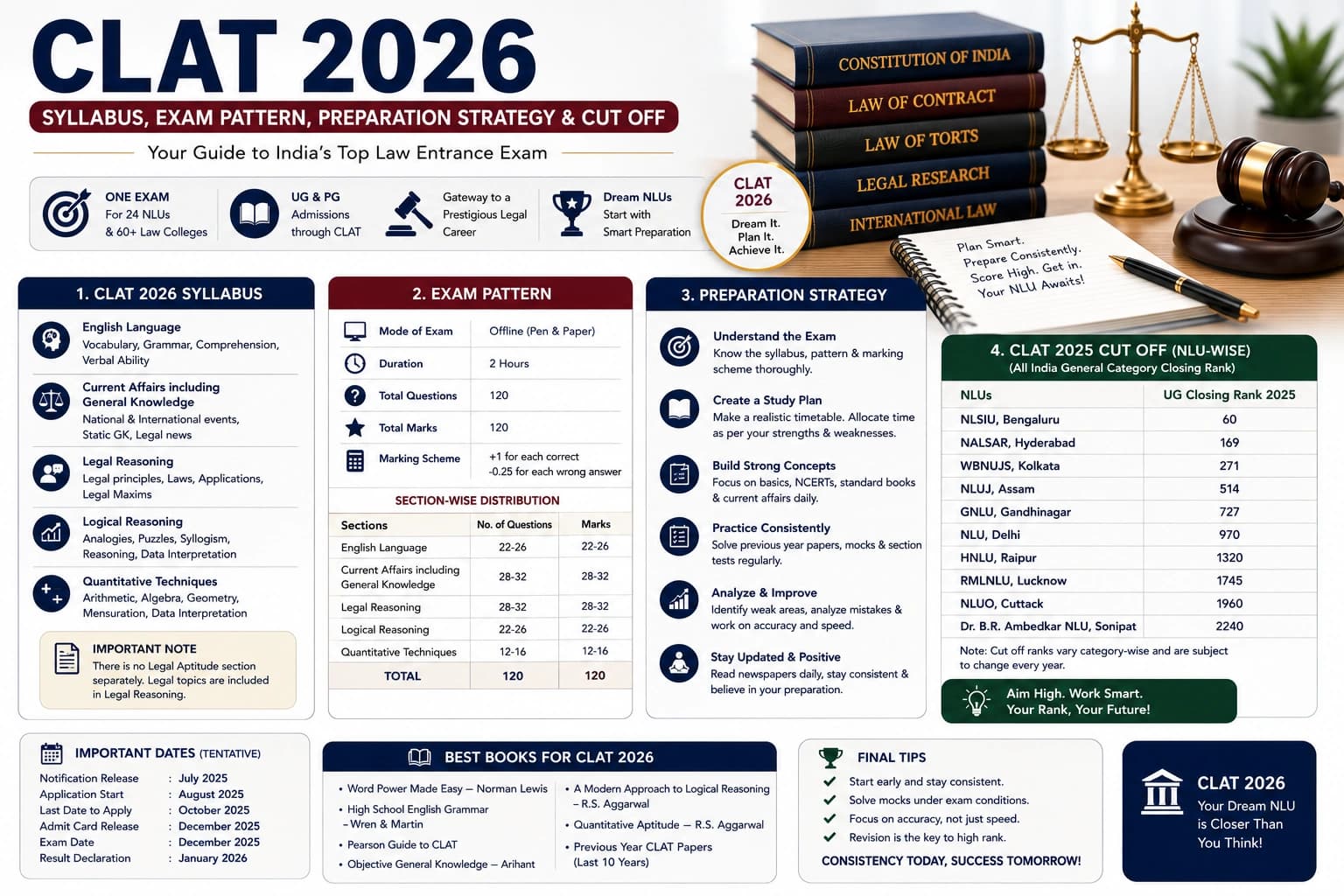
CLAT 2026 was held on December 7, 2025, with results announced later that month and counseling rounds running into early 2026. If you're reading this now, the 2026 cycle itself has concluded — but the syllabus, exam pattern, and cut-off trends barely shift year to year, which makes this a genuinely useful reference whether you're reviewing what happened in 2026 or actively preparing for the next edition of CLAT.
CLAT 2026 Exam Pattern: The Basics
CLAT is conducted by the Consortium of National Law Universities for admission to 5-year integrated LLB programs (and LLM programs, under a separate paper) across the NLU network. The exam format has stayed consistent for a few years now:
- Total questions: 120, all multiple choice
- Duration: 2 hours, single shift, pen-and-paper mode
- Marking: +1 for each correct answer, -0.25 for each incorrect one
- No negative marking for unattempted questions
Why the Format Matters More Than It Looks
CLAT isn't testing isolated facts — nearly every section is built around reading passages, some running 400-450 words. This means raw subject knowledge only gets you partway; reading speed and the ability to extract the relevant detail under time pressure matter just as much.
CLAT Syllabus: Section by Section
CLAT UG covers five sections. Here's the breakdown and approximate weightage:
English Language (roughly 20% weightage)
- Comprehension passages testing inference, tone, and main idea
- Grammar and vocabulary in context
- Synonyms and antonyms embedded within passages
Current Affairs Including General Knowledge (roughly 25% weightage)
- Significant national and international events from the past 12 months
- Arts, culture, and international affairs
- Historical events with continuing relevance today
Legal Reasoning (roughly 25% weightage)
- Legal principles applied to a given set of facts
- General legal awareness and legal current affairs
- No prior formal legal knowledge required — the passage typically gives you the principle to apply
Logical Reasoning (roughly 20% weightage)
- Critical reasoning, arguments, and assumptions
- Logical sequences and puzzles
- Analogies and pattern-based questions
Quantitative Techniques (roughly 10% weightage)
- Basic arithmetic up to Class 10 level
- Ratios, proportions, and basic algebra
- Data interpretation from short data sets, charts, and graphs
CLAT 2026 Cut-Off Trends
Because CLAT 2026 has already concluded, actual cut-off data is available and worth studying even if you're preparing for a future cycle — it tells you what competitive ranks actually looked like.
- Total NLU seats across the network stayed at roughly 3,700, spread over 24 participating NLUs
- Competition at the very top tier (NLSIU Bangalore, NALSAR Hyderabad, and similar) remained intense, with closing ranks for the top few institutions typically falling within the first few hundred ranks for the general category
- Cut-offs are released round-by-round during counseling, not as one final number — so your realistic target rank should be checked against the specific round and NLU you're aiming for
- Category-wise cut-offs (OBC, SC, ST, EWS) and domicile-based reservations at several NLUs mean the "cut-off" is really a set of different numbers depending on your category and home state
Important: cut-offs shift every year based on difficulty level and number of applicants — treat any specific rank figure you see (including from this article) as a reference point for trend analysis, not a guarantee for a future cycle. Always cross-check current-year figures against the Consortium of NLUs' official portal.
How to Prepare for CLAT: A Practical Strategy
Start With Reading, Not Rules
Since nearly every section is passage-based, daily reading practice (editorials, long-form articles, legal news) does more for your score than memorizing grammar rules in isolation.
Build Legal Reasoning Without a Law Background
You don't need to know actual law to do well in Legal Reasoning — the passage usually states the legal principle, and the question tests whether you can apply it correctly to the given facts. Practice is about pattern recognition, not legal knowledge.
Treat Current Affairs as a Running Habit, Not a Cram Subject
Because this section covers roughly the past year's events, cramming in the final month rarely works well. A daily or weekly current affairs habit, sustained over several months, performs far better than a last-minute push.
Don't Neglect Quantitative Techniques Just Because It's 10%
A weak Quant section can quietly cost you a rank band, especially since fewer students prepare seriously for it — meaning the questions you get right there can meaningfully separate you from the pack.
Use Full-Length Mock Tests Under Real Time Pressure
Reading calmly at home is nothing like decoding a dense passage in under two minutes with the clock running. Strict-timing mocks, taken regularly in your final few months, are non-negotiable.
Revise With Previous Year Papers, Not Just Notes
Previous year CLAT papers show you exactly how principles get tested in practice — often more useful in the final revision phase than reading fresh material.
Common Preparation Mistakes to Avoid
- Ignoring negative marking math — a few wild guesses can cost a full mark, sometimes the exact margin between two rank bands
- Treating Current Affairs as pure memorization instead of reading-and-retention practice
- Skipping timed mocks until the final month, then being surprised by the reading pressure
- Assuming a single sectional weakness (often Quant) won't matter because it's a small percentage of the paper
- Relying only on notes without working through previous year papers and full mocks
Frequently Asked Questions
1. What is the CLAT 2026 exam pattern? 120 multiple-choice questions across five sections, in a single 2-hour pen-and-paper shift, with +1 for correct answers and -0.25 for incorrect ones.
2. How many questions are in each CLAT section? Weightage is roughly English 20%, Current Affairs & GK 25%, Legal Reasoning 25%, Logical Reasoning 20%, and Quantitative Techniques 10%, though exact question counts can vary slightly year to year.
3. Is prior legal knowledge required for the Legal Reasoning section? No. The passage typically provides the legal principle; the question tests whether you can apply it correctly to the facts given.
4. What is a good CLAT score for a top NLU? This varies by year and NLU, but as a general reference, scores well above the exam's midpoint have historically been needed for the top few institutions — always check the current year's official cut-off rather than relying on a past figure.
5. Can I prepare for CLAT without coaching? Yes, many aspirants prepare successfully through self-study, previous year papers, and disciplined mock test practice — coaching can help with structure and peer benchmarking, but isn't a strict requirement.
6. How is the CLAT cut-off decided? It emerges from the counseling process itself, based on the number of applicants, seat availability at each NLU, and category-wise reservations — it isn't a fixed number announced in advance.
7. Does CLAT have negative marking for unattempted questions? No. Negative marking of -0.25 applies only to incorrect answers; leaving a question blank doesn't cost you marks.
8. How far in advance should I start CLAT preparation? Most successful candidates prepare over several months to a year, particularly because Current Affairs and reading speed both improve gradually rather than through last-minute cramming.
Related Reading
Deciding between CLAT and its counterpart? See our CLAT vs AILET Comparison Guide. For broader admission planning, explore the LLB Course page, Law Admission, and Best Colleges in India.
🌐 Website: www.vidyapun.com 📞 Call / WhatsApp: +91 96438 02216