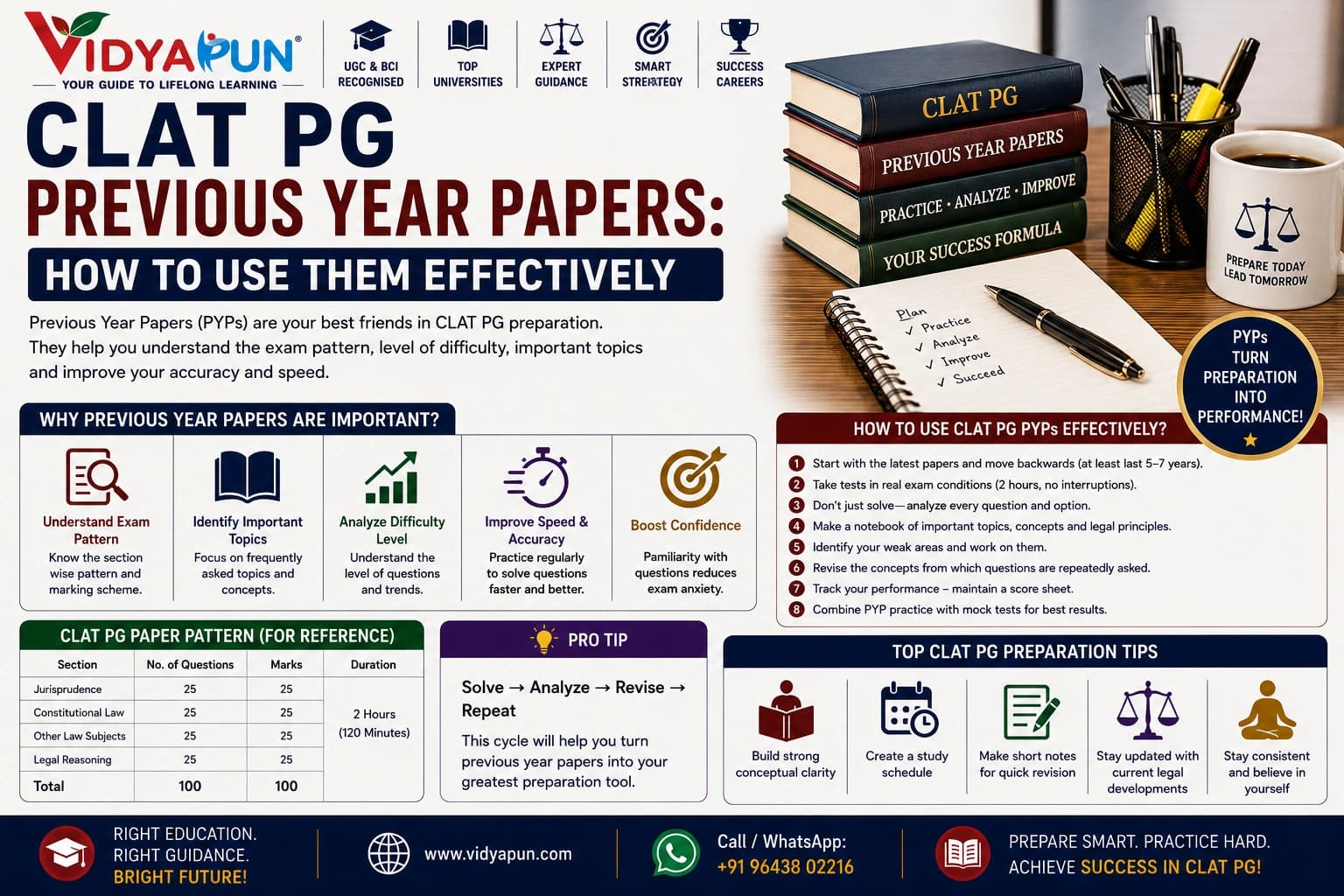
Most CLAT PG aspirants know they should practice with previous year papers, but far fewer use them in a way that actually improves their score. Simply attempting old papers and checking answers afterward captures only a fraction of the value these papers can offer if used more deliberately.
This guide covers where to find genuine previous year papers, how to actually analyze your performance on them, and a practical step-by-step approach to using them throughout your preparation.
Why Previous Year Papers Matter for CLAT PG Preparation
Understanding why these papers are uniquely valuable helps justify building your preparation around them.
What They Reveal About Actual Difficulty
Previous year papers show you the real difficulty level, question style, and time pressure of the actual exam — something generic practice material, however well-designed, can only approximate rather than replicate exactly.
Why Generic Prep Material Isn't Enough
Generic question banks are useful for building foundational knowledge, but they don't reflect the specific phrasing patterns, passage style, or reasoning structure that CLAT PG's actual question setters use, which is exactly what previous papers let you study directly.
Where to Find Genuine, Official Previous Year Papers
Not all "previous year paper" resources online are equally reliable.
Official CLAT Consortium Sources
Always prioritize papers sourced directly from the official CLAT Consortium website or verified official communications, since these guarantee authenticity and accuracy of both questions and answer keys.
Being Cautious of Unverified Third-Party Sources
Many third-party websites republish previous papers with transcription errors, incorrect answer keys, or outdated formats. Cross-check any third-party source against the official version where possible, since practicing with incorrect answer keys can actively reinforce wrong understanding.
Understanding the CLAT PG Exam Pattern Through Past Papers
Past papers are also one of your most reliable sources for understanding the exam's actual structure.
Recurring Subject Areas
Reviewing multiple years of papers helps you identify which subject areas (constitutional law, jurisprudence, and other core LLB subjects) appear consistently, giving you a genuine sense of where to concentrate your revision effort.
How Question Style Has Evolved
Exam patterns can shift somewhat from year to year — always confirm the current year's official syllabus and pattern from the CLAT Consortium directly, using past papers to understand general question style rather than assuming this year's exam will be identical to previous ones.
Step 1: Take a Diagnostic Test Under Real Conditions
Your first attempt at a previous paper should function as an honest baseline, not just practice.
Simulating Actual Exam Timing
Attempt your first previous year paper under strict, timed conditions matching the actual exam as closely as possible, rather than working through it casually — this gives you an honest baseline rather than an inflated sense of readiness.
Honestly Assessing Your Starting Point
Resist the temptation to look up answers or extend time mid-test. An honest diagnostic result, even if disappointing, is far more useful for planning your preparation than a flattering but inaccurate one.
Step 2: Analyze Your Mistakes Systematically
This is the step most students skip, and it's where the real value of previous papers lies.
Categorizing Errors by Type
For every wrong answer, categorize the mistake — was it a genuine knowledge gap, a misread question, poor time management, or a careless error? This categorization reveals patterns a simple score alone doesn't show you.
Identifying Recurring Weak Areas
Track which subject areas or question types you consistently get wrong across multiple papers, rather than treating each paper as an isolated event. Recurring patterns point directly to where your revision time is best spent.
Step 3: Build a Targeted Revision Plan Around Gaps
Use your error analysis to make your remaining preparation time genuinely efficient.
Prioritizing High-Frequency Topics
Focus your revision disproportionately on topics that both appear frequently across previous papers and represent your identified weak areas — this combination should drive most of your remaining preparation time.
Balancing Strengths and Weaknesses
While weak areas deserve extra attention, don't neglect maintaining your existing strengths through periodic review — a balanced approach outperforms one that over-corrects entirely toward weaknesses at the expense of everything else.
Step 4: Do Timed, Repeated Practice Closer to the Exam
As your exam date approaches, shift toward full-length, repeated practice under realistic conditions.
Simulating Full-Length Tests
In the final weeks before your exam, prioritize complete, timed attempts at previous papers over topic-by-topic study, since building stamina and pacing for the full exam duration is itself a skill worth practicing directly.
Tracking Improvement Over Time
Keep a simple record of your scores and error patterns across multiple attempts, so you can objectively see whether your preparation strategy is actually working, rather than relying on a subjective sense of improvement.
Common Mistakes When Using Previous Papers
Passive Review Without Active Analysis
The single biggest mistake is treating previous papers as a passive activity — attempting them and briefly checking answers, without the deeper error analysis covered in Step 2. This passive approach captures only a fraction of what structured, analytical practice can offer.
Frequently Asked Questions
1. Where can I find genuine CLAT PG previous year papers?
Prioritize the official CLAT Consortium website or verified official communications, and cross-check any third-party source against the official version to avoid transcription errors or incorrect answer keys.
2. How many previous year papers should I practice before the exam?
There's no fixed number, but working through several years' worth, combined with genuine error analysis after each attempt, tends to be more valuable than rushing through many papers superficially.
3. Should I time myself while practicing previous papers?
Yes, especially as your exam date approaches — simulating actual exam timing builds pacing skills that are just as important as subject knowledge.
4. What should I do after completing a previous year paper?
Systematically analyze your mistakes by category (knowledge gap, misread question, time management, careless error) rather than just checking your score, since this analysis reveals patterns a simple score doesn't show.
5. Does the CLAT PG exam pattern change from year to year?
It can shift somewhat, so always confirm the current year's official syllabus and pattern directly from the CLAT Consortium rather than assuming it exactly mirrors previous years.
6. Is practicing only previous papers enough for CLAT PG preparation?
Not entirely — previous papers are most effective when combined with genuine subject revision and error-driven study, rather than used as your sole preparation method.
Ready to structure your CLAT PG preparation? Review full details on the Master of Laws (LLM) page, check Career After LLM to keep your bigger goals in view, or revisit your Bachelor of Laws (LLB) or BA LLB Course foundation.
Download our LLM Entrance Exam Prep Brochure or talk to an admission expert:
🌐 Website: www.vidyapun.com 📞 Call / WhatsApp: +91 96438 02216