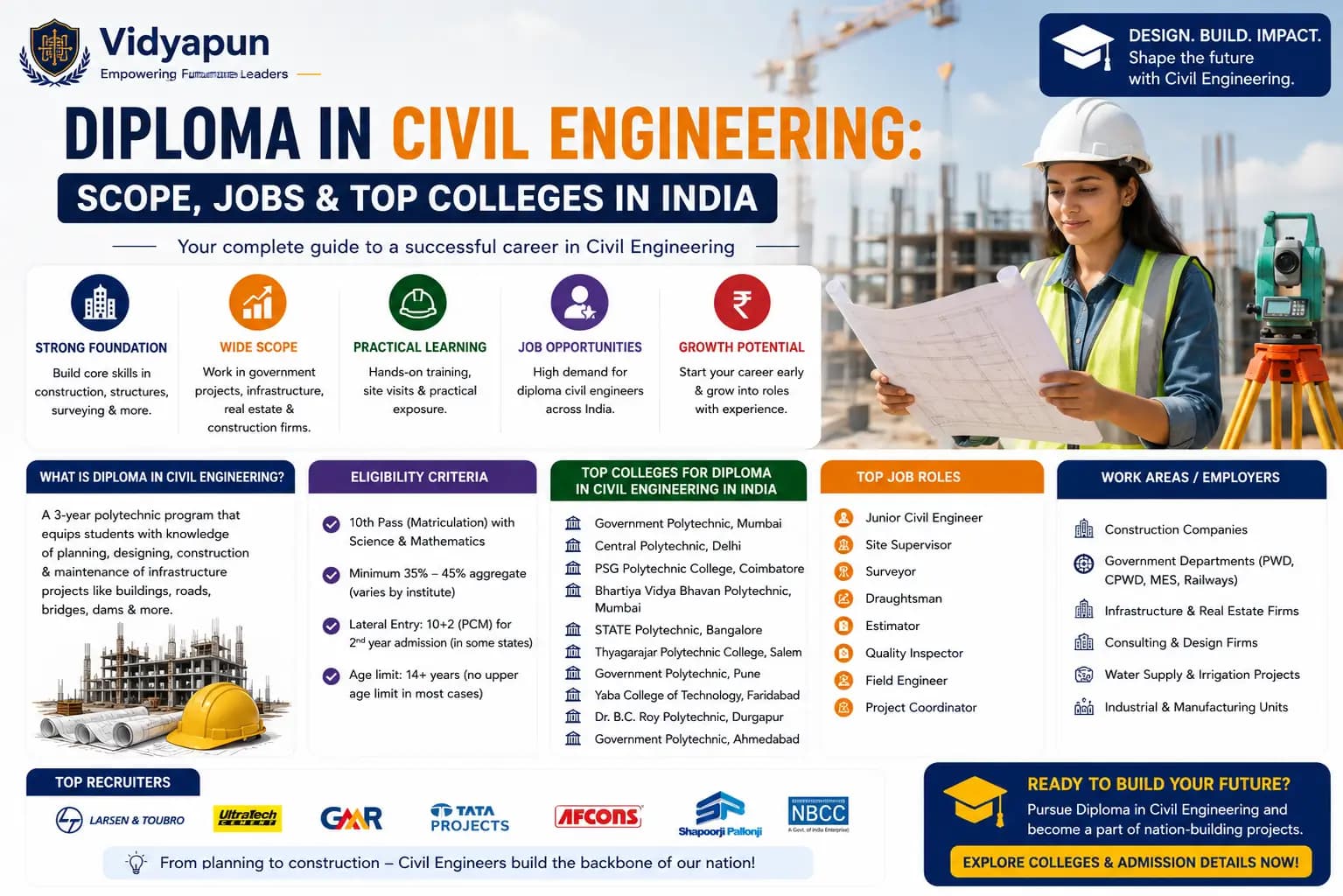
India is building at a pace never seen before. Metro rail networks, national highways, smart cities, flyovers, bridges, dams — everywhere you look, civil engineering is the backbone. And right behind every big infrastructure project, there's a large workforce of skilled, diploma-level civil engineers making it happen on the ground.
If you've just finished your Class 10 or 12 and you're wondering whether a Diploma in Civil Engineering is worth your time and money — this guide is written exactly for you. We'll break down everything: what the course covers, what the career scope actually looks like in the kind of jobs available, salary expectations, and the top colleges in India where you can pursue this diploma.
Let's get into it.
What Is a Diploma in Civil Engineering?
A Diploma in Civil Engineering is a 3-year polytechnic program (typically after Class 10) that trains students in the core principles of construction, structural design, surveying, materials, and project management. Some states also offer a 2-year lateral entry program for students who've completed Class 12 with science.
This is not a degree program — but don't let that mislead you. A civil engineering diploma is a government-recognized technical qualification that opens doors to both employment and higher education. Thousands of students across India choose polytechnic diplomas specifically because they offer hands-on skills at an affordable cost, in a shorter timeframe than a full B.Tech degree.
Key Subjects Covered in the Course
The curriculum varies slightly across states, but most diploma programs in civil engineering cover:
- Engineering Drawing and AutoCAD – Technical drafting and computer-aided design
- Building Materials and Construction Technology – Concrete, bricks, steel, timber
- Surveying and Levelling – Land measurement and mapping techniques
- Structural Engineering Basics – Load analysis, beams, columns, and foundations
- Soil Mechanics and Foundation Engineering – Ground behavior and stability
- Hydraulics and Water Supply Engineering – Fluid mechanics, drainage systems
- Road and Transportation Engineering – Highway design and traffic systems
- Estimation, Costing, and Valuation – Project cost calculation and reporting
- Environmental Engineering – Waste management, water treatment
- Construction Project Management – Timelines, labor management, quality control
The course balances theory with practical lab sessions and field visits, which is one reason employers appreciate diploma holders — they can often be deployed on-site with minimal additional training.
Eligibility Criteria
The minimum eligibility for a Diploma in Civil Engineering is passing Class 10 (SSC/Matriculation) with Mathematics and Science as compulsory subjects. A minimum aggregate of 35% to 50% is generally required, depending on the state board and college.
For lateral entry (direct admission to the second year), students need a Class 12 pass with Physics, Chemistry, and Mathematics, or an ITI certificate in a related trade.
Scope of Diploma in Civil Engineering in India
This is the question most students — and their parents — ask first. And the honest answer is: the scope is genuinely strong, and it's growing.
India's infrastructure spending has surged significantly in recent budgets. The government's focus on roads, railways, affordable housing (Pradhan Mantri Awas Yojana), smart cities, metro expansion, and rural infrastructure means there is consistent demand for trained civil engineering professionals at every level — including diploma holders.
Scope in Government Sector
Government departments and public sector units hire diploma civil engineers through competitive exams and direct recruitment at the Junior Engineer (JE) level. The scope here is stable, with job security and pension benefits.
Key hiring bodies include:
- Public Works Department (PWD) – State-level
- Central Public Works Department (CPWD)
- National Highways Authority of India (NHAI)
- Railways (Indian Railways / RailTel)
- Military Engineering Services (MES)
- State Electricity Boards and Water Supply Boards
- Municipal Corporations (for urban infrastructure roles)
Scope in Private Sector
Private construction companies, real estate developers, and infrastructure firms are major employers of diploma civil engineers. India's real estate and construction industry is one of the largest sectors in the country, and fresh diploma holders are hired as site supervisors, quality inspectors, and junior estimators.
Scope in Higher Education (LEET / Direct Admission)
One of the biggest advantages of a Diploma in Civil Engineering is that it qualifies you for Lateral Entry Engineering Technology (LEET) admission into B.Tech Civil Engineering programs. You can join the second year of a B.Tech course directly, saving one academic year. This pathway is widely used by students who want a degree without starting from scratch.
Jobs After Diploma in Civil Engineering
Let's be real — most students pursuing this diploma are looking for stable employment after graduation. Here's a detailed look at the job roles available.
Junior Engineer (JE) – Civil
This is the most sought-after government job for diploma civil engineers. Junior Engineers work under the supervision of Assistant Engineers and are responsible for on-site execution, quality control, and reporting. Recruitments happen through state PSC exams, SSC JE exam, or departmental selection.
Site Supervisor / Construction Supervisor
In the private sector, site supervisors manage day-to-day construction activities — labor coordination, material procurement, and ensuring work progresses as per the drawing and schedule. Most fresh diploma holders start in this role.
AutoCAD Draftsman / CAD Technician
With AutoCAD skills, diploma civil engineers can work as draftsmen in engineering consultancies, architecture firms, and government agencies. This is a growing role, especially with 3D modeling software like Revit gaining traction.
Quantity Surveyor / Estimator
Estimators prepare bills of quantities, cost estimates, and tender documents. This role suits students with strong arithmetic and analytical skills. Construction companies and government contractors hire for these positions regularly.
Quality Control Inspector
QC inspectors ensure that materials and construction processes meet IS standards. This role is common in large infrastructure and residential projects.
Road Survey Technician
With NHAI and state highway departments constantly expanding road networks, road survey technicians are in steady demand. Knowledge of Total Station, GPS, and levelling instruments is a plus.
Self-Employment and Contracting
Many experienced diploma civil engineers eventually start their own construction contracting business, taking up small civil works — residential buildings, road repair, drainage — on a contract basis. This is a well-worn path in Tier-2 and Tier-3 cities.
Salary After Diploma in Civil Engineering
Salary expectations vary widely based on the employer, location, and role.
| Role | Approximate Monthly Salary (India) |
|---|---|
| Junior Engineer (Govt) | ₹25,000 – ₹45,000 |
| Site Supervisor (Private) | ₹12,000 – ₹22,000 (fresher) |
| AutoCAD Draftsman | ₹15,000 – ₹30,000 |
| Quantity Surveyor | ₹18,000 – ₹35,000 |
| QC Inspector | ₹16,000 – ₹28,000 |
With 3–5 years of experience and certifications, salaries can grow significantly — especially in the Middle East, where Indian diploma civil engineers are in high demand for construction projects in UAE, Qatar, Saudi Arabia, and Kuwait.
Top Colleges for Diploma in Civil Engineering in India
Here are some of the highly regarded government and private polytechnic institutions for civil engineering diplomas across India:
Government Polytechnics (State-wise)
- Government Polytechnic, Mumbai – One of the oldest and most reputed polytechnics in Maharashtra
- Government Polytechnic College, Pune – Known for strong industry connections
- Government Polytechnic, Chennai – Premier polytechnic under Tamil Nadu Directorate
- Coimbatore Institute of Technology (Polytechnic Wing), Tamil Nadu
- Government Polytechnic, Lucknow – Uttar Pradesh's flagship polytechnic
- Government Polytechnic, Patna – Bihar's leading technical institute
- H.S.B.T.E. affiliated polytechnics, Haryana
- Delhi Skill and Entrepreneurship University (DSEU), Delhi
- Government Polytechnic College, Ahmedabad, Gujarat
- K.K. Wagh Polytechnic, Nashik, Maharashtra
Private Polytechnics with Good Reputation
- Annamalai University Polytechnic, Tamil Nadu
- Thiagarajar Polytechnic College, Salem, Tamil Nadu
- Sinhgad Technical Education Society's Polytechnics, Pune
- Datta Meghe Polytechnic, Nagpur
- Sri Sai Ram Polytechnic College, Chennai
How to Choose the Right College
When selecting a college for a civil engineering diploma, keep these factors in mind:
- AICTE approval and state board affiliation – Mandatory for recognition
- Placement record and industry tie-ups – Ask about campus recruitment
- Lab and equipment quality – Surveying instruments, AutoCAD labs, soil testing labs
- Faculty experience – Industry practitioners as visiting faculty add real value
- Location – Proximity to industrial/construction zones matters for internship opportunities
Government Exams for Diploma Civil Engineers
If government jobs are your target, prepare for these key examinations:
- SSC JE (Staff Selection Commission – Junior Engineer) – Conducted annually; open to diploma holders for civil, electrical, and mechanical posts across central government departments
- State PSC JE Exams – Each state has its own JE recruitment through the State Public Service Commission or engineering services board
- RRB JE (Railway Recruitment Board – Junior Engineer) – Open to diploma holders; covers technical and non-technical civil engineering topics
- UPSSSC JE (Uttar Pradesh) – State-level exam for civil JE posts
- DSSSB JE (Delhi) – Delhi Subordinate Services Selection Board
Cracking the SSC JE or State JE exam is a top goal for most diploma students, given the stability and benefits these roles offer.
Diploma in Civil Engineering vs B.Tech Civil Engineering
| Parameter | Diploma | B.Tech |
|---|---|---|
| Duration | 3 years (after Class 10) | 4 years (after Class 12) |
| Cost | ₹20,000 – ₹80,000 (govt) | ₹2 – ₹10 lakh |
| Entry Level | Junior Engineer / Site Supervisor | Graduate Engineer |
| Higher Studies | Lateral entry to B.Tech | M.Tech, MBA |
| Government Jobs | JE Level | AE / Executive Engineer Level |
The diploma is ideal if you want to enter the workforce quickly or if finances are a constraint. The B.Tech is better if you want design-level roles and faster career progression to senior engineering positions.
Frequently Asked Questions (FAQs)
Q1. Is a Diploma in Civil Engineering good for a career in India?
Yes, absolutely. Given India's massive infrastructure growth, diploma civil engineers have consistent employment opportunities in both government and private sectors. It's a practical, job-oriented qualification.
Q2. What is the duration of a Diploma in Civil Engineering?
The standard duration is 3 years after Class 10. Students with Class 12 (Science) can get lateral entry into the second year, making it a 2-year program for them.
Q3. What is the salary of a diploma civil engineer in India?
Entry-level salaries range from ₹12,000 to ₹22,000 per month in the private sector. Government Junior Engineers earn ₹25,000 to ₹45,000 per month, plus allowances.
Q4. Can a diploma civil engineer apply for SSC JE?
Yes. The SSC JE exam is open to candidates holding a diploma in civil engineering from a recognized board or institution. It's one of the top government recruitment opportunities for diploma holders.
Q5. Can I do B.Tech after a Diploma in Civil Engineering?
Yes. Through the Lateral Entry scheme (LEET), diploma holders can directly join the second year of a B.Tech Civil Engineering program, saving one academic year.
Q6. Is diploma in civil engineering valid for jobs abroad?
Yes, especially in Gulf countries like UAE, Qatar, Bahrain, and Saudi Arabia, Indian diploma civil engineers are widely hired for construction and infrastructure projects. Some countries may require attestation of your diploma certificate.
Q7. What is the difference between AICTE-approved and non-AICTE polytechnics?
AICTE (All India Council for Technical Education) approval is mandatory for a diploma to be recognized by central government employers and for lateral entry to B.Tech. Always verify AICTE approval before admissions.
Q8. Which government jobs can diploma civil engineers get?
Diploma civil engineers can apply for Junior Engineer (JE) posts in PWD, CPWD, NHAI, Indian Railways, MES, State Water Supply Boards, and Municipal Corporations, among others.
Final Thoughts
A Diploma in Civil Engineering is one of the most practical technical qualifications you can pursue after Class 10. It's affordable, job-focused, and directly aligned with India's infrastructure growth story. Whether your goal is a government job as a Junior Engineer, a private sector career as a site supervisor, or eventually a B.Tech through lateral entry — this diploma gives you a solid foundation to build on.
The key is to choose an AICTE-approved college, develop strong AutoCAD and surveying skills alongside your academic studies, and start preparing for competitive exams like SSC JE or State PSC JE from the second year itself.
Ready to Take the Next Step?
If you're seriously considering a Diploma in Civil Engineering and want expert guidance on college selection, entrance processes, or exam preparation — don't leave it to chance. Connect with a career counselor today, download our free Civil Engineering Career Roadmap, or explore verified college listings to compare fees, placement records, and faculty profiles.
Your career in civil engineering starts with one right decision. Make it now.
Website: www.vidyapun.com
Call / WhatsApp: +91 96438 02216