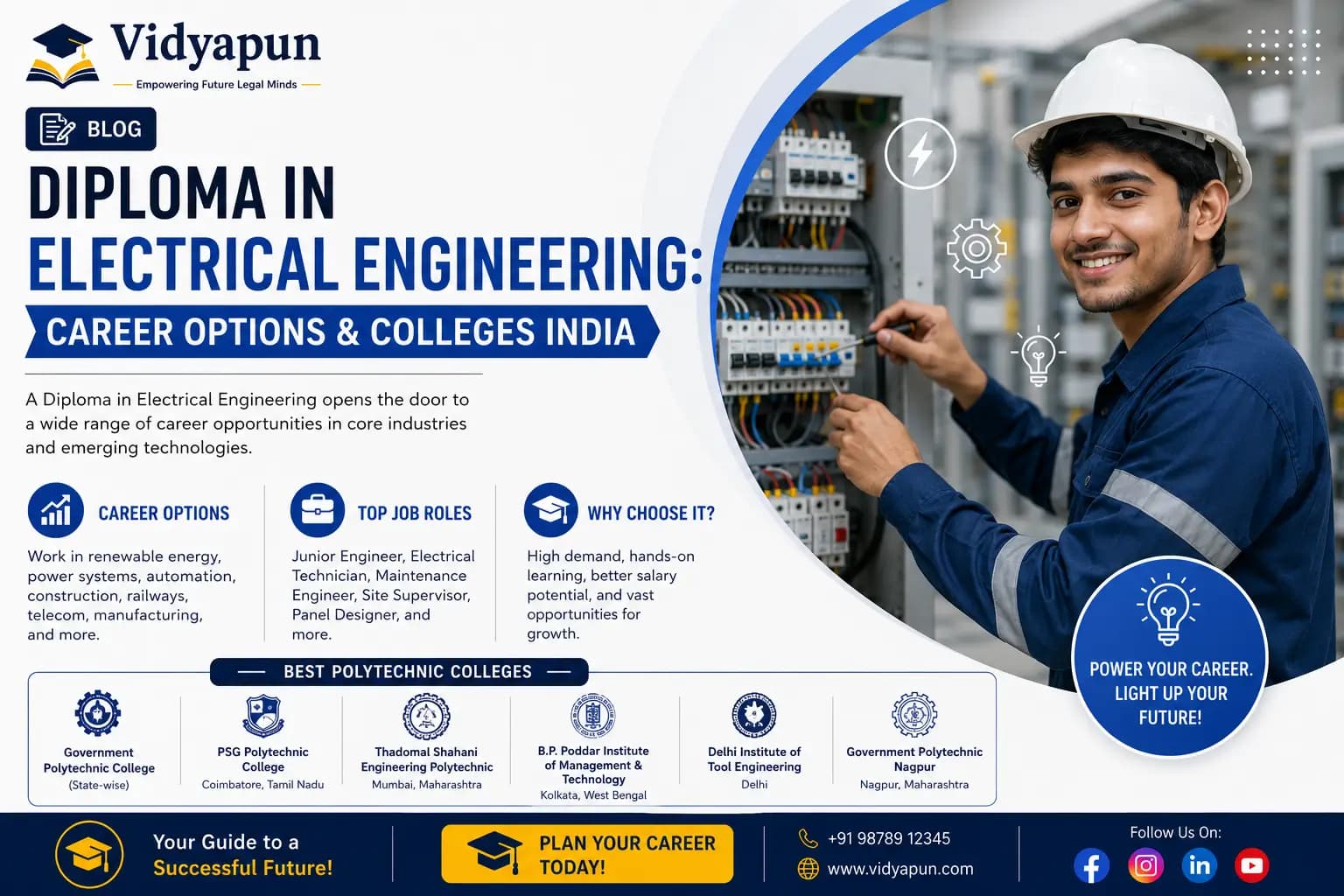
There is something quietly powerful about electrical engineering — it literally keeps the lights on. From the transformer on your street corner to the solar panel on a factory roof, every single one of those systems was designed, installed, or maintained by someone with an electrical engineering background. And a large number of those "someones" started their journey with a Diploma in Electrical Engineering.
If you are a Class 10 pass student looking for a technical course that leads to real employment without burning through four years and a small fortune, this blog is for you. We are going to cover what the course actually involves, the genuine career options after Diploma in Electrical Engineering, government job opportunities, salary expectations, and how to find a good college — without the usual vague advice.
What Is a Diploma in Electrical Engineering?
A Diploma in Electrical Engineering is a three-year polytechnic programme (six semesters) that trains students in the fundamentals of electrical systems, circuits, machines, power distribution, and control systems. It is approved by the All India Council for Technical Education (AICTE) and conducted by State Boards of Technical Education across the country.
You can join right after clearing Class 10 — no need to wait until Class 12. That is one of the biggest practical advantages this course offers. By the time your school friends are finishing their intermediate exams, you could already be in your second year of a recognised technical programme.
The diploma is formally known as Diploma in Electrical Engineering or Diploma in EE, and in some states it is clubbed with Electronics under Diploma in Electrical and Electronics Engineering (EEE). Both are largely equivalent for most job and study purposes.
Diploma in Electrical Engineering Syllabus: What You Will Actually Study
The syllabus is structured to take you from basics to application over three years. Here is a broad overview of what most state polytechnic boards cover:
First Year — Foundation
- Applied Mathematics and Physics
- Basic Electrical Engineering
- Engineering Drawing
- Workshop Practice
- Communication Skills
Second Year — Core Technical
- Electrical Machines (DC and AC)
- Electrical Measurements and Instruments
- Network Analysis
- Electronics Fundamentals
- Power Systems — Generation, Transmission and Distribution
- Industrial Wiring and Estimation
Third Year — Advanced and Applied
- Control Systems
- Switchgear and Protection
- Utilisation of Electrical Energy
- Renewable Energy Systems
- Project Work and Industrial Training
Most colleges include a mandatory industrial training period — usually 4 to 6 weeks — where you work at a power plant, manufacturing unit, or electrical contracting firm. This is not optional box-ticking. It is genuinely where you learn how actual systems work and where many students get their first job leads.
Career Options After Diploma in Electrical Engineering
Let us get into the real substance — what actually happens after you finish this diploma. The scope of Diploma in Electrical Engineering is wider than most people assume, cutting across government, private sector, and self-employment.
1. Electrical Supervisor or Junior Engineer (Private Sector)
Manufacturing plants, construction companies, real estate developers, hotels, hospitals, and shopping malls all need qualified electrical supervisors on their payroll. Your diploma, combined with a wireman or supervisor licence from the state Electrical Inspectorate, qualifies you for these roles. Many diploma holders start here and grow into senior supervisor or project engineer positions within five years.
2. Junior Engineer in Government Departments
This is where a Diploma in Electrical Engineering genuinely shines. State electricity boards, public works departments (PWD), municipal corporations, and central government organisations regularly recruit diploma holders as Junior Engineers (JE). These are stable, pensionable posts with structured salary growth.
Key recruiting bodies include:
- State Electricity Boards (MSEDCL, UPPCL, TNEB, PSPCL, etc.)
- Central Public Works Department (CPWD)
- Military Engineering Services (MES)
- Public Health Engineering Department (PHED)
- Various PSUs under the Ministry of Power
3. Indian Railways — Technician and JE Posts
Railway Recruitment Boards (RRB) conduct regular exams for Technician Grade III and Junior Engineer (Electrical) posts. These are among the most sought-after government jobs for diploma in electrical engineering holders, and the competition — while real — is not nearly as fierce as for UPSC or banking exams.
4. Defence Sector (Army, Navy, Air Force)
The Indian Army, Navy, and Air Force recruit diploma holders for technical trades. The Army's Soldier Technical and Havildar Technical posts, Navy's Artificer Apprentice programme, and Air Force's Airmen (Technical) recruitment all consider Diploma in Electrical Engineering as a qualifying credential.
5. Power Sector PSUs
Public sector companies like NTPC, BHEL, NHPC, PGCIL (Power Grid Corporation), THDC, and SJVN recruit diploma holders as ITI/Diploma apprentices and later for permanent technical positions. Getting through an apprenticeship in any of these organisations significantly boosts your resume and often converts into permanent employment.
6. Electrical Contractor and Self-Employment
With an electrical supervisor licence and some field experience, many diploma graduates set up their own electrical contracting business. Wiring of residential buildings, industrial installations, solar panel setup, and AMC (Annual Maintenance Contracts) for commercial properties are all viable business areas. In smaller cities and semi-urban areas especially, a qualified and reliable electrical contractor can build a solid income relatively quickly.
Salary After Diploma in Electrical Engineering
Here is a realistic salary picture for fresh diploma holders and those with 2–5 years of experience:
| Role | Starting Salary (Per Month) | With 3–5 Years Experience |
|---|---|---|
| Junior Engineer (Private) | ₹12,000 – ₹22,000 | ₹28,000 – ₹45,000 |
| JE Government (State EB) | ₹25,000 – ₹35,000 | ₹38,000 – ₹55,000 |
| Electrical Supervisor | ₹14,000 – ₹25,000 | ₹30,000 – ₹50,000 |
| PSU Apprentice (Stipend) | ₹8,000 – ₹12,000 | Permanent post after conversion |
| Railways Technician | ₹19,900 – ₹25,500 (7th CPC) | Incremental scale |
| Self-Employed Contractor | Variable | ₹40,000 – ₹1,00,000+ |
Government salaries look modest at entry level but come with DA, HRA, medical benefits, job security, and pension — which makes the total compensation package quite competitive once you factor everything in.
Higher Education After Diploma in Electrical Engineering
The diploma does not have to be your final qualification. There are clear, well-established paths forward:
Lateral Entry into BTech (Second Year) AICTE allows diploma holders to seek lateral entry into the second year of BTech Electrical Engineering. You skip the first year and complete your degree in three additional years. Almost all state universities have lateral entry quotas (usually 10–15% of total intake), and competition for these seats is noticeably lower than for regular BTech admissions.
AMIE (Associate Member of Institution of Engineers) The Institution of Engineers India (IEI) offers the AMIE qualification — a part-time, self-study engineering degree equivalent. Diploma holders can get exemptions for several sections. It is a slower path but works well for those who are already employed.
Advanced Diplomas and Certification Short-term programmes in solar energy systems, industrial automation, PLC and SCADA, and energy auditing are increasingly valued by employers. Organisations like TERI, MNRE-empanelled institutes, and Siemens training centres offer relevant certifications.
Best Polytechnic Colleges for Diploma in Electrical Engineering in India
Choosing the right college is more important than most students acknowledge. A government polytechnic with properly equipped labs and experienced faculty will prepare you better than a private college with impressive-sounding marketing material.
Here are some consistently well-regarded institutions for Diploma in Electrical Engineering:
Government Polytechnics
- Government Polytechnic, Pune — One of Maharashtra's oldest technical institutes with strong electrical department
- Ambedkar Institute of Technology, Delhi — Reputed Delhi government polytechnic with good placement activity
- Government Polytechnic College, Chennai — TNEA-affiliated, strong faculty in electrical streams
- Government Polytechnic, Lucknow — Among UP's top-ranked polytechnics for EE diploma
- Government Polytechnic, Ahmedabad — Gujarat's flagship polytechnic with industry linkages
- Bhopal Polytechnic College, Bhopal — AICTE-approved, well-established in MP's technical education circle
- Guru Nanak Dev Polytechnic, Ludhiana — Highly regarded in Punjab for electrical and mechanical trades
What to Verify Before You Finalise Any College
- AICTE approval (verify at aicte-india.org — do not rely on the college's own claims)
- Whether the electrical labs have functional equipment — transformers, machines, meters, and PLC setups
- Placement history for EE diploma specifically — ask for last two years' data
- Whether the college helps with supervisor licence application
- Distance from your home — for polytechnic diplomas, day scholars often do better because they can take up part-time work or internships locally
Diploma in Electrical Engineering vs ITI Electrician: What Is the Difference?
A lot of students come from families where ITI electrician is the familiar route. Here is how the two compare honestly:
| Parameter | Diploma in EE | ITI Electrician |
|---|---|---|
| Duration | 3 years | 1–2 years |
| Qualification After | Diploma (AICTE recognised) | NTC/NAC certificate |
| Eligibility | Class 10 | Class 8 or 10 |
| Job Level | Junior Engineer, Supervisor | Wireman, Technician |
| Government Jobs | JE posts, PSU, Railways | Technician Grade only |
| Higher Studies | BTech lateral entry | Limited options |
| Self-Employment | Contracting firm | Individual wireman work |
The diploma takes longer but positions you for supervisory and engineering roles rather than trade-level work. Both are legitimate — it depends on where you want to be in ten years.
Frequently Asked Questions (FAQs)
Q1. Is Diploma in Electrical Engineering good for government jobs? Yes, it is one of the strongest diploma streams for government employment. Junior Engineer posts in state electricity boards, CPWD, railways, and defence all actively recruit diploma holders in electrical engineering.
Q2. What is the scope of Diploma in Electrical Engineering in India? The scope covers private manufacturing, construction, power sector PSUs, government departments, railways, defence, and self-employment as an electrical contractor. Demand for qualified electrical diploma holders is consistent across India.
Q3. Can I do BTech after Diploma in Electrical Engineering? Yes. AICTE's lateral entry scheme allows direct admission to the second year of BTech Electrical Engineering in most state universities. This is one of the best pathways for diploma holders who want a full engineering degree.
Q4. What is the starting salary after Diploma in Electrical Engineering? Private sector starting salaries range from ₹12,000 to ₹22,000 per month. Government Junior Engineer posts start at ₹25,000–₹35,000 per month with additional allowances.
Q5. Which exam should I prepare for after getting a Diploma in Electrical Engineering? RRB JE (Railways), SSC JE, UPPCL JE, MPEB JE, TNEB Junior Engineer, and various state PWD/electricity board exams are the most relevant government recruitment exams for electrical diploma holders.
Q6. Do electrical diploma holders get jobs in NTPC or BHEL? Yes, through apprenticeship programmes. NTPC, BHEL, NHPC, and PGCIL regularly offer trade apprenticeships under the Apprentices Act for diploma holders, which is often a stepping stone to permanent employment.
Q7. Is an electrical supervisor licence necessary after this diploma? For most field jobs — especially in construction, maintenance, and contracting — yes. The Electrical Supervisor Competency Certificate (issued by State Electrical Inspectorates) is a practical requirement for many job roles and essential if you want to run your own contracting business.
Closing Thoughts
A Diploma in Electrical Engineering is one of those courses where the value is very real but often undersold. Electricity is not going anywhere — if anything, the shift toward solar energy, electric vehicles, smart grids, and industrial automation is creating more demand for qualified electrical technicians and supervisors than ever before.
The students who come out of this diploma and actually do well are not always the ones who scored highest in their board exams. They are the ones who paid attention during industrial training, got their supervisor licence done promptly, kept their options open between private employment and government exams, and stayed curious enough to keep learning after the coursework ended.
Website: www.vidyapun.com
Call / WhatsApp: +91 96438 02216