Let's be honest — when most students hear "diploma course," they picture it as a backup plan. Something you do when engineering entrance exams don't go your way. But that's a badly outdated view, especially when it comes to a Diploma in Electronics Engineering.
In 2026, electronics is embedded into literally everything around us — smartphones, electric vehicles, medical devices, satellites, industrial machines, and smart home systems. Someone has to design, assemble, test, and maintain all of that. And diploma-level electronics engineers are very much part of that workforce — often getting into the industry two to three years before their degree-holding peers.
If you're considering this path, this guide will give you a clear picture of what to expect — the scope, career options, salary range, and the colleges that are actually worth your time.
What Is a Diploma in Electronics Engineering?
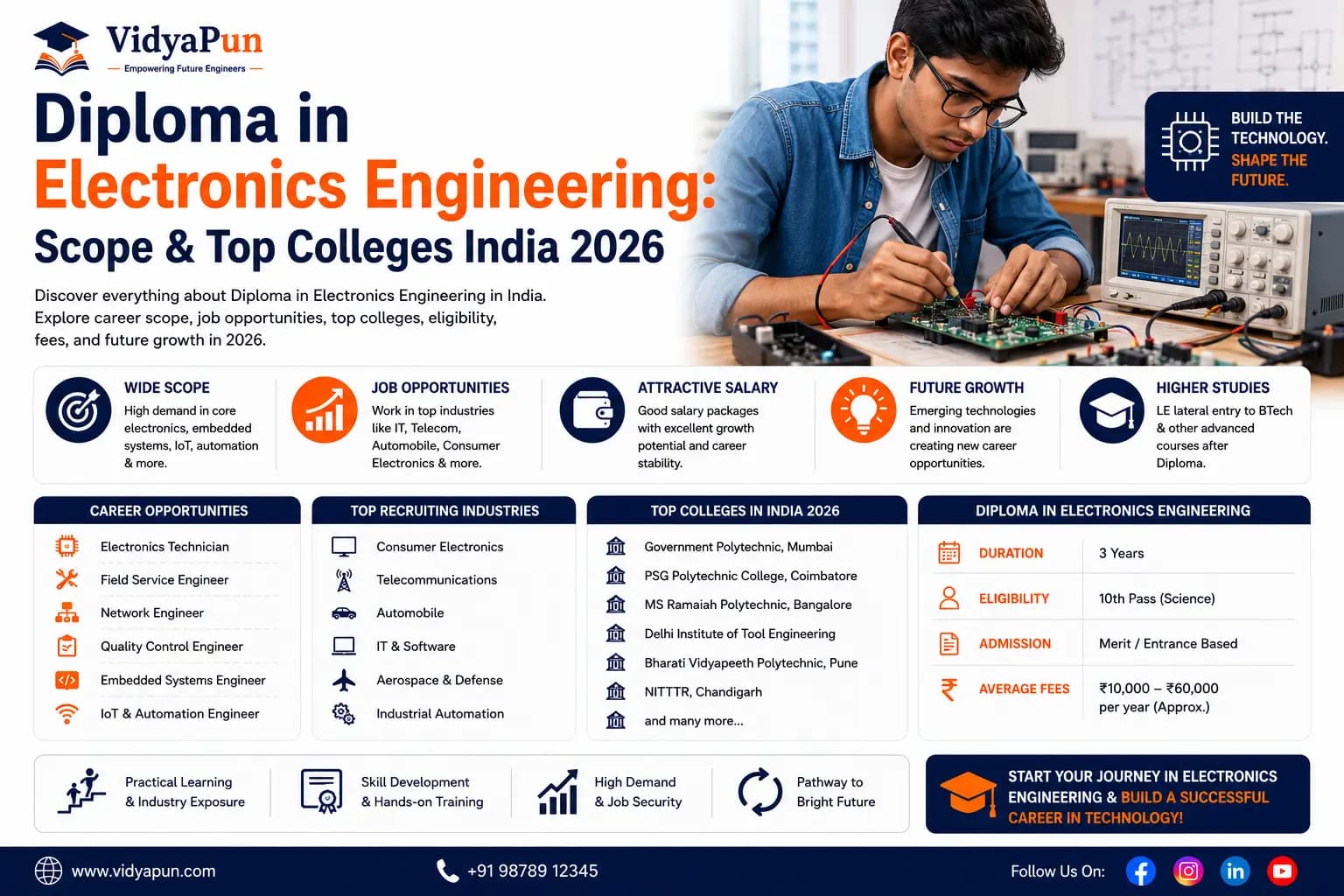
A Diploma in Electronics Engineering is a three-year polytechnic program (sometimes 2.5 years for certain state boards) that covers the fundamentals of electronics, electrical circuits, communication systems, microprocessors, embedded systems, and industrial electronics.
It's designed to make you job-ready at the technician and junior engineer level — with enough practical knowledge to work in manufacturing plants, telecom companies, consumer electronics firms, and government departments.
The course is typically offered through government and private polytechnic institutes affiliated with state technical education boards. Admission is usually after Class 10, though some institutes also admit students after Class 12.
One significant advantage — students who complete a Diploma in Electronics Engineering can directly enter the second year of a BTech Electronics Engineering program through the lateral entry scheme. So it's not a dead end; it's actually a faster route into engineering if you plan it right.
Diploma in Electronics Engineering Scope in 2026
The electronics industry in India has been growing at a pace that's hard to ignore. The government's Production Linked Incentive (PLI) scheme for electronics manufacturing has attracted major global players — Apple suppliers, Samsung, and dozens of component manufacturers have set up or expanded operations in India.
This directly translates into demand for trained electronics technicians and engineers on the shop floor and in testing labs.
Here's where diploma holders are finding strong opportunities in 2026:
Consumer Electronics Manufacturing Companies like Dixon Technologies, Voltas, Havells, and contract manufacturers for global brands need large numbers of technicians who understand circuit boards, quality testing, and assembly processes.
Telecom and Networking With 5G infrastructure rolling out across the country, telecom companies and tower operators are actively hiring electronics diploma holders for installation, maintenance, and field operations roles.
Automotive and EV Sector Electric vehicles have dramatically increased the electronics content of modern cars. Battery management systems, motor controllers, and infotainment units all need people who understand electronics — and that demand is only growing.
Embedded Systems and IoT Smart devices — from industrial sensors to home automation products — rely on embedded electronics. Diploma holders with skills in microcontrollers like Arduino or ESP32 are finding freelance and full-time opportunities in this space.
Defence and Government PSUs Organizations like BEL (Bharat Electronics Limited), BSNL, ECIL, and DRDO employ electronics diploma holders in technical and supervisory roles, often through competitive exams.
Medical Electronics Hospitals and diagnostic centres need biomedical equipment technicians who can maintain ECG machines, X-ray units, ventilators, and other electronic medical devices — a niche but stable career path.
Career Options After Diploma in Electronics Engineering
One of the things students want to know most is — what kind of job will I actually get? Here's a realistic picture.
Job Roles and Average Salaries
| Job Role | Average Salary (India) |
|---|---|
| Electronics Technician | ₹2 – ₹3.5 LPA |
| Junior Electronics Engineer | ₹2.5 – ₹4 LPA |
| Field Service Engineer | ₹3 – ₹5 LPA |
| PCB Design & Testing Technician | ₹2.5 – ₹4 LPA |
| Embedded Systems Technician | ₹3 – ₹5 LPA |
| Telecom Tower Technician | ₹2.5 – ₹4 LPA |
| Biomedical Equipment Technician | ₹3 – ₹5 LPA |
Salaries depend on location, company, and your skill set. Metro cities and MNC manufacturing plants typically pay at the higher end.
Government Job Opportunities
Many students choose electronics diploma specifically for government job eligibility. Some prominent options:
- ITI/Polytechnic-level government jobs through state employment exchanges
- Railway Recruitment Board (RRB) — Junior Engineer and Technician posts
- BEL, ECIL, BSNL, ONGC technical assistant and operator posts
- Army Technical Entry and defence civilian technical roles
- State Electricity Boards — Junior Technician posts in substations and control rooms
Government jobs in electronics are stable, come with good benefits, and don't require you to chase private sector hiring cycles every few years.
Higher Education After Diploma in Electronics Engineering
If a job right after diploma isn't your goal, your options for further study are genuinely good:
- Lateral Entry to BTech Electronics Engineering — Skip first year and directly join second year. Available at most NITs, state government colleges, and private engineering colleges. This is one of the most popular paths for diploma holders who want a degree.
- AMIE (Associate Member of the Institution of Engineers) — A degree equivalent certification recognized for government jobs and higher studies.
- Diploma to Degree (D2D) programs — Some states like Gujarat have dedicated D2D programs for polytechnic graduates.
- Online certifications — Courses in embedded systems, PCB design (Altium, KiCad), VLSI, IoT, and PLC programming significantly boost your employability and salary ceiling.
Subjects Covered in Diploma in Electronics Engineering
Understanding what you'll actually study helps you make an informed decision. The typical curriculum includes:
First Year: Basic Electrical Engineering, Engineering Mathematics, Engineering Physics, Workshop Practice, Computer Fundamentals
Second Year: Electronic Devices and Circuits, Digital Electronics, Microprocessors and Microcontrollers, Communication Systems, Industrial Electronics
Third Year: Embedded Systems, VLSI Design Basics, Fiber Optic Communication, Project Work, Industrial Training
The practical component — lab sessions and industrial training — is a major part of what makes this diploma valuable. You don't just learn theory; you work with actual equipment, test circuits, and troubleshoot real problems.
Top Colleges for Diploma in Electronics Engineering in India 2026
Choosing the right institute matters. Government polytechnics generally offer better infrastructure, lower fees, and more industry-connected training than many private ones. Here's a state-wise look at reputed institutions:
Maharashtra
- Government Polytechnic Mumbai — One of the oldest and most respected polytechnics in India. Excellent placement connections in the Mumbai industrial belt.
- Government Polytechnic Pune — Strong infrastructure and consistent industry tie-ups.
- Veermata Jijabai Technological Institute (VJTI) Polytechnic, Mumbai — Part of the prestigious VJTI campus; strong brand recognition.
Delhi and NCR
- Government Polytechnic for Women, Delhi — Excellent option for women students in North India.
- Ambedkar Institute of Technology, Delhi — Well-regarded polytechnic under Delhi government.
- Apeejay Institute of Technology, Greater Noida — Good private option in NCR with decent placement support.
Tamil Nadu
- Government Polytechnic College, Chennai — Strong reputation with industry connections in the Chennai electronics manufacturing zone.
- Dr. Dharmambal Government Polytechnic College for Women, Chennai — Highly rated women's polytechnic.
- PSG Polytechnic College, Coimbatore — One of the top private polytechnics in South India.
Karnataka
- Government Polytechnic, Bangalore — Urban location with proximity to Bangalore's electronics and tech industry.
- Sri Jayachamarajendra Polytechnic, Bangalore — Reputed government institute with consistent student outcomes.
Uttar Pradesh
- Government Polytechnic Lucknow — One of the largest and most established polytechnics in UP.
- Government Polytechnic Kanpur — Strong in industrial electronics, good placement record in the Kanpur industrial sector.
- Bundelkhand Institute of Engineering and Technology (BIET) Polytechnic, Jhansi — Well-regarded in the Bundelkhand region.
Rajasthan
- Government Polytechnic College, Jaipur — Good option for students in Rajasthan, with decent campus facilities.
Gujarat
- L.D. College of Engineering Polytechnic, Ahmedabad — Strong government polytechnic with industry links in the Gujarat manufacturing corridor.
West Bengal
- Calcutta Polytechnic — One of the oldest technical institutes in Eastern India.
- Government College of Engineering and Ceramic Technology (Polytechnic Wing), Kolkata
Tip: Always check the specific AICTE approval status and state board affiliation before applying. Unapproved institutes can create problems with certification and government job eligibility.
Admission Process for Diploma in Electronics Engineering 2026
Admission to polytechnic programs varies by state, but here's the general process:
After Class 10: Most states conduct centralized polytechnic entrance exams or use Class 10 board marks for merit-based admission.
- UP: JEECUP (Joint Entrance Examination Council Uttar Pradesh)
- Maharashtra: Maharashtra State Board of Technical Education (MSBTE) centralized admission
- Delhi: Delhi Polytechnic CET (Common Entrance Test)
- Tamil Nadu: TNEA Polytechnic Counselling based on Class 10 marks
- Karnataka: DTE Karnataka merit-based admission
- Rajasthan: BTER (Board of Technical Education Rajasthan) centralized admission
After Class 12: Some institutes offer direct admission to the second year of the diploma program for students who have passed Class 12 with Science (Physics, Chemistry, Maths).
For 2026 admissions, keep an eye on your state's technical education board website — application windows typically open between April and June.
Skills That Will Set You Apart as an Electronics Diploma Graduate
Your diploma certificate gets you considered — your skills get you hired. Students who do well in the job market after a Diploma in Electronics Engineering usually invest time in:
- Learning PCB design tools — KiCad (free) or Altium Designer are industry standards. Even basic proficiency helps.
- Microcontroller programming — Arduino, ESP32, and Raspberry Pi projects build practical embedded skills fast.
- PLC and SCADA basics — Programmable Logic Controllers are widely used in industrial automation. Even a basic certification opens doors in manufacturing.
- Soldering and circuit troubleshooting — Sounds basic, but hands-on proficiency in hardware is genuinely rare and valued.
- IoT project experience — Small projects connecting sensors to cloud platforms demonstrate initiative and practical knowledge.
If you dedicate even one to two hours daily to building these skills alongside your course, you'll be significantly ahead of most diploma graduates by the time you finish.
Frequently Asked Questions About Diploma in Electronics Engineering
Q1. Is a Diploma in Electronics Engineering worth it in 2026? Yes — especially if you want to enter the workforce quickly or plan to use it as a stepping stone to lateral entry in BTech. The electronics manufacturing sector in India is actively expanding, and trained technicians are in demand.
Q2. What is the scope of Diploma in Electronics Engineering in government jobs? Diploma holders are eligible for Junior Engineer and Technician posts in Railways, BEL, ECIL, BSNL, state electricity boards, and defence establishments. These are stable, pensionable roles with steady demand.
Q3. Can I do BTech after Diploma in Electronics Engineering? Yes. Through the lateral entry scheme, you can directly join the second year of BTech Electronics Engineering at most government and private engineering colleges, saving you one full year of study.
Q4. What is the fee for Diploma in Electronics Engineering in government polytechnics? Government polytechnic fees are very affordable — typically between ₹10,000 to ₹30,000 per year depending on the state. Private polytechnics charge more, ranging from ₹40,000 to ₹1,00,000+ per year.
Q5. Which is better — Diploma in Electronics Engineering or Diploma in Electrical Engineering? It depends on your interest. Electronics focuses on circuits, communication, and embedded systems — more relevant for consumer electronics, telecom, and tech companies. Electrical is stronger for power sector and core infrastructure jobs. Both have good scope; pick based on where you want to work.
Q6. How long is the Diploma in Electronics Engineering course? It is typically a 3-year (6-semester) program after Class 10. Some states offer a 2.5-year variant. After Class 12, some institutes offer a 2-year lateral diploma.
Q7. What is the starting salary after Diploma in Electronics Engineering? Starting salaries in India typically range from ₹2 to ₹4 LPA depending on the company, city, and your skill level. With experience and upskilling, mid-career earnings can reach ₹6–8 LPA, particularly in embedded systems, IoT, or field service engineering roles.
Wrapping Up
A Diploma in Electronics Engineering in 2026 is a practical, focused, and financially accessible path into one of India's fastest-growing industrial sectors. Whether you want to start working quickly, land a stable government job, or use it as a launchpad into a BTech degree — the options are genuinely solid.
The key is going in with a clear plan: choose a reputed government polytechnic, build hands-on skills beyond the classroom, and don't ignore the lateral entry route if a degree is part of your long-term goal.
Website: www.vidyapun.com
Call / WhatsApp: +91 96438 02216