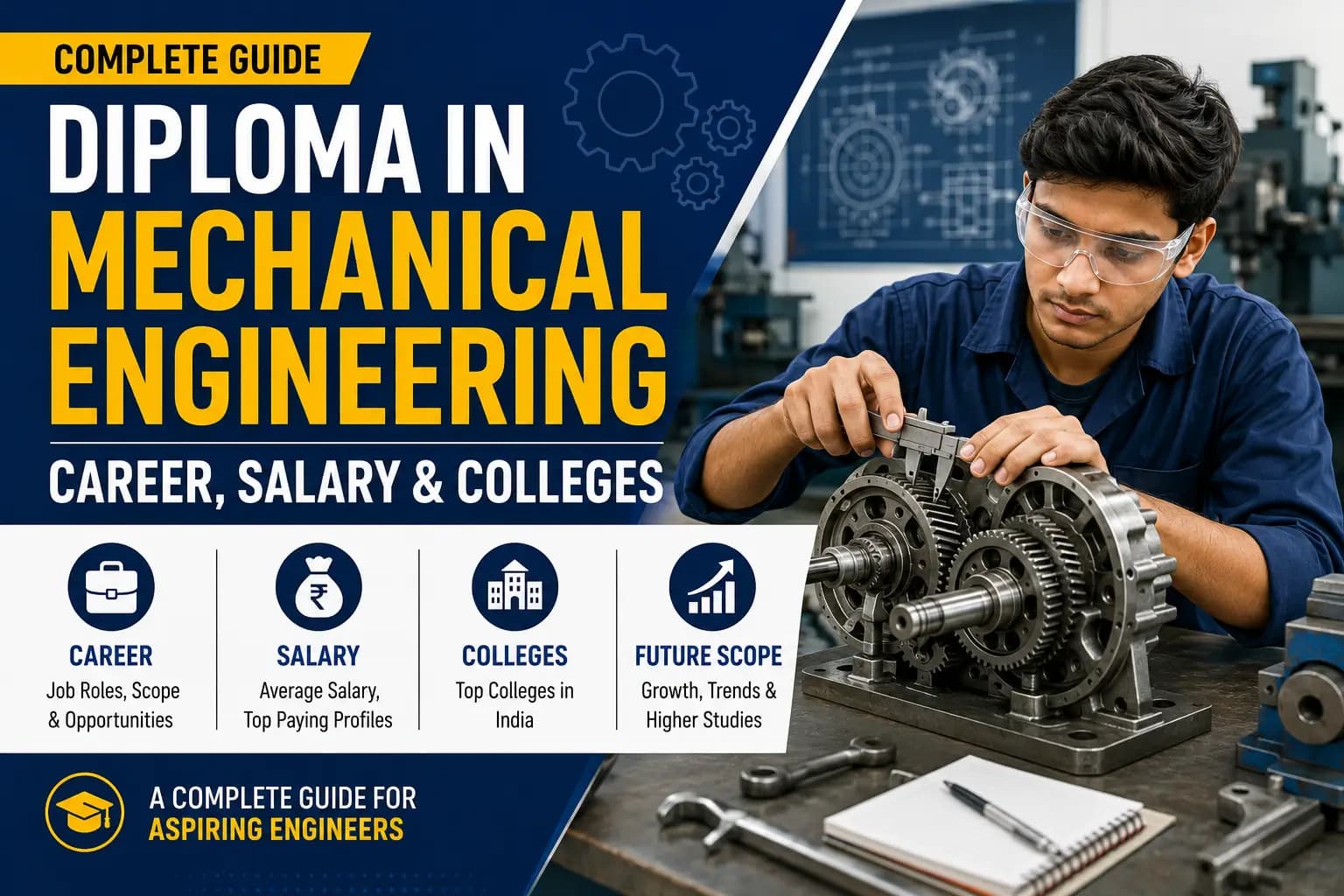
Walk into any manufacturing plant, automobile workshop, power plant, or production unit in India — and you'll find diploma-level mechanical engineers running the show on the floor. They're the ones who keep machines running, oversee production lines, troubleshoot equipment breakdowns, and coordinate between shop floor workers and senior engineers.
The Diploma in Mechanical Engineering is one of the oldest and most popular polytechnic programs in India — and in 2026, it remains one of the most employable technical qualifications you can hold. Whether you're a Class 10 pass student looking for a practical career path, or a parent trying to understand whether this course is the right investment — this guide covers everything honestly.
Let's start from the basics and work our way up.
What Is a Diploma in Mechanical Engineering?
A Diploma in Mechanical Engineering is a 3-year polytechnic program designed to train students in the design, production, operation, and maintenance of mechanical systems and machinery. It is offered after Class 10 by government and private polytechnic colleges across India, affiliated to respective State Boards of Technical Education.
The program is approved by AICTE (All India Council for Technical Education) and is recognized by central and state government employers for Junior Engineer-level recruitment.
Unlike a B.Tech degree, this diploma is heavily practical — workshops, machine labs, and industrial visits are built into the curriculum from the first semester itself. That hands-on orientation is precisely why manufacturing and engineering companies hire diploma holders directly for shop floor and supervisory roles.
Course Duration and Eligibility
Duration: 3 years (6 semesters) after Class 10
Lateral Entry: 2 years (direct admission to 2nd year) for Class 12 PCM or ITI certificate holders
Eligibility:
- Passed Class 10 / SSC with Mathematics and Science
- Minimum aggregate: 35% to 50% depending on state and college
- Age: Generally no upper age limit for government polytechnics
Admission is usually through state-level polytechnic entrance exams (like UP JEECUP, Maharashtra CET, Tamil Nadu TNEA Polytechnic, etc.) or merit-based selection.
Subjects Covered in the Diploma Mechanical Engineering Course
The curriculum is designed to give students both theoretical understanding and workshop-level practical skills. Core subjects typically include:
- Engineering Mathematics and Applied Science – Foundation for all technical subjects
- Engineering Drawing and CAD – Technical drafting, 2D and 3D design using AutoCAD
- Workshop Technology – Fitting, welding, casting, forging, machining
- Thermodynamics – Heat engines, steam, refrigeration basics
- Theory of Machines – Gears, cams, belts, linkages, and motion analysis
- Manufacturing Technology – Lathe, milling, drilling, CNC basics
- Fluid Mechanics and Hydraulic Machines – Pumps, turbines, pipe flow
- Strength of Materials – Stress, strain, beams, torsion
- Metrology and Quality Control – Measurement tools and inspection methods
- Automobile Engineering – Engine systems, transmission, chassis (optional in some states)
- Refrigeration and Air Conditioning – RAC systems, compressors, refrigerants
- Industrial Management and Entrepreneurship – Production planning, costing, basic management
The final semester usually includes an industrial training or project component, which gives students real-world exposure before graduation.
Scope of Diploma in Mechanical Engineering in 2026
The scope for diploma mechanical engineers in 2026 is multi-layered — and better than most students realize when they first enroll.
Manufacturing and Production Sector
India's manufacturing sector under the PLI (Production Linked Incentive) scheme has attracted significant investment in electronics, automobiles, pharmaceuticals, and defence. Every new plant needs trained mechanical technicians and supervisors. Diploma holders fill exactly these roles — and they're hired in large numbers.
Automobile Industry
The Indian automobile industry — including electric vehicles — is growing steadily. Maruti Suzuki, Tata Motors, Mahindra, Hero MotoCorp, Bajaj, and their vendor ecosystems employ thousands of diploma mechanical engineers in assembly, quality, maintenance, and service roles every year.
Power and Energy Sector
Thermal power plants, hydroelectric projects, solar installations, and wind farms all need mechanical engineers for turbine maintenance, piping systems, and equipment upkeep. PSUs like NTPC, BHEL, and ONGC hire diploma holders regularly.
Government Sector (JE Roles)
Central and state governments recruit diploma mechanical engineers as Junior Engineers (JE) in railways, defence, ordnance factories, and public works departments. This is one of the most stable career paths available.
Abroad Opportunities
Gulf countries (UAE, Qatar, Saudi Arabia, Oman) have consistent demand for Indian diploma mechanical engineers in oil and gas, construction equipment maintenance, and facility management. With 3–5 years of experience and proper document attestation, overseas salaries can be 3–5x Indian salaries.
Higher Education (Lateral Entry to B.Tech)
Diploma holders can pursue a B.Tech in Mechanical Engineering through lateral entry, joining directly in the second year. Many students use the diploma as a stepping stone to a full engineering degree while already having practical skills that B.Tech freshers lack.
Jobs After Diploma in Mechanical Engineering
Here's a realistic breakdown of the job roles diploma mechanical engineers take up — both government and private sector.
Junior Engineer (JE) – Mechanical
The most coveted role for diploma holders. JEs in government departments handle maintenance, supervision, and quality control of mechanical systems. Recruited through SSC JE, RRB JE, and State PSC exams.
Production / Manufacturing Supervisor
Manufacturing companies hire fresh diploma holders as production trainees or floor supervisors. Responsibilities include shift supervision, line output monitoring, and coordination with quality and maintenance teams.
Maintenance Technician / Engineer
Factories, power plants, and large commercial buildings need mechanical maintenance engineers who can handle breakdowns, schedule preventive maintenance, and manage spare parts inventory.
CAD/CAM Technician
With AutoCAD and SolidWorks skills, diploma mechanical engineers work in design offices, product development teams, and engineering consultancies as draftsmen or CAD operators.
Quality Control Inspector
QC inspectors ensure products and components meet dimensional and functional standards using measuring instruments like vernier calipers, micrometers, and CMMs. Automotive and precision engineering companies hire heavily for these roles.
Service Engineer (Automobile / Industrial Equipment)
Automobile dealerships, equipment manufacturers, and industrial OEMs employ diploma holders as field service engineers — handling customer site visits, repairs, and after-sales support.
RAC Technician / HVAC Engineer
With refrigeration and air conditioning as a core subject, diploma graduates can work in HVAC firms, cold chain logistics, and building services companies — a segment that's growing fast in India.
ITI Instructor / Technical Trainer
Government ITIs (Industrial Training Institutes) hire diploma holders as instructors for trade training programs. This is a stable government job with reasonable pay and social respect.
Salary After Diploma in Mechanical Engineering in India
Salary expectations are a major factor for most students and their families. Here's a realistic picture for 2026:
| Job Role | Monthly Salary (Fresher) | With 3–5 Years Experience |
|---|---|---|
| Junior Engineer (Govt) | ₹28,000 – ₹48,000 | ₹45,000 – ₹70,000 |
| Production Supervisor | ₹13,000 – ₹22,000 | ₹25,000 – ₹40,000 |
| Maintenance Technician | ₹14,000 – ₹24,000 | ₹28,000 – ₹45,000 |
| CAD/CAM Technician | ₹15,000 – ₹28,000 | ₹30,000 – ₹50,000 |
| QC Inspector | ₹14,000 – ₹25,000 | ₹28,000 – ₹42,000 |
| Service Engineer | ₹13,000 – ₹22,000 | ₹25,000 – ₹38,000 |
| Abroad (Gulf countries) | ₹45,000 – ₹90,000 | ₹80,000 – ₹1,50,000 |
Government JE roles offer additional perks — HRA, DA, medical benefits, and pension — which make the effective compensation significantly higher than the basic salary.
Government Exams for Diploma Mechanical Engineers
If a government job is the goal, these are the key exams to target:
SSC JE (Staff Selection Commission – Junior Engineer) One of the biggest central government recruitment exams. Open to diploma holders in mechanical engineering. Posts are across CPWD, CWC, MES, and other central departments. Exam has two papers — Paper 1 (objective) and Paper 2 (descriptive/conventional).
RRB JE (Railway Recruitment Board – Junior Engineer) Indian Railways recruits diploma mechanical engineers for loco maintenance, carriage & wagon, and production units. The RRB JE exam is highly competitive but offers excellent career growth within railways.
BHEL Apprentice / Trainee Bharat Heavy Electricals Limited hires diploma holders as apprentices and later as technicians. This is an excellent entry point into a Navratna PSU.
Ordnance Factory Board (OFB) Ordnance factories across India recruit diploma mechanical engineers as Junior Works Managers (JWM) and technicians. Defence sector jobs come with strong job security and benefits.
State PSC JE Exams Every state conducts its own JE recruitment through the State Public Service Commission or Technical Services Board — covering PWD, irrigation, industrial development bodies, and state electricity boards.
NTPC / ONGC / IOCL Apprentice Large PSUs recruit diploma engineers as graduate/technician apprentices under the Apprentices Act — a great way to get PSU experience and sometimes a permanent job.
Top Colleges for Diploma in Mechanical Engineering in India
Government Polytechnics
- Government Polytechnic, Mumbai, Maharashtra – One of India's oldest and most respected polytechnics
- Government Polytechnic, Pune, Maharashtra – Strong industry linkages with Pune's manufacturing belt
- PSG Polytechnic College, Coimbatore, Tamil Nadu – Excellent lab infrastructure and placement record
- Government Polytechnic College, Chennai, Tamil Nadu
- Government Polytechnic, Lucknow, Uttar Pradesh – Premier UP state polytechnic
- Government Polytechnic, Patna, Bihar
- Chandigarh Polytechnic College, Chandigarh
- Government Polytechnic, Ahmedabad, Gujarat
- Bhopal Polytechnic College, Madhya Pradesh
- Government Polytechnic, Hyderabad, Telangana
Private Polytechnics with Strong Placement
- K.K. Wagh Polytechnic, Nashik, Maharashtra
- Sinhgad Polytechnic, Pune, Maharashtra
- Sri Sai Ram Polytechnic, Chennai, Tamil Nadu
- Thiagarajar Polytechnic College, Salem, Tamil Nadu
- Datta Meghe Polytechnic, Nagpur, Maharashtra
- Agnel Polytechnic, Vashi, Navi Mumbai
How to Pick the Right College
Before finalizing a college, check these points:
- AICTE approval and affiliation to the state technical education board
- Workshop and lab quality — mechanical diploma without good workshop practice is incomplete
- Placement cell activity — ask for last year's placement data, not just brochure claims
- Faculty with industry experience — not just academic qualifications
- Location proximity to industrial zones — better internship and job opportunities
Diploma in Mechanical Engineering vs ITI Mechanical
A common dilemma for Class 10 students is whether to choose a diploma or an ITI (Industrial Training Institute) certificate in a mechanical trade.
| Parameter | Diploma | ITI |
|---|---|---|
| Duration | 3 years | 1–2 years |
| Level | Supervisory/Junior Engineer | Skilled Tradesman |
| Government Jobs | JE Level posts | Technician/Trade posts |
| Higher Studies | Lateral entry to B.Tech | Limited pathways |
| Salary Range | Higher (especially in govt) | Moderate |
| Practical Depth | Broader coverage | Deep trade-specific skills |
In simple terms — ITI makes you a skilled tradesman, while a diploma makes you a junior engineer or supervisor. Both are valid, but the diploma opens more doors, especially in government recruitment.
Frequently Asked Questions (FAQs)
Q1. Is Diploma in Mechanical Engineering a good career option in 2026? Yes. With India's growing manufacturing base, automobile sector, and PSU expansion, diploma mechanical engineers have consistent demand across sectors. Government JE roles and private manufacturing jobs remain strong.
Q2. What is the salary of a diploma mechanical engineer in India? Freshers earn ₹13,000–₹22,000/month in private sector roles. Government Junior Engineers earn ₹28,000–₹48,000/month plus allowances. Experienced professionals in the Gulf can earn ₹80,000–₹1,50,000/month.
Q3. Can a diploma mechanical engineer apply for SSC JE? Yes. The SSC JE exam accepts diploma holders in mechanical engineering from AICTE-recognized institutions. It's one of the best government job opportunities available for diploma holders.
Q4. Can I do B.Tech after Diploma in Mechanical Engineering? Yes. Through the Lateral Entry scheme, diploma holders can join the second year of B.Tech Mechanical Engineering directly, skipping the first year. This is offered by most state universities and private engineering colleges.
Q5. Which is better — Diploma in Mechanical Engineering or ITI? For long-term career growth, especially in government jobs and supervisory roles, the diploma is better. ITI suits those who want quick employment in a specific trade with shorter training duration.
Q6. What are the best government jobs for diploma mechanical engineers? Top options include SSC JE, RRB JE, BHEL Technician Apprentice, Ordnance Factory Board JWM, NTPC Apprentice, and State PSC JE exams in PWD and electricity departments.
Q7. Is CAD knowledge important for diploma mechanical engineers? Absolutely. AutoCAD and basic SolidWorks or CATIA knowledge significantly improves job prospects, especially for CAD/CAM technician and design office roles. Many colleges now include it in the curriculum.
Q8. What is the scope of diploma mechanical engineers abroad? Gulf countries — UAE, Qatar, Saudi Arabia, Oman, Bahrain — have strong demand for Indian diploma mechanical engineers in oil and gas, construction equipment, HVAC, and facility management. Salaries are 3–5x Indian pay scales.
Wrapping Up
A Diploma in Mechanical Engineering in 2026 is far from a "backup option." It's a focused, career-oriented qualification that gets you into the workforce faster, costs significantly less than a B.Tech degree, and opens doors to some of the most stable jobs in India — including government JE posts, PSU apprenticeships, and manufacturing sector roles.
The key is to choose a recognized college with good workshop facilities, build your AutoCAD and machining skills seriously, and start preparing for SSC JE or RRB JE from your second year onward. Those who do that consistently land solid jobs — in government and private sector both.
And if you want a degree later? The lateral entry route to B.Tech is always open.
Take the First Step Toward Your Mechanical Engineering Career
If you're ready to explore admission options, compare colleges, or get clarity on which government exams to target after your diploma — don't figure it all out alone. Get personalized guidance from a career counselor, download our free 2026 Mechanical Engineering Career Roadmap, or compare top polytechnic colleges near you based on placement records and fees.
Your future in mechanical engineering is closer than you think. Start today.
Website: www.vidyapun.com
Call / WhatsApp: +91 96438 02216