Every year, thousands of Class 10 students and their parents sit across the kitchen table trying to answer the same question — should I go for a diploma or wait and do BTech? It sounds straightforward, but the answer is genuinely different for different people. And most of the advice floating around online either oversimplifies it ("BTech is always better") or complicates it unnecessarily.
So let us have an honest conversation about Diploma vs BTech Engineering — not the brochure version, but the real one. What each path actually costs, what it leads to, who it suits, and where people go wrong when they choose without thinking it through.
Understanding the Two Paths First
Before comparing, it helps to be clear about what each option actually is.
What Is a Diploma in Engineering?
A Diploma in Engineering is a three-year polytechnic programme you can join right after Class 10. It is approved by AICTE and conducted through State Boards of Technical Education. The course is hands-on and technically focused — you spend a significant portion of your time in labs and workshops, learning to actually do things rather than just understand them theoretically.
Popular streams include Diploma in Civil Engineering, Diploma in Mechanical Engineering, Diploma in Electrical Engineering, Diploma in Computer Science, and Diploma in Electronics. By the time you finish, you are 18 or 19 years old with a recognised technical qualification.
What Is a BTech in Engineering?
BTech (Bachelor of Technology) is a four-year undergraduate degree you join after Class 12. It requires you to clear Class 12 with Physics, Chemistry, and Maths (PCM), and for better colleges, you need to qualify in JEE Main or state-level entrance exams like MHT-CET, KCET, or UPSEE.
BTech is academically more comprehensive — it covers more theory, more mathematics, and broader engineering principles. Graduates are eligible for software and core engineering jobs in large companies, higher studies like MTech or MBA, and government posts at the Junior Engineer to Assistant Engineer level.
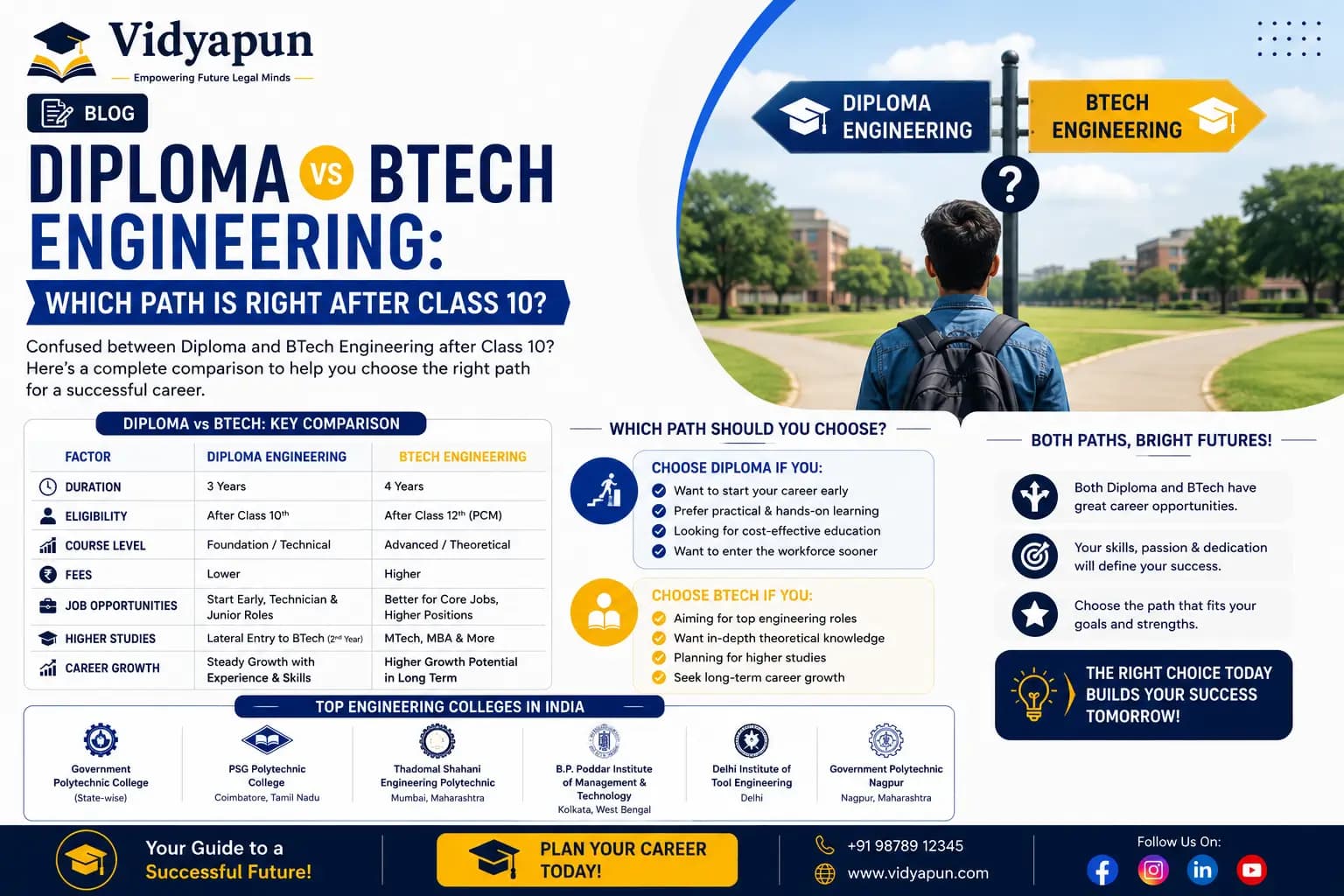
Diploma vs BTech: The Key Differences at a Glance
| Parameter | Diploma in Engineering | BTech Engineering |
|---|---|---|
| Entry Qualification | Class 10 | Class 12 (PCM) |
| Duration | 3 years | 4 years |
| Total Time from Class 10 | 3 years | 6 years (2+4) |
| Approximate Total Cost | ₹30,000 – ₹1.5 Lakh | ₹3 Lakh – ₹15 Lakh+ |
| Focus | Practical and hands-on | Theoretical and conceptual |
| Job Level (Entry) | Technician, Junior Engineer | Engineer, Software Developer |
| Government Job Posts | JE Level | JE to AE Level |
| Higher Studies Option | BTech via lateral entry | MTech, MBA, MS abroad |
| Time to First Job | 3 years from Class 10 | 6 years from Class 10 |
This table tells part of the story. But numbers alone do not tell you which path is right for you.
Who Should Choose a Diploma After Class 10?
The diploma route makes genuine sense for a specific type of student. If any of the following describe your situation, the polytechnic path deserves serious consideration.
Your Family Needs You to Contribute Sooner
This is the most honest and most common reason — and there is zero shame in it. If your household needs you to be earning within three years rather than six or seven, a diploma gets you there. You will be job-ready at 18 or 19, and with the right skills, you can start supporting yourself and your family while many of your peers are still in college.
You Are Not Comfortable with Class 12 PCM
BTech requires strong Class 12 results in Physics, Chemistry, and Maths. If you are realistic about the fact that clearing PCM with decent marks — and then cracking a competitive entrance exam — is going to be a struggle, forcing yourself through that route can cost two extra years and still leave you with a weaker college option. A diploma taken seriously gets you further than a BTech from a poor-quality private college.
You Learn Better by Doing
Some people genuinely absorb technical knowledge through practice rather than textbooks and lectures. Polytechnic education is designed around that style of learning. If you were the kind of student who understood things best when you could actually see and touch them, diploma engineering suits your learning style better.
You Want to Start a Business Eventually
If your long-term goal is to run your own contracting, manufacturing, or technical services business, a diploma gives you the practical knowledge and the earlier start. Many successful electrical contractors, civil construction supervisors, and IT service providers in India started with a polytechnic diploma — not an engineering degree.
Who Should Choose BTech After Class 12?
BTech is the right choice when the following apply to your situation.
You Want to Work in Top IT or Core Engineering Companies
Large IT firms like TCS, Infosys, Wipro, and HCL primarily recruit BTech graduates from campus. Core engineering companies — L&T, BHEL, Siemens India, Tata Motors — hire at the Engineer level from BTech programmes. If your ambition is to work in these organisations, a BTech is effectively a prerequisite.
You Are Targeting Competitive Government Exams at Higher Levels
UPSC ESE (Engineering Services Examination), Group A engineering posts in Railways, and Senior Engineer cadre in PSUs require a full engineering degree. Diploma holders can access Junior Engineer posts, but the ceiling is lower without a BTech.
You Want the Option of Higher Studies
MTech, MBA from IIMs, MS from foreign universities — all of these require a bachelor's degree as the entry qualification. If you think you might want to pursue advanced studies five or six years from now, a BTech keeps those doors open in a way that a diploma alone does not.
Your Family Can Support Four More Years of Education
This is practical, not elitist. BTech costs more and takes longer. If you have the family support — financially and in terms of time — to go through Class 11, Class 12, entrance exam preparation, and four years of college, and if a good college is accessible to you, the long-term return on that investment is real.
The Lateral Entry Bridge: The Option Most Students Miss
Here is something that does not get talked about enough when people debate diploma vs BTech engineering.
You do not have to choose one and give up the other permanently.
AICTE allows diploma holders to seek lateral entry into the second year of BTech. This means if you complete a Diploma in Mechanical Engineering, for example, you can apply for second-year admission to BTech Mechanical Engineering — skipping the first year and finishing your degree in three additional years rather than four.
What this means practically: a student who does a diploma after Class 10 can still end up with a BTech degree by age 21 or 22 — roughly the same age as someone who went the Class 12 + BTech route directly. And along the way, they have already had industrial training, real lab experience, and often some actual work exposure.
Lateral entry seats have lower competition than direct BTech admissions in most states, and diploma holders often perform well because they have a more practical foundation. This pathway is genuinely underused, and it is worth factoring into your decision.
Cost Comparison: What Are You Actually Paying?
Money matters, and it is worth being direct about this.
A government polytechnic diploma typically costs between ₹30,000 and ₹1.5 lakh for the full three years — that includes tuition and most fees. Private polytechnics are more expensive but rarely cross ₹3–4 lakh for the full course.
A BTech from a government NIT or IIT costs ₹5–8 lakh for four years including hostel. From a decent private engineering college, you are looking at ₹6–15 lakh. From a low-ranked private college with minimal placement prospects, you might still pay ₹8–12 lakh and come out with very limited job options.
This is where the comparison gets important. A diploma from a good government polytechnic versus a BTech from a poor-quality private college — the diploma wins, both financially and in terms of employment outcomes. The BTech advantage is real only when the college is decent.
Job Market Reality: What Employers Actually Think
Here is an honest picture of how employers view diploma vs BTech candidates.
For technical field roles — site supervision, maintenance, installation, operations — employers often prefer diploma holders because they are more practically trained and are perceived as less likely to leave for a desk job the moment one comes along.
For software development, design engineering, and corporate roles — BTech is preferred, and in many large companies it is a hard filter in the application system.
For government jobs — both are eligible for Junior Engineer posts, but BTech holders have access to higher-level recruitment and promotional avenues.
The honest truth is that in India's job market, a diploma with strong skills beats a BTech with weak skills almost every time at the entry level. Employers at small and medium companies — which is where most fresh graduates actually get hired — care more about what you can do than what your degree says.
Frequently Asked Questions (FAQs)
Q1. Is diploma better than BTech after Class 10? Neither is universally better — it depends on your financial situation, career goals, and learning style. Diploma gets you employed faster and costs less. BTech opens more doors long-term. Many students combine both via lateral entry.
Q2. Can I do BTech after completing a diploma in engineering? Yes. AICTE's lateral entry scheme allows diploma holders direct admission to the second year of BTech. This pathway is available in almost all state universities and has lower competition than regular BTech admissions.
Q3. What is the salary difference between diploma and BTech engineers? At entry level, BTech engineers in IT companies earn ₹3–6 LPA while diploma holders in technical roles earn ₹1.5–3 LPA. However, in field-based and government roles, the gap narrows significantly — especially with 3–5 years of experience.
Q4. Which is better for government jobs — diploma or BTech? Both qualify for Junior Engineer posts in Railways, SSC JE, and state PWD/electricity board exams. BTech holders additionally qualify for higher-level posts like Assistant Engineer and Engineering Services (UPSC ESE). For JE-level jobs specifically, diploma holders are equally competitive.
Q5. Is diploma in engineering worth it in 2025? Yes, especially from a government polytechnic. The practical training, early employment, low cost, and lateral entry option make it a genuinely strong choice for students who cannot or do not want to wait six years to start working.
Q6. What are the disadvantages of diploma compared to BTech? Lower starting salary in corporate roles, fewer options at top IT companies, limited eligibility for higher-level government posts, and less social recognition in some professional environments. These are real — but not insurmountable.
Q7. Which engineering stream is best for diploma after Class 10? It depends on your interest, but Civil, Electrical, Mechanical, and Computer Science diplomas consistently have the most job opportunities and government recruitment activity across India.
So, Which Path Is Right for You?
Here is the simplest way to think about it.
Choose diploma if: You need to start earning within three years, you learn better practically, your family budget is limited, or you want to go into technical field work or start your own business eventually.
Choose BTech if: You want corporate IT or core engineering jobs, you are targeting higher-level government exams, your family can support four more years, and you have the academic strength for Class 12 PCM plus entrance exams.
Consider diploma first, then BTech via lateral entry if: You want practical experience early, want to keep degree options open, and are comfortable with a slightly longer combined timeline.
There is no universally correct answer here. The right choice is the one that fits your actual circumstances — not the one that sounds most impressive at a family gathering.
Still weighing your options? Start by being honest about two things — your family's financial situation and what kind of work genuinely interests you. Then look at AICTE-approved government polytechnics and state engineering colleges in your area, compare what they actually offer in terms of labs, placements, and faculty, and make your decision based on real information rather than peer pressure or assumptions. Your career is long — three years either way is not wasted if you choose thoughtfully and work seriously.
Website: www.vidyapun.com
Call / WhatsApp: +91 96438 02216