
Job listings for law graduates use titles like "Legal Associate," "Junior Counsel," "Paralegal," and "Legal Executive" almost interchangeably — but they're not the same role, don't require the same qualifications, and don't lead to the same career trajectory. Here's what each one actually means before you apply.
Legal Associate
The most common entry-level title at law firms. A Legal Associate typically works under a senior associate or partner, handling legal research, drafting, due diligence, and client-facing work under supervision.
- Typical employer: Law firms, from boutique practices to Tier-1 firms
- Qualification needed: A completed LLB or BA LLB, usually with Bar Council enrolment expected or in progress
- Career trajectory: Associate → Senior Associate → Principal Associate → Partner, the standard law firm ladder
Junior Counsel
Usually refers to a lawyer assisting a senior advocate or designated counsel in litigation matters — drafting pleadings, assisting with case research, and sometimes appearing in lower courts independently as experience grows.
- Typical employer: A senior advocate's chamber, or occasionally an in-house legal team's litigation function
- Qualification needed: LLB/BA LLB with Bar Council enrolment (you need to be enrolled as an advocate to appear in court)
- Career trajectory: Junior Counsel → Independent practice or Senior Counsel status over many years, or a shift toward designated senior advocate status eventually
Paralegal
A support role that assists lawyers with research, document preparation, and case management — but does not require Bar Council enrolment and generally cannot represent clients in court.
- Typical employer: Law firms, in-house legal departments, and legal process outsourcing (LPO) companies
- Qualification needed: A law degree helps but isn't always mandatory depending on the employer; paralegal-specific certifications also exist
- Career trajectory: Often a stepping stone role, sometimes used by those still completing their degree or bar enrolment, or as a distinct long-term career for those who prefer research-heavy work without court appearances
Legal Executive
A broader, less standardised title — usually found in companies rather than law firms, covering compliance support, contract review, and basic legal administration for a business.
- Typical employer: Corporates, banks, and startups with smaller in-house legal teams
- Qualification needed: Varies significantly by company; some require a law degree, others accept relevant experience without one
- Career trajectory: Legal Executive → Legal Manager → Legal Counsel / Company Secretary track at some organisations, though this varies a lot by company size and structure
Legal Researcher
A role focused specifically on research output — case law analysis, comparative legal research, or policy research — rather than client-facing or drafting work.
- Typical employer: Law firms, think tanks, judges' chambers (as a law clerk), NGOs, and academic institutions
- Qualification needed: LLB/BA LLB; strong research and writing skills matter more here than Bar Council enrolment
- Career trajectory: Often a path toward academia, policy work, or judicial clerkships rather than traditional practice
Judicial Law Clerk
A research and drafting support role for a sitting judge, typically at the High Court or Supreme Court level.
- Typical employer: High Courts and the Supreme Court, through their respective clerkship programs
- Qualification needed: A completed law degree, usually selected through a competitive application process specific to each court
- Career trajectory: Often a launchpad — clerkship alumni frequently move into litigation, academia, or policy roles with a strong credential boost
Compliance Associate / Analyst
An entry-level role focused on regulatory compliance rather than litigation or transactional law — increasingly common as companies build out dedicated compliance functions.
- Typical employer: Banks, NBFCs, insurance companies, and larger corporates
- Qualification needed: A law degree is valued but not always mandatory; some compliance-specific certifications can substitute or supplement it
- Career trajectory: Compliance Associate → Compliance Manager → Chief Compliance Officer track at larger organisations
How to Tell Which Role Actually Fits a Job Posting
Job titles alone are unreliable — always check the actual job description for:
- Whether court appearance or litigation exposure is expected (a signal it's genuinely a Junior Counsel-type role, regardless of title)
- Whether Bar Council enrolment is a stated requirement (if not, it may functionally be a paralegal or research-support role)
- Who you'd report to and what the day-to-day deliverables are — this tells you more than the title itself
Frequently Asked Questions
1. What is the difference between a Legal Associate and a Paralegal? A Legal Associate typically requires a law degree and Bar Council enrolment (or enrolment in progress) and takes on more substantive legal work; a Paralegal supports lawyers with research and documentation but doesn't need bar enrolment and can't represent clients in court.
2. Do I need to be enrolled with the Bar Council for these entry-level roles? It depends on the role — Legal Associate and Junior Counsel positions generally expect it (especially if court appearances are involved), while Paralegal, Legal Researcher, and Compliance Associate roles often don't require it.
3. What does a Judicial Law Clerk actually do? Assists a judge with legal research, case analysis, and drafting orders or judgments — a research and writing-heavy role rather than an advocacy one.
4. Is "Legal Executive" the same as "Legal Associate"? No — Legal Executive is typically a corporate, in-house role focused on compliance and contract support, while Legal Associate is the standard law firm entry-level title.
5. Can a BA LLB graduate become a Compliance Associate without extra certification? Often yes, though some employers value additional compliance-specific certifications alongside the law degree — check the specific employer's requirements.
6. Which entry-level legal role is best for someone who doesn't want to go to court? Paralegal, Legal Researcher, Legal Executive, and Compliance Associate roles generally involve little to no court appearance, unlike Legal Associate or Junior Counsel positions in litigation-focused settings.
Related Reading
For a broader look at career paths and how to choose between them, see our Litigation, Corporate, or Judiciary decision framework and Top Career Options After BA LLB. Explore the BA LLB Course page or check your Admission Chances.
🌐 Website: www.vidyapun.com 📞 Call / WhatsApp: +91 96438 02216
Free admission guidance
Tell us what you are looking for. A counsellor will call you.
Read next

BA LLB Campus Placements: What to Expect
A realistic guide to BA LLB campus placements — how the process works, what placement statistics actually mean, typical recruiters, and how to prepare.
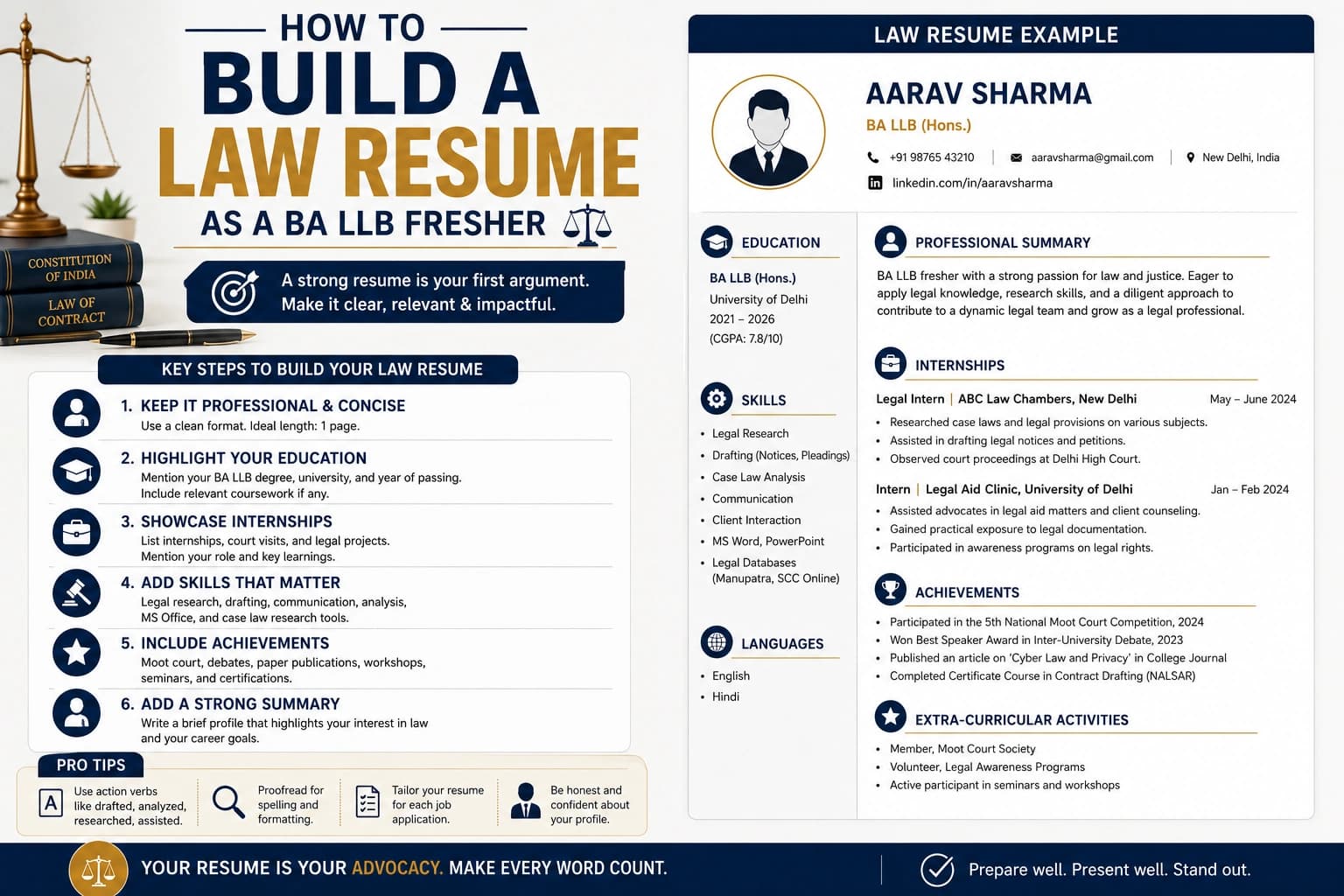
How to Build a Law Resume as a BA LLB Fresher
A practical, section-by-section guide to building a strong law resume as a BA LLB fresher — structure, internships, moot court, formatting, and mistakes to avoid.
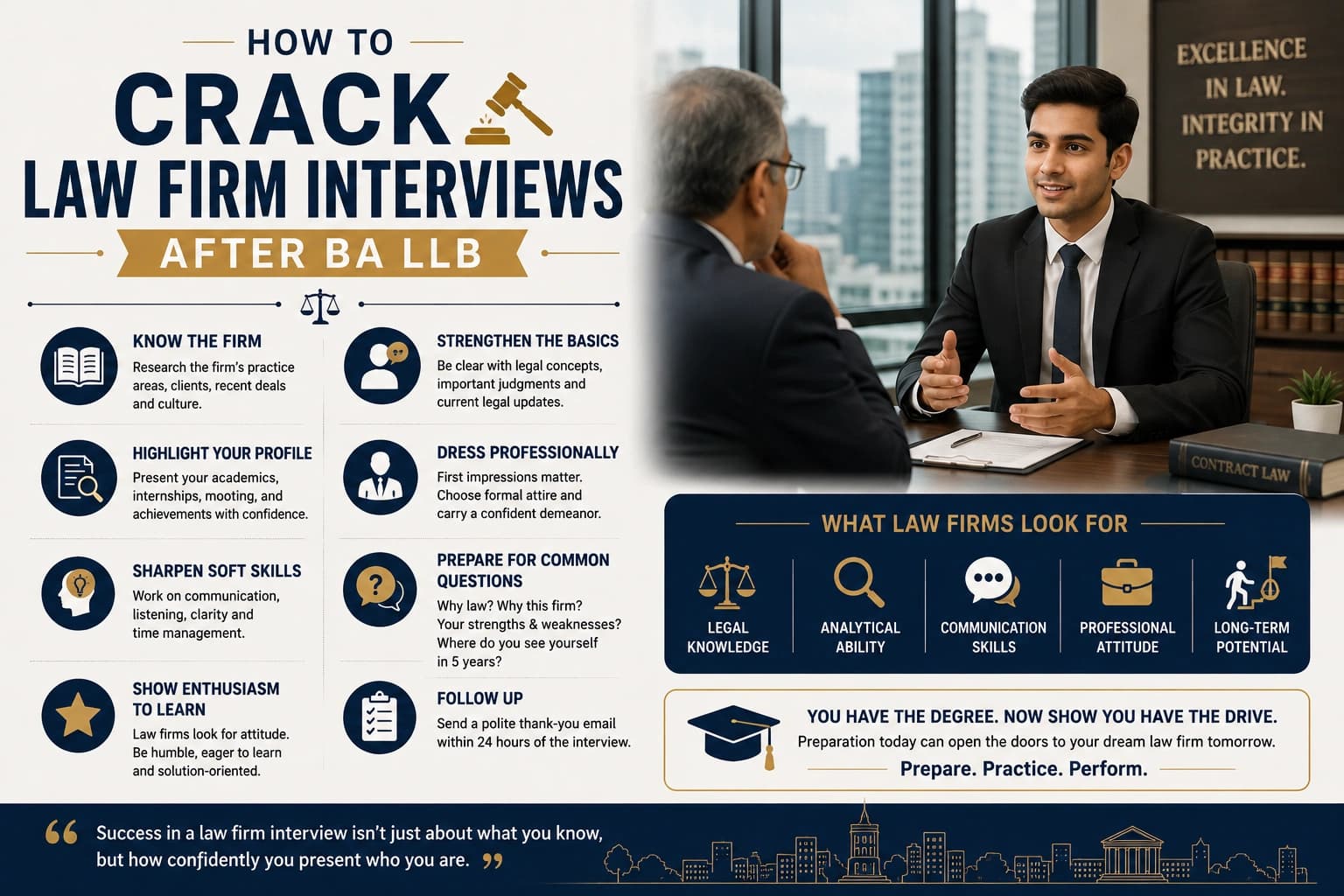
How to Crack Law Firm Interviews After BA LLB
A practical, step-by-step guide to preparing for and cracking law firm interviews after BA LLB — common questions, technical rounds, and mistakes to avoid.
Most read on Vidyapun
Comments
0No comments yet
Be the first to share your thoughts!