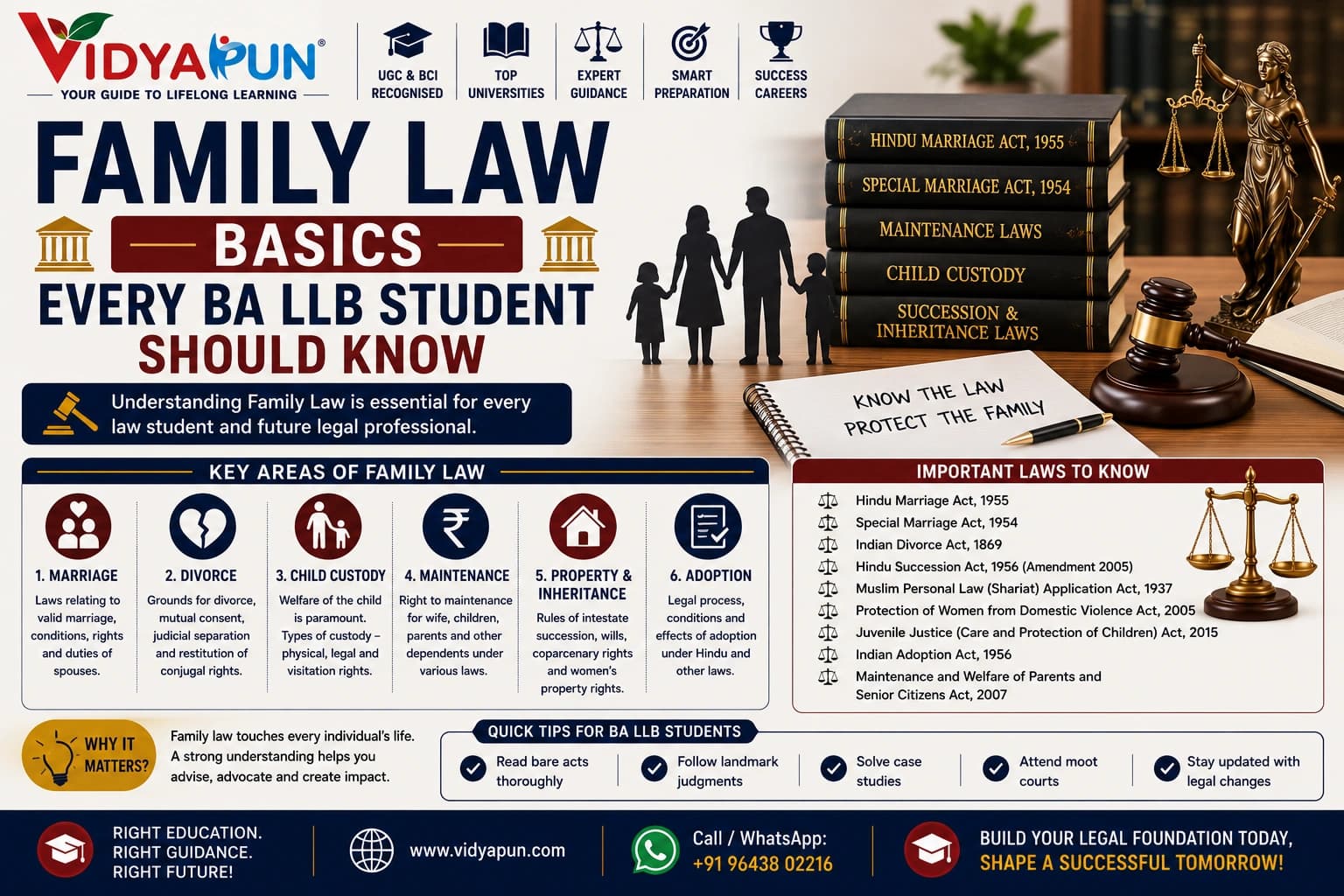
Family law is one of the first subjects in a BA LLB curriculum that feels immediately relevant — it touches marriage, divorce, custody, and inheritance, all things students can usually relate to from their own families or communities. But it's also a subject with more structural complexity than it first appears, given how many different personal laws operate side by side in India. This guide covers the essentials every BA LLB student should have a solid grip on.
Why Family Law Is a Core Subject in BA LLB
Family law sits at an unusual intersection of everyday life and legal doctrine, which is part of why it's treated as a foundational subject.
Personal Laws and Their Everyday Relevance
Unlike some more abstract subjects, family law directly governs situations most students will encounter personally or professionally at some point — marriage, divorce, inheritance — making it one of the more immediately relatable parts of the curriculum.
A Frequently Tested Subject in Exams and Interviews
Family law questions show up consistently in semester exams, moot court problems, and even internship interviews, since it's considered a core competency area for any general practitioner.
Sources of Family Law in India
India's family law framework is genuinely distinctive because it doesn't operate as a single unified code.
Religion-Based Personal Laws
Different religious communities in India are governed by their own personal laws on matters like marriage, divorce, and succession — Hindu law, Muslim law, Christian law, and Parsi law each have distinct statutory and customary sources.
Secular and Codified Family Laws
Alongside personal laws, certain statutes apply more broadly or provide a secular alternative — the Special Marriage Act being the clearest example, allowing interfaith or civil marriages outside religious personal law.
Marriage and Divorce Laws Every Student Should Know
This is usually the first substantive topic covered in a family law course, and it sets the foundation for everything after it.
Conditions and Registration of Marriage
Each personal law sets its own conditions for a valid marriage (age, consent, prohibited relationships), and understanding these conditions side by side is one of the most useful early comparisons a student can make.
Grounds and Procedure for Divorce
Divorce grounds and procedures also vary by personal law, though most systems now recognise similar broad categories — cruelty, desertion, and mutual consent being common across several statutes.
Maintenance, Custody, and Succession Basics
Beyond marriage and divorce, family law covers what happens to dependents, children, and property afterward.
Maintenance Rights Under Family Law
Maintenance provisions — both under personal laws and secular provisions like Section 125 of the Criminal Procedure Code — exist to ensure financial support for spouses, children, and dependent parents after separation or divorce.
Child Custody and Succession Basics
Custody law generally centres on the "best interest of the child" standard, while succession law (governing inheritance) again varies significantly by personal law, making this one of the more comparison-heavy areas of the subject.
Studying Family Law Effectively During BA LLB
Family law rewards a slightly different study approach than more doctrinally uniform subjects.
Building a Bare Act and Case Law Reading Habit
Since multiple statutes govern overlapping situations, get comfortable reading the actual bare acts (Hindu Marriage Act, Special Marriage Act, and others) rather than relying purely on textbook summaries, which can blur the distinctions between them.
Using Case Studies to Understand Practical Application
Work through real case law and hypothetical fact patterns regularly — family law concepts click far more easily when applied to a specific scenario than when studied as abstract rules.
Career Paths in Family Law After BA LLB
Family law leads to some genuinely distinct career paths compared to other specialisations.
Family Law Practice and Litigation
Family court litigation — handling divorce, custody, and maintenance matters — remains a steady, in-demand area of practice, often built through years of consistent client work rather than large firm placements.
Alternative Dispute Resolution in Family Matters
Mediation and conciliation are increasingly used in family disputes, creating a growing niche for lawyers interested in resolving matters outside a traditional courtroom setting.
Final Thoughts
Family law's biggest challenge for BA LLB students isn't complexity of concept — it's the sheer number of parallel systems (Hindu, Muslim, Christian, Parsi, and secular law) governing similar situations differently. Build your understanding by comparing these systems side by side, ground your learning in bare acts and case law rather than summaries alone, and you'll find this subject becomes one of the more practically useful parts of your degree.
Curious how your BA LLB profile is shaping up? Check Your Admission Chances with Vidyapun's free assessment tool.
Frequently Asked Questions
Q1. What is family law in the context of BA LLB?
A: Family law is the branch of law governing marriage, divorce, maintenance, custody, and succession, largely structured around different religion-based personal laws alongside certain secular statutes.
Q2. Why does India have different family laws for different religions?
A: India recognises distinct personal laws for different religious communities (Hindu, Muslim, Christian, Parsi) on family matters, alongside secular options like the Special Marriage Act for interfaith or civil marriages.
Q3. What are the common grounds for divorce across personal laws in India?
A: While specifics vary by statute, cruelty, desertion, and mutual consent are recognised as grounds for divorce across most of India's personal law systems.
Q4. How is child custody decided in Indian family law?
A: Custody decisions are generally guided by the "best interest of the child" standard, considered by courts alongside the specific provisions of the applicable personal law.
Q5. How should BA LLB students study family law effectively?
A: Read the actual bare acts rather than relying only on textbook summaries, and work through real case law and fact patterns to see how the concepts apply practically.
Q6. What career options exist in family law after BA LLB?
A: Family court litigation and alternative dispute resolution (mediation and conciliation) in family matters are two of the most common and steady career paths in this specialisation.
🌐 Website: www.vidyapun.com 📞 Call / WhatsApp: +91 96438 02216