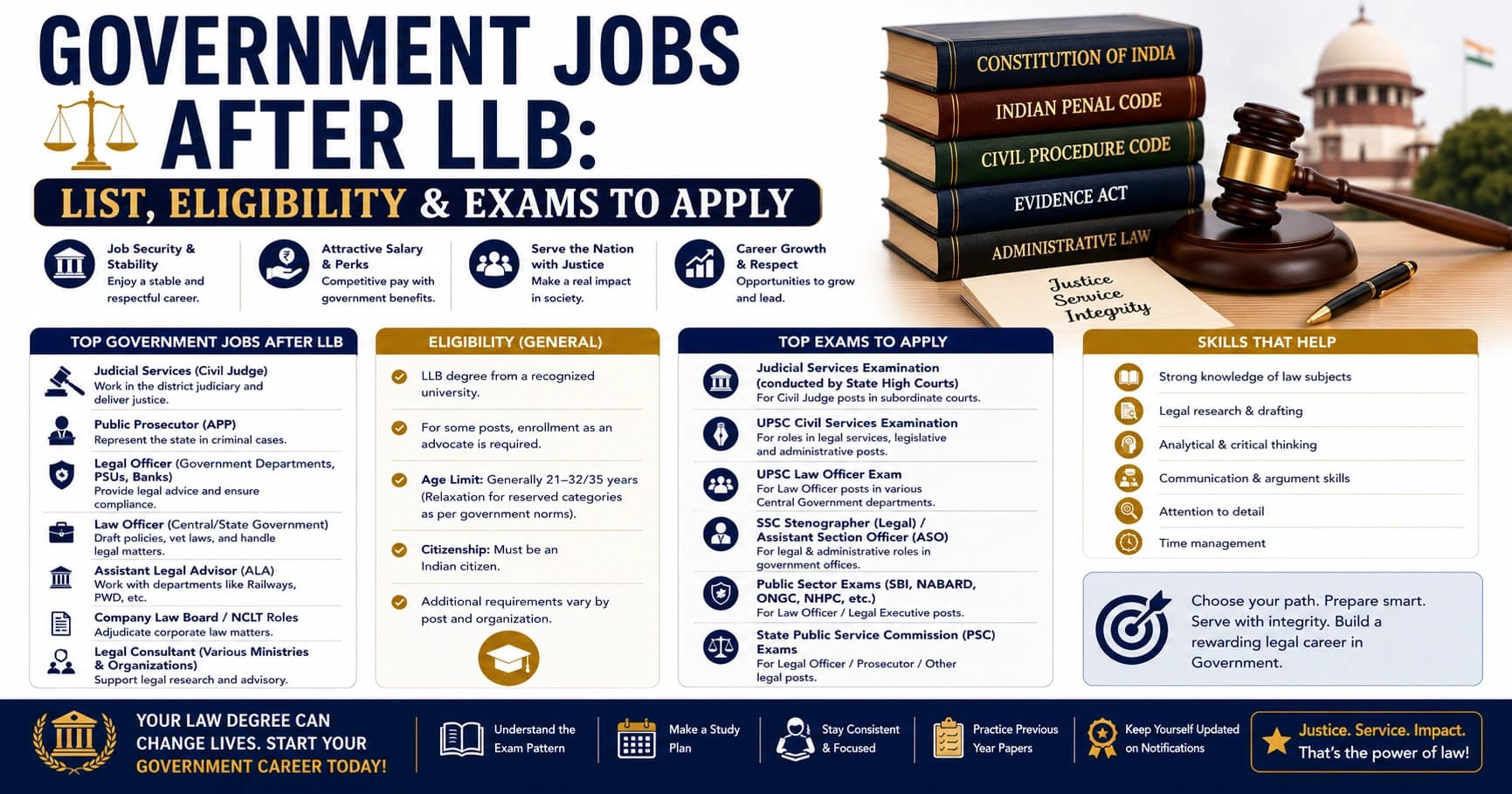
Government legal jobs after LLB fall into two broad categories: exams open only to law graduates (judiciary, public prosecutor), and exams open to any graduate that law graduates happen to compete well in (SSC, banking, RBI Grade B). Here's each route broken down by eligibility, exam structure, and how to actually apply.
For a broader overview of all career paths after LLB — including private-sector options — see our companion guide, Career After LLB in India.
Category 1: Exams Open Only to Law Graduates
Judicial Services Examination (PCS-J)
The primary route to becoming a Civil Judge or Judicial Magistrate, conducted separately by each state's public service commission or High Court.
- Eligibility: LLB degree with enrolment as an advocate under the Advocates Act, 1961 (most states require this; a few allow fresh graduates to apply directly — check your specific state's notification)
- Exam structure: Preliminary exam, main written exam, and a personal interview
- How to apply: Through the respective state public service commission's official notification and portal — timing and eligibility criteria vary meaningfully by state, so track your specific state's judicial service notification directly
Public Prosecutor / Assistant Public Prosecutor
State governments recruit prosecutors to represent the state in criminal cases.
- Eligibility: LLB degree, generally with a minimum number of years of practice as an advocate (the exact requirement varies by state)
- Exam structure: Typically a written test followed by an interview
- How to apply: Through the respective state's Public Service Commission recruitment notification
Indian Legal Service (ILS)
A central government service that provides in-house legal expertise across ministries and departments.
- Eligibility: LLB degree; specific age and experience criteria set by the recruiting body for each notified vacancy
- How to apply: Through UPSC or the relevant ministry's specific recruitment notification, as ILS vacancies are notified periodically rather than through a single standing annual exam
Category 2: PSU and Sector-Specific Legal Officer Roles
PSU Legal Officer (ONGC, SAIL, IOCL, PGCIL, and Similar)
Public Sector Undertakings regularly hire Law Officers to handle contracts, litigation, and regulatory compliance.
- Eligibility: LLB degree; some PSUs specify a minimum aggregate percentage or additional preferred experience
- Exam structure: Typically a written test, sometimes followed by a group discussion and interview — format varies by PSU
- How to apply: Through each PSU's own recruitment portal or a common recruitment exam some PSUs participate in — check individual PSU career pages directly, since there's no single unified exam covering all of them
RBI Grade B (Legal Officer, DEPR/DSIM Legal Stream)
The Reserve Bank of India recruits legal officers through its Grade B recruitment process.
- Eligibility: LLB degree with a minimum aggregate percentage specified in the RBI's official notification
- Exam structure: Written exam (typically in phases) followed by an interview
- How to apply: Through RBI's official recruitment portal when the notification is released — check RBI's official site directly for current-year eligibility figures, since these can be revised
Bank Legal Officer (Public Sector Banks)
Several public sector banks recruit specialist legal officers through IBPS or their own specialist officer recruitment process.
- Eligibility: LLB degree, generally with a minimum aggregate percentage
- Exam structure: Written exam (often through IBPS SO) followed by an interview
- How to apply: Through IBPS's specialist officer recruitment notification or the specific bank's own portal
Railway and Defence Legal Roles
Indian Railways and the defence sector occasionally recruit for legal assistant or legal officer positions (distinct from the Army JAG entry scheme, which is a separate commissioned officer route).
- Eligibility and process: Vary significantly by the specific recruiting body and vacancy — these aren't standing annual exams in the way judiciary or RBI Grade B are, so watch specific recruitment board notifications (Railway Recruitment Board, respective defence department) rather than assuming a fixed annual cycle
Category 3: General Graduate Exams Where Law Graduates Compete Well
Staff Selection Commission (SSC) Exams
Several SSC exams (CGL and others) are open to any graduate, including LLB holders, for various central government administrative and legal-support roles.
Civil Services Examination (UPSC)
Open to any graduate; legal training is often considered an advantage for the compulsory law and governance-related portions of the exam, though it isn't a law-specific route.
Age Limit and Reservation Notes
Age limits and reservation policy vary by specific exam and recruiting body — general category age limits for most of these exams commonly sit in the mid-to-late 20s to early 30s range, with standard relaxations for reserved categories, though exact figures differ by exam. See our LLB Reservation Policy guide for the general reservation framework, and always confirm the specific exam's current notification for exact age and category criteria.
How to Prepare: A General Strategy Across These Exams
- Start with bare acts and core subjects relevant to your target exam (Constitutional Law and CrPC/IPC matter heavily for judiciary and prosecutor exams specifically)
- Practice answer writing, not just reading, for the main/written stages — most of these exams are evaluated on structured written responses, not just objective questions
- Track official notifications directly, since these exams don't follow one unified national calendar the way CLAT does — missing a notification window is one of the most common, entirely avoidable mistakes
- Prepare for the interview stage separately — legal knowledge alone doesn't carry you through a personal interview; judicial temperament and communication matter distinctly
Frequently Asked Questions
1. Do I need to be enrolled as an advocate to apply for the judiciary exam?
Most states require enrolment under the Advocates Act, 1961, though a few states allow fresh LLB graduates to apply directly — check your specific state's current notification.
2. Which government legal jobs don't require prior practice experience?
PSU legal officer roles, RBI Grade B, and bank legal officer positions generally don't require prior practice experience, unlike judiciary and public prosecutor roles in most states.
3. Is there one common exam for all PSU legal officer jobs?
No — each PSU generally runs its own recruitment process, though some participate in common recruitment exams. Check individual PSU career pages for current openings.
4. What is the eligibility for RBI Grade B Legal Officer?
An LLB degree with a minimum aggregate percentage specified in RBI's official notification — confirm the current-year figure directly with RBI, since it can be revised.
5. Can a fresh LLB graduate apply for the Indian Legal Service?
Eligibility depends on the specific notified vacancy's age and experience criteria, which vary — check the specific ILS recruitment notification rather than assuming a fixed standing eligibility.
6. Are government legal jobs more stable than private practice?
Generally yes, offering structured pay scales, job security, and defined promotional paths, though typically with a lower long-term income ceiling than a highly successful independent litigation practice or senior corporate partnership.
7. How is the judiciary exam different from the public prosecutor exam?
The judiciary exam qualifies you to become a judge (a decision-making role), while the public prosecutor exam qualifies you to represent the state in criminal prosecutions (an advocacy role) — different eligibility norms and exam structures apply to each.
8. Do reservation benefits apply to these government legal exams?
Yes, standard central or state reservation policies (SC/ST/OBC/EWS/PwD) generally apply, though exact percentages and age relaxations vary by exam and recruiting body.
Related Reading
For the broader picture of career paths after LLB, see Career After LLB in India. For reservation policy details relevant to these exams, see LLB Reservation Policy Explained. Explore the LLB Course page for broader planning.
🌐 Website: www.vidyapun.com 📞 Call / WhatsApp: +91 96438 02216