
If you're pursuing a BA LLB, internships aren't optional extras — they're where most of your practical legal skills actually get built. Yet a surprising number of students reach their third or fourth year without a clear strategy for finding law internships, and end up scrambling right before placements. This guide walks through when to start, where to look, how to apply, and how to make each internship count.
Why Internships Matter During Your BA LLB
Classroom learning gives you the theory. Internships are where you find out what legal practice actually looks like day to day.
Building Practical Legal Skills
Drafting, client interaction, case research, and courtroom observation are skills you simply can't fully develop from lectures alone — internships are where theory starts turning into practical competence.
Strengthening Your Resume and Network
Every internship adds a credible line to your resume and, more importantly, a professional contact who can vouch for your work later — whether for your next internship, a reference letter, or eventually a job offer.
When to Start Looking for Law Internships
Timing your internship search well makes a real difference to the quality of opportunities you get access to.
Ideal Timeline Across Your 5 Years
Most successful BA LLB students start with smaller, local internships (NGOs, trial courts, individual advocates) in years 1–2, then move toward law firms and litigation chambers in years 3–4, and use their final year for internships that could convert into a job offer.
Semester Breaks vs Ongoing Internships
Short semester-break internships (2–6 weeks) are the most common format, but if your college allows it, a longer ongoing internship alongside coursework can give you deeper exposure to a single practice area.
Where to Find Law Internships
Opportunities are more varied than most students realise — it's rarely just about applying to the biggest law firms.
Law Firms and Litigation Chambers
Corporate law firms, boutique litigation practices, and individual advocates all take interns, often through direct email applications, referrals from professors, or listings on legal internship portals.
Corporate Legal Departments, NGOs, and Government Offices
In-house legal teams at companies, human rights and legal-aid NGOs, and government legal departments also offer valuable (and often less competitive) internship opportunities that expose you to a different side of legal practice than firm life.
How to Apply for a Law Internship
A strong application matters as much as where you apply.
Building a Strong CV and Cover Letter
Keep your CV to one page, lead with relevant coursework, moot court experience, and any prior internships, and tailor your cover letter to the specific practice area of the firm or organisation you're applying to — generic applications rarely get shortlisted.
Using Internship Portals and College Placement Cells
Legal internship portals, LinkedIn, and your college's placement or internship cell are usually your fastest routes to verified opportunities — check with your placement cell early, since many law firms send openings directly to colleges before posting them publicly.
Making the Most of Your Internship
Getting the internship is only half the work — what you do with it matters just as much.
Setting Goals for Each Internship
Go in with 2–3 specific things you want to learn (a particular area of law, a skill like drafting, or exposure to court procedure), so you leave with more than just a certificate.
Turning Internships into References and PPOs
Stay in touch with your supervising advocate or associate after the internship ends — a short thank-you note and occasional updates keep the door open for a strong reference or, in some cases, a pre-placement offer (PPO) later.
Common Mistakes to Avoid While Applying
A few avoidable habits account for most rejected or ignored applications.
Applying Too Late or Too Broadly
Sending applications only a week or two before you want to start, or mass-emailing generic CVs to dozens of firms at once, both significantly reduce your response rate compared to targeted, well-timed applications.
Not Following Up After Applying
A polite follow-up email a week or two after your initial application can make the difference between being overlooked and getting a response, especially at smaller firms and chambers that don't have a formal recruitment process.
Final Thoughts
Finding the right law internships during your BA LLB comes down to starting early, applying strategically rather than broadly, and treating each internship as a chance to build both skills and relationships — not just a line on your resume. The students who build the strongest legal careers are usually the ones who took their internship search seriously from year one.
Curious what your BA LLB admission and internship prospects look like based on your profile? Check Your Admission Chances with Vidyapun's free assessment tool.
Frequently Asked Questions
1. When should I start applying for law internships during BA LLB? Start as early as your first or second year with smaller, local opportunities, and move toward law firms and litigation chambers by your third and fourth years as your CV and skills develop.
2. Where can I find law internship opportunities as a BA LLB student? Law firms, litigation chambers, corporate legal departments, NGOs, government legal offices, legal internship portals, LinkedIn, and your college's placement cell are all reliable sources.
3. How long should a law internship typically last? Most internships run 2–6 weeks during semester breaks, though longer ongoing internships are possible at some colleges and can offer deeper exposure to a practice area.
4. Do law firms pay BA LLB interns? It varies — some law firms and corporate legal departments offer a stipend, while many litigation chambers and NGOs offer unpaid internships focused on learning and exposure instead.
5. How can a law internship turn into a job offer? Strong performance, staying in touch with your supervisor after the internship, and expressing continued interest in the organisation all improve your chances of a pre-placement offer (PPO) or referral later.
6. What should I include in my CV for a law internship application? Keep it to one page, highlight relevant coursework, moot court participation, prior internships, and any published or research work, and tailor it to the specific practice area you're applying to.
Free admission guidance
Tell us what you are looking for. A counsellor will call you.
Read next

BA LLB Campus Placements: What to Expect
A realistic guide to BA LLB campus placements — how the process works, what placement statistics actually mean, typical recruiters, and how to prepare.
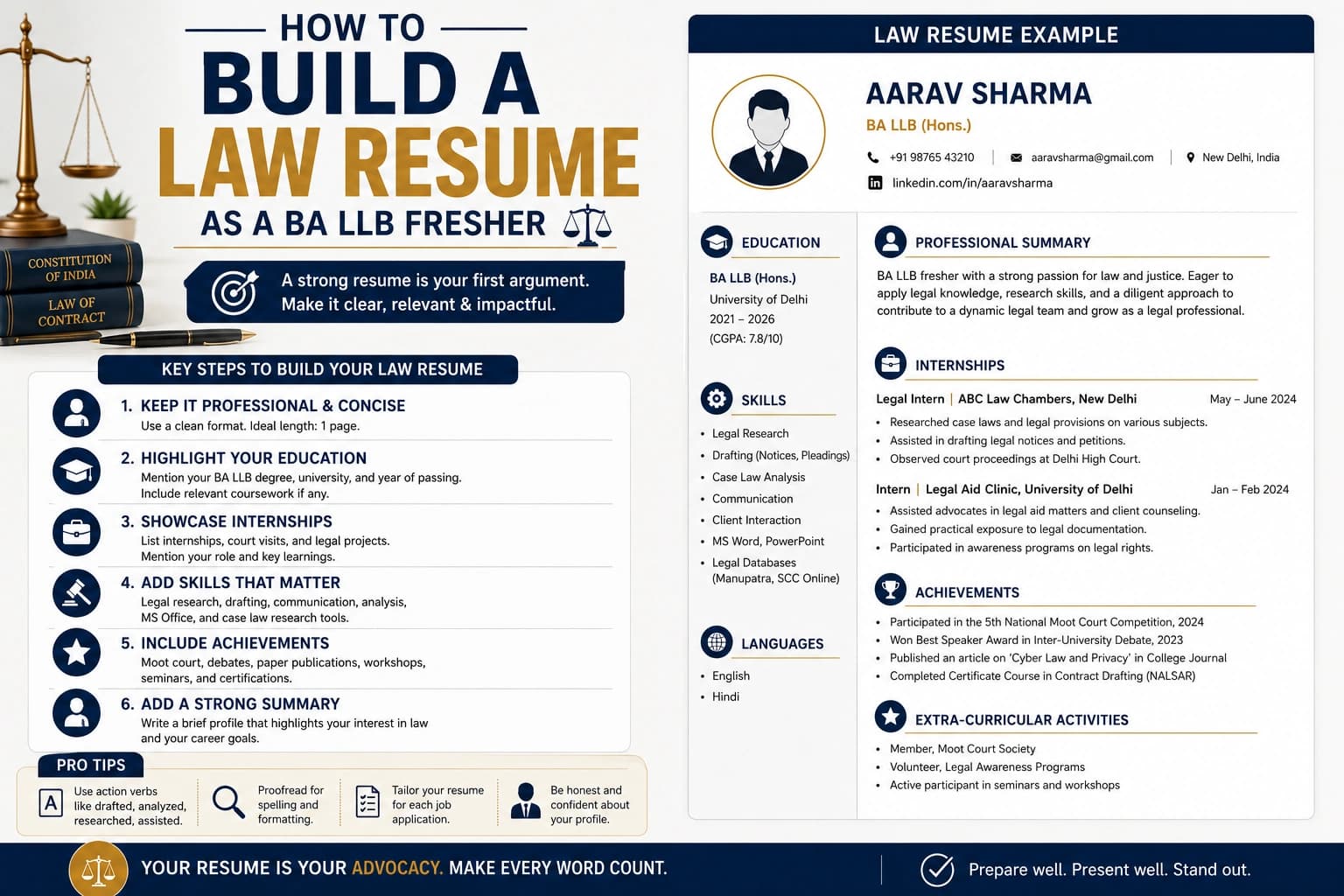
How to Build a Law Resume as a BA LLB Fresher
A practical, section-by-section guide to building a strong law resume as a BA LLB fresher — structure, internships, moot court, formatting, and mistakes to avoid.

How to Crack Law Firm Interviews After BA LLB
A practical, step-by-step guide to preparing for and cracking law firm interviews after BA LLB — common questions, technical rounds, and mistakes to avoid.
Most read on Vidyapun
Comments
0No comments yet
Be the first to share your thoughts!