
Legal writing is one of those skills law school assumes you'll pick up along the way, without ever really teaching it as a standalone subject in most curricula. Yet it's arguably the single most transferable skill across every legal career path — litigation, corporate practice, judiciary, or research — which makes it worth developing deliberately rather than hoping it improves by accident.
This guide covers what makes legal writing genuinely different, the core skills to build, and practical ways to actually improve, starting from wherever you are right now.
Why Legal Writing Is Different from Regular Academic Writing
Understanding this difference is the first step toward writing more effectively.
Precision Over Style
Legal writing prioritizes precision, clarity, and unambiguous meaning over stylistic flourish. A beautifully written sentence that leaves room for multiple interpretations is a liability in legal writing, whereas the same ambiguity might be acceptable — even valued — in creative or general academic writing.
Structure Matters as Much as Content
Legal documents follow expected structures — issue, rule, application, conclusion in case analysis; specific formats for pleadings, contracts, or memorials. Readers (professors, judges, senior advocates) expect information in a predictable order, and deviating from that structure makes your writing harder to follow, regardless of how strong the underlying content is.
Core Legal Writing Skills Every Law Student Needs
A few specific skills form the foundation of almost all legal writing you'll do.
Case Briefing and Summarization
Being able to distil a lengthy judgment into its key facts, issues, holding, and reasoning is a foundational skill that underlies almost everything else in legal writing — from exam answers to memorials to research papers.
Legal Drafting and Documentation
Drafting contracts, pleadings, notices, and other legal documents requires a different register than analytical writing — precise, formal, and following established conventions and formats specific to that document type.
How to Improve Legal Research That Feeds Your Writing
Strong legal writing is downstream of strong legal research — you can't write clearly about something you haven't researched thoroughly.
Using Primary and Secondary Sources Correctly
Learn to distinguish between primary sources (statutes, case law) and secondary sources (commentary, textbooks, articles), and build the habit of grounding your arguments primarily in primary sources, using secondary sources to support interpretation rather than as your main evidence.
Proper Legal Citation
Learn your university's required citation format early and apply it consistently. Inconsistent or incorrect citation is a common, easily avoidable weakness that undermines otherwise strong legal writing, especially in memorials and research papers.
Practical Exercises to Build Legal Writing Skills
Deliberate practice, not just passive reading, is what actually improves writing over time.
Rewriting and Editing Practice
Take a piece of your own writing from a few weeks earlier and rewrite it for clarity and conciseness — you'll often be surprised how much can be tightened without losing meaning. This editing muscle is one of the most transferable skills you can build, and it improves faster with deliberate practice than with time alone.
Practicing Through Moot Court Memorials
Moot court memorials are one of the best real practice grounds for legal writing, since they require structured argument, proper citation, and persuasive but precise language, all under a defined format and word limit.
Common Legal Writing Mistakes Students Make
Recognizing these patterns in your own writing is the first step to correcting them.
Overly Complex Sentences and Jargon
Long, convoluted sentences and unnecessary legal jargon often obscure meaning rather than demonstrating expertise. Strong legal writing tends to be more direct and readable than students initially assume, not less.
Weak Structure and Poor Organization
Jumping between points without clear logical flow, or failing to signal transitions between sections, makes even well-researched writing hard to follow. Outlining your argument's structure before writing is one of the simplest ways to avoid this.
Building a Long-Term Legal Writing Habit
Improvement here is genuinely cumulative — small, consistent habits compound over your five years.
Reading Judgments and Legal Commentary Regularly
Regularly reading well-written judgments and legal commentary — noticing how experienced writers structure arguments and use language precisely — builds an intuitive sense of good legal writing that's hard to develop through instruction alone.
Seeking Feedback from Professors and Peers
Actively seeking feedback on your writing, rather than only submitting for grading, accelerates improvement significantly. Professors and seniors who've reviewed hundreds of student submissions can often spot patterns in your writing that are hard to see in your own work.
Frequently Asked Questions
1. Why is legal writing different from regular academic writing?
Legal writing prioritizes precision and unambiguous meaning over stylistic flourish, and follows expected structures that readers rely on to locate information efficiently.
2. What are the core legal writing skills I should focus on first?
Case briefing and summarization, and legal drafting fundamentals — these underlie most of the legal writing you'll do throughout law school and beyond.
3. How does legal research improve legal writing?
Strong writing depends on strong research — knowing how to use primary versus secondary sources correctly and cite them properly directly strengthens the clarity and credibility of your writing.
4. What's the best way to practice legal writing during BA LLB?
Regularly rewriting and editing your own past work, and participating actively in moot court, which forces structured, properly cited, persuasive writing under real constraints.
5. What are the most common legal writing mistakes students make?
Overly complex sentences and unnecessary jargon, and weak organizational structure that makes even well-researched arguments hard to follow.
6. How can I keep improving my legal writing over time?
Read well-written judgments and legal commentary regularly to build intuition for good structure and language, and actively seek feedback from professors and peers rather than writing in isolation.
Ready to build strong foundational skills from day one? Explore full details on the BA LLB course page, or use Vidyapun's Admission Chances Predictor if you're still finalizing your college choice.
Still have questions about building your legal skills? Reach out to our counsellors directly.
🌐 Website: www.vidyapun.com 📞 Call / WhatsApp: +91 96438 02216
Free admission guidance
Tell us what you are looking for. A counsellor will call you.
Read next

BA LLB Campus Placements: What to Expect
A realistic guide to BA LLB campus placements — how the process works, what placement statistics actually mean, typical recruiters, and how to prepare.
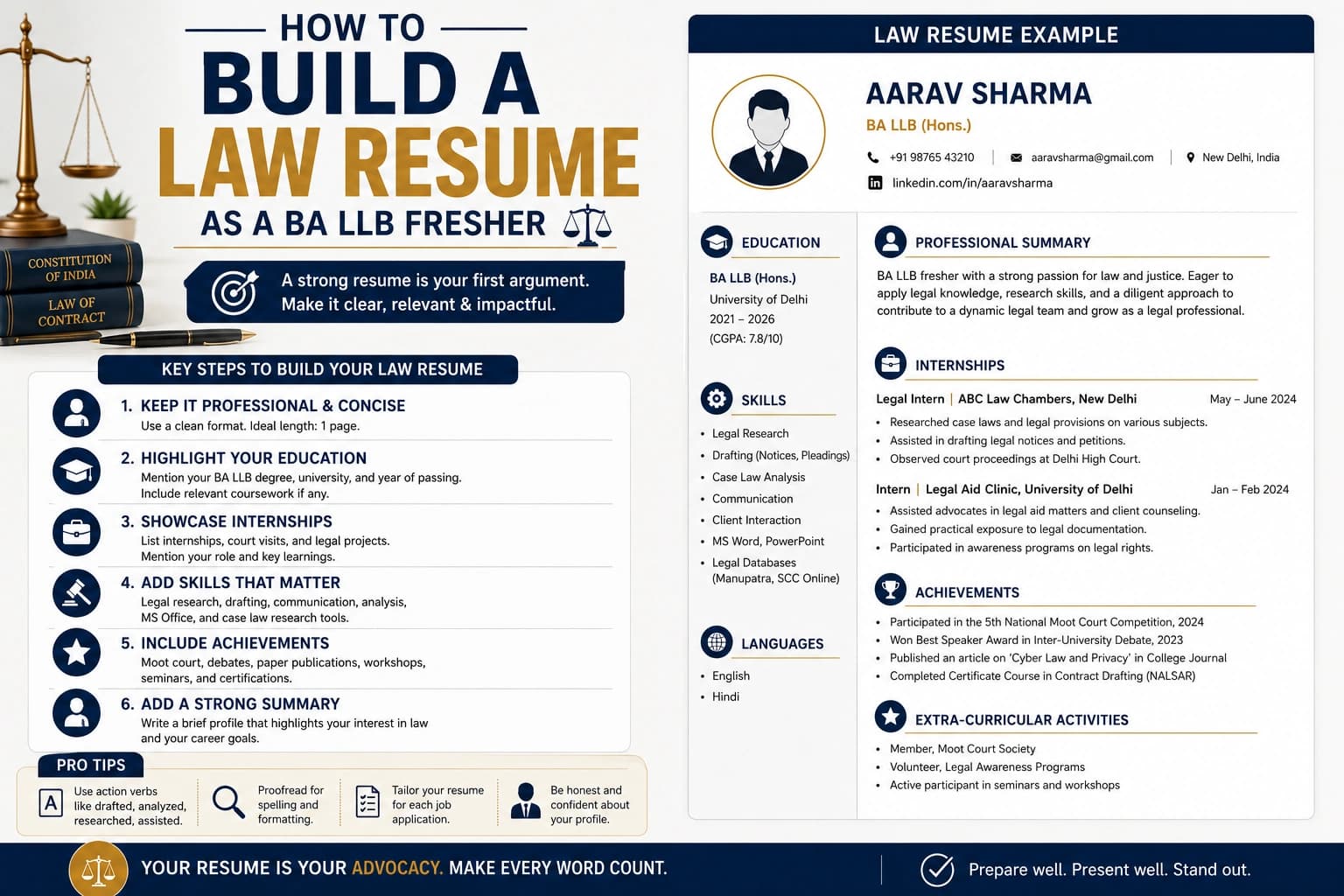
How to Build a Law Resume as a BA LLB Fresher
A practical, section-by-section guide to building a strong law resume as a BA LLB fresher — structure, internships, moot court, formatting, and mistakes to avoid.

How to Crack Law Firm Interviews After BA LLB
A practical, step-by-step guide to preparing for and cracking law firm interviews after BA LLB — common questions, technical rounds, and mistakes to avoid.
Most read on Vidyapun
Comments
0No comments yet
Be the first to share your thoughts!