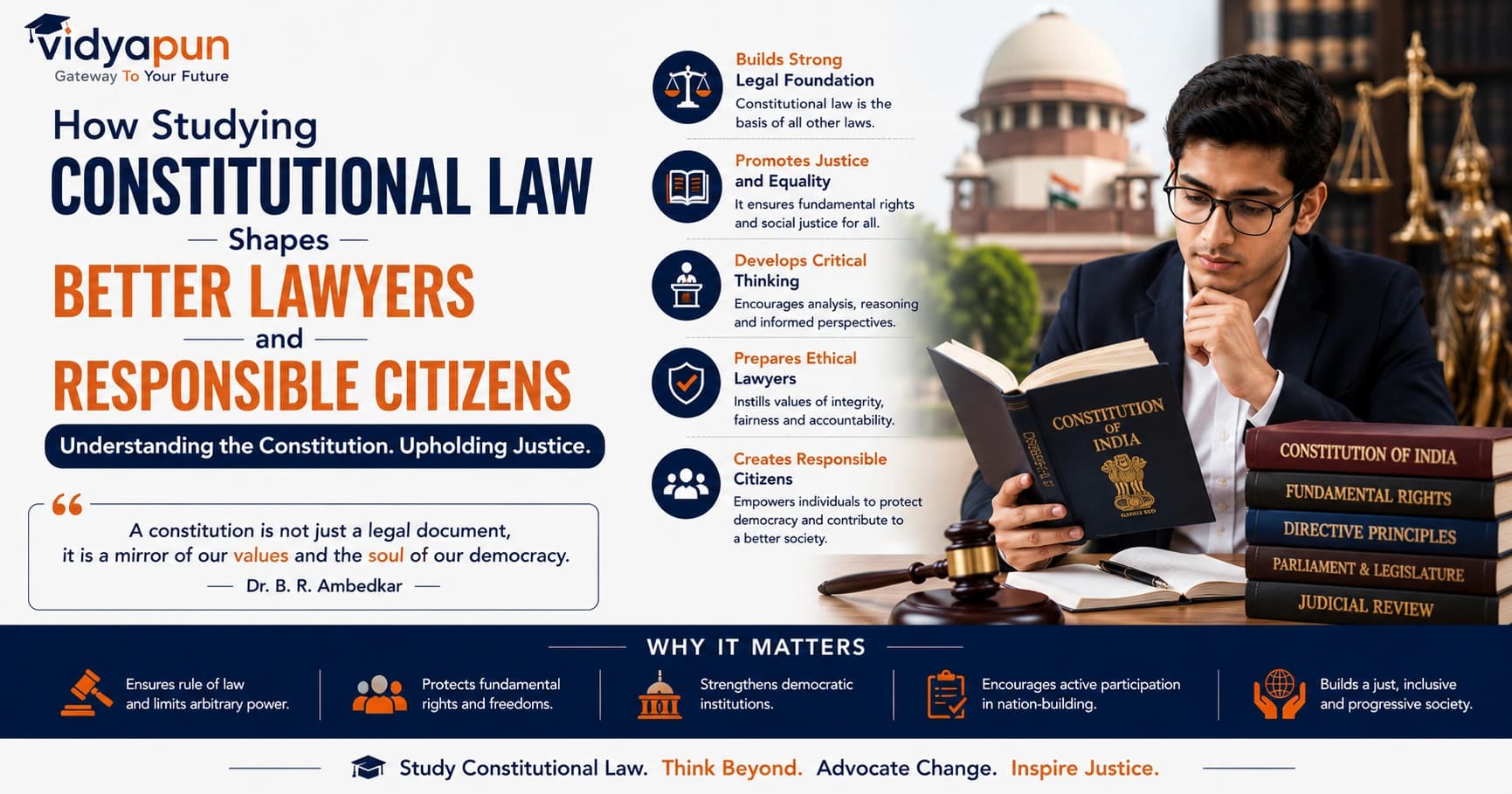
Among all the subjects taught during a BA LLB programme, Constitutional Law stands as the foundation of legal education. It introduces students to the principles that govern the nation, define the powers of public institutions, and protect the rights of individuals.
For every aspiring lawyer, understanding Constitutional Law is not just about passing examinations. It is about learning how justice, governance, equality, and the rule of law function in everyday life.
Whether students plan to work in litigation, corporate law, public policy, academics, or legal consultancy, a strong understanding of Constitutional Law provides knowledge that supports every stage of a legal career.
What is Constitutional Law?
Constitutional Law is the branch of law that explains how a country's Constitution operates and how government institutions exercise their powers.
It covers subjects such as:
- Fundamental Rights
- Directive Principles of State Policy
- Fundamental Duties
- Structure of Government
- Separation of Powers
- Judicial Review
- Federalism
- Constitutional Remedies
These principles form the backbone of India's legal and democratic system.
Why Every BA LLB Student Should Master Constitutional Law
Constitutional Law influences almost every area of legal practice.
A solid understanding helps students:
- Interpret legislation correctly
- Understand judicial reasoning
- Analyse public policy
- Protect constitutional values
- Develop balanced legal opinions
- Build strong analytical skills
The subject also encourages students to think critically about law and governance.
Understanding Fundamental Rights
One of the first concepts students encounter is Fundamental Rights.
These rights ensure the protection of individuals by guaranteeing freedoms and equality under the Constitution.
Students study areas including:
- Right to Equality
- Right to Freedom
- Protection against Exploitation
- Freedom of Religion
- Cultural and Educational Rights
- Constitutional Remedies
Understanding these rights enables future legal professionals to appreciate the importance of justice and individual liberty.
Learning the Structure of Government
Constitutional Law explains how different branches of government function together.
Students learn about:
- Legislature
- Executive
- Judiciary
- Constitutional Authorities
- Centre–State Relations
This knowledge provides clarity about the functioning of democratic institutions.
Building Strong Legal Reasoning
Constitutional cases often involve complex legal questions.
Studying them improves the ability to:
- Interpret constitutional provisions
- Compare legal arguments
- Analyse judicial decisions
- Apply constitutional principles
- Develop independent legal opinions
These skills are useful across every branch of law.
Reading Landmark Judgments
Constitutional Law encourages students to explore significant judicial decisions.
Reading judgments helps students understand:
- Judicial interpretation
- Constitutional evolution
- Legal reasoning
- Practical application of constitutional principles
Regular case analysis also strengthens legal research and writing abilities.
Connecting Law with Society
Unlike many academic subjects, Constitutional Law directly relates to everyday life.
Students understand how constitutional principles influence:
- Education
- Freedom of speech
- Equality
- Public administration
- Social justice
- Democratic participation
This broader understanding makes legal education more meaningful.
Developing Professional Ethics
Constitutional values inspire ethical legal practice.
Students learn the importance of:
- Fairness
- Equality
- Accountability
- Transparency
- Respect for the rule of law
Professional ethics remain essential throughout a legal career.
Essential Skills Developed Through Constitutional Law
Studying Constitutional Law helps students strengthen numerous transferable skills.
Critical Thinking
Evaluating legal issues from multiple perspectives.
Legal Research
Studying constitutional provisions and judicial precedents.
Communication
Explaining complex constitutional concepts clearly.
Analytical Ability
Understanding relationships between laws and governance.
Decision-Making
Applying constitutional principles to legal questions.
Public Awareness
Understanding the legal rights and responsibilities of citizens.
Common Challenges Faced by Students
Many first-year law students initially find Constitutional Law challenging because of its detailed provisions and landmark judgments.
These challenges can be overcome by:
- Reading the Constitution regularly
- Creating chapter-wise notes
- Studying important judgments
- Participating in classroom discussions
- Revising key constitutional concepts consistently
Gradual learning builds confidence.
Effective Study Tips
To master Constitutional Law, students should:
- Read one constitutional topic daily.
- Maintain a judgment summary notebook.
- Understand concepts before memorising provisions.
- Revise important Articles regularly.
- Participate in legal discussions.
- Follow constitutional developments through reliable educational resources.
Consistency is the key to long-term understanding.
Why Choose Vidyapun?
Choosing the right university plays a major role in your legal education.
Vidyapun provides:
- BA LLB Admission Guidance
- LLB Admission Support
- University Comparison
- Eligibility Assessment
- Documentation Assistance
- Career Counselling
- Personalised Admission Support
- Guidance for Recognised Universities
Our experienced counsellors help students select universities that provide quality legal education and strong academic support.
Frequently Asked Questions
Why is Constitutional Law important in BA LLB?
It forms the foundation of legal education by helping students understand governance, constitutional rights, judicial interpretation, and the rule of law.
Is Constitutional Law useful for every legal career?
Yes. Constitutional principles influence many areas of legal practice and strengthen analytical and legal reasoning skills.
How can students improve in Constitutional Law?
Regular reading of the Constitution, studying landmark judgments, preparing notes, and revising important Articles can improve understanding.
Does Constitutional Law improve critical thinking?
Yes. Students learn to analyse legal issues, interpret constitutional provisions, and evaluate judicial reasoning from different perspectives.
How can Vidyapun help?
Vidyapun offers expert admission counselling, university comparison, documentation assistance, and personalised support for students pursuing BA LLB and LLB programmes.
Author Information
Reviewed by: Vidyapun Education Team
Conclusion
Constitutional Law is much more than an academic subject—it is the cornerstone of legal education. It equips BA LLB students with a deep understanding of governance, justice, rights, and democratic values while strengthening legal reasoning, research, and analytical abilities. Students who build a solid foundation in Constitutional Law are better prepared to excel throughout their legal education and contribute meaningfully to society.
Begin Your BA LLB Journey with Vidyapun
Planning to pursue a BA LLB from a recognised university?
Vidyapun provides expert admission guidance, university comparison, eligibility support, and personalised counselling to help you choose the right legal education pathway.
🌐 Website: www.vidyapun.com
📞 Call / WhatsApp: +91 96438 02216
Contact Vidyapun today and start building your future in legal education.