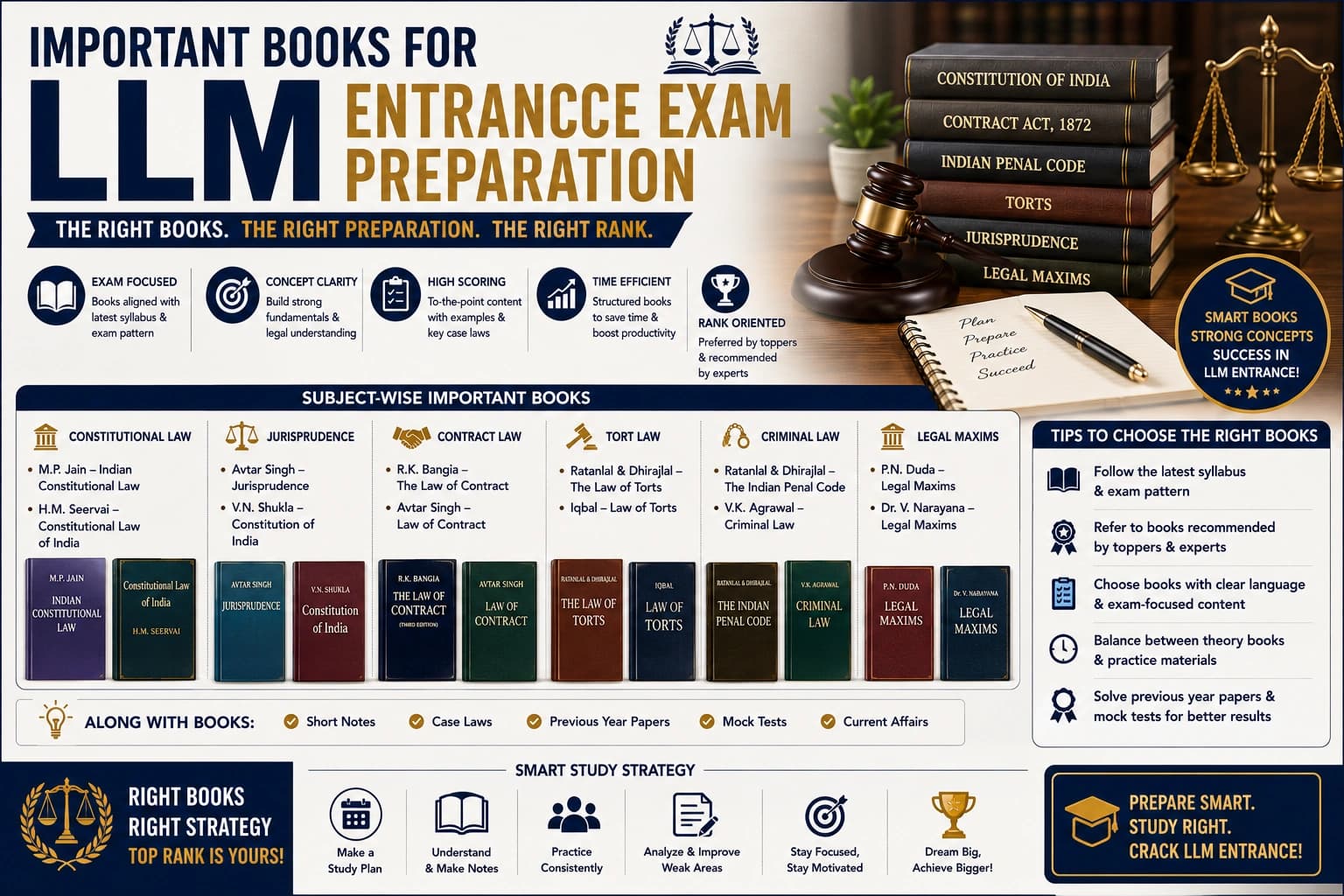
The good news about LLM entrance exam books is that you likely already own most of what you need — CLAT PG and AILET PG draw directly on standard LLB coursework, not a separate syllabus. This is a subject-wise breakdown of the textbooks consistently recommended by law aspirants and coaching resources, plus how to actually use them rather than just collect them.
Start With Bare Acts, Not Textbooks
Before any commentary or guidebook, the bare act itself is the foundation every serious aspirant is advised to build from.
Why Bare Acts Come First
Several questions in CLAT PG and AILET PG are drawn directly from statutory language — section numbers, specific provisions, exact wording — which no amount of secondary commentary substitutes for. Read the bare act of a subject before moving to any textbook on it.
Which Bare Acts Matter Most
The Constitution of India, the Indian Contract Act, the Indian Penal Code (or its successor, the Bharatiya Nyaya Sanhita, depending on current syllabus framing), and the Transfer of Property Act are consistently cited as high-priority bare acts across aspirant guides.
Constitutional Law: The Highest-Weightage Subject
Constitutional Law is repeatedly flagged as the single most heavily-weighted subject across CLAT PG and similar exams, so your book choice here matters more than for any other subject.
Standard Recommended Texts
M.P. Jain's Indian Constitutional Law and J.N. Pandey's Constitutional Law of India are the two most consistently recommended texts across aspirant resources; V.N. Shukla's Constitution of India and D.D. Basu's Introduction to the Constitution of India are also widely referenced alternatives.
How to Actually Use Them
Don't read a Constitutional Law textbook cover to cover as narrative — use it specifically to build context around provisions you've already read in the bare act, and to understand the reasoning behind landmark judgments you'll need to recall.
Jurisprudence: Where Aspirants Often Under-Prepare
Jurisprudence tends to be a weaker area for many LLB graduates, since it's philosophy-adjacent rather than procedural, and gets less attention relative to subjects like Contract or Torts.
Standard Recommended Texts
N.V. Paranjape's jurisprudence text is widely cited as an accessible starting point, with V.D. Mahajan's Jurisprudence and Legal Theory as a solid alternative or second reference.
A Practical Study Technique
Since jurisprudence tests recall of specific jurists and their theories, building a simple chart (jurist name, school of thought, key contribution) tends to work better than reading the text as continuous prose.
Law of Contracts and Torts
These two subjects come up consistently across nearly every version of the CLAT PG and similar syllabi.
Standard Recommended Texts for Contract Law
Avtar Singh's Law of Contract and R.K. Bangia's contract law text are the two names that appear most consistently across aspirant resources.
Standard Recommended Texts for Torts
Ratanlal & Dhirajlal's Law of Torts and R.K. Bangia's torts text are the standard references, often supplemented with the Consumer Protection Act given its overlap with tort principles.
Criminal Law (IPC / BNS)
Criminal law preparation should account for India's transition from the older codes to the newer criminal law framework.
Standard Recommended Texts
PSA Pillai's Criminal Law and Ratanlal & Dhirajlal's IPC commentary are the most consistently cited texts, though given the shift to the Bharatiya Nyaya Sanhita, confirm which framework your target exam's current syllabus references before relying heavily on older IPC-specific commentary.
Family Law and Property Law
Less heavily weighted than Constitutional Law or Contracts, but still a regular feature across LLM entrance syllabi.
Standard Recommended Texts
Poonam Pradhan's texts on family and property law are consistently referenced across aspirant resources for this subject cluster.
Building a Case Law Notebook Alongside Your Books
Textbooks alone aren't enough — case law recall is a heavily tested, separate skill.
Why a Separate Notebook Matters
Multiple aspirant guides independently recommend maintaining a dedicated notebook for landmark judgments — noting the case name, bench strength, key judges, and the ratio decidendi — rather than relying on textbook summaries alone, since exam questions sometimes probe specific details like a dissenting judge's name.
What to Prioritise in It
Focus especially on Constitutional Law landmark cases and any judgments from the past two to three years, since recent developments are frequently and specifically tested.
How to Sequence Your Preparation
Books alone don't create a study plan — sequencing matters just as much as content.
A Reasonable Reading Order
Bare act first, then the relevant textbook chapter, then your own case law notes for that topic, then practice questions specific to that subject — repeating this cycle subject by subject tends to work better than reading all textbooks first and practicing later.
Don't Neglect Previous Year Papers as Study Material in Their Own Right
Previous year papers aren't just for mock practice — reviewing which specific topics and case laws have actually been tested helps you prioritise your textbook reading time toward what's proven to matter.
Frequently Asked Questions
1. Do I need to buy new textbooks, or can I use my LLB course books?
In most cases, your existing LLB course textbooks for Constitutional Law, Contracts, Torts, and Jurisprudence are sufficient starting points — CLAT PG and similar exams draw directly on standard LLB coursework rather than a separate syllabus.
2. Which subject deserves the most book-reading time?
Constitutional Law is consistently flagged as the highest-weightage subject across CLAT PG and similar exams, making it the subject worth prioritising most in your reading schedule.
3. Are bare acts more important than textbooks?
Bare acts should generally be read first, since several questions test statutory language directly — textbooks then help you understand context, interpretation, and case law built around those provisions.
4. Is jurisprudence really necessary to prepare deeply, given it's a smaller section?
Yes — jurisprudence is commonly under-prepared precisely because it's a smaller, less procedural subject, which makes focused preparation here a genuine differentiator relative to other candidates.
5. Should I prepare from IPC or the Bharatiya Nyaya Sanhita?
Check your specific target exam's current syllabus notification, since India's criminal law framework has transitioned from the IPC to the BNS — older commentary may need to be cross-checked against the current framework.
6. How should I use a case law notebook alongside my textbooks?
Maintain it as a running, separate reference — noting case name, bench strength, key judges, and the core reasoning — and prioritise recent judgments (the past two to three years) alongside classic landmark cases.
Related Reading
For exam-specific preparation, see our guides on AILET PG and university-level LLM entrance exams. For dissertation planning after admission, see LLM Dissertation Topics in Corporate Law. Explore the LLM Admission Guide, Is LLM Worth It in India? for the abroad-vs-India comparison, and the Master of Laws (LLM) course page.
🌐 Website: www.vidyapun.com 📞 Call / WhatsApp: +91 96438 02216