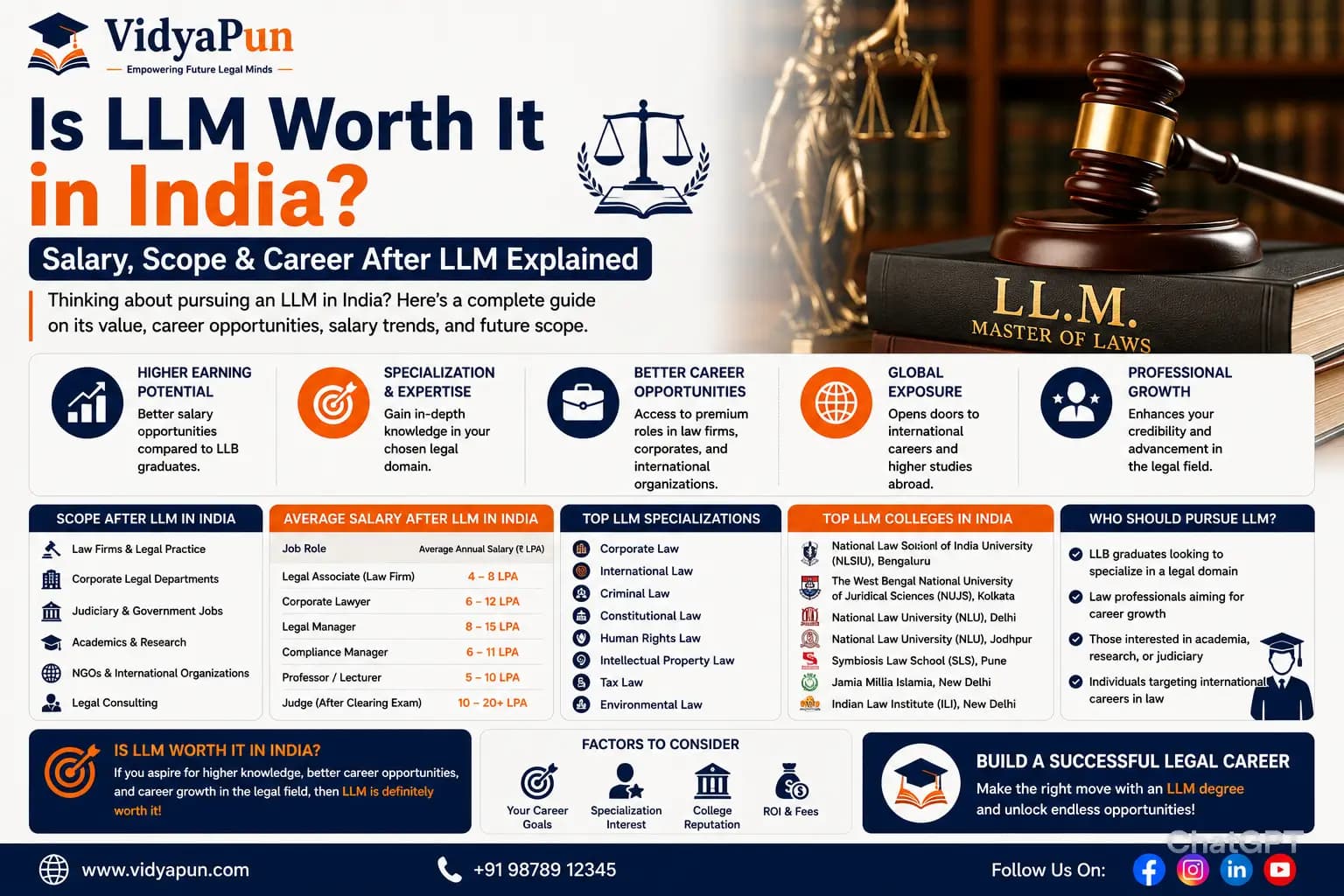
Let's be upfront about something — the decision to pursue an LLM in India is not as straightforward as it sounds. You've completed your LLB or BA LLB, you're standing at the crossroads, and everyone around you has a different opinion. Some say it's essential. Others say it's a waste of two years. Your seniors who cracked the judicial services didn't do it. But that one professor you respect deeply has a gold-framed LLM degree on his wall.
So what's the truth?
The truth is — an LLM is absolutely worth it for the right person with the right plan. And it can be a expensive detour for someone who pursues it just because they didn't know what else to do after law school.
This guide is going to give you the full picture — honestly, without sugarcoating — so you can decide whether an LLM fits your goals in 2026.
What Is LLM and Who Is It For?
LLM stands for Master of Laws (Legum Magister in Latin). It's a postgraduate law degree that allows you to specialize in a specific area of law — corporate law, intellectual property, criminal law, international law, constitutional law, and more.
In India, LLM is typically a one-year or two-year program. The one-year LLM is more common in newer universities, while the two-year version is still followed at many traditional institutions including BHU, DU, and several state universities.
Who should consider LLM?
- Law graduates who want to specialize in a specific legal domain
- Those who want to pursue an academic or teaching career in law
- Lawyers who want to work with international law firms or MNCs
- Candidates preparing for the judicial services (especially higher judiciary)
- Those planning to pursue a PhD in Law
If none of these apply to you — if you just want to practice law and build a litigation career — honestly, you may be better off joining a good law firm or a senior advocate's chamber directly after LLB.
LLM Eligibility and Admission in India 2026
To pursue LLM in India, you need:
- An LLB (3-year) or integrated BA LLB / BBA LLB / B.Com LLB (5-year) degree
- Minimum 55% marks (some universities require 50%)
- Entrance exam qualification — CLAT PG is the most important one for NLUs
Key LLM Entrance Exams in India:
- CLAT PG — For admission to National Law Universities (NLUs)
- AILET PG — For NLU Delhi specifically
- DU LLM Entrance — Delhi University
- BHU PET — Banaras Hindu University
- State-level exams — Many state universities conduct their own tests
CLAT PG is the gateway to the most prestigious LLM programs in India. The competition is real but manageable if you prepare systematically.
LLM Specializations Available in India
Choosing the right specialization is arguably the most important decision in your LLM journey. Your specialization shapes your career, your network, and your earning potential.
Here are the most popular and career-relevant LLM specializations in 2026:
Corporate and Commercial Law
By far the most popular choice among LLM aspirants. Covers company law, mergers and acquisitions, securities regulation, contract law, and corporate governance. Highly relevant for law firm careers and in-house legal roles.
Intellectual Property Rights (IPR) Law
One of the fastest-growing specializations. With India's startup ecosystem booming and multinational companies setting up R&D centers, IPR lawyers — especially those who understand patents and trademarks — are in strong demand.
International Law and Human Rights
Ideal for those interested in working with international organizations, embassies, NGOs, or global law firms. A good LLM in international law from a reputed NLU or foreign university opens doors that a general LLB simply cannot.
Criminal Law
For those who want to go deep into criminal jurisprudence, this specialization is valuable — especially for public prosecutors, defense lawyers, and those interested in the judicial services.
Constitutional and Administrative Law
Preferred by those planning to appear for judicial services exams or work in constitutional litigation. Strong theoretical foundation required.
Taxation Law
With GST, income tax regulations, and international tax treaties becoming increasingly complex, tax lawyers are genuinely hard to find. LLM in Taxation is an underrated specialization with excellent career returns.
Cyber Law and Technology Law
A newer but rapidly growing area. With data protection laws, IT Act amendments, and cybercrime regulation becoming central issues in India, this specialization has strong future scope.
Career Options After LLM in India
Now the part you're really here for. What can you actually do after completing an LLM?
1. Law Firm Associate (Specialized Practice)
Most top-tier law firms in India — AZB & Partners, Cyril Amarchand Mangaldas, Shardul Amarchand Mangaldas, Khaitan & Co — prefer LLM holders for specialized practice areas like M&A, PE/VC, capital markets, and IPR. An LLM from a top NLU significantly improves your chances of getting into the Tier-1 law firm circuit.
2. In-House Legal Counsel
Corporates, banks, fintech companies, and MNCs regularly hire in-house legal counsels. An LLM in corporate or commercial law makes you a stronger candidate for these roles, which often pay considerably well — especially in the tech and finance sectors.
3. Judicial Services (Higher Judiciary)
While judicial services at the district level generally don't require an LLM, the Higher Judicial Service (HJS) — which covers appointment as District Judge through direct recruitment — often has candidates who hold an LLM. Additionally, some High Court direct recruitment notifications give preference to postgraduate law candidates.
4. Legal Academia and Teaching
Want to teach law? An LLM is the minimum qualification required to become a law lecturer or assistant professor in India (as per UGC norms). If you eventually plan to pursue a PhD in law and build an academic career, LLM is not optional — it's mandatory.
5. Legal Research and Policy Work
Think tanks, government bodies like the Law Commission of India, NITI Aayog, and international organizations like UNDP and ILO hire legal researchers and policy analysts. An LLM, especially in constitutional, international, or human rights law, is a strong credential for these roles.
6. International Law Firms and Global Opportunities
An LLM from a reputed Indian NLU — or better yet, a foreign university — opens doors to international law firms in Dubai, Singapore, London, and New York. The bar exam requirements differ by country, but the LLM credential itself is recognized globally.
7. Judicial Clerkship
Several High Courts in India and the Supreme Court appoint law clerks — and while not mandatory, an LLM is a meaningful differentiator when applying. These clerkships provide unmatched exposure and often shape an entire legal career.
LLM Salary in India 2026 — What to Realistically Expect
This is where many guides give you inflated numbers. Let's be honest instead.
| Career Path | Entry-Level Salary | Mid-Level (5–7 yrs) | Senior Level |
|---|---|---|---|
| Tier-1 Law Firm Associate | ₹10 – 18 LPA | ₹20 – 40 LPA | ₹50 LPA+ |
| In-House Legal Counsel | ₹6 – 12 LPA | ₹15 – 30 LPA | ₹40 LPA+ |
| Legal Academia (Assistant Prof) | ₹4 – 7 LPA | ₹8 – 14 LPA | ₹15 – 25 LPA |
| Government / PSU Legal | ₹5 – 8 LPA | ₹10 – 16 LPA | ₹18 – 25 LPA |
| NGO / Policy Research | ₹3 – 5 LPA | ₹6 – 10 LPA | ₹12 – 18 LPA |
| International Law Firms (abroad) | $50K – $80K | $90K – $130K | $150K+ |
Honest note: The salary after LLM is heavily tied to where you did your LLM and which specialization you chose. An LLM from NLSIU Bangalore or NLU Delhi in Corporate Law places you very differently from an LLM from an unknown private university in a general specialization.
Top Colleges for LLM in India 2026
National Law Universities (NLUs)
- NLSIU Bangalore — Consistently ranked #1 for law in India
- NLU Delhi — Admission through AILET PG; top placement record
- NALSAR Hyderabad — Strong faculty and research culture
- NUJS Kolkata — Known for corporate and IP law
- NLU Jodhpur — Good corporate law placements
Other Top Law Schools
- Faculty of Law, University of Delhi — Legacy institution, affordable, strong alumni network
- Faculty of Law, BHU — Traditional but highly respected
- ILS Law College, Pune
- Government Law College, Mumbai
- Symbiosis Law School, Pune (private)
- Jindal Global Law School (private, internationally oriented)
For international LLM: If budget allows, universities like King's College London, University of Melbourne, National University of Singapore (NUS), and Georgetown Law offer LLM programs with excellent return on investment for Indian candidates.
LLM in India vs LLM Abroad — Which Is Better?
This depends entirely on your goals and financial situation.
LLM in India makes sense if:
- You want to practice in Indian courts
- You're targeting judicial services or academia
- Budget is a constraint (NLU LLM costs ₹1–3 lakh vs ₹30–80 lakh abroad)
- You want to work in top Indian law firms
LLM abroad makes sense if:
- You want to work internationally or in global law firms
- You're targeting international organizations or policy roles
- You have funding (scholarship or family support)
- You want to pivot to a foreign jurisdiction
Many Indian lawyers do their LLB in India and then pursue a one-year LLM from a foreign university to get the best of both worlds.
Is LLM Worth It in India? The Honest Answer
Yes — if you have a specific reason for doing it.
The LLM is worth every rupee and every month if you're using it to specialize, to get into academia, to improve your profile for international work, or to strengthen your judicial services preparation.
It is not worth it if you're pursuing it simply because you're unsure about what to do next, or if you're hoping the degree alone will magically open doors. Law is a profession where your network, courtroom experience, and specialization depth matter more than any certificate on the wall.
The students who get the most out of an LLM are those who enter the program knowing exactly what they want — and use those one or two years to build skills, connections, and research depth that directly serve that goal.
FAQs — LLM in India
Q1. Is LLM necessary to become a lawyer in India? No, LLM is not mandatory to practice law in India. You can enroll with the Bar Council after completing your LLB or integrated law degree. LLM is a postgraduate specialization, not a licensing requirement.
Q2. Can I do LLM while working as a lawyer? Some universities offer part-time or distance LLM programs. However, top NLUs and law schools offer only full-time LLM programs. Check individual university norms before applying.
Q3. What is the scope of LLM in India in 2026? The scope is strong, particularly in corporate law, IPR, taxation, and technology law. With India becoming a major destination for global legal work, specialized lawyers with LLM credentials are increasingly valued.
Q4. Which LLM specialization has the highest salary in India? Corporate and Commercial Law followed by Intellectual Property Rights (IPR) and Taxation Law tend to offer the highest salaries — particularly in Tier-1 law firms and MNC in-house roles.
Q5. Is CLAT PG necessary for LLM admission? CLAT PG is required specifically for NLU admissions. Other universities have their own entrance exams. If you're not targeting NLUs, CLAT PG is not mandatory.
Q6. Can an LLM graduate become a professor? Yes. As per UGC regulations, an LLM is the minimum qualification to become an Assistant Professor in law. A NET/SET qualification or PhD may additionally be required depending on the institution.
Q7. How long does LLM take in India? LLM programs in India are either one year or two years depending on the university. NLUs typically offer a one-year LLM, while traditional universities like DU and BHU follow the two-year structure.
Q8. What is the difference between LLM and MBA for law graduates? LLM deepens legal expertise and is ideal for those staying in the legal profession. MBA gives business and management skills and is suited for those transitioning into management consulting, legal operations, or corporate strategy roles. Some lawyers pursue both.
Final Thoughts
An LLM in India in 2026 is a powerful credential — but only when it's backed by a clear purpose. The legal profession in India is evolving fast. Specialization is no longer optional for those who want to rise above general practice. Whether you're eyeing a Tier-1 law firm, a judicial career, or a position in academia or policy, an LLM from the right institution in the right specialization can genuinely change your trajectory.
But spend time thinking before you apply. Talk to practicing lawyers who did their LLM. Talk to those who didn't. Read about the placement records of the colleges you're considering — not just the brochure version, but the actual numbers.
The investment is real. Make sure the return is planned.
Thinking about pursuing an LLM but still unsure which college or specialization is right for you?
Don't make this decision based on incomplete information. Explore detailed LLM college comparisons, CLAT PG preparation strategies, and specialization-wise career roadmaps — all in one place.
Website: www.vidyapun.com
Call / WhatsApp: +91 96438 02216