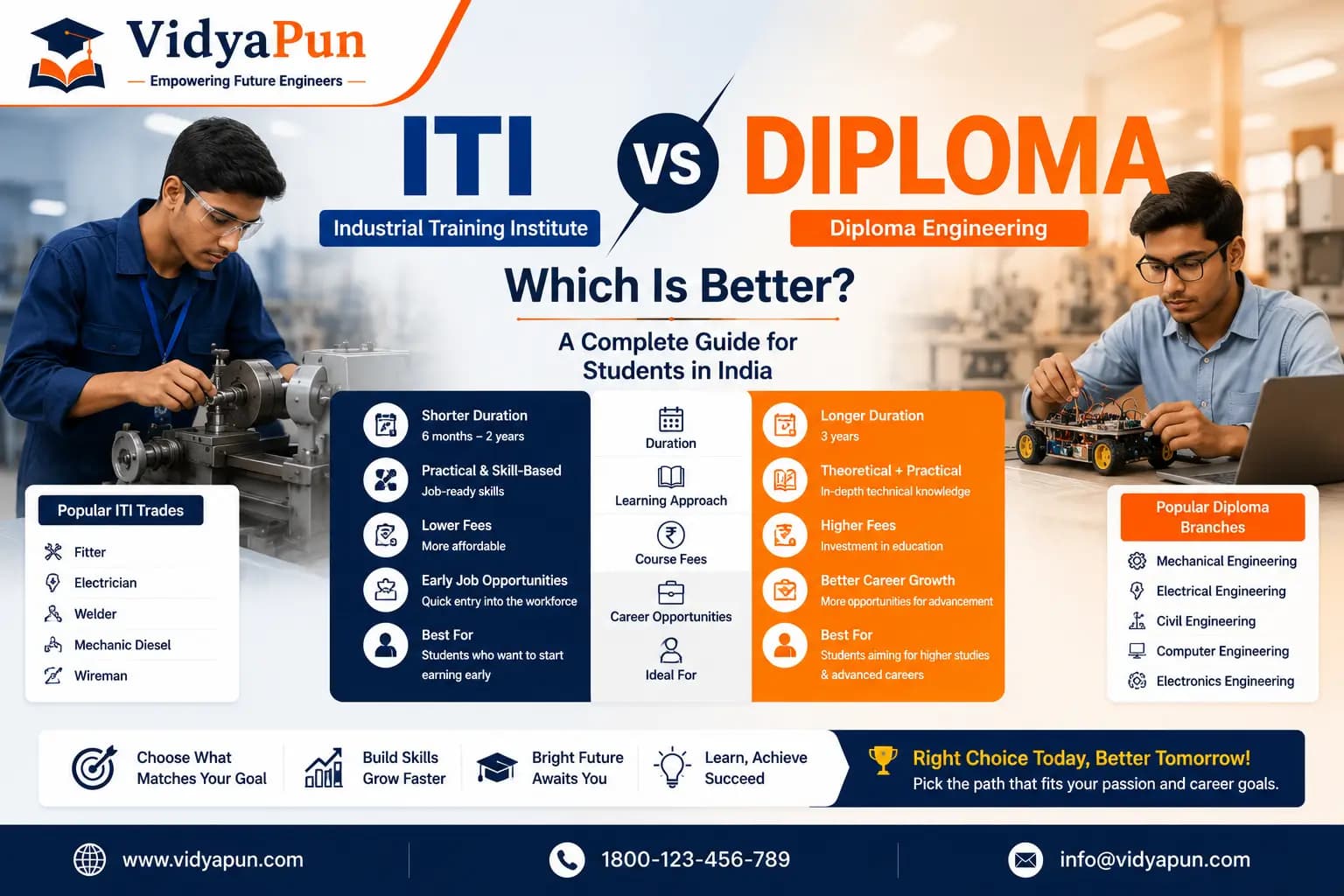
This is one of the most searched questions among Class 10 pass-outs in India — andhonestly, one of the most poorly answered ones too.
Most comparisons you find online either oversimplify it into "ITI is for trade jobs, diploma is for engineering jobs" or get lost in generic lists that do not actually help you decide. Neither is useful when you are standing at a real crossroads after your board exams.
So let us be direct.
Both ITI and Diploma Engineering are legitimate, respected technical pathways. Both lead to real jobs. Both have genuine career value. But they are built for different people, different goals, and different kinds of work. The question is not which one is universally better — it is which one is better for you.
This guide gives you an honest, detailed comparison across every factor that actually matters: duration, cost, curriculum, job scope, salary, government job eligibility, and long-term career potential.
Understanding the Basics: What Are ITI and Diploma Engineering?
Before comparing, it helps to be clear on what each program actually is.
What Is ITI?
ITI stands for Industrial Training Institute. ITI courses are vocational training programs that teach specific trade skills — electrician, fitter, machinist, welder, COPA (Computer Operator and Programming Assistant), plumber, motor mechanic vehicle, and many more.
ITI programs are governed by the Directorate General of Training (DGT) under the Ministry of Skill Development and Entrepreneurship. They are offered at government ITIs (very affordable) and private ITIs across India.
Duration: 1 to 2 years depending on the trade Entry qualification: Class 8 or Class 10 depending on the trade Focus: Hands-on trade skill development for specific job roles
What Is Diploma Engineering?
A Diploma in Engineering (also called a Polytechnic Diploma) is a technical program offered by government and private polytechnic colleges, governed by each state's Board of Technical Education (BTE) or Directorate of Technical Education (DTE).
It covers a broader range of technical subjects — mechanical, civil, electrical, electronics, computer science, mechatronics, and more — combining theory with practical training.
Duration: 3 years after Class 10 (or 2 years via lateral entry after Class 12/ITI) Entry qualification: Class 10 pass with minimum percentage (usually 35–50%) Focus: Technical engineering foundations with practical application
ITI vs Diploma Engineering: A Direct Comparison
1. Duration
ITI: Most ITI trades are 1 year. A few trades — Electrician, Fitter, Turner, Machinist — are 2 years.
Diploma Engineering: 3 years after Class 10. However, ITI pass students can take lateral entry into the second year of a Diploma program, completing it in just 2 years.
Verdict: ITI gets you into the workforce faster. If speed to employment matters most, ITI has an edge. But if you want to upgrade to Diploma later, the lateral entry option makes the overall timeline comparable.
2. Course Fees
ITI: Government ITIs charge extremely nominal fees — typically ₹500 to ₹3,000 per year. Even private ITIs are relatively affordable at ₹15,000–40,000 per year. Total cost for a 2-year ITI from a government institute can be as low as ₹1,000–6,000.
Diploma Engineering: Government polytechnics charge ₹10,000–30,000 per year. Private polytechnics charge ₹30,000–80,000 per year. Total cost for a 3-year diploma from a government polytechnic: ₹30,000–90,000.
Verdict: ITI is significantly more affordable, especially from government institutes. For families with tight budgets, this is a real and important factor.
3. Curriculum and Depth
ITI: Curriculum is trade-specific and intensely practical. An Electrician ITI student learns wiring, panel installation, and circuit troubleshooting in depth. A Fitter ITI student masters precision fitting, lathe operations, and assembly. The training is narrow but very deep within that trade.
Diploma Engineering: Curriculum is broader and combines theory with practical work. A Diploma in Mechanical Engineering student studies thermodynamics, machine design, manufacturing processes, CAD, and more. The depth in any single area is less than ITI, but the breadth is considerably greater.
Verdict: ITI wins on trade-specific depth. Diploma wins on technical breadth. Your preference depends on whether you want to master one craft or build broader technical knowledge.
4. Job Opportunities
ITI: ITI graduates are directly employable in trade roles. Common job opportunities include:
- Electrician in industrial plants, construction companies, and maintenance departments
- Fitter and machinist in manufacturing units
- Welder in fabrication, shipbuilding, and construction
- Motor vehicle mechanic in automobile service centers
- COPA operator in offices and businesses
- Plumber in civil construction
ITI graduates are also eligible for Apprenticeship Training under the Apprentices Act — a 1–2 year paid on-the-job training scheme at companies like BHEL, ONGC, Indian Railways, and state electricity boards. This is one of the best early career accelerators for ITI pass-outs.
Diploma Engineering: Diploma engineers are hired for more technically diverse roles:
- Junior Engineer (JE) in construction, electrical, mechanical, and civil departments
- Technical Assistant / Supervisor in manufacturing companies
- Site Engineer in infrastructure and real estate companies
- PLC Technician and Automation Technician in factories
- Service Engineer at OEM companies (Siemens, ABB, Bosch, L&T)
- Computer Hardware and Network Technician
Diploma engineers can also appear for State Public Service Commission Junior Engineer examinations — one of the most sought-after government job opportunities for diploma holders.
Verdict: Both have strong job markets. ITI is more directly trade-specific. Diploma opens more diverse technical roles, including supervisory and engineering positions.
5. Government Job Eligibility
This is one of the most important comparison points for many students — and one that clearly favors Diploma Engineering.
ITI holders are eligible for:
- Apprenticeship posts in PSUs and railways
- Technician and trade assistant roles in DRDO, defence establishments, and state electricity boards
- Some Group D and Group C posts in Indian Railways (RRB NTPC technical posts)
- State government trade-based recruitment in PWD, irrigation, and municipal departments
Diploma Engineering holders are eligible for:
- Junior Engineer (JE) posts in SSC JE examination — one of India's largest central government recruitment drives
- JE posts through state PSC and state PWD departments
- Technical posts in PSUs like BHEL, BSNL, ONGC, NTPC, and BEL
- Technician-B and Technician-C posts in ISRO and DRDO
- Indian Railways — Junior Engineer and Section Engineer posts
Verdict: Diploma Engineering opens significantly more government job opportunities, including the highly competitive SSC JE exam which is not accessible to ITI holders.
6. Salary Comparison
ITI fresher salary (private sector):
- Electrician, Fitter, Welder: ₹1.2–2.5 lakhs per annum at entry level
- After apprenticeship and 2–3 years experience: ₹2.5–5 lakhs per annum
- Skilled ITI tradesmen with 5+ years: ₹5–9 lakhs per annum in good companies
ITI fresher salary (government/PSU):
- Apprenticeship stipend: ₹7,000–10,000 per month
- After absorption or competitive selection: ₹2–3.5 lakhs per annum (with strong progression through pay scales)
Diploma Engineering fresher salary (private sector):
- Entry-level technical roles: ₹1.8–3.5 lakhs per annum
- Service engineer at OEM: ₹2.5–4 lakhs per annum
- Automation and PLC roles: ₹2.5–4.5 lakhs per annum
Diploma Engineering fresher salary (government):
- Junior Engineer (SSC JE, state JE): ₹3–5 lakhs per annum (with 7th Pay Commission grade pay, allowances included)
- PSU technical posts: ₹3–5 lakhs per annum at entry with structured progression
Long-term salary potential: Diploma engineers consistently earn 20–40% more than ITI tradesmen at equivalent experience levels, largely because they are eligible for supervisory and junior management roles that ITI holders are not.
Verdict: Entry-level salaries are comparable. Long-term earning potential is meaningfully higher for Diploma Engineering graduates.
7. Further Education Options
After ITI:
- Lateral entry into Diploma Engineering (second year) — highly recommended upgrade path
- Bridge courses under the Craftsman Training Scheme
- Advanced ITI trades for specialization
- Apprenticeship training for industry experience
- Some private universities offer BTech for ITI + Diploma holders
After Diploma Engineering:
- Lateral entry into BTech/BE (second year) — one of the most commonly used upgrade paths in India
- AMIE (Associate Member of the Institution of Engineers) — a work-while-you-study engineering degree equivalent
- Direct employment with option to pursue part-time degree programs
- Government JE positions with promotion track to Assistant Engineer over time
Verdict: Diploma Engineering has a more structured and widely recognized higher education upgrade path, particularly through lateral entry BTech.
8. Entrepreneurship and Self-Employment
ITI: Genuinely strong for self-employment. An ITI-trained electrician can start an electrical contracting business. A plumber or welder can build a skilled trades service business. Many successful small contractors and technical service providers are ITI-trained entrepreneurs.
Diploma Engineering: Also good for entrepreneurship, particularly in technical services, small manufacturing, and construction supervision. However, startup costs may be higher depending on the business type.
Verdict: ITI actually has a slight edge for self-employment in skilled trades. The startup costs are lower and the market for skilled tradespeople is strong and growing.
Which Industries Prefer ITI vs Diploma?
Industries that prefer ITI:
- Construction and infrastructure (electricians, plumbers, welders)
- Automobile service (motor vehicle mechanics)
- Small and medium manufacturing units
- Household and commercial electrical/maintenance services
- Shipbuilding and heavy fabrication
Industries that prefer Diploma Engineering:
- Automotive manufacturing (Maruti, Tata Motors, Mahindra)
- Electronics and semiconductor manufacturing
- Industrial automation (Siemens, ABB, Honeywell)
- Civil infrastructure and real estate development
- IT hardware, networking, and technical support
- Defence and space (DRDO, ISRO, HAL, BEL)
The Lateral Entry Advantage: Best of Both Worlds
Here is something that not enough people talk about: the ITI → Diploma lateral entry path is one of the smartest career moves a technically-minded student can make.
Complete a 2-year ITI trade course. Get genuine, deep hands-on skills in your trade. Then use lateral entry to join the second year of a Diploma Engineering program, completing your diploma in 2 additional years instead of 3.
By the time you finish, you have:
- Deep practical trade skills from ITI
- Broader engineering theory from the Diploma
- 4 years of technical education total — equivalent to a standard diploma with richer practical grounding
Many employers value this combination highly because you bring hands-on skill depth that pure diploma students often lack. And you can still pursue BTech lateral entry afterward if you want to go further.
FAQs: ITI vs Diploma Engineering
Q1. Is ITI better than Diploma Engineering for getting a job quickly? ITI gets you job-ready faster — in 1–2 years vs 3 years for a diploma. For students who need to enter the workforce quickly, ITI is the faster path. However, Diploma Engineering opens more job types and higher salary potential over time.
Q2. Can an ITI student get a government job? Yes, but options are more limited compared to diploma holders. ITI graduates are eligible for apprenticeship posts, trade assistant roles in railways and PSUs, and some Group C technical posts. They are generally not eligible for SSC JE or state JE examinations, which require a diploma or degree.
Q3. Which is better for salary — ITI or Diploma Engineering? Entry-level salaries are comparable. Over 5–10 years, Diploma Engineering graduates typically earn 20–40% more because they qualify for supervisory and junior engineering roles. ITI tradesmen with strong skills and experience in specialized areas can also earn well, but the ceiling is generally lower.
Q4. Can I do a Diploma after ITI? Yes — and this is actively encouraged. ITI graduates can take lateral entry into the second year of a Diploma Engineering program, completing the diploma in 2 years instead of 3. This is one of the best upgrade paths available.
Q5. Which is cheaper — ITI or Diploma Engineering? ITI is significantly cheaper, especially at government ITIs where annual fees can be as low as ₹500–3,000. Government polytechnics for Diploma Engineering charge ₹10,000–30,000 per year. For families with very limited budgets, ITI from a government institute is the most financially accessible technical option.
Q6. Is Diploma Engineering equivalent to ITI for apprenticeship training? Both ITI and Diploma holders are eligible for apprenticeship training under the Apprentices Act. However, diploma holders are designated as "Technician Apprentices" with higher stipends, while ITI holders are designated as "Trade Apprentices." The roles and training scope differ accordingly.
Website: www.vidyapun.com
Call / WhatsApp: +91 96438 02216