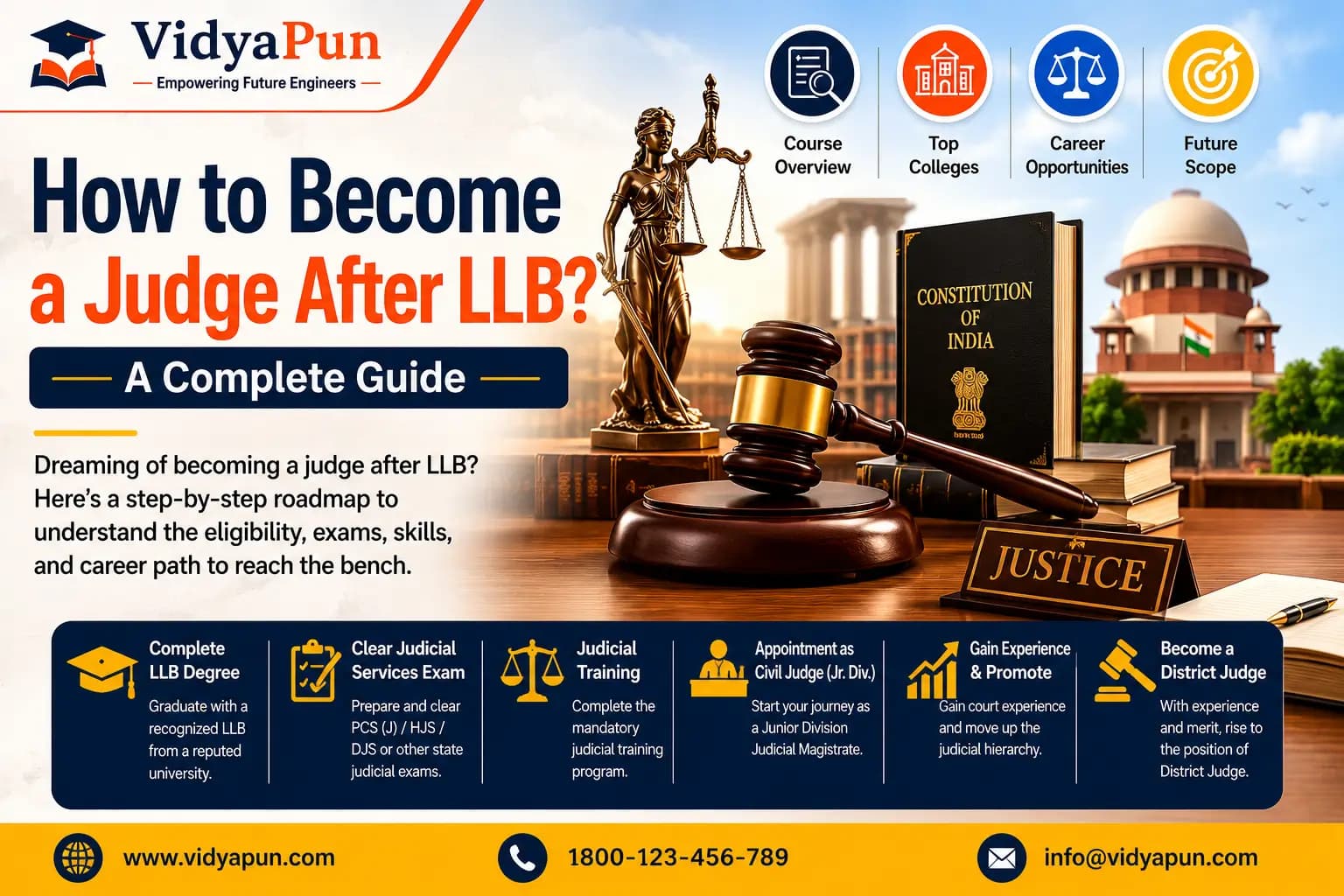
Becoming a judge is one of the most respected career goals a law graduate can set — and honestly, one of the most misunderstood ones too.
Most LLB students know they want to become a judge someday. Far fewer know exactly how that happens — which exams to clear, how many years of practice are needed, what the selection process looks like, and whether the path changes depending on which level of judiciary you are targeting.
If you have just completed your LLB or are in your final year and wondering how to become a judge after LLB, this guide walks you through everything — clearly, step by step, without the confusion.
Understanding India's Judicial Structure First
Before mapping your path, you need to understand where judges sit within India's three-tier judicial system. Because the route to becoming a judge is completely different depending on which court you are targeting.
District and Subordinate Courts — These are the trial courts at the grassroots level. Civil judges, judicial magistrates, and additional district judges all fall under this category. Entry here is through State Judicial Services Examinations.
High Courts — Each state has a High Court that handles appeals and original jurisdiction matters. High Court judges are appointed through a collegium system — not through a direct examination after LLB.
Supreme Court of India — The apex court. Judges here are appointed by the President of India based on collegium recommendations. There is no direct examination route to the Supreme Court.
So when most LLB graduates ask how to become a judge after LLB, what they are actually asking about is the District and Subordinate Judiciary route — and that is exactly what this guide focuses on.
Step 1: Complete Your LLB Degree
This sounds obvious, but there are important details here.
To appear for most State Judicial Services Examinations, you need a 3-year LLB (after graduation) or a 5-year BA LLB/BBA LLB/B.Com LLB integrated degree from a Bar Council of India (BCI) recognized institution.
A few important points:
- Your LLB percentage matters. Many states require a minimum of 45% to 55% in your LLB for judicial exam eligibility. Check the specific notification for your state.
- Your institution must be recognized by the BCI. Degrees from unrecognized law colleges may disqualify you entirely.
- Distance education LLB degrees are generally not accepted for judicial service applications. Verify this for your state before applying.
If you are still in your LLB, use this time strategically. Start reading bare acts and judgments regularly. Build a habit of reading the Constitution, CPC, CrPC (now BNSS), IPC (now BNS), and IEA thoroughly — these form the core of every judicial exam.
Step 2: Enroll With the State Bar Council
After completing your LLB, enroll as an advocate with your State Bar Council. This is a prerequisite for almost every judicial services examination in India.
The enrollment process involves:
- Submitting your LLB degree certificate and marksheets
- Identity and address proof
- Enrollment fee (varies by state, typically ₹750–₹3,000)
- Oath of office as an advocate
Some states also require a minimum period of practice as an advocate before you can appear for the judicial exam. This varies — some states require no prior practice for the Lower Judiciary exam, while others require 3 to 7 years for higher judicial service posts.
Step 3: Understand the Two Main Entry Routes
There are two primary pathways through which LLB graduates become judges in India:
Route 1 — State Judicial Services Examination (Direct Entry)
This is the most common and accessible route for fresh or recently graduated law students. Every state Public Service Commission conducts a Judicial Services Examination (also called the Civil Judge Examination or Munsiff Exam in some states) to recruit Civil Judges (Junior Division) and Judicial Magistrates.
Who conducts it: The High Court of the respective state, often in coordination with the State Public Service Commission.
Eligibility: LLB degree + Bar Council enrollment (and sometimes minimum practice period — varies by state).
Age limit: Typically 21 to 35 years, with relaxation for SC/ST/OBC/PwD candidates as per state rules.
Selection process:
- Preliminary Examination (Objective MCQ)
- Mains Examination (Descriptive — law papers)
- Interview / Viva Voce
On clearing all three stages, selected candidates are posted as Civil Judge (Junior Division) or Judicial Magistrate, First Class.
Route 2 — Higher Judicial Services (HJS) Examination
The Higher Judicial Services route is for appointment as Additional District Judge or District Judge directly. This requires:
- Minimum 7 years of practice as an advocate, OR
- Minimum 7 years of service as a Civil Judge (Junior Division) through promotion
This route is for more experienced law professionals. If you are a fresh LLB graduate, Route 1 is your starting point — and Route 2 becomes available after years of service or practice.
Step 4: Know the Core Subjects You Will Be Tested On
Every State Judicial Services Examination tests a largely similar set of subjects, though the paper pattern differs by state. The core subjects are:
Constitutional Law — Fundamental rights, directive principles, constitutional amendments, landmark judgments
Code of Civil Procedure (CPC / now partly replaced) — Suits, decrees, orders, execution, appeals
Code of Criminal Procedure (CrPC / now BNSS 2023) — FIR, arrest, bail, trial procedure, appeals, revision
Indian Penal Code (IPC / now BNS 2023) — General exceptions, offences against persons and property, defences
Indian Evidence Act (IEA / now BSA 2023) — Relevance, admissibility, burden of proof, presumptions
Transfer of Property Act — Sale, mortgage, lease, gift, exchange
Contract Act — Offer, acceptance, consideration, void and voidable contracts, specific relief
Specific Relief Act — Specific performance, injunctions
Limitation Act — Period of limitation for suits and appeals
Hindu Law and Muslim Law — Marriage, divorce, inheritance, succession
Some states also include Revenue Laws, Land Acquisition, and Local Acts specific to that state. Always read the official notification carefully.
Step 5: Build Your Preparation Strategy
Clearing a State Judicial Services Examination is genuinely hard. Pass rates are typically between 1% and 3% of total applicants. Here is a preparation approach that actually works:
Read Bare Acts, Not Just Guides
Judicial exam questions are drawn directly from statutory language. If you cannot read the bare text of the CPC or IPC and understand it without a guide, you will struggle in both Mains and Viva. Make bare act reading a daily habit — at least 20 to 30 sections every day.
Study Case Laws Alongside Statutes
For constitutional law and evidence law especially, landmark Supreme Court judgments are tested directly. Maintain a handwritten case law notebook — case name, facts in two lines, holding, significance. This becomes invaluable during revision.
Write Answers Regularly
The Mains examination is descriptive. Many candidates who read extensively still struggle to write structured, time-bound answers. Practice writing 800 to 1,000 word answers to law questions under timed conditions at least four times a week.
Join a Judicial Services Coaching Program
While self-study is possible, structured coaching significantly improves your preparation efficiency. Look for coaching centers or online programs that specifically focus on your target state's judicial exam — the paper pattern, recent question trends, and interview preparation vary significantly across states.
Solve Previous Year Question Papers
At minimum, solve the last 7 to 10 years of your target state's judicial exam papers — both Prelims and Mains. This gives you an accurate sense of difficulty level, frequently tested topics, and how questions are framed.
Step 6: Crack the Viva Voce (Interview)
Many candidates clear Prelims and Mains but stumble at the interview stage. The Viva Voce for judicial services is not a casual conversation — it is a structured assessment of your:
- Legal knowledge and clarity of thought
- Temperament and judicial demeanor
- Communication and articulation skills
- Awareness of current legal developments and recent judgments
- Personal integrity and motivation for judicial service
Interviewers — typically senior High Court judges — ask questions that test both depth of knowledge and how you think under pressure. They may present you with a hypothetical legal situation and ask how you would proceed.
Prepare for the interview by:
- Reading recent Supreme Court and High Court judgments in your state
- Following legal news and significant case developments
- Practicing mock interviews with mentors or experienced advocates
- Being clear and honest about your motivation to serve in the judiciary
Salary of a Judge After LLB in India
One of the most practical questions — and a fair one.
Civil Judge (Junior Division) / Judicial Magistrate: Starting salary: ₹77,840 per month (as per the Seventh Pay Commission recommendations, though states vary slightly) With grade pay, allowances, and perks: effectively ₹1–1.2 lakhs per month
District Judge: ₹1.44–2.07 lakhs per month (with additional allowances)
High Court Judge: ₹2.5 lakhs per month + official residence, vehicle, staff, and other benefits
Supreme Court Judge: ₹2.5 lakhs per month + Chief Justice of India receives ₹2.8 lakhs per month
Beyond salary, judicial officers receive housing, medical benefits, leave travel concession, pension, and significant social standing. Job security is exceptional, and career progression through the judicial ladder is structured and merit-based.
How Long Does It Take to Become a Judge After LLB?
Realistically — and this is important to set proper expectations — the timeline looks something like this:
- Complete 3-year LLB: 3 years after graduation (or 5-year integrated degree)
- Bar enrollment + preparation: 6 months to 2 years
- Clearing Prelims, Mains, and Interview: 1 to 3 exam cycles (many candidates appear 2–3 times)
- Training period after selection: 6 months to 1 year
Realistic timeline from LLB completion to first posting as a Civil Judge: 2 to 4 years
This is not discouraging — it is simply realistic. The judicial exam demands serious preparation, and most successful candidates invest 18 to 24 months of dedicated study before clearing it.
FAQs: How to Become a Judge After LLB
Q1. Can I become a judge directly after completing LLB without practice experience? Yes, for the Civil Judge (Junior Division) examination in most states, prior practice experience is not mandatory. You need an LLB degree and Bar Council enrollment. However, some states do require 1–3 years of practice even for entry-level judicial posts — always check the specific state notification.
Q2. Which state judicial services exam is easiest to crack in India? There is no genuinely "easy" judicial services exam, but smaller states with fewer vacancies and less competitive applicant pools — like Uttarakhand, Himachal Pradesh, and some northeastern states — sometimes have relatively lower cutoffs. However, preparation depth matters more than which state you target.
Q3. Is coaching necessary to become a judge after LLB? Not mandatory, but practically helpful. Structured coaching — especially for Mains answer writing and Viva preparation — significantly improves your chances. Many self-study candidates have cleared the exam, but they typically had very disciplined self-structured preparation.
Q4. What is the age limit for the judicial services examination in India? Most states set the upper age limit at 35 years for the general category, with relaxations of 3–5 years for SC/ST/OBC candidates. Some states have higher upper limits. Always verify with the specific state's official notification.
Q5. Can I become a High Court judge directly after LLB? No. High Court judges are appointed through the collegium system based on years of distinguished practice as an advocate (minimum 10 years) or elevation from the lower judiciary after years of service. There is no direct examination route to the High Court.
Q6. What is the difference between a Civil Judge and a Munsiff? In most states, these terms refer to the same entry-level judicial position. "Munsiff" is used in some states like Kerala and Tamil Nadu, while "Civil Judge (Junior Division)" is the more common designation in northern and central India. Both are recruited through the state judicial services examination.
Website: www.vidyapun.com
Call / WhatsApp: +91 96438 02216