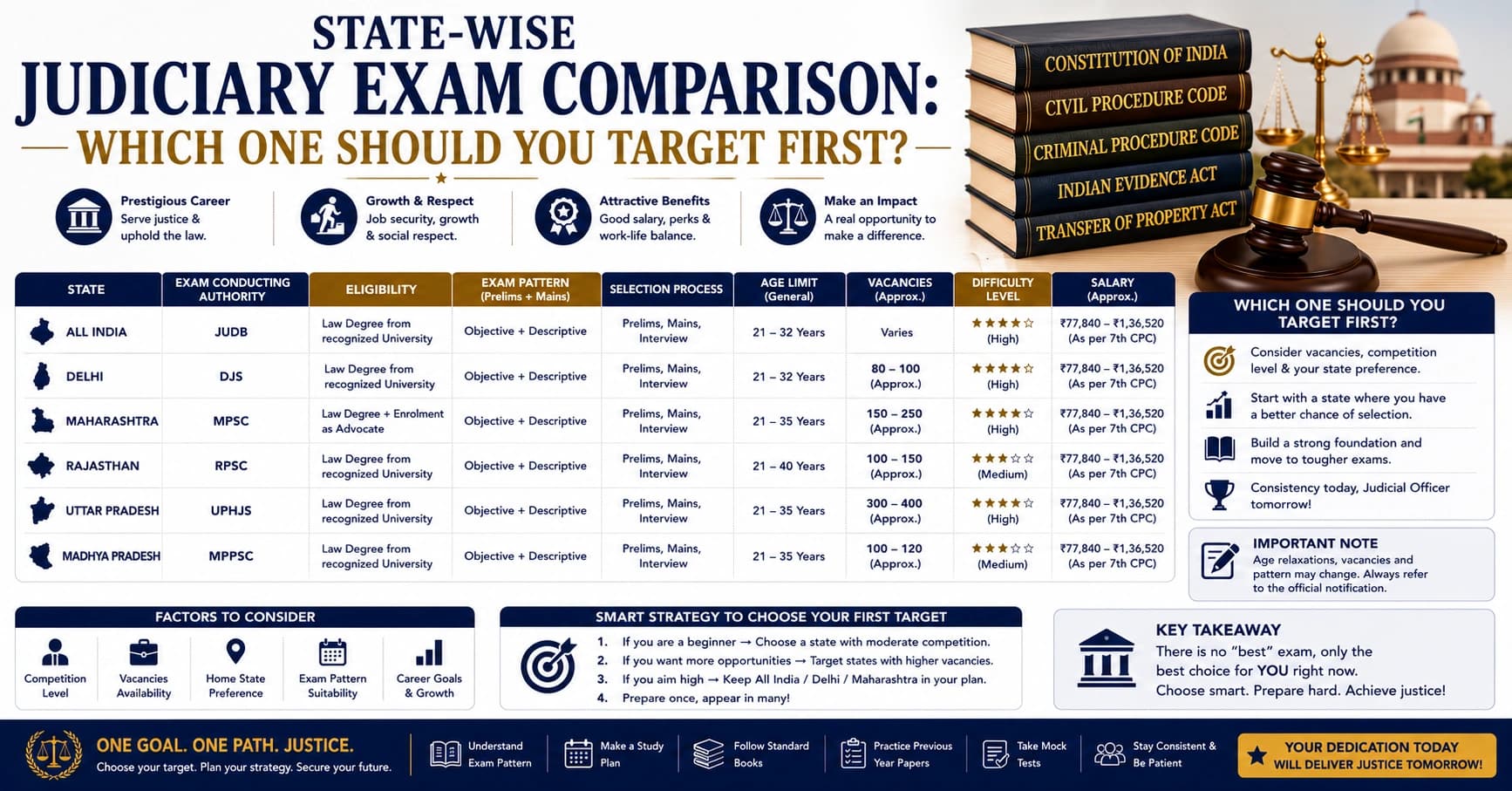
Every state runs its own judiciary exam, with its own age limits, language requirements, and vacancy cycles — and many aspirants end up preparing for one state without realising how much overlap exists with two or three others. This is the side-by-side comparison our general guide to becoming a judge doesn't cover in this level of state-specific detail.
The Rule That Now Applies Almost Everywhere: 3 Years of Practice
Before comparing states individually, one critical, relatively recent change applies broadly across the country: following a Supreme Court ruling in the All India Judges Association case, a minimum of three years of continuous practice as an enrolled advocate is now a mandatory eligibility condition for entry-level judicial service exams in the states that have issued 2026 notifications, including Bihar, Gujarat, Maharashtra, and others. This is a meaningful shift from the earlier position in several states where fresh LLB graduates could appear immediately after Bar enrolment. If you're a final-year student or recent graduate, this timeline should factor directly into your planning — check the specific current notification for your target state, since implementation details are still being clarified in some places.
Bihar Judicial Service Examination (BJSE)
- Conducted by: Bihar Public Service Commission
- Age limit: Generally 22-35 years, with standard reserved-category relaxations
- Practice requirement: 3 years of continuous advocate practice, certified by a senior advocate or Principal Judge
- 2026 vacancies: Among the earliest and largest notified for the cycle — 173 vacancies for Civil Judge/Munsiff
- Language: Hindi is central to the exam
Rajasthan Judicial Service (RJS)
- Conducted by: Rajasthan High Court
- Age limit: Generally 23-35 years
- Language: Knowledge of Hindi in Devanagari script is specifically required — a distinct requirement worth noting if you're not from a Hindi-medium background
- Vacancies: Historically consistent notification cycle with a meaningful vacancy count most years
- Preparation note: Rajasthan-specific local laws form a distinct, important preparation area beyond the core national subjects
Uttar Pradesh PCS (Judicial) — UP PCS-J
- Conducted by: Uttar Pradesh Public Service Commission
- Language: Primarily Hindi-medium, with English tested specifically at the Mains stage
- Syllabus overlap: UP PCS-J shares substantial core syllabus overlap with Madhya Pradesh Judiciary and Haryana PCS-J, which is why many aspirants prepare for multiple states in the same cycle rather than committing to just one
- Note: Uttar Pradesh's Higher Judicial Service (UP HJS) is a separate, more senior route requiring roughly 7 years of legal practice and a higher age bracket (commonly cited around 35-45 years) — distinct from the entry-level PCS-J route most fresh graduates target
Haryana Judiciary Exam (Haryana PCS-J)
- Conducted by: Haryana Public Service Commission
- Age limit: A notably wider bracket than most states, commonly cited around 21-42 years
- Syllabus overlap: Shares significant preparation overlap with UP PCS-J, making it a natural second-state target for aspirants already preparing for UP
Maharashtra Judicial Service
- 2026 cycle: Among the larger 2026 notifications, with 286 vacancies announced
- Practice requirement: Subject to the same 3-year practice mandate now applying broadly
- Preparation note: Maharashtra-specific local acts and state amendments require dedicated attention alongside the core national subjects
Delhi Judicial Service (DJS)
- Language: Primarily an English-medium examination — a genuinely important distinguishing factor, since Hindi-medium aspirants may find this a structural disadvantage compared to Hindi-heavy states like UP or Rajasthan
Gujarat and Odisha Judicial Service
- Gujarat: Announced 237 vacancies for the 2026 cycle, among the largest so far
- Odisha: A comparatively smaller vacancy count (78 for the 2026 cycle) but shouldn't be treated casually — competition can remain high even with fewer seats, and the selection process still tests conceptual command of bare acts, procedural law, and written expression at the same rigour as larger states
How to Decide Which State(s) to Target
If You're Hindi-Medium
UP PCS-J, Rajasthan RJS, Bihar BJSE, and Haryana PCS-J share meaningful syllabus overlap and are commonly prepared for together in the same cycle.
If You're English-Medium or More Comfortable in English
Delhi DJS is a more natural fit, though it's worth confirming current vacancy trends, since Delhi's cycle and seat count vary year to year.
If You Want to Maximise Your Attempts in One Season
Because core subjects (Constitutional Law, CPC, CrPC/BNSS, IPC/BNS, Evidence Act) overlap substantially across states, many serious aspirants prepare a strong core foundation and then layer state-specific local laws on top for two or three states with compatible exam calendars — rather than betting everything on one state's single annual cycle.
Don't Dismiss Smaller-Vacancy States
A state with fewer notified vacancies (like Odisha in 2026) isn't necessarily an easier exam — the selection bar and competition can remain just as demanding, so choose based on genuine fit (language, local law comfort, timeline) rather than vacancy count alone.
What to Verify Before Committing to a State
- Current practice requirement and how it's being implemented in that state's 2026 notification specifically
- Exact age limit and category-based relaxations for the current cycle
- Language requirements, including whether Devanagari script proficiency or similar state-specific conditions apply
- Domicile requirements, if any, since some states restrict a share of seats to state residents
Frequently Asked Questions
1. Is the 3-year practice rule mandatory for all state judiciary exams now?
It applies to the states that have issued 2026 notifications so far (including Bihar, Gujarat, and Maharashtra), following a Supreme Court ruling — check your specific target state's current notification, as implementation details continue to be clarified across states.
2. Which state judiciary exam has the most vacancies in 2026?
As of the notifications issued so far, Maharashtra (286) and Gujarat (237) are among the largest, with Bihar (173) also significant — several major states including UP, MP, Haryana, and Punjab had not yet notified at the time of writing.
3. Can I prepare for multiple state judiciary exams at once?
Yes — UP PCS-J, MP Judiciary, and Haryana PCS-J in particular share substantial syllabus overlap, and many aspirants target more than one state in the same season, provided exam dates don't clash.
4. Which state judiciary exam is best for English-medium candidates?
Delhi Judicial Service is primarily English-medium, unlike most other states which lean heavily Hindi-medium.
5. Does Rajasthan have a special language requirement?
Yes — proficiency in Hindi in the Devanagari script is a specific requirement for the Rajasthan Judicial Service, worth preparing for separately if it isn't already a strength.
6. Is a smaller vacancy count a sign of an easier exam?
No — states with fewer notified vacancies can still have high competition and the same rigorous selection standard, so don't choose a state based on vacancy count alone.
7. What's the difference between UP PCS-J and UP HJS?
UP PCS-J is the entry-level judiciary exam most fresh graduates target; UP HJS (Higher Judicial Service) is a separate, more senior route requiring around 7 years of legal practice and a higher age bracket.
Related Reading
For the full step-by-step path to becoming a judge, syllabus breakdown, and preparation strategy, see our companion guide, How to Become a Judge After LLB. For broader government career options, see Government Jobs After LLB. Explore the LLB Course page for further planning.
🌐 Website: www.vidyapun.com 📞 Call / WhatsApp: +91 96438 02216