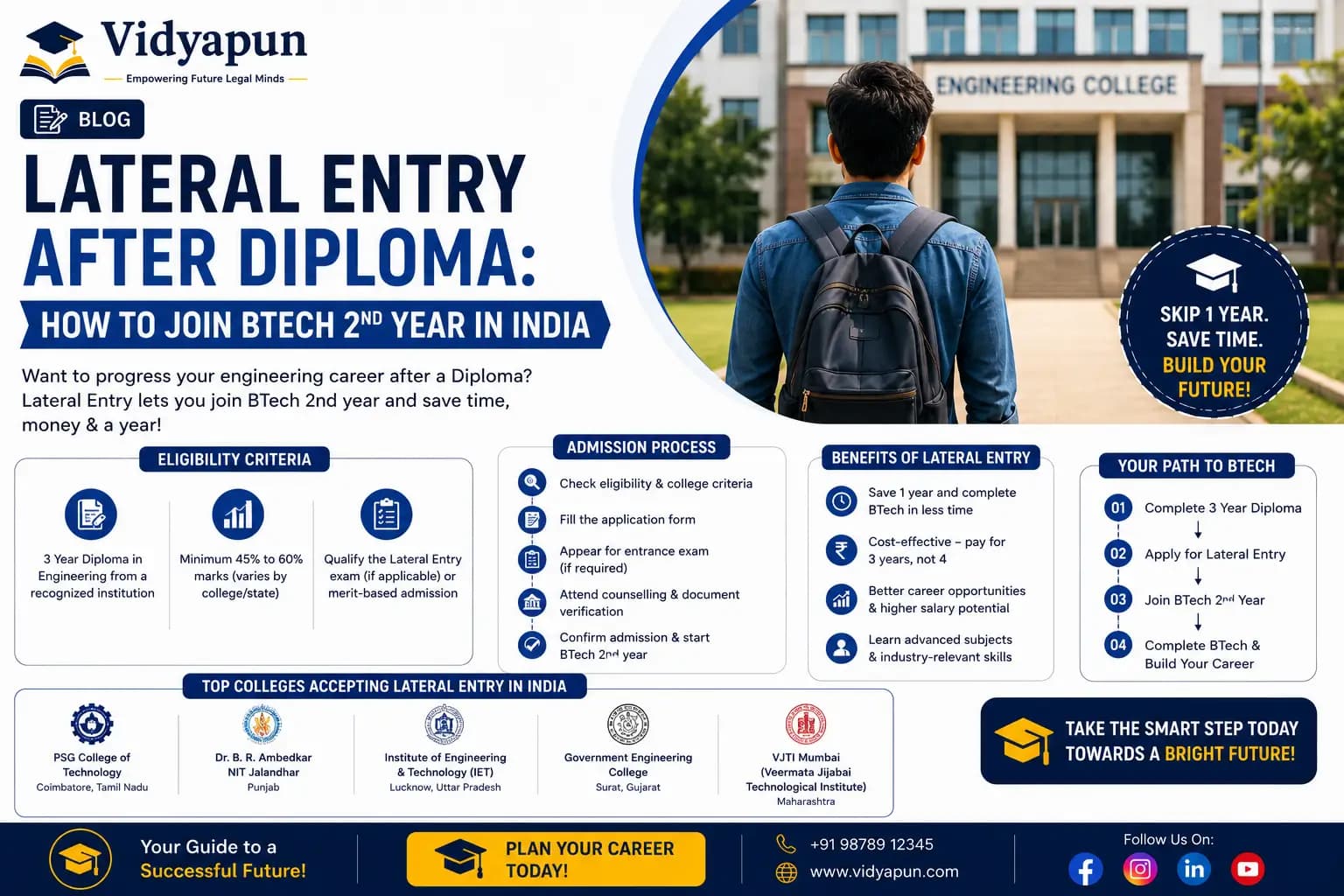
If you have completed a diploma in engineering and someone told you that you need to start BTech from the first year — they were wrong. There is a perfectly legitimate, AICTE-approved pathway that lets diploma holders skip the first year and join BTech directly in the second year. It is called lateral entry, and it is one of the most underused opportunities in India's technical education system.
This blog is a complete, no-fluff guide to lateral entry after diploma — how it works, which states offer it, what the eligibility conditions are, how the admission process runs, and what you should realistically expect once you get in. If you are a diploma holder considering a BTech degree, read this carefully before you make any decisions.
What Is Lateral Entry in BTech?
Lateral entry is a scheme under which diploma holders in engineering (and in some states, BSc graduates) can seek direct admission to the second year (third semester) of a BTech programme — bypassing the first year entirely.
The scheme is recognised and supported by the All India Council for Technical Education (AICTE). Almost every state in India has adopted it, though the specific process, seat allocation, and eligibility conditions vary from state to state.
The core logic is simple: a diploma engineer has already covered significant foundational technical content during three years of polytechnic education. Making them repeat the same basics in BTech first year would be redundant. Lateral entry acknowledges that prior learning and gets you into the more advanced content directly.
Key Point: Lateral entry seats are typically separate from the regular BTech intake. Most states allocate a dedicated lateral entry quota — usually 10 to 15 percent of the total approved intake of each BTech branch — specifically for diploma and BSc holders.
Who Is Eligible for Lateral Entry After Diploma?
Eligibility conditions are broadly similar across states, though details differ. Here is what most states require:
Basic Eligibility
- Completed a three-year Diploma in Engineering or Technology from an AICTE-approved or state board-recognised polytechnic
- Minimum aggregate marks in the diploma — typically 45% (40% for reserved category candidates in most states)
- The diploma stream should ideally match or be related to the BTech branch you are applying for (Civil diploma → BTech Civil; Mechanical diploma → BTech Mechanical, etc.)
For BSc Graduates (where applicable) Some states also allow BSc (Physics/Maths) graduates to apply for lateral entry into BTech — usually into the Computer Science or Electronics stream. This is a separate category and not available everywhere.
Age and Gap Year Conditions Most states do not have a strict upper age limit for lateral entry. Gap years are generally acceptable, though some universities prefer recent diploma pass-outs. Check your specific state's rules.
State-Wise Lateral Entry Process: How It Works Across India
The admission process for BTech lateral entry after diploma varies significantly by state. Here is an overview of how major states handle it:
Maharashtra — MHT-CET Lateral Entry
Maharashtra conducts a separate lateral entry examination as part of MHT-CET. Diploma holders appear for this exam and are allotted seats through a centralised admission process (CAP rounds) conducted by the State Common Entrance Test Cell. Admissions are merit-based.
Uttar Pradesh — UPSEE/AKTU Lateral Entry
AKTU (Dr. APJ Abdul Kalam Technical University) manages lateral entry admissions for UP. Diploma holders apply through the UPSEE lateral entry paper. Seat allotment happens through centralised counselling.
Karnataka — DCET (Diploma Common Entrance Test)
Karnataka has a dedicated exam called DCET conducted by KEA (Karnataka Examinations Authority). This is one of the more structured lateral entry systems in India, with separate papers for each engineering stream.
Tamil Nadu — TNEA Lateral Entry
Tamil Nadu Engineering Admissions (TNEA) includes a lateral entry category. Admissions are based on diploma marks — no separate entrance exam is required. This makes TN one of the more accessible states for lateral entry.
Rajasthan, MP, Gujarat, Punjab
These states conduct their own lateral entry counselling processes, some with entrance exams and some purely merit-based. Candidates need to register with the respective state technical education or admission authority.
Delhi — IPU CET Lateral Entry
Indraprastha University conducts IPU CET with a lateral entry paper for diploma holders seeking admission to affiliated engineering colleges.
The key takeaway: Before preparing anything, go to the official website of your state's technical education board or common entrance test authority and download the current year's information brochure. Rules change slightly every year, and the official source is the only reliable one.
Documents Required for Lateral Entry Admission
Keep these documents ready well in advance — missing even one can get your application rejected during document verification:
- Diploma marksheets (all semesters)
- Diploma passing certificate / provisional certificate
- Class 10 marksheet and certificate
- Migration certificate from your polytechnic (very important — most students forget this)
- Caste / category certificate (if applicable)
- Income certificate (for fee concessions where applicable)
- Domicile / residential certificate
- Passport-size photographs
- Aadhaar card
- Transfer certificate from last institution
Some states and universities also ask for a character certificate and gap year affidavit (if there was a break between diploma completion and BTech admission). Get these prepared early — last-minute scrambles at the SDM office a week before counselling are entirely avoidable.
Which BTech Stream Can You Join After Which Diploma?
This is a question that trips up many students. The general rule is that your diploma stream should correspond to the BTech branch you are applying for. Here is how it typically maps:
| Diploma Stream | Eligible BTech Branch(es) |
|---|---|
| Diploma in Civil Engineering | BTech Civil Engineering |
| Diploma in Mechanical Engineering | BTech Mechanical, Production, Automobile |
| Diploma in Electrical Engineering | BTech Electrical, Electrical & Electronics |
| Diploma in Electronics | BTech Electronics, E&C, E&TC |
| Diploma in Computer Science | BTech CSE, IT, Computer Engineering |
| Diploma in Chemical Engineering | BTech Chemical Engineering |
| Diploma in Instrumentation | BTech Instrumentation, Electronics |
Some universities allow cross-stream lateral entry with additional bridge courses, but this is not universal. Check the specific college and university rules before applying for a branch different from your diploma stream.
Lateral Entry Colleges: Government vs Private
One important decision you will face during counselling is choosing between government and private engineering colleges for lateral entry.
Government and Autonomous Colleges Government engineering colleges and NITs (where lateral entry is applicable) offer better infrastructure, more experienced faculty, lower fees, and stronger placement activity. Competition for these seats is naturally higher. If you have a strong diploma percentage — say 75% or above — target these institutions seriously.
Private Colleges Private engineering colleges have more lateral entry seats available and less competition for them. Quality varies enormously. Some private colleges with NBA accreditation and active industry partnerships are genuinely good options. Many others are not. Check NIRF rankings, NAAC grades, and actual placement data before committing.
Fees to Expect Government college BTech fees for lateral entry students are typically ₹30,000–₹80,000 per year. Private college fees range from ₹80,000 to ₹2.5 lakh per year. Total cost for the remaining three years of BTech via lateral entry in a government college is often under ₹3 lakh — making it one of the most cost-effective paths to an engineering degree in India.
What to Expect Academically After Lateral Entry
Here is the part nobody warns you about enough — the academic adjustment.
When you join BTech second year via lateral entry, you will be sitting alongside students who completed their first year through regular BTech. There are some subject areas — particularly Engineering Mathematics, Basic Electronics, and Engineering Physics — where regular BTech students will have covered content you may not have in your diploma.
This gap is real but manageable. Most universities either offer bridge courses at the start of second year or expect lateral entry students to self-study the gaps. Here is how to handle it:
Before Joining Go through the first-year BTech syllabus of your university. Identify topics you have not covered in your diploma. Spend the summer before second year working through these — Engineering Maths (differential equations, transforms) and the basics of any subjects new to your stream.
During Second Year Do not be shy about asking questions or clarifying concepts you missed. Most faculty are aware that lateral entry students have a different background and are generally accommodating. Forming study groups with regular-batch classmates helps more than most students expect.
The Advantage You Have On the practical side — labs, workshops, project work — lateral entry students consistently outperform their regular-batch peers because of the hands-on polytechnic training. Use that confidence. Your practical instincts are a genuine asset in BTech labs and project work.
Lateral Entry vs Starting BTech from First Year: Which Is Better?
Some students wonder whether they should just start BTech from scratch — clearing Class 12 and getting into a good college through regular admissions — rather than using lateral entry.
The honest answer depends on the college you can access.
If lateral entry gets you into a decent government or autonomous college, it is almost always the better choice — you save a year, you carry your practical skills, and you reach the same destination. If lateral entry only gets you into low-quality private colleges while regular BTech admissions could get you into a significantly better institution, the trade-off deserves careful thought.
Most students, however, find that lateral entry into a reasonably good college is the more practical and financially sensible route — and the outcomes are comparable.
Frequently Asked Questions (FAQs)
Q1. Can I get lateral entry into BTech after diploma without an entrance exam? Some states like Tamil Nadu offer merit-based lateral entry without a separate exam. Most states, however, require a lateral entry entrance test. Check your specific state's admission authority for current rules.
Q2. Is lateral entry BTech degree equivalent to regular BTech? Yes, completely. A BTech degree obtained through lateral entry is exactly equivalent to a regular BTech degree. The final certificate does not mention "lateral entry" — it is the same degree from the same university.
Q3. What percentage is required in diploma for lateral entry in BTech? Most states require a minimum of 45% aggregate in the diploma for general category students and 40% for reserved category candidates. Some universities and states have higher cutoffs.
Q4. Can I apply for lateral entry if my diploma stream is different from the BTech branch? In most cases, you need a matching or closely related diploma stream. Some universities allow cross-stream entry with bridge courses, but it is not standard. Check the specific university's eligibility rules.
Q5. Do NIT and IIT offer lateral entry after diploma? NITs do not offer lateral entry admissions currently. IITs do not either. Lateral entry is primarily available at state government engineering colleges, autonomous colleges, and private colleges affiliated to state universities.
Q6. How many years does it take to complete BTech via lateral entry? Three years — you join in the second year (third semester) and complete sixth, seventh, and eighth semesters before graduating. Your total qualification timeline from Class 10 is six years (3 diploma + 3 BTech).
Q7. Is lateral entry worth it after diploma? Yes, for most students it is the smartest path. You save one year compared to a regular BTech, carry your practical foundation, and end up with the same degree. The cost savings and time efficiency make it genuinely worthwhile.
Final Thoughts
Lateral entry after diploma is one of those options that quietly solves a problem many students do not even know they have — how to get a BTech degree without starting from zero. It is practical, it is officially recognised, and it rewards the work you already put into your polytechnic education.
The students who make the most of it are the ones who go in prepared — they know the academic gaps to bridge, they choose their college carefully rather than just grabbing any available seat, and they use their polytechnic experience as an advantage rather than being defensive about it.
Website: www.vidyapun.com
Call / WhatsApp: +91 96438 02216