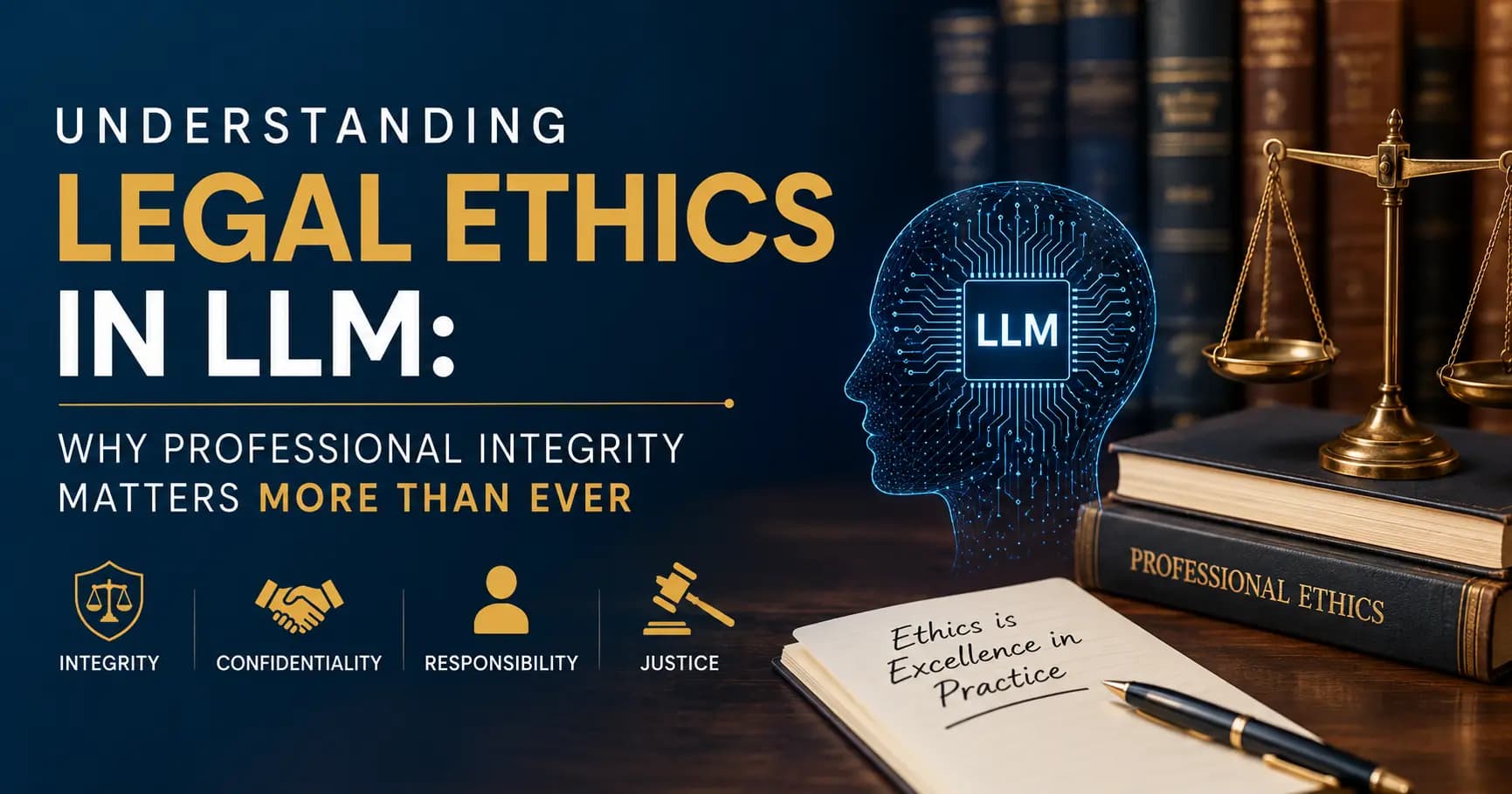
An LLM programme is not only about gaining advanced legal knowledge—it is also about developing the ethical mindset expected of legal professionals. In today's legal environment, where technology, artificial intelligence, and digital information influence legal practice, professional integrity has become more important than ever.
Whether students pursue careers in corporate law, litigation, public policy, academia, or legal consulting, ethical decision-making forms the foundation of professional credibility.
Modern legal education encourages students to combine knowledge with honesty, responsibility, and accountability throughout their academic and professional journey.
Why Legal Ethics is an Essential Part of an LLM
Postgraduate legal education involves advanced research, legal analysis, academic writing, and independent thinking.
Legal ethics helps students:
- Build professional credibility
- Make fair legal decisions
- Conduct honest research
- Respect confidential information
- Follow academic integrity
- Develop responsible leadership
Professional ethics influence every stage of a legal career.
Academic Integrity Begins in the Classroom
An LLM student should develop habits that reflect academic honesty.
Good academic practices include:
- Writing original research
- Properly citing legal sources
- Verifying legal information
- Respecting intellectual property
- Avoiding plagiarism
- Maintaining research transparency
Strong academic integrity prepares students for professional legal responsibilities.
Responsible Use of Artificial Intelligence in Legal Education
AI-powered research tools are becoming common in higher education.
Students should use technology responsibly by:
- Verifying AI-generated information
- Checking legal citations independently
- Reading original statutes and judgments
- Avoiding blind reliance on automated summaries
- Maintaining independent legal analysis
Technology should support legal learning—not replace critical thinking.
Ethical Legal Research Practices
Quality legal research depends on reliable information.
Students should use trusted sources such as:
- Official legislation
- Court judgments
- Government publications
- Academic journals
- Recognised legal databases
- University research libraries
Cross-checking information improves the accuracy of legal analysis.
Professional Responsibility Beyond Academics
Legal ethics extends beyond university assignments.
Future legal professionals should practice:
Honesty
Present facts accurately without misleading others.
Confidentiality
Respect sensitive legal information.
Fairness
Consider different viewpoints before reaching conclusions.
Accountability
Accept responsibility for academic and professional work.
Respect
Treat clients, colleagues, faculty, and peers professionally.
Developing Trust Through Original Work
Google's latest Search guidance encourages creators to produce original, helpful, people-first content that demonstrates real expertise and experience.
For LLM students, this principle applies equally to:
- Research papers
- Legal articles
- Academic projects
- Dissertation writing
- Case analysis
Producing original work strengthens both academic credibility and professional reputation.
Critical Thinking Supports Ethical Decision-Making
Ethics and analytical thinking work together.
Students should learn to:
- Evaluate evidence objectively
- Identify conflicts of interest
- Understand legal responsibilities
- Balance competing legal principles
- Reach evidence-based conclusions
These skills are valuable in every legal profession.
Common Ethical Challenges for LLM Students
Students may encounter situations such as:
- Incorrect citation practices
- Over-reliance on AI tools
- Misinterpreting legal authorities
- Inadequate source verification
- Time pressure leading to poor academic practices
Recognising these challenges early helps students maintain professional standards.
Building a Professional Reputation During Your LLM
Professional credibility develops gradually.
Students can strengthen their reputation by:
- Publishing original legal articles
- Following ethical research practices
- Participating in academic seminars
- Maintaining consistent academic performance
- Respecting intellectual property
- Learning from experienced faculty members
Professional reputation is built through consistent ethical behaviour.
How This Reflects Google's Latest Helpful Content Guidance
Google's recent guidance for education and information websites highlights the importance of Experience, Expertise, Authoritativeness, and Trust (E-E-A-T). Rather than creating content solely for search rankings, publishers should focus on providing accurate, original, well-researched information that genuinely helps readers make informed decisions.
For postgraduate law students, the same principles apply to academic work: prioritise original analysis, cite reliable sources, verify facts, and communicate information clearly. These practices strengthen both academic integrity and professional credibility.
Why Choose Vidyapun?
Choosing the right university is one of the most important steps in postgraduate legal education.
Vidyapun provides:
- LLM Admission Guidance
- University Comparison
- Eligibility Assessment
- Documentation Assistance
- Specialisation Counselling
- Career Guidance
- Personalised Admission Support
Our experienced education counsellors help students identify recognised universities that support quality legal education and long-term academic growth.
Frequently Asked Questions
Why is legal ethics important in an LLM programme?
Legal ethics helps students develop professional integrity, academic honesty, and responsible decision-making—qualities that are essential throughout a legal career.
Can AI tools be used during legal research?
AI tools can assist with research, but students should always verify information using official legal sources, academic journals, and court decisions. Independent analysis remains essential.
What is academic integrity?
Academic integrity means producing original work, properly acknowledging sources, avoiding plagiarism, and maintaining honesty throughout the learning process.
How can LLM students build professional credibility?
Students can strengthen their credibility by conducting ethical research, publishing original work, participating in academic discussions, and continuously improving their legal knowledge.
How can Vidyapun help with LLM admissions?
Vidyapun offers expert counselling, university comparison, admission guidance, eligibility assessment, and documentation support to help students choose the right postgraduate law programme.
Author Information
Reviewed by: Vidyapun Education Team
Editorial Policy: This article is created following Google's latest Helpful Content and E-E-A-T principles. It is reviewed for factual accuracy, educational relevance, originality, and student value. Information is intended for educational guidance and should not be treated as legal advice.
Conclusion
An LLM is not only an opportunity to deepen your legal knowledge but also to develop the ethical standards expected of today's legal professionals. Academic honesty, responsible research, independent thinking, and professional integrity form the foundation of a respected legal career. Students who combine advanced legal education with strong ethical values are better prepared to earn trust, contribute meaningfully to the legal profession, and succeed in a rapidly evolving legal landscape.
Pursue Your LLM with Expert Guidance from Vidyapun
If you're planning to pursue an LLM Degree, let Vidyapun help you choose the right university and postgraduate programme with personalised admission guidance and career counselling.
🌐 Website: www.vidyapun.com
📞 Call / WhatsApp: +91 96438 02216
Contact Vidyapun today for trusted LLM admission support, university comparison, and expert guidance to build a successful future in legal education.