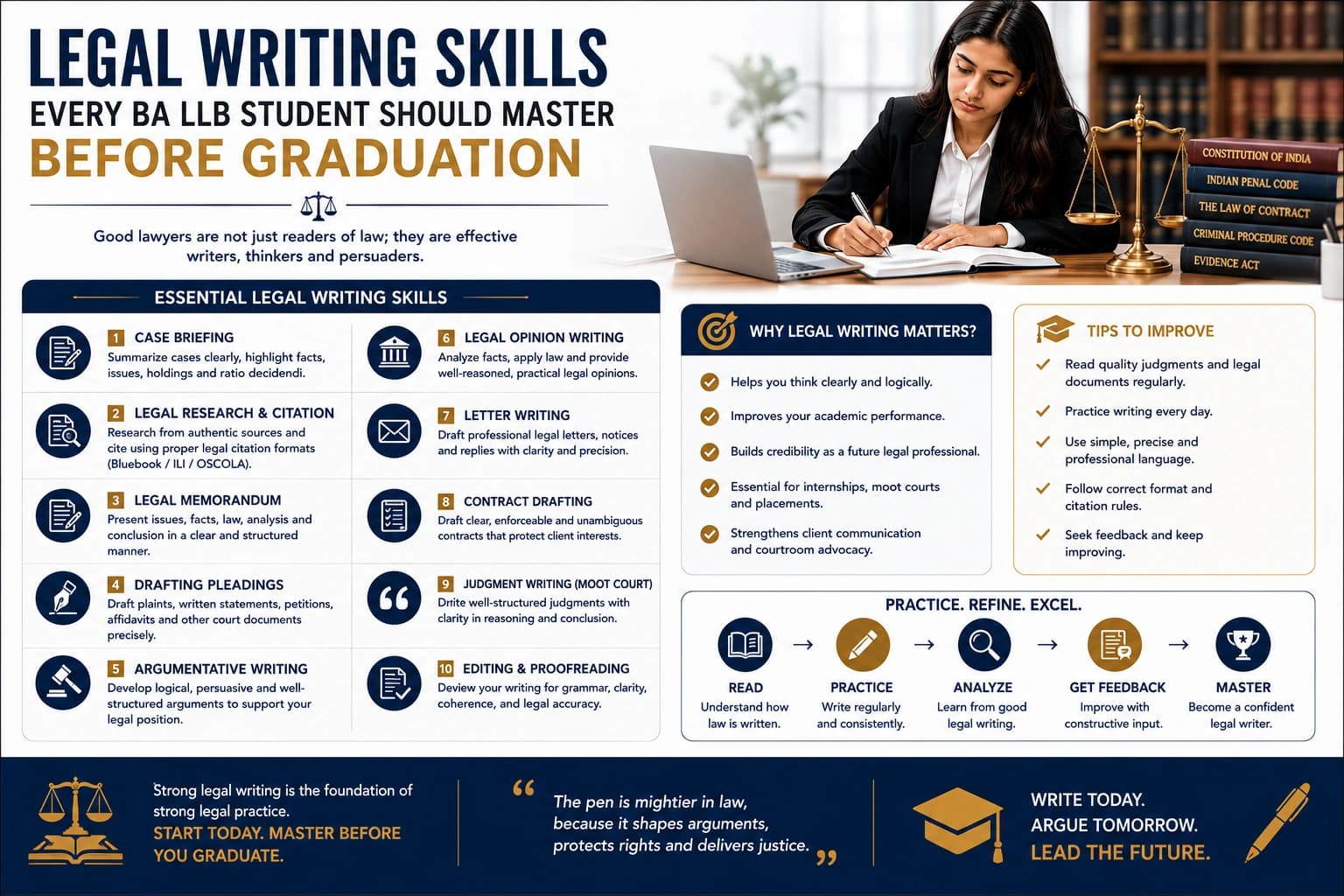
Legal writing is one of the most valuable skills a law student can develop during a BA LLB programme. Whether your career goal is litigation, corporate law, legal consultancy, judicial services, academia, or policy research, the ability to write clearly and accurately is essential.
Legal professionals are expected to draft contracts, prepare legal notices, analyse judgments, write research papers, prepare legal opinions, and communicate complex legal concepts with precision. Developing these skills during law school gives students a strong academic and professional advantage.
This guide explains the most important legal writing skills every BA LLB student should master before graduation and offers practical strategies to improve them.
Why Legal Writing Matters in Law
Legal writing is more than good grammar. It is about presenting legal arguments logically, accurately, and persuasively.
Strong legal writing helps students:
- Explain legal concepts clearly
- Build logical arguments
- Improve research quality
- Perform better in examinations
- Prepare professional legal documents
- Develop analytical thinking
- Communicate effectively with clients and colleagues
Good writing reflects good legal thinking.
Understand the Basics of Legal Writing
Before writing legal documents, students should understand the principles of professional legal communication.
Focus on:
- Clarity
- Accuracy
- Logical structure
- Concise language
- Proper legal terminology
- Correct citations
Avoid unnecessary complexity and focus on making legal content easy to understand.
Learn Legal Research Before Writing
Strong writing begins with strong research.
Before preparing any assignment:
- Read Bare Acts carefully.
- Study landmark judgments.
- Refer to reliable legal journals.
- Compare different legal viewpoints.
- Verify legal provisions before using them.
Reliable research improves the credibility of your writing.
Develop Case Brief Writing Skills
Every law student should know how to prepare case briefs.
A standard case brief should include:
- Case name
- Facts
- Legal issue
- Arguments
- Judgment
- Legal principles
- Key learning
Writing case briefs regularly improves legal analysis and examination preparation.
Practice Legal Drafting
Legal drafting is a practical skill that every future lawyer should learn.
Students should practise preparing:
- Contracts
- Legal notices
- Agreements
- Affidavits
- Memorandums
- Legal opinions
Regular drafting practice improves confidence and attention to detail.
Improve Academic Writing
Law schools require students to submit research papers, assignments, and essays.
To improve academic writing:
- Use reliable legal sources.
- Organise ideas logically.
- Support arguments with evidence.
- Avoid plagiarism.
- Follow proper citation styles.
Well-written academic work reflects professionalism.
Master Legal Citation
Accurate citation strengthens legal writing.
Students should learn to:
- Cite judgments correctly
- Reference statutes
- Credit academic sources
- Maintain consistency throughout documents
Proper citations improve the quality and authenticity of legal research.
Expand Your Legal Vocabulary
A strong legal vocabulary improves writing quality.
Develop the habit of learning:
- Legal terminology
- Latin legal phrases
- Constitutional expressions
- Commercial law terminology
- Judicial language
Understanding legal language helps students write more professionally.
Avoid Common Writing Mistakes
Many students lose marks because of avoidable errors.
Common mistakes include:
- Long and confusing sentences
- Unsupported legal arguments
- Grammatical mistakes
- Incorrect legal citations
- Poor document organisation
- Repetition of ideas
Editing and proofreading are essential before submitting any legal document.
Read High-Quality Legal Documents
Reading professional legal writing helps students improve naturally.
Useful resources include:
- Supreme Court judgments
- High Court decisions
- Law Commission reports
- Government notifications
- Academic legal journals
Observing professional writing styles builds better drafting habits.
Develop Writing Through Daily Practice
Writing improves through consistency.
Spend time each week writing:
- Legal summaries
- Article reviews
- Case analyses
- Opinion pieces
- Research notes
Regular practice gradually strengthens legal communication skills.
Use Technology Responsibly
Modern legal professionals use digital tools to improve productivity.
Students can use technology to:
- Organise research
- Check grammar
- Manage references
- Store legal notes
- Track writing progress
Technology should support learning, not replace independent thinking.
Skills That Complement Legal Writing
Strong legal writing works best alongside other professional skills.
Students should also develop:
- Legal research
- Critical thinking
- Public speaking
- Communication
- Time management
- Ethical decision-making
Together, these skills prepare students for diverse legal careers.
Career Benefits of Strong Legal Writing
Excellent legal writing opens opportunities in:
- Litigation
- Corporate law
- Legal consultancy
- Compliance
- Academia
- Public policy
- Legal research
- Government services
Employers value candidates who can communicate legal ideas effectively.
Why Choose Vidyapun?
Choosing the right university is the first step toward building strong legal skills.
Vidyapun provides:
- BA LLB Admission Guidance
- LLB Admission Support
- LLM Admission Counselling
- University Comparison
- Eligibility Assessment
- Documentation Assistance
- Career Counselling
- Personalised Admission Support
Our experienced counsellors help students choose recognised universities that support academic excellence and long-term career growth.
Frequently Asked Questions
Why is legal writing important for BA LLB students?
Legal writing helps students present legal arguments clearly, prepare professional documents, improve academic performance, and build practical skills needed for various legal careers.
How can I improve my legal writing?
Read judgments regularly, practise legal drafting, improve legal research skills, follow proper citation methods, and write consistently.
What documents should law students learn to draft?
Students should practise drafting contracts, legal notices, agreements, affidavits, legal opinions, memorandums, and research papers.
Does legal writing help in competitive examinations?
Yes. Strong writing skills improve answer presentation, legal reasoning, and analytical ability in university exams and many legal competitive examinations.
How can Vidyapun help?
Vidyapun offers expert admission counselling, university comparison, eligibility assessment, and personalised guidance for students planning to pursue BA LLB, LLB, or LLM programmes.
Conclusion
Developing Legal Writing Skills for BA LLB Students is one of the most valuable investments a future legal professional can make. Strong writing reflects clear thinking, careful research, and professional discipline. By practising legal drafting, case analysis, research writing, and accurate citation throughout law school, students build a foundation that supports academic success and long-term career growth.
Start Your Legal Education Journey with Vidyapun
Planning to pursue BA LLB, LLB, or LLM from a recognised university?
Vidyapun provides expert admission guidance, university comparison, and personalised counselling to help you choose the right law programme.
🌐 Website: www.vidyapun.com
📞 Call / WhatsApp: +91 96438 02216
📧 Email: info@vidyapun.com
Contact Vidyapun today and take the first step toward a successful legal career.