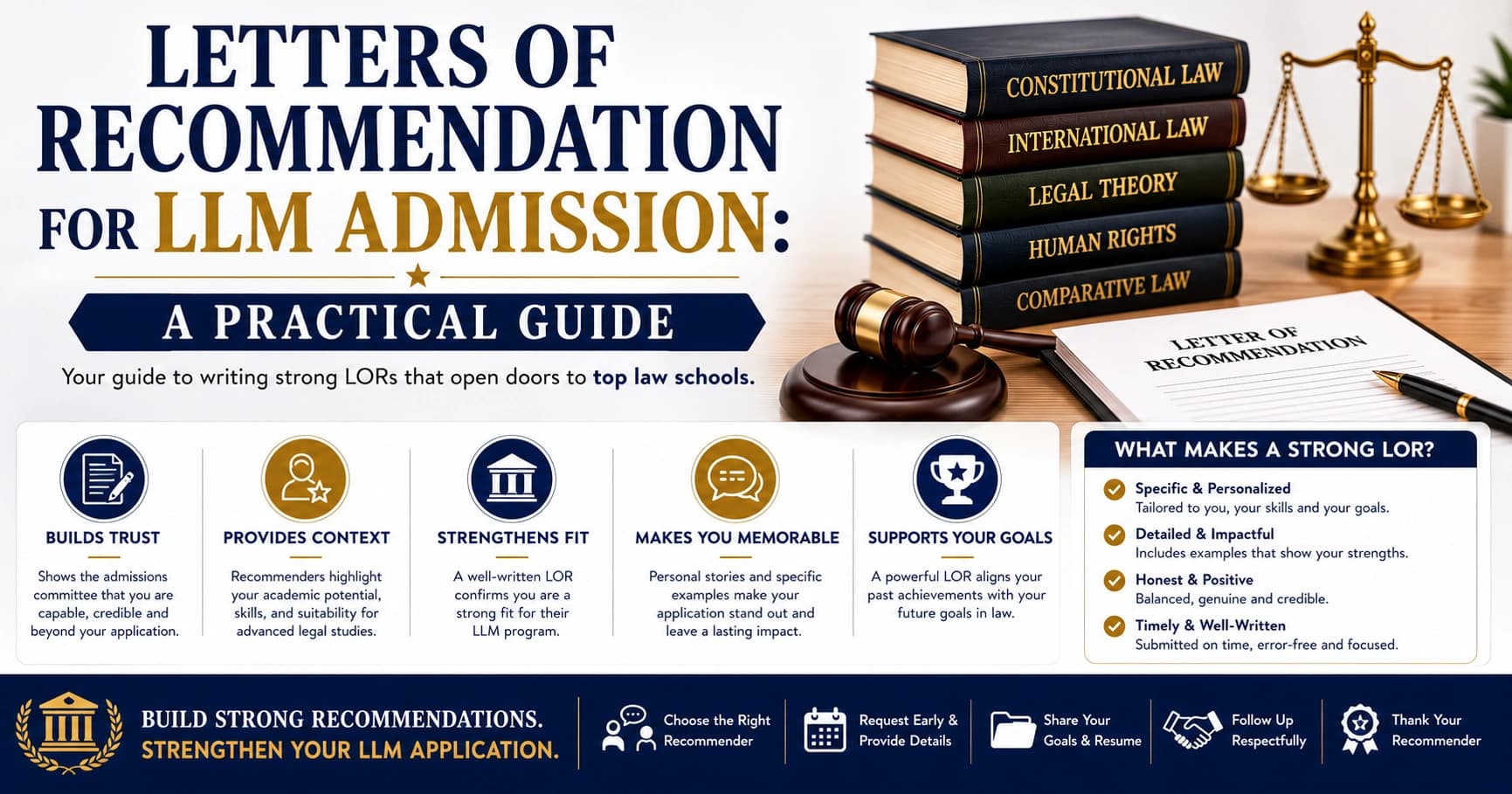
A generic, vaguely-worded letter of recommendation can quietly undercut an otherwise strong LLM application. Since you don't write it yourself, the LOR is one of the few parts of your application where quality depends entirely on preparation and choice, not academic performance. Here's how to handle it properly.
Why Letters of Recommendation Matter for LLM Admission
They Verify What Your Application Claims
Your CV and statement of purpose describe your abilities in your own words. A recommendation letter provides independent verification from someone who's actually observed your work — which is exactly why admissions committees weigh it seriously.
They Matter More for Competitive and International Programs
Indian universities often treat LORs as a formality alongside marks and entrance scores, but competitive NLU LLM programs and international universities frequently use them as a genuine differentiator between similarly-qualified applicants, particularly at the shortlisting stage.
How Many Letters of Recommendation Do You Actually Need
For Most Indian LLM Programs
Typically two recommendation letters, usually from academic referees (professors who taught you directly), though some universities also accept one professional referee (an internship supervisor or lawyer you worked under).
For International or Highly Competitive Programs
Often two to three letters are expected, generally with a mix of academic and professional recommenders — check the specific program's requirements directly, since this varies more internationally than domestically.
Who Should You Actually Ask
A Professor Who Taught You Directly, Not Just Graded You
A recommender who can speak to specific classroom performance, participation, or a paper you wrote is far more valuable than a well-known professor who barely remembers you. Familiarity beats seniority here.
An Internship or Chamber Supervisor
Someone who supervised your actual legal work — drafting, research, court assistance — can speak to practical skills a professor often can't, which is particularly valuable if you're applying for a practice-oriented LLM specialization.
A Moot Court Coach or Judge You Worked With Closely
If a faculty moot court coach mentored you closely through a competition, they can offer genuinely specific insight into your legal reasoning and argumentation under pressure.
Avoid Recommenders Who Barely Know You
A letter from a high-profile name who can only offer generic praise is weaker than a detailed, specific letter from someone less well-known who actually supervised your work closely.
What Actually Makes a Letter of Recommendation Strong
Specificity Over General Praise
"An excellent student" says almost nothing. "Scored the highest marks in my Constitutional Law seminar and wrote a paper on judicial review that I later used as a reference example for other students" says a great deal. Strong letters describe specific instances, not general adjectives.
Direct Relevance to the Program You're Applying To
A letter that connects your demonstrated strengths to the specific LLM specialization you're pursuing (say, a recommender noting your strong analytical writing for a Constitutional Law LLM) is more persuasive than a generic letter reused across every application.
Comparative Context, Where Possible
A recommender noting that you were "among the top 5 students I've taught in the last decade" gives the admissions committee a benchmark that pure praise doesn't.
How to Ask a Recommender the Right Way
Ask Early, Not Under Deadline Pressure
Give your recommender at least three to four weeks' notice. A rushed letter written under pressure is far more likely to be generic than one written with time to think it through properly.
Ask in Person or Over a Proper Email, Not in Passing
A considered, direct request ("would you be willing to write me a strong letter of recommendation for my LLM application") gives your recommender the chance to say yes only if they can genuinely write a strong one — which protects you from a lukewarm letter as much as it helps you.
Provide Them With Material to Work From
Send your recommender your CV, a brief note on the specific LLM program and specialization you're targeting, and a short reminder of specific projects, papers, or moot courts you worked on together. This isn't writing the letter for them — it's making it easy for them to write something specific rather than generic.
Common Mistakes That Weaken a Letter of Recommendation
- Asking a prestigious but distant recommender who can't offer specific detail
- Asking too close to the deadline, leading to a rushed, generic letter
- Not providing your recommender with your CV or program details, forcing them to write from vague memory
- Requesting the same generic letter be reused across very different program types without any tailoring
- Assuming a recommender said yes enthusiastically when they may have simply felt unable to refuse
What a Strong Letter of Recommendation Structure Looks Like
While you don't write the letter yourself, understanding its typical structure helps you provide better material to your recommender:
- How the recommender knows you — course, project, or supervision context, and for how long
- Specific evidence of your ability — a particular paper, case, moot performance, or piece of work, described concretely
- Comparative standing, if genuine — how you compare to other students or interns they've worked with
- A direct statement of support for your specific program or specialization
- Contact details for verification, if requested by the institution
Timeline: When to Start This Process
Start identifying your recommenders at least two months before your application deadline, and make your formal request at least three to four weeks before you need the letter submitted — this gives your recommender genuine time to write something specific rather than something generic under pressure.
Frequently Asked Questions
1. How many letters of recommendation do I need for LLM admission in India?
Typically two, usually academic, though some universities accept a mix of academic and professional recommenders — always check the specific program's requirement.
2. Should I ask a well-known professor or one who knows me well?
Choose familiarity over reputation — a detailed, specific letter from someone who knows your work closely is more persuasive than a generic one from a prestigious but distant recommender.
3. Can I use the same letter of recommendation for multiple LLM applications?
The core content can overlap, but a letter tailored to the specific program or specialization you're applying to is generally more effective than an identical, unmodified letter sent everywhere.
4. How far in advance should I ask for a letter of recommendation?
At least three to four weeks before the submission deadline, ideally with recommenders identified two months in advance.
5. Can a moot court coach write my letter of recommendation?
Yes, especially if they mentored you closely through a competition — they can speak to legal reasoning and argumentation skills a classroom professor might not have observed directly.
6. What should I give my recommender to help them write a strong letter?
Your CV, a short note on the specific program and specialization you're targeting, and a reminder of specific projects, papers, or moot courts you worked on together.
Related Reading
Explore the LLM Course page for program details, our guide on Best LLM Specializations, and the BA LLB Course or LLB Course pages if you're planning your path toward an LLM. For broader admission planning, see Law Admission.
🌐 Website: www.vidyapun.com 📞 Call / WhatsApp: +91 96438 02216