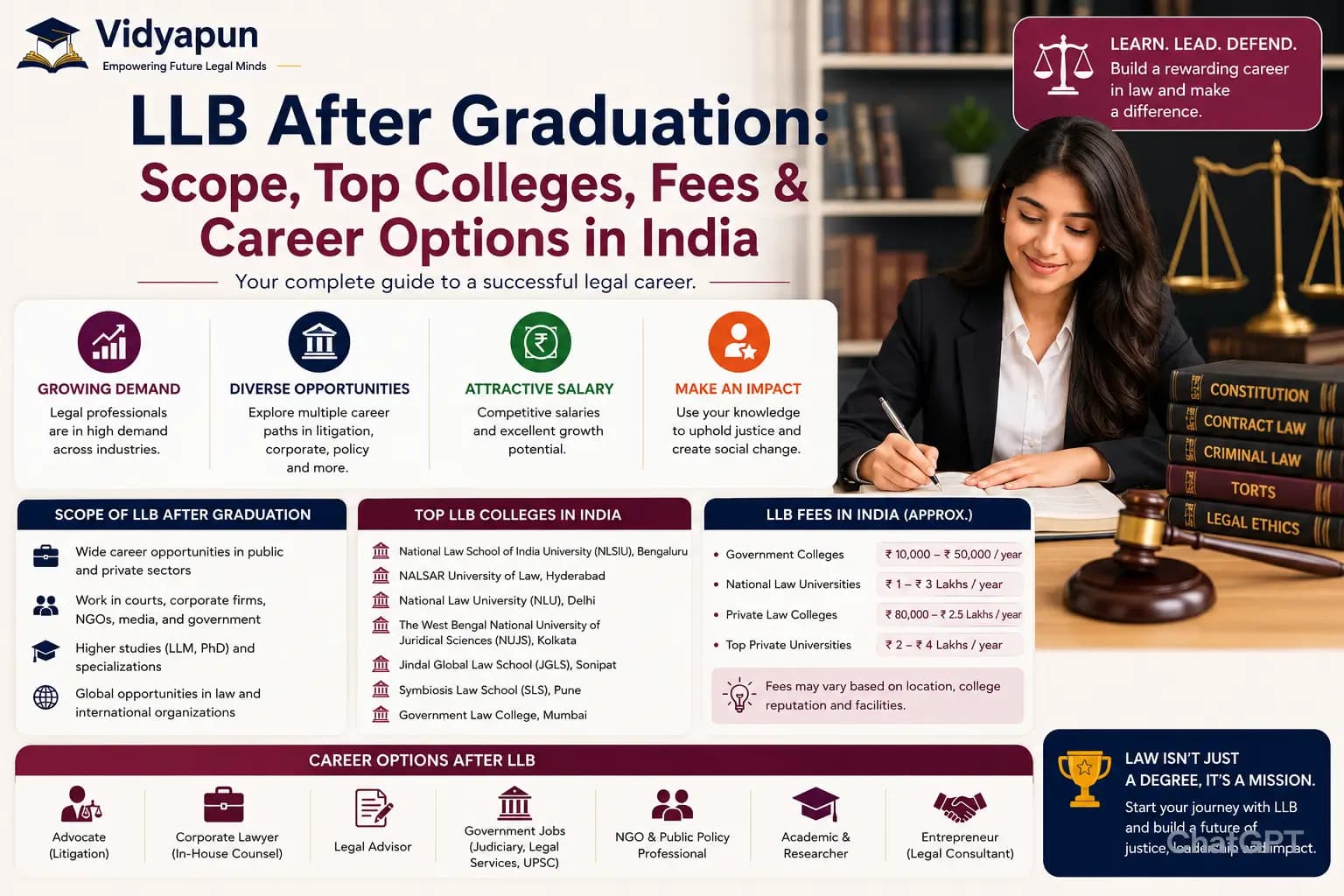
So you've finished your graduation — maybe it was a BCom, BA, BSc, or BBA — and now you're seriously thinking about law. Good instinct. A lot of people discover their interest in legal careers only after completing their undergraduate degree, and the good news is that the path is very much open to you.
Pursuing LLB after graduation in India is one of the most practical and career-transforming decisions you can make. Unlike the five-year integrated BA LLB programme that students enter straight after Class 12, the three-year LLB is designed specifically for graduates like you — people who already have a foundation in another subject and now want to add legal expertise to it.
This guide walks you through everything you need to know before taking that step: what the degree actually involves, which colleges are worth applying to, what it'll cost you, and most importantly — what kind of career you can build once you have that LLB in hand.
What Is LLB After Graduation?
LLB stands for Legum Baccalaureus, or Bachelor of Legislative Law. The 3-year LLB programme is a full-time undergraduate law degree offered to candidates who have already completed a bachelor's degree in any discipline.
It's different from the 5-year BA LLB or BBA LLB integrated programmes in one important way: those are for students entering directly after Class 12, while the 3-year LLB is for graduates. Both lead to the same professional qualification — you can practise law after either — but the 3-year route lets you bring the knowledge and perspective from your first degree into your legal education.
The curriculum typically covers subjects like:
- Constitutional Law and Administrative Law
- Law of Contracts and Torts
- Criminal Law (IPC, CrPC)
- Property Law and Transfer of Property Act
- Family Law and Personal Laws
- Labour and Industrial Law
- Civil Procedure Code (CPC)
- Jurisprudence and Legal Theory
- Environmental Law
- Company Law and Business Legislation
Most universities also require a moot court participation and practical training component, which helps bridge the gap between legal theory and real courtroom practice.
Eligibility Criteria for LLB After Graduation
Before you start applying, here's what you need to know about eligibility:
Educational Qualification: A bachelor's degree in any discipline — BA, BCom, BSc, BBA, BCA, BTech — from a recognised university is required.
Minimum Marks: Most universities require a minimum of 45% aggregate marks in graduation. Some top institutions ask for 50% or higher. SC/ST candidates often get a 5% relaxation.
Age Limit: As per the Bar Council of India (BCI) guidelines, candidates must be under 30 years of age for general category (45 for reserved categories) at the time of admission. However, this age limit has been subject to legal challenges and changes — always verify the latest BCI circular before applying.
Entrance Exam: Many universities require clearing an entrance test. Common ones include CLAT (for NLUs), LSAT India, AILET, DU LLB Entrance Exam, and state-level law entrance exams.
Scope of LLB After Graduation in India
This is the question most people have before committing to three more years of study. Is it worth it? What doors does it actually open?
The honest answer is: quite a few, and the scope is growing steadily.
India's Legal Sector Is Expanding
India has one of the largest legal services markets in Asia. With more businesses operating formally, more regulatory compliance requirements, and a growing awareness of legal rights across society, the demand for qualified lawyers continues to increase.
Your First Degree Becomes a Superpower
Here's something that doesn't get said enough — your graduation background doesn't become irrelevant when you pursue LLB. It becomes an advantage. A BCom graduate who becomes a lawyer has a natural edge in taxation, corporate, and financial law. A BSc graduate is better positioned for environmental law or patent law. A BA Political Science graduate brings valuable context to constitutional and public law. Your first degree and your LLB together create a combination that many employers actively value.
Diverse Practice Areas
LLB graduates in India can practise across a wide range of legal areas — corporate law, criminal defence, family law, intellectual property, real estate, labour law, tax law, and more. The breadth of options means you're not locked into one narrow path.
Growing Demand in Corporate Sector
India's corporate world — startups, MNCs, banks, NBFCs, insurance companies — increasingly needs in-house legal counsel. These roles don't require you to appear in court; they involve contract drafting, compliance, legal advisory, and risk management. They're well-paying, stable, and in high demand.
Government and Judicial Services
LLB opens the door to judicial services (becoming a civil judge or magistrate through state judicial service exams), government law officer roles, and positions with bodies like the Income Tax department, enforcement directorates, and legal aid boards.
The scope of LLB after graduation in India is, in short, genuinely wide — and it's only getting wider as India's economy formalises and its legal infrastructure grows.
Top Colleges for LLB After Graduation in India
Choosing the right college matters — for the quality of education, the faculty, and the credibility your degree carries with employers and clients. Here are institutions consistently recognised for their 3-year LLB programmes:
1. Faculty of Law, University of Delhi (DU)
Delhi University's law faculty is one of the most respected in India. The 3-year LLB programme here is highly competitive, with an entrance exam that attracts thousands of applicants. The Delhi location also gives students excellent access to the Supreme Court, Delhi High Court, and top law firms for internships.
2. Faculty of Law, Banaras Hindu University (BHU)
BHU has a long-standing reputation for legal education. It's a strong government university option for students in North India, offering quality education at relatively affordable fees.
3. Symbiosis Law School, Pune
Among private institutions, Symbiosis is consistently ranked at the top. It offers strong infrastructure, good placement support, and has a well-regarded 3-year LLB programme alongside its integrated offerings.
4. Amity Law School, Delhi/Noida
Amity is a good private university option with a structured curriculum, reasonable placement reach, and campuses in easily accessible locations. It's worth considering if you're comfortable with private university fees.
5. Government Law College, Mumbai
One of the oldest law colleges in Asia, Government Law College Mumbai has produced some of India's most distinguished legal professionals. Its 3-year LLB is highly respected and Mumbai's position as India's commercial capital means excellent internship and career opportunities nearby.
6. ILS Law College, Pune
ILS has a strong academic tradition and is particularly well-regarded in Maharashtra. It offers quality legal education at reasonable costs and has a good alumni network in legal practice.
7. Christ University, Bangalore
Christ offers a well-structured LLB programme in a professional environment. Bangalore's growing legal and corporate ecosystem makes it a practical city to study law in.
8. Aligarh Muslim University (AMU), Faculty of Law
AMU has a respected law faculty with a strong research culture. It's a solid government university option for students in the northern and central India region.
9. Osmania University, Faculty of Law, Hyderabad
Osmania has a long history in legal education and offers affordable quality education in Hyderabad — a city with a growing legal and corporate market.
10. Campus Law Centre, University of Delhi
Another DU-affiliated law centre with a competitive LLB programme. Like the main Faculty of Law, it benefits from proximity to India's constitutional and legal nerve centre.
LLB After Graduation Fees in India
Fees vary widely depending on whether you choose a government or private institution:
| College Type | Approximate Annual Fees (INR) |
|---|---|
| Government Universities (DU, BHU, AMU) | ₹5,000 – ₹25,000 |
| State Government Law Colleges | ₹10,000 – ₹40,000 |
| National Law Universities (NLUs) | ₹80,000 – ₹1,50,000 |
| Private Universities (Symbiosis, Amity, Christ) | ₹1,00,000 – ₹3,00,000 |
Government colleges remain by far the most affordable option and often the most academically respected. If getting into a DU or BHU is within reach for you, it's worth working toward.
Education loans for law programmes are available through most nationalised banks, and many private universities offer scholarship programmes for merit students.
Career Options After LLB in India
Once you have your LLB, the Bar Council of India requires you to enroll with a State Bar Council to practise as an advocate. But practising in court is far from your only option. Here's a breakdown of the main career paths:
Litigation Joining a law firm or practising independently in district courts, High Courts, or eventually the Supreme Court. Litigation builds slowly but can be extremely rewarding in the long run — both professionally and financially.
Corporate Law / In-House Counsel Working in the legal department of a company — drafting contracts, advising on regulatory compliance, handling mergers and acquisitions, managing disputes. Corporate legal roles offer structured career growth and competitive salaries.
Judicial Services Clearing state judicial service examinations to become a Civil Judge or Judicial Magistrate. This is a respected and stable government career with good long-term prospects.
Legal Process Outsourcing (LPO) India has a massive LPO industry. Companies like Integreon, UnitedLex, and Pangea3 hire LLB graduates for document review, contract management, and legal research — good entry-level roles with decent pay.
Banking and Financial Sector Banks, NBFCs, and insurance companies have significant legal departments. Your LLB combined with a BCom or finance background is a strong fit here.
Government Law Officer Roles with the Central or State Government as Assistant Government Pleaders, Public Prosecutors, or legal advisors to departments and PSUs.
Legal Journalism and Policy Writing about law for publications, think tanks, or advocacy organisations — a path for those who combine strong communication skills with legal knowledge.
Higher Studies (LLM) Many 3-year LLB graduates go on to pursue an LLM in a specialised area — IP law, constitutional law, corporate law, or international law — to deepen their expertise and access higher-level career opportunities.
Salary After LLB in India
| Career Path | Approximate Starting Salary (INR) |
|---|---|
| Junior Associate – Law Firm | ₹3–7 LPA |
| Corporate Legal / In-House Counsel | ₹5–10 LPA |
| Judicial Services (Civil Judge) | ₹8–12 LPA |
| LPO / Legal Analyst | ₹3–6 LPA |
| Government Law Officer | ₹6–10 LPA |
| Senior Litigator (8–10 years exp.) | ₹20–50 LPA+ |
Legal careers tend to be cumulative — your reputation, client base, and expertise build over time, and the earning potential at senior levels is substantial.
FAQs: LLB After Graduation in India
Q1. Can I do LLB after any graduation stream? Yes. Whether you've done BA, BCom, BSc, BBA, BCA, or BTech, you're eligible for the 3-year LLB programme as long as you meet the minimum marks requirement. Your graduation background often becomes an asset in your legal specialisation.
Q2. Is the 3-year LLB equal to the 5-year BA LLB in terms of career value? Yes, in terms of professional qualification and Bar Council enrollment, both are equivalent. The 5-year programme is integrated and often attended by students with a stronger early commitment to law, but the 3-year LLB from a good institution carries equal professional weight.
Q3. Which entrance exam should I prepare for LLB after graduation? CLAT PG (for NLU 3-year LLB), DU LLB Entrance Exam (for Delhi University), LSAT India, and various state-level law entrance exams are the main ones. Research which colleges you're targeting and prepare accordingly.
Q4. Can I do LLB after graduation through distance learning? The Bar Council of India does not recognise distance or correspondence LLB programmes for the purpose of enrollment as an advocate. If you want to practise law, you must complete a regular full-time LLB from a BCI-recognised institution.
Q5. Is LLB after BCom a good combination? Extremely good. BCom + LLB is one of the most practical combinations for corporate law, taxation law, banking law, and financial litigation — areas with consistently strong demand and competitive salaries.
Q6. How long does it take to become a practising lawyer after LLB? After completing your LLB (3 years), you enroll with a State Bar Council. You can begin practising immediately, though most people spend 1–3 years as a junior under a senior advocate before building an independent practice.
Q7. What is the age limit for LLB admission after graduation? As per BCI guidelines, the general upper age limit has been 30 years (45 for reserved categories). However, this has been legally contested multiple times. Always check the latest BCI notification and the specific college's admission guidelines before applying.
Your Legal Career Starts With One Decision
The legal profession in India is more accessible, more diverse, and more in demand than most people realise — and doing LLB after graduation is a perfectly valid, well-established path into it. The three years you invest will give you a qualification that combines with everything you already know, opening doors in litigation, corporate law, government service, and beyond.
Start by identifying the colleges that match your academic profile and the city where you want to build your career. Prepare seriously for the entrance exam relevant to your target institution. And if you're still unsure about your specialisation, don't worry — the LLB itself will help you figure out which area of law excites you most.
The courtroom, the boardroom, the policy room — all of them need good lawyers. That could be you.
Confused about which college to target or how to prepare for the LLB entrance exam? Drop your question in the comments and we'll help you figure out the best path forward.
Website: www.vidyapun.com
Call / WhatsApp: +91 96438 02216