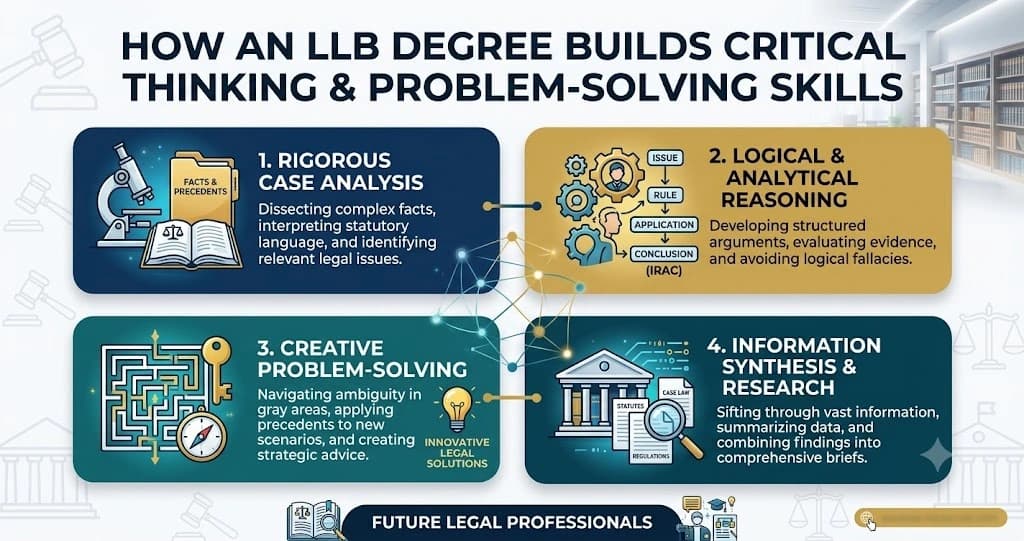
Legal education is about much more than learning statutes and legal definitions. One of the greatest benefits of pursuing an LLB Degree is developing the ability to think critically, evaluate evidence, solve complex legal issues, and make well-reasoned decisions.
Modern legal professionals are expected to analyse situations from multiple perspectives, interpret laws carefully, and communicate solutions effectively. These abilities begin developing during law school.
Why Critical Thinking Matters in Law
Every legal issue involves facts, evidence, legal principles, and interpretation.
Critical thinking enables students to:
- Analyse legal situations objectively
- Compare different legal viewpoints
- Identify strengths and weaknesses in arguments
- Make logical conclusions
- Develop professional judgment
These abilities form the foundation of legal practice.
Learn to Analyze Legal Problems
During an LLB programme, students regularly examine legal scenarios.
Instead of memorising answers, students learn to:
- Identify legal issues
- Understand applicable laws
- Evaluate evidence
- Interpret judicial decisions
- Recommend logical legal solutions
This analytical approach prepares students for real-world legal work.
Strengthen Legal Reasoning
Legal reasoning allows students to apply legal principles correctly.
Students improve this skill by:
- Reading landmark judgments
- Studying constitutional provisions
- Understanding legislative intent
- Comparing judicial interpretations
- Practicing legal analysis
Strong reasoning leads to better academic and professional performance.
Improve Decision-Making Skills
Law students frequently evaluate multiple legal perspectives before reaching conclusions.
This develops:
- Independent thinking
- Objective analysis
- Ethical decision-making
- Professional responsibility
- Balanced judgment
Decision-making is valuable in every area of law.
Build Research-Based Learning Habits
Critical thinking begins with reliable information.
Students should regularly use:
- Bare Acts
- Supreme Court Judgments
- High Court Decisions
- Government Publications
- Academic Journals
- Official Legal Resources
Research-backed learning improves both knowledge and confidence.
Develop Effective Communication
Critical thinking becomes meaningful only when ideas are communicated clearly.
Students should practice:
- Legal writing
- Academic presentations
- Research discussions
- Professional communication
- Analytical writing
Clear communication strengthens legal arguments.
Apply Technology Responsibly
Technology supports legal education, but independent thinking remains essential.
Students should:
- Verify AI-generated information
- Cross-check legal references
- Conduct original research
- Avoid plagiarism
- Use authentic legal databases
Technology should enhance—not replace—legal analysis.
Why Choose Vidyapun?
Vidyapun supports students throughout their legal education journey with:
- LLB Admission Guidance
- University Comparison
- Eligibility Assessment
- Documentation Support
- Career Counselling
- Personalised Admission Assistance
Our experienced education counsellors help students choose recognised universities that support academic excellence and long-term career growth.
Frequently Asked Questions
Why is critical thinking important in an LLB degree?
Critical thinking helps students analyse legal issues, interpret laws, evaluate evidence, and make logical legal decisions.
How can law students improve legal reasoning?
By reading judgments, studying legislation, practising legal writing, conducting research, and analysing real legal situations.
Does technology improve legal learning?
Yes. Digital legal resources support research, but students should always verify information using official legal sources.
Can these skills help outside legal careers?
Yes. Critical thinking, communication, research, and problem-solving are valuable in many professional fields.
How can Vidyapun help?
Vidyapun offers expert admission counselling, university comparison, documentation assistance, and personalised guidance for students pursuing an LLB.
Author Information
Reviewed by: Vidyapun Education Team
Editorial Policy: This article follows Google's latest Helpful Content System and E-E-A-T principles by providing original, people-first educational guidance based on trusted information and practical academic insights.
Conclusion
An LLB Degree develops much more than legal knowledge. It strengthens critical thinking, legal reasoning, research ability, ethical decision-making, and professional communication—skills that remain valuable throughout a legal career. Students who focus on continuous learning and analytical thinking will be better prepared to succeed in the evolving legal profession.
Start Your LLB Journey with Vidyapun
Planning to pursue an LLB from a recognised university?
Vidyapun helps students compare universities, understand admission requirements, and choose the right legal education pathway.
🌐 Website: www.vidyapun.com
📞 Call / WhatsApp: +91 96438 02216
Contact Vidyapun today for trusted LLB admission guidance and personalised counselling.