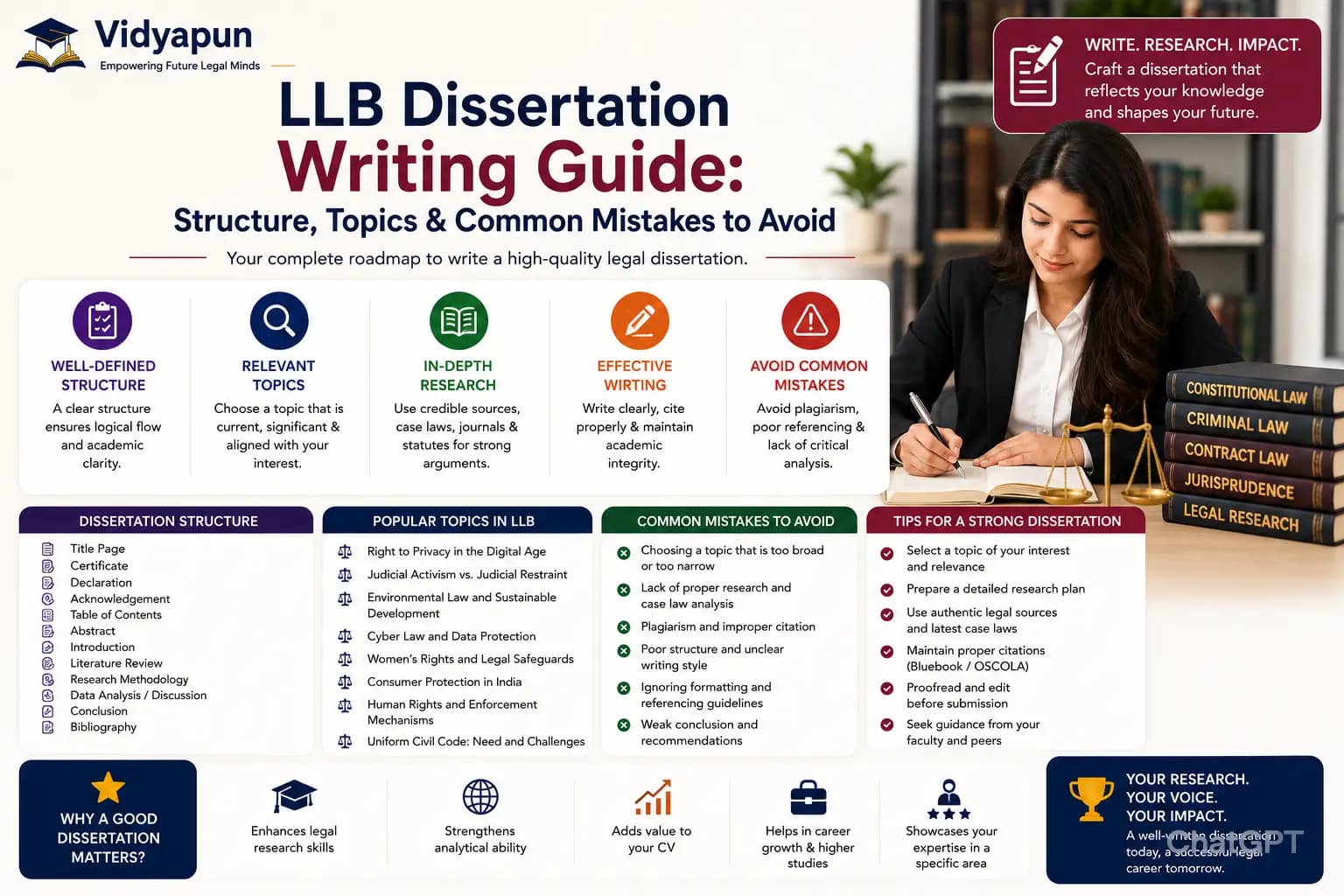
Let's be honest — the LLB dissertation is the one piece of work that most law students dread more than any exam. It's longer than anything you've written before, the topic selection feels overwhelming, and there's no weekly deadline forcing you to make progress. Most students either start too late or spend so much time choosing a topic that they're left scrambling to write the entire thing in a few weeks.
If that sounds familiar, you're in the right place.
This LLB dissertation writing guide is designed to take the confusion out of the process. Whether you're just starting to think about your topic or you're already mid-way through and feeling stuck, this guide gives you a clear framework — how to structure your dissertation properly, how to choose a topic that works in your favour, and the most common mistakes that cost students marks they really didn't need to lose.
What Is an LLB Dissertation?
Before diving into the how, it helps to be clear about the what.
An LLB dissertation is an extended, independent research project — usually between 8,000 and 15,000 words depending on your university — that demonstrates your ability to identify a legal problem, analyse it in depth using primary and secondary sources, and arrive at original conclusions or recommendations.
It's different from a regular assignment or seminar paper in a few important ways. A dissertation requires you to formulate a research question, build a sustained argument across multiple chapters, engage critically with existing legal scholarship, and demonstrate an understanding of legal research methodology. It's the closest thing your undergraduate degree has to a piece of genuine academic legal research.
Most universities require LLB students to submit a dissertation in their final year, though some offer it as an optional module. If it's optional at your institution — take it. A well-executed dissertation is one of the strongest signals you can send to law firms, postgraduate admissions committees, and judicial services about your research and analytical capabilities.
Choosing the Right LLB Dissertation Topic
This is where most students lose weeks of precious time — and often end up with a topic that's either too broad to handle or too narrow to sustain 10,000 words.
Here are the principles that actually work:
Pick Something That Genuinely Interests You
You're going to spend months with this topic. If you choose something purely because it sounds impressive but you find it dull, it will show in the writing. Genuine intellectual curiosity produces better research — and better marks.
Make Sure There's Enough Secondary Literature
Your dissertation needs to engage with existing scholarship. If you choose a topic that's too niche or too recently emerged, you may find there simply isn't enough published work to engage with critically.
Find a Specific Legal Problem or Debate
The best dissertation topics aren't just subjects — they're questions. Instead of "Intellectual Property Law in India," think "Does the current framework for copyright protection in India adequately address the challenges posed by AI-generated content?" The more specific your question, the more focused and convincing your analysis will be.
Check That Your Topic Has Scope for Original Argument
A dissertation that only summarises existing law scores poorly. You need to make an argument — take a position, defend it, acknowledge counterarguments, and explain why your conclusion is the right one.
Good LLB Dissertation Topic Ideas (Low-Competition, High-Relevance)
Here are some topic areas that offer rich research potential, have enough existing literature to engage with, and are specific enough to produce focused dissertations:
Constitutional and Public Law
- The expanding scope of Article 21 and its implications for socio-economic rights in India
- Constitutional morality versus popular morality: a critical analysis of the Supreme Court's approach post-Navtej Singh Johar
- The Basic Structure Doctrine: limits of parliamentary sovereignty in India
Criminal Law
- Marital rape and the gap in Indian criminal law: a case for reform
- Juvenile justice in India: balancing rehabilitation with accountability post the 2015 Act
- The death penalty in India: an analysis of the "rarest of rare" doctrine in practice
Intellectual Property Law
- AI-generated works and copyright ownership: who owns what the machine creates?
- Compulsory licensing of pharmaceutical patents in India: balancing innovation and public health
- Geographical Indications in India: effectiveness of the GI tag in protecting traditional knowledge
Corporate and Commercial Law
- Minority shareholder protection under the Companies Act 2013: how effective is the framework?
- Insolvency and Bankruptcy Code 2016: an assessment of its impact on creditor rights
- Corporate social responsibility under Indian law: obligation or aspiration?
Family and Personal Law
- Uniform Civil Code in India: constitutional necessity or political controversy?
- Gender neutrality in Hindu succession law: gaps and reform possibilities
- Live-in relationships and legal recognition: an analysis of judicial trends in India
Environmental Law
- The precautionary principle in Indian environmental jurisprudence: application and limitations
- Climate change litigation in India: scope, challenges, and future prospects
These are just starting points — the real topic emerges when you narrow down to a specific question within one of these areas.
LLB Dissertation Structure: Chapter by Chapter
This is the part most guides get wrong — they give you a generic structure without explaining what each chapter actually needs to do. Here's a breakdown that works:
Chapter 1: Introduction (800–1,200 words)
Your introduction has one job: make the reader understand what you're arguing, why it matters, and how you're going to go about it.
It should include:
- Background context — briefly situate the legal problem you're examining
- Research question — state it clearly and specifically
- Aim and objectives — what are you trying to find out or establish?
- Significance of the study — why does this question matter legally or socially?
- Research methodology — are you using doctrinal analysis, comparative analysis, empirical data, or a combination?
- Chapter outline — a brief roadmap of what each subsequent chapter covers
Don't try to be clever or mysterious in your introduction. Clarity is what examiners reward here.
Chapter 2: Literature Review (1,500–2,500 words)
The literature review is not a summary of everything you've read. It's a critical engagement with existing scholarship that establishes where the gaps, debates, and unanswered questions lie — and how your dissertation fits into that landscape.
Structure it thematically rather than as a list of "X said this, Y said that." Group scholars by the positions they take or the aspects of your topic they address, and critically evaluate what their arguments do and don't establish.
Chapter 3: Research Methodology (500–800 words)
For most LLB dissertations, this chapter is relatively brief. Explain whether your approach is:
- Doctrinal — analysing statutes, case law, and legal principles
- Comparative — comparing the legal position across different jurisdictions
- Socio-legal — examining how law operates in its social context
- Empirical — using surveys, interviews, or data (less common at LLB level)
Justify your choice of methodology and acknowledge its limitations.
Chapter 4 (and sometimes Chapter 5): Analysis and Discussion (3,000–5,000 words)
This is the core of your dissertation — where you do the actual legal analysis. Structure it around the sub-questions or themes that flow from your main research question.
Each section should:
- State the legal position clearly
- Analyse it critically — what does the law get right, where does it fall short?
- Engage with scholarship that supports or challenges your analysis
- Build toward your overall argument
Avoid the common mistake of just describing the law. Every section should be moving your argument forward.
Chapter 5 or 6: Conclusion (800–1,200 words)
Your conclusion should do three things:
- Summarise your key findings — not by repeating everything, but by drawing together the threads of your argument
- Answer your research question directly and clearly
- Suggest implications or recommendations — what should change in law or policy, or what further research is needed?
Don't introduce new material in your conclusion. And don't end with vague statements like "this is a complex area that requires further study." Take a position.
Bibliography and Footnotes
Use the citation style required by your university — OSCOLA is standard for most Indian and UK law schools. Be meticulous. Inconsistent or incomplete citations are one of the easiest ways to lose marks unnecessarily.
Common Mistakes in LLB Dissertation Writing
These are the errors that come up repeatedly in examiner feedback — and most of them are entirely avoidable.
1. A Research Question That's Too Broad "Analysing Criminal Law in India" is not a research question. It's a subject. Narrow it down to a specific legal problem, debate, or gap in the law.
2. Descriptive Rather Than Analytical Writing The most common criticism in LLB dissertation feedback is that the work is "largely descriptive." Simply explaining what the law says is not enough. You need to critically evaluate it — argue why it's inadequate, effective, contradictory, or in need of reform.
3. Ignoring Methodology Many students skip the methodology chapter or treat it as a formality. This is a mistake. Explaining your methodological approach shows the examiner that you understand what kind of research you're doing and why it's appropriate.
4. Poor Source Selection Relying heavily on textbooks and websites rather than primary sources (legislation, case law) and peer-reviewed secondary sources (law review articles, academic books) significantly weakens a dissertation.
5. Starting Too Late A dissertation cannot be written in two weeks. The research, planning, and drafting phases each take time. Starting your topic selection and preliminary reading at least four to five months before the submission date is the minimum advisable approach.
6. Neglecting the Literature Review Many students treat the literature review as a box-ticking exercise. A strong literature review demonstrates that you know the scholarly landscape of your topic — and it significantly strengthens the credibility of your analysis.
7. Inconsistent Referencing Switching between citation styles, missing page numbers, incomplete references — these are easy marks to lose. Use a reference management tool like Zotero or Mendeley from the start to keep your citations organised.
8. Not Answering the Research Question It sounds obvious, but many dissertations drift so far into analysis that the conclusion never clearly answers the question posed in the introduction. Keep your research question visible as you write — it should anchor every chapter.
FAQs: LLB Dissertation Writing
Q1. How long should an LLB dissertation be? Most Indian and UK universities require LLB dissertations to be between 8,000 and 15,000 words. The exact requirement varies by institution — always check your university's dissertation guidelines. Word counts typically exclude footnotes and bibliography.
Q2. Can I change my dissertation topic after it's been approved? In most universities, you can make changes early in the process, but significant topic changes after supervisor approval are discouraged and may require formal permission. This is one reason to think carefully before submitting your topic proposal.
Q3. How do I choose between doctrinal and comparative methodology for my LLB dissertation? If your research question focuses primarily on analysing Indian law, doctrinal methodology works well. If your question involves evaluating whether India should adopt an approach used elsewhere, comparative methodology is more appropriate. Many strong dissertations use a combination of both.
Q4. How many sources should an LLB dissertation have? There's no fixed number, but a well-researched LLB dissertation typically engages with 30–60 sources — a mix of primary sources (cases, statutes) and secondary sources (journal articles, books). Quality and relevance matter more than quantity.
Q5. Is it okay to use newspaper articles as sources in an LLB dissertation? Newspaper articles can be used to establish factual context or illustrate a social issue, but they shouldn't be used as legal authority or to support legal arguments. Peer-reviewed journals, court judgments, and academic books should form the backbone of your sources.
Q6. What is OSCOLA referencing and do I need to use it? OSCOLA (Oxford University Standard for the Citation of Legal Authorities) is the most widely used citation style for legal academic writing in India and the UK. Most law schools either require it or strongly recommend it. Download the free OSCOLA guide from the University of Oxford website.
Q7. How do I avoid plagiarism in my LLB dissertation? Always properly cite every source you use — both for direct quotes and for paraphrased ideas. Use plagiarism detection tools like Turnitin or Grammarly's plagiarism checker to review your work before submission. Original analysis and argument, built on properly attributed sources, is the foundation of academic integrity.
Write a Dissertation You're Actually Proud Of
An LLB dissertation is not just a graduation requirement — it's an opportunity. A genuinely well-researched, well-argued dissertation opens doors: it strengthens LLM applications, impresses law firm recruiters, and demonstrates the kind of rigorous legal thinking that distinguishes you from the crowd.
The formula isn't complicated. Choose a focused, interesting question. Structure your chapters so each one builds the argument forward. Engage critically with the law rather than just describing it. Start early enough to do the research justice.
If you're at the stage of choosing your topic, start narrowing today — pick one area of law you genuinely find compelling and identify the specific debate or gap within it that your dissertation will address. That single decision will make everything that follows significantly easier.
Working on your LLB dissertation and need help with topic selection or structure? Drop your question in the comments — we're happy to point you in the right direction.
Website: www.vidyapun.com
Call / WhatsApp: +91 96438 02216