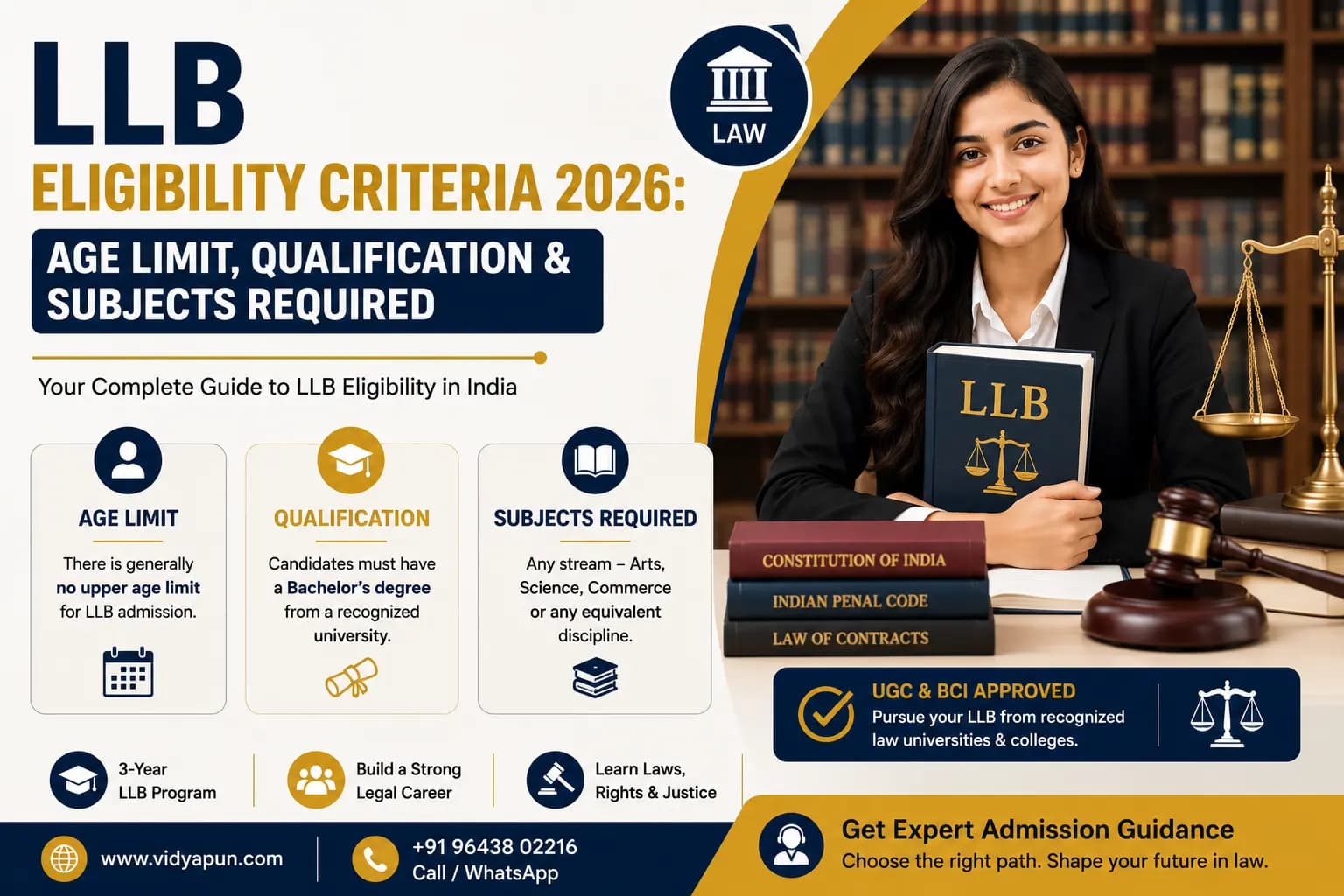
"LLB" can mean two different things depending on where you're starting from — a 3-year course for graduates, or a 5-year integrated course for 12th-pass students. That distinction is exactly why LLB eligibility criteria confuses so many first-time applicants: the rules genuinely differ depending on which LLB you're applying for.
This guide breaks down LLB eligibility clearly — qualification requirements, age limits, stream restrictions (or lack of them), and category-based relaxations — so you know exactly where you stand before you start applying.
What Is LLB Eligibility Criteria?
LLB eligibility criteria refers to the minimum academic qualification, age, and — in some cases — additional conditions a candidate must meet to apply for an LLB program in India, as set by individual universities within the framework laid down by the Bar Council of India (BCI).
LLB Course Overview
In India, "LLB" is commonly used for two distinct program types: the 3-year LLB, meant for students who already hold a bachelor's degree in any discipline, and the 5-year integrated LLB (like BA LLB or BBA LLB), meant for students straight out of Class 12. Both lead to the same professional law degree, but the entry point and eligibility requirements differ meaningfully between them.
Why Eligibility Matters Before You Apply
Meeting a university's minimum eligibility doesn't guarantee you a seat — that still depends on your entrance exam score or merit ranking — but failing to meet it disqualifies your application entirely, no matter how well you might otherwise perform. Confirming eligibility should always be your first step, before you spend time or money on exam preparation or applications.
Minimum Qualification Required for LLB
The core qualification requirement depends entirely on which LLB format you're applying to.
3-Year LLB Qualification
For the 3-year LLB, you must hold a bachelor's degree (in any discipline — Arts, Commerce, Science, Engineering, or any other stream) from a recognized university. There is generally no restriction on which undergraduate degree you hold; law schools accept graduates from virtually any academic background for this route.
5-Year Integrated LLB Qualification
For the 5-year integrated LLB (BA LLB, BBA LLB, and similar combinations), you need to have passed Class 12 from a recognized board. As with the 3-year route, no specific stream is mandatory — Arts, Commerce, and Science students are all eligible to apply for the integrated program.
Is There an Age Limit for LLB Admission?
Age criteria for LLB has shifted over the years and still varies by institution, making it one of the details worth double-checking directly with your target university.
General Age Criteria
Some universities apply an upper age limit for LLB admission, while a number of institutions — including several major exam-conducting bodies — have removed age limits altogether in recent years following regulatory and judicial developments. There is no single uniform national rule, so don't assume a limit applies (or doesn't) until you've confirmed it for your specific target college.
Age Relaxation for Reserved Categories
Where an age limit does apply, most universities extend a relaxation of a few years for candidates from reserved categories (SC/ST/OBC) and for candidates with disabilities, in line with applicable government policy. The exact relaxation period differs by institution, so confirm the specific figure for your target college rather than relying on a general number.
Can Commerce and Science Students Apply for LLB?
A common misconception is that law requires an Arts or Humanities background — this isn't true for either LLB format.
Stream-Neutral Admission Policy
Neither the 3-year LLB nor the 5-year integrated LLB restricts eligibility to a specific Class 12 or undergraduate stream. Commerce and Science students are admitted in large numbers alongside Arts and Humanities students every year, across both formats.
Subject Combinations That Help
While no specific subjects are compulsory, prior exposure to subjects like Political Science, Economics, History, or English can ease the transition into law's reading- and writing-heavy coursework — though it's in no way a prerequisite for doing well. Strong analytical ability and reading comprehension matter more than any particular subject background.
Minimum Percentage Required for LLB Admission
Marks cutoffs are one of the most frequently searched — and most frequently misunderstood — parts of LLB eligibility.
General Category Percentage
Most universities set a minimum aggregate somewhere in the 45-50% range for general category candidates, whether at the undergraduate (for 3-year LLB) or Class 12 level (for 5-year LLB), though some more selective programs set the bar higher. Treat any specific percentage you've seen online as indicative, and confirm the exact figure from your target university's current-year admission notification.
Reserved Category Relaxation
Reserved category candidates (SC/ST/OBC) typically receive a marks relaxation of a few percentage points below the general category cutoff, in line with applicable reservation policy. This varies by institution and state, so check the specific relaxation your target university offers rather than assuming a blanket figure.
LLB Eligibility as per Bar Council of India Norms
The Bar Council of India sets the baseline standards that every recognized law program in the country must follow, though individual institutions can add their own additional conditions.
BCI Minimum Standards
BCI norms establish the core qualification requirements (bachelor's degree for the 3-year route, Class 12 pass for the 5-year route) and set minimum standards around program duration, practical training, and infrastructure that a law college must meet to remain recognized. A degree from a BCI-recognized program is what makes you eligible to enrol as an advocate later, after clearing the All India Bar Examination (AIBE).
University-Specific Additional Criteria
On top of the BCI baseline, individual universities often add their own specific conditions — a higher minimum percentage, an entrance exam requirement, or additional documentation. This is why eligibility can differ meaningfully between two colleges offering the "same" LLB degree, even though both meet the BCI's minimum framework.
Special Eligibility Cases
A few less common situations come up often enough to be worth addressing directly.
Working Professionals, Gap Years & Diploma Holders
A gap year between your previous qualification and applying for LLB generally does not affect eligibility, as long as you meet the core academic requirement. Working professionals with a qualifying bachelor's degree remain eligible for the 3-year LLB regardless of how long they've been out of full-time study. Diploma holders' eligibility depends on whether their diploma is recognized as equivalent to the required qualifying examination by the specific university — this should be confirmed directly rather than assumed.
How to Verify Your LLB Eligibility Before Applying
With meaningful variation between institutions, direct verification is always safer than relying on general information.
Document Checklist for Eligibility Verification
Keep your Class 10 and 12 mark sheets (for 5-year LLB) or your undergraduate degree certificate and mark sheets (for 3-year LLB), along with category certificates if applicable, ready in both digital and physical form. Every university publishes an official admission notification each year — this is the authoritative source for that year's exact eligibility criteria, and it should always take precedence over older information or secondhand advice.
Frequently Asked Questions
1. What percentage is required for LLB admission? Most universities set the minimum aggregate around 45-50% for general category candidates, though this varies by institution and is usually relaxed for reserved categories. Always confirm the exact figure with your target university.
2. Is there an age limit for the LLB course? It depends on the institution. Some universities apply an upper age limit, while others have removed it entirely in recent years. Check the current admission notification for each college you're targeting.
3. Can commerce students apply for LLB? Yes. Neither the 3-year nor the 5-year LLB restricts eligibility to a specific stream — commerce students are fully eligible to apply, alongside Arts and Science students.
4. Can science students apply for LLB? Yes, science students are equally eligible for both the 3-year and 5-year LLB formats, with no stream-based restriction.
5. What is the eligibility difference between 3-year and 5-year LLB? The 3-year LLB requires a completed bachelor's degree in any discipline, while the 5-year integrated LLB requires only a Class 12 pass. Both otherwise follow similar age and category relaxation principles, which vary by institution.
6. Is a law entrance exam required to meet LLB eligibility? No — eligibility (the minimum qualification to apply) and admission (getting an actual seat, often via an entrance exam or merit) are two separate things. You can meet eligibility criteria without ever taking an entrance exam, though most competitive seats are still filled through exams or merit lists.
7. Is graduation compulsory for LLB? Only for the 3-year LLB. The 5-year integrated LLB (such as BA LLB) is designed specifically for students who have completed Class 12 and have not yet graduated.
8. How is eligibility verified during counselling? During document verification after seat allotment, universities check your original mark sheets, certificates, and category proof against your application. Any mismatch between your declared and actual qualifications can affect your admission, so ensure your documents are accurate and complete before applying.
Once you've confirmed your eligibility, explore full details on the LLB Course page, or browse Law Admission guidance for the complete application process. Ready to shortlist colleges? Check out the Best Colleges in India for law.
Talk to Admission Expert:
🌐 Website: www.vidyapun.com 📞 Call / WhatsApp: +91 96438 02216