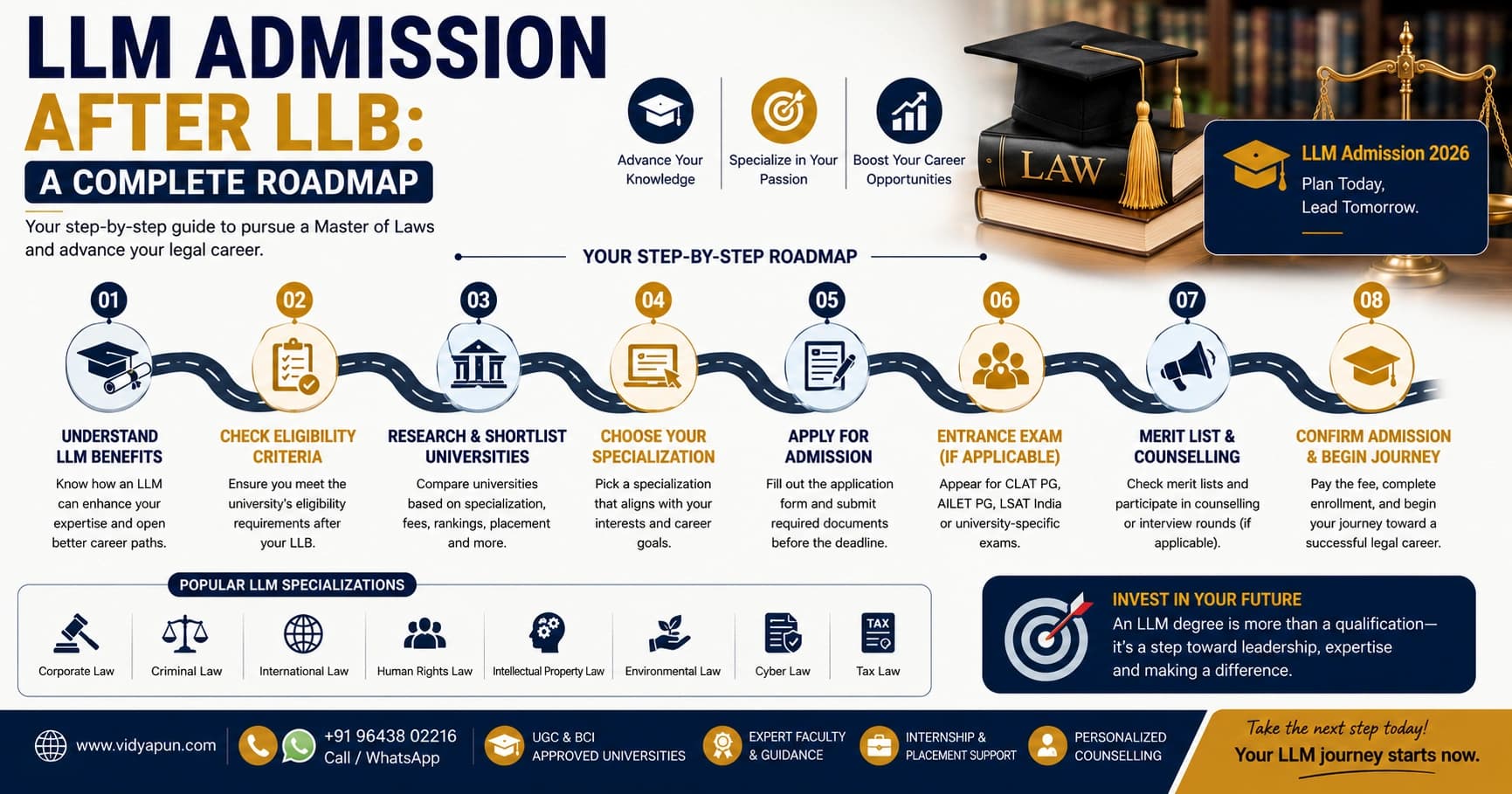
If you're in your final year of LLB and thinking about an LLM, the biggest risk isn't making the wrong decision — it's making the right decision too late. LLM application windows, entrance exams, and specialization research all need to start well before your LLB results are even out, and many students lose a year simply because they started planning after graduation instead of during it.
This roadmap walks through exactly when to start planning, what to confirm before you apply, and how to manage your final year of LLB alongside LLM preparation, so you can transition straight into your postgraduate degree without losing momentum. For the full picture of dates, eligibility, and process, pair this with our LLM Admission 2026 guide.
Should You Pursue LLM Immediately After LLB?
This is worth deciding deliberately, not by default, since it shapes your entire final-year planning.
Direct LLM vs Work Experience First
Going straight into LLM lets you build on your LLB knowledge while it's still fresh and keeps your academic momentum going, which particularly benefits students aiming for academia, research, or judiciary preparation. Gaining a year or two of work experience first can sharpen your sense of which specialization genuinely fits you, particularly useful if you're still unsure about your direction. Neither path is objectively better — it depends on how clear your specialization direction already is.
Signs LLM Right After LLB Makes Sense
If you already have a clear specialization interest, strong final-year academic performance, and a specific career goal (corporate law, academia, judiciary, or international law) that benefits from immediate specialization, applying directly after LLB is usually the more efficient path.
When to Start Planning Your LLM During Final Year
Timing is the single biggest factor separating students who transition smoothly from those who end up waiting a year.
Ideal Planning Timeline
Start researching specializations and shortlisting universities at the beginning of your final year, well before your final semester exams. Most LLM application cycles open months before the academic session starts, often overlapping directly with your final LLB semester — so waiting until after your results are declared can mean missing entire application windows at your preferred universities.
What to Do in Each Semester of Final Year
In your first final-year semester, focus on specialization research and building your university shortlist. In your final semester, focus on completing applications, preparing for any required entrance exam, and tracking each university's specific deadline — while still managing your LLB coursework, dissertation, and internships.
Confirming Your LLM Eligibility Before Graduating
Confirming eligibility early avoids unpleasant surprises close to your application deadlines.
Minimum Qualification and Marks
You need a completed LLB (3-year or 5-year integrated) from a recognized university, with most institutions setting a minimum aggregate around 50-55% for general category candidates. Reserved category candidates typically receive a relaxation of a few percentage points. Confirm the exact current-year cutoff for each university on your shortlist directly.
What If Your Final LLB Result Isn't Out Yet
Most universities accept a provisional admission based on your LLB mark sheets up to your second-to-last semester, with your final degree certificate submitted once available. This is a standard, well-understood situation for universities — but confirm the specific provisional admission policy for each institution you're applying to, since the exact process varies.
Choosing Your LLM Entrance Route While Still in LLB
Deciding your entrance route early lets you plan preparation time realistically alongside your existing coursework.
CLAT PG and National Exams
CLAT PG is the most widely used national-level entrance exam for LLM, accepted by National Law Universities and several other institutions. If several universities on your shortlist accept it, this is often the most efficient exam to focus on. Our LLM Entrance Exam Guide covers the full range of options in more depth.
University-Specific and Merit-Based Options
Many universities also offer merit-based admission using your LLB percentage directly, or conduct their own separate entrance test. If your shortlist leans toward merit-based institutions, you may not need dedicated entrance exam preparation at all — worth confirming early so you don't spend unnecessary time preparing for an exam you don't need.
Balancing LLB Final-Year Work with LLM Preparation
This is often the most underestimated part of the transition — final year is already demanding before LLM applications enter the picture.
Managing Dissertation, Internships and Exam Prep Together
Your final LLB year typically includes a dissertation, continued internships, moot court commitments, and possibly judiciary or placement preparation — adding LLM applications and entrance exam prep on top requires realistic scheduling rather than assuming you'll find spare time reactively.
Time Management Strategies
Block out specific, protected time each week for LLM-related work (research, applications, exam prep) rather than treating it as something to fit in around everything else. Many students find it easier to concentrate LLM-specific tasks into short, defined windows (like weekends) rather than trying to spread it thin across every day alongside LLB coursework.
Choosing a Specialization Before You Apply
Your LLB final year is actually a good vantage point for this decision, since you've likely already discovered which subjects and internship experiences genuinely interested you.
Aligning Specialization with Your LLB Interests
Look back at which LLB electives, internships, or moot court experiences engaged you most — this is often a more reliable signal than choosing a specialization based on general prestige or trending sectors. Our Best LLM Specializations guide breaks down common options and career alignment in detail.
Researching Specialization Strength by University
Not every university is equally strong in every specialization, even among well-known institutions. Research faculty expertise, research output, and past student outcomes specifically within your chosen specialization area, rather than relying on a university's overall reputation alone.
Application Timeline and What to Prepare in Advance
Preparing documentation ahead of time removes one of the most common causes of last-minute stress.
Documents to Start Collecting Early
Start gathering your LLB mark sheets (semester-wise), provisional degree certificate details, Class 10 and 12 certificates, and category documents if applicable, well before application deadlines approach. Many of these take time to procure from your university's administrative office, so don't leave this until the week applications open.
Application and Deadline Checklist
Maintain a simple tracker listing each shortlisted university, its specific application deadline, entrance exam (if any), and required documents. Because LLM admission runs across many independent university timelines rather than one centralized calendar, a personal tracker is often the only reliable way to avoid missing a deadline.
Common Mistakes Final-Year Students Make When Planning LLM
A few recurring patterns are worth actively guarding against.
How to Avoid Losing a Year
The most common mistake is waiting until final results are declared to start researching universities and specializations — by then, several application windows may have already closed. Other frequent mistakes include assuming every university's timeline mirrors CLAT PG's, and neglecting to confirm provisional admission policies in advance. Starting your research and shortlist at the beginning of final year, rather than the end, is the single most effective way to avoid a forced gap year.
Frequently Asked Questions
1. Can I apply for LLM before my final LLB result is declared? Yes, most universities accept provisional applications based on your mark sheets up to your second-to-last semester, with the final degree certificate submitted once available. Confirm the specific policy with each university.
2. When should I start planning for LLM during my final year of LLB? Ideally at the very start of your final year, since LLM application windows often open before your final semester results are declared.
3. Do I need work experience before applying for LLM? No, most universities allow direct application after LLB without prior work experience, though a few specialized programs may prefer or require some professional background.
4. How do I choose an LLM specialization if I'm still in my final year? Look back at which LLB subjects, internships, or moot court experiences genuinely interested you — this is usually a more reliable guide than choosing based on prestige or trends alone.
5. Is CLAT PG the only entrance exam for LLM after LLB? No. Many universities also accept merit-based admission using your LLB percentage, or conduct their own separate entrance tests, so your required preparation depends on which route your shortlisted universities use.
6. What happens if I miss LLM application deadlines during my final year? You would typically need to wait for the next admission cycle at that specific university, though some institutions occasionally offer late or spot rounds if seats remain vacant — this isn't guaranteed, so it's best to track deadlines carefully rather than relying on it.
Ready to map out your own timeline? Check your eligibility using Vidyapun's Check Eligibility tool, review full details on the Master of Laws (LLM) page, or explore our Best LLM Specializations and LLM Entrance Exam Guide to firm up your plan. Already thinking about your final project? See our LLM Dissertation Guide. Considering studying abroad instead? Check our LLM Abroad Guide.
Still planning your final-year LLM timeline? Reach out to our counsellors directly.
🌐 Website: www.vidyapun.com 📞 Call / WhatsApp: +91 96438 02216