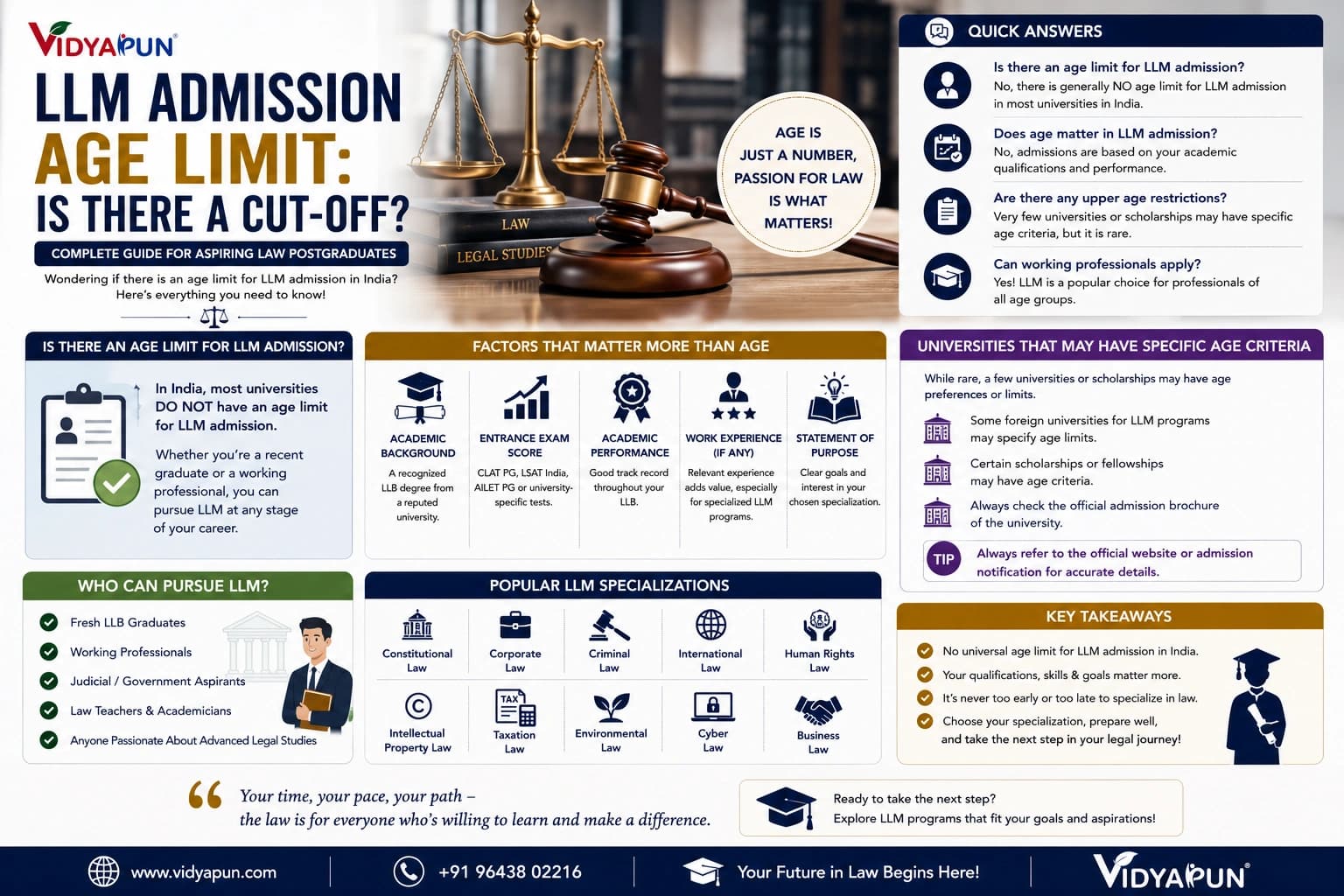
If you've been out of law school for several years — whether practicing, working in a different field, or taking a career break — one of the first questions that comes up when considering an LLM is whether you're simply too old to apply. It's a genuinely common concern, and the honest answer is more reassuring than most people expect, though it does require checking the specific rules of your target institution.
This guide explains how age criteria actually work for LLM admission in India, where limits still exist, and what to verify before assuming either way.
Is There Really an Age Limit for LLM Admission?
The short version: it depends entirely on the institution, and there's no single national rule.
The Short Answer
Some universities apply an upper age limit for LLM admission, while many others — including several major institutions — have removed age limits altogether in recent years. There is no uniform, nationwide age cap that applies to every LLM program in India.
Why This Question Comes Up So Often
Because rules vary so much by institution, and because older information circulating online often reflects outdated policy, this remains one of the most commonly asked and most inconsistently answered questions among prospective LLM applicants, particularly working professionals.
How Age Limits Have Changed in Recent Years
Understanding the trend helps put current concerns in context.
Historical Context
Some Indian universities historically applied upper age limits for postgraduate law admission, often in the mid-to-late 20s to early 30s range for general category candidates, as part of broader institutional eligibility norms.
Current Trend Across Institutions
In recent years, several institutions have relaxed or fully removed these age limits, following regulatory developments and, in some cases, court rulings that questioned whether rigid age caps served a legitimate educational purpose. This shift means many working professionals who might have been excluded a decade ago are now eligible at a growing number of institutions.
Age Limits at National Law Universities
NLU policies vary individually rather than following one shared rule.
CLAT PG and Age Criteria
CLAT PG itself, as an entrance exam, does not uniformly impose an age limit — eligibility is generally tied to holding a qualifying LLB degree rather than an age cap. However, individual NLUs participating in CLAT PG counselling may apply their own additional institutional criteria.
NLU-Specific Variations
Because each NLU sets its own detailed admission rules within the broader CLAT PG framework, always check the specific information bulletin of each NLU you're applying to rather than assuming a blanket rule applies across all of them.
Age Limits at State and Private Universities
This is where the most variation exists, given the decentralized nature of LLM admission overall.
State University Policies
State universities set their own eligibility criteria, and age limit policy (where it exists) is typically defined in their annual admission notification, which can be revised from year to year.
Private University Flexibility
Private and deemed universities generally have more flexibility in setting their own eligibility criteria, and many either don't apply an age limit at all or apply a more generous one specifically to accommodate working professionals and executive-style LLM applicants.
Does Age Affect Working Professionals Specifically?
This is often the underlying concern behind the broader age limit question.
No Separate Relaxation for Professionals
There typically isn't a special age-based relaxation specifically for "working professionals" as a category — eligibility depends on whether the specific institution applies an age limit at all, not on your professional status. If a university has no age limit, this applies equally regardless of how many years you've been working.
What Actually Matters Instead
What genuinely matters more for working professionals is choosing the right program format (full-time versus part-time or executive LLM) and being clear about your motivation in any application essay, rather than worrying about an age barrier that, at a growing number of institutions, simply doesn't exist.
Category-Based Age Relaxations
Where an age limit does exist, most institutions provide standard relaxations.
How Much Relaxation Is Typically Offered
Where a university applies an age limit, reserved category candidates (SC/ST/OBC) and candidates with disabilities typically receive a relaxation of a few years, in line with applicable government policy. The exact number of years varies by institution rather than following one fixed rule.
Documentation Required to Claim It
To claim an age relaxation, you'll generally need a valid category or disability certificate in the prescribed format, submitted alongside your application. Confirm the specific documentation requirement with your target university, since formats can vary by state and institution.
Frequently Asked Questions
1. Is there an age limit for LLM admission in India?
It depends on the institution — some apply an upper age limit while many others have removed it in recent years. There's no single nationwide rule, so check each specific university's current notification.
2. Has India removed age limits for LLM admission nationally?
There's no single national removal of age limits — it's determined institution by institution, though the overall trend in recent years has been toward relaxing or removing such limits.
3. Do NLUs have an age limit for LLM admission through CLAT PG?
CLAT PG itself doesn't uniformly impose an age cap, but individual NLUs may apply their own institutional criteria. Check each specific NLU's admission bulletin.
4. Do state or private universities apply different age rules than NLUs?
Yes. State universities set their own criteria through annual admission notifications, while private and deemed universities generally have more flexibility and often skip an age limit altogether, particularly for executive-style LLM programs.
5. Can working professionals in their 30s or 40s apply for LLM?
Yes, at institutions without an age limit (which is a growing number), age isn't a barrier regardless of how long you've been working. Focus on choosing the right program format instead.
6. Is there an age relaxation for reserved categories in LLM admission?
Where an age limit applies, most institutions offer a relaxation of a few years for SC/ST/OBC and PwD candidates, along with a valid category certificate to claim it — though the exact figure varies by institution.
Ready to explore your options regardless of your age or career stage? Review full details on the Master of Laws (LLM) page, check Career After LLM to see where an LLM could take you, or explore Best LLM Specializations to plan your focus area. For the full application process, check Law Admission guidance.
Talk to an Admission Expert to confirm the age criteria at your target universities:
🌐 Website: www.vidyapun.com 📞 Call / WhatsApp: +91 96438 02216