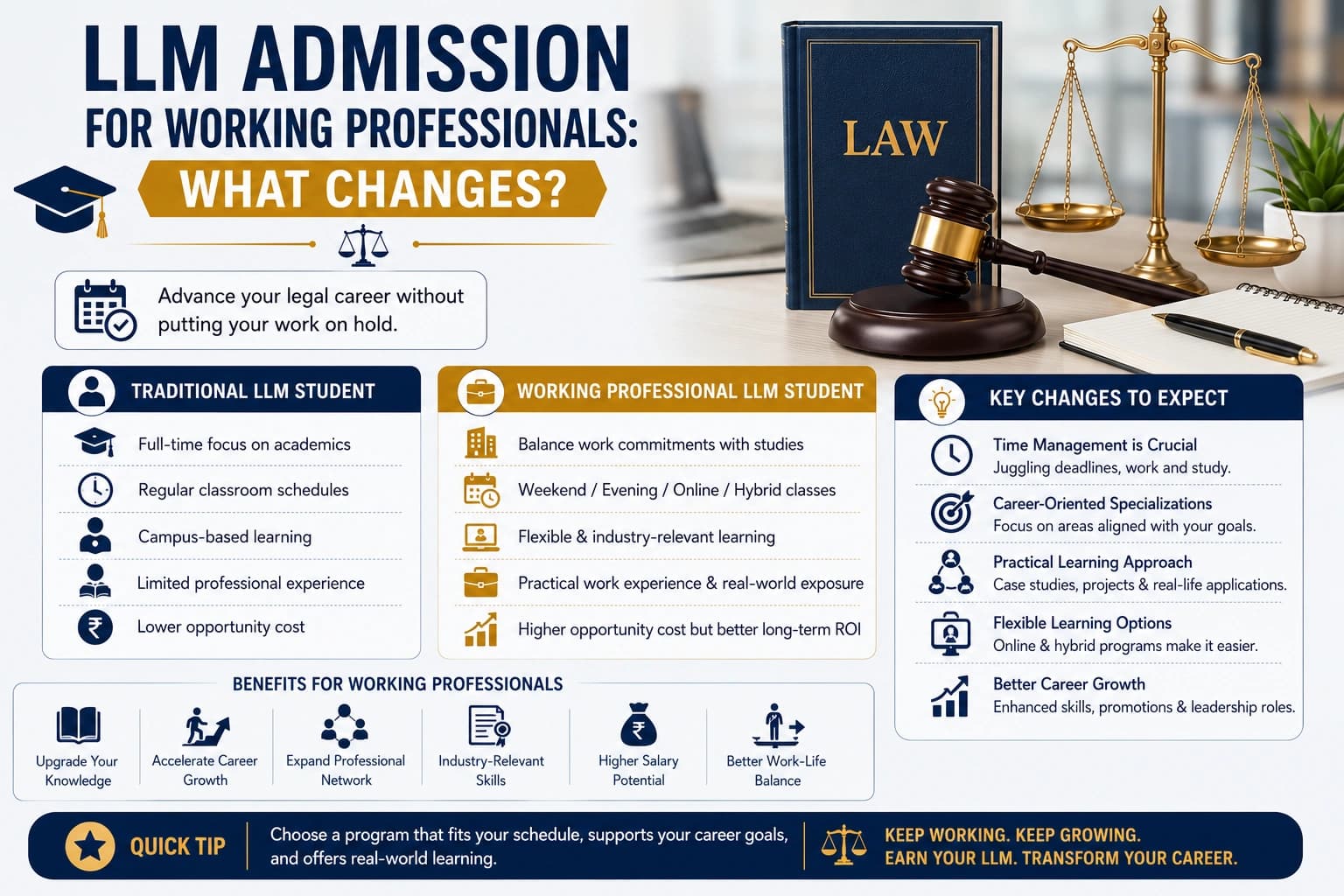
Most guides to LLM admission assume you're applying straight after LLB with no other commitments. If you're already practicing law, working in a corporate legal team, or in an unrelated career and considering a pivot, the admission process itself doesn't change dramatically — but the decisions around it do, from which program format fits your schedule to how you frame years of work experience in your application, to having a genuinely different conversation with your employer than a fresh graduate ever needs to have.
This guide covers what genuinely changes about LLM admission when you're approaching it as a working professional, rather than repeating generic advice aimed at fresh graduates.
How LLM Admission Differs for Working Professionals
The core admission mechanics stay largely the same — it's the surrounding decisions that shift.
Eligibility Still Applies the Same Way
Your basic eligibility for LLM — a completed LLB from a recognized university, meeting the minimum aggregate marks — doesn't change based on how many years you've been working. There's no separate, relaxed eligibility bar for working professionals at most institutions, though a few specialized executive programs occasionally set slightly different criteria.
What Actually Changes
What genuinely changes is the range of program formats worth considering, how you manage the application process alongside a job, and how universities and employers view your work experience as part of your overall profile — not the fundamental eligibility requirement itself.
Choosing Between Full-Time, Part-Time, and Distance LLM
This is often the first major decision working professionals face that fresh graduates don't need to consider as seriously.
Full-Time LLM While Working
Pursuing a full-time, on-campus LLM while working typically requires taking a career break or securing extended leave, since most full-time programs expect regular class attendance. This route offers the most immersive experience and strongest peer networking, but requires the most significant disruption to your current job — and is worth weighing carefully against what you'd be giving up in income and career momentum during that period.
Part-Time and Executive LLM Options
A growing number of universities offer part-time, weekend, or executive-style LLM programs specifically designed for working professionals, often with evening or weekend class schedules. These let you continue working while studying, though the pace and depth can differ from full-time programs — research each option's actual schedule and coursework intensity before assuming it's simply a lighter version of the full-time route, since some executive programs compress the same syllabus into a more demanding weekly rhythm rather than reducing content.
Balancing Work Experience with Academic Requirements
Your professional background becomes a genuine asset in the admission process, not just a scheduling constraint.
How Universities View Work Experience
Many universities, particularly for executive-style LLM programs, view relevant work experience favorably, sometimes factoring it into admission decisions alongside your academic record. A few specialized programs may even prefer or require a minimum number of years of professional experience.
Leveraging Experience in Your Application
Where an application requires a statement of purpose or essay, working professionals have a genuine advantage — you can draw on real practical experience to explain why a specific specialization matters to you, which often reads more convincingly than a purely academic justification from a fresh graduate.
Entrance Exams and Admission Routes for Working Professionals
The exam landscape itself doesn't change, but your approach to it often needs to.
CLAT PG for Working Professionals
CLAT PG remains open to working professionals meeting the standard eligibility criteria, but preparing for it alongside a full-time job requires realistic time-blocking, since the exam still tests the same depth of legal knowledge and reasoning regardless of your professional status.
University-Specific Executive Programs
Many universities' executive or part-time LLM programs use merit-based admission (based on your LLB percentage and professional profile) rather than a formal entrance exam, which can be a meaningfully less demanding route if your schedule doesn't allow for dedicated exam preparation.
Managing Time: Work, Study, and Family Commitments
This is often the most underestimated challenge working professionals face once they've actually enrolled.
Realistic Time Management Strategies
Block out specific, protected study time each week rather than assuming you'll find time reactively around work. Many working professionals find it more sustainable to concentrate coursework into specific evenings or weekend blocks rather than trying to spread study time thin across every day, and to communicate these boundaries clearly with family and colleagues so the time is actually protected rather than routinely encroached upon.
What to Expect From Coursework Intensity
Even part-time and executive programs maintain meaningful academic rigor — don't assume a flexible schedule means a lighter workload. Reading assignments, research papers, and exams typically carry similar depth expectations to full-time programs, just spread across a longer timeline, which can actually make sustained motivation harder to maintain than the shorter, more intense full-time format.
Financial Considerations for Working Professionals
Financing an LLM looks different when you already have income and, potentially, an employer relationship to factor in.
Employer Sponsorship and Study Leave
Some employers, particularly law firms and corporate legal departments, sponsor employees' LLM fees in exchange for a post-study service commitment, or offer study leave for part-time programs. It's worth having this conversation with your employer early, since sponsorship terms and available leave policies vary significantly by organization.
Fee Structures for Executive Programs
Executive or part-time LLM programs sometimes carry a different fee structure than standard full-time programs, occasionally higher to reflect the flexible format and professional cohort. Always request a complete, itemized fee breakdown directly from the university rather than assuming it mirrors the standard program's cost.
Career Impact: Why Working Professionals Pursue LLM
Understanding your own motivation clearly helps you choose the right specialization and program format.
Common Motivations
Working professionals typically pursue LLM to specialize more deeply within their current practice area, pivot toward a different specialization (for instance, moving from litigation into corporate law), or strengthen credentials for academia, in-house counsel roles, or international opportunities.
How to Communicate Your Goals in Applications
Be specific in any application essay or interview about how the specialization connects to your professional trajectory — vague statements about "wanting to learn more" are less compelling than a clear narrative connecting your work experience to your chosen specialization and future goals.
Practical Tips Before You Apply
A few practical steps make the transition into LLM smoother for working professionals specifically.
Building a Realistic Application Timeline
Account for the additional time needed to have a conversation with your employer about sponsorship or leave, gather recommendation letters from supervisors (which can take longer to arrange around busy schedules), and realistically assess how much time you can commit to entrance exam preparation, if required. Building this timeline a few months earlier than a fresh graduate typically needs to is a sensible buffer.
Frequently Asked Questions
1. Does LLM eligibility change for working professionals? No, the core eligibility (a completed LLB meeting the minimum aggregate) remains the same regardless of work experience, though a few specialized executive programs may have slightly different criteria.
2. Can I pursue a full-time LLM while continuing to work? It's difficult, since full-time programs typically require regular class attendance. Many working professionals instead choose part-time or executive-style LLM programs designed specifically for this situation.
3. Do universities give preference to candidates with work experience? Some do, particularly for executive-style LLM programs, where relevant professional experience can be viewed favorably alongside your academic record.
4. Is CLAT PG different for working professionals? No, the exam itself is the same regardless of your professional status. What changes is how realistically you can allocate preparation time alongside a full-time job.
5. Will my employer sponsor my LLM fees? Some employers, particularly in the legal sector, do offer sponsorship or study leave, but this varies significantly by organization. It's worth discussing directly with your employer early in your planning process.
6. Are part-time LLM programs less rigorous than full-time ones? Not necessarily. Many part-time and executive programs maintain similar academic depth and workload expectations to full-time programs, just spread across a longer schedule.
Ready to explore your options? Review full details on the Master of Laws (LLM) page, browse our LLM Admission Guide for the complete process, or use Compare Universities to evaluate part-time and executive program options side by side. Already thinking about your final project? See our LLM Dissertation Guide. Considering studying abroad instead? Check our LLM Abroad Guide, or explore PHD Admission if research is your longer-term goal.
Still working out how to fit LLM into your career? Reach out to our counsellors directly.
🌐 Website: www.vidyapun.com 📞 Call / WhatsApp: +91 96438 02216