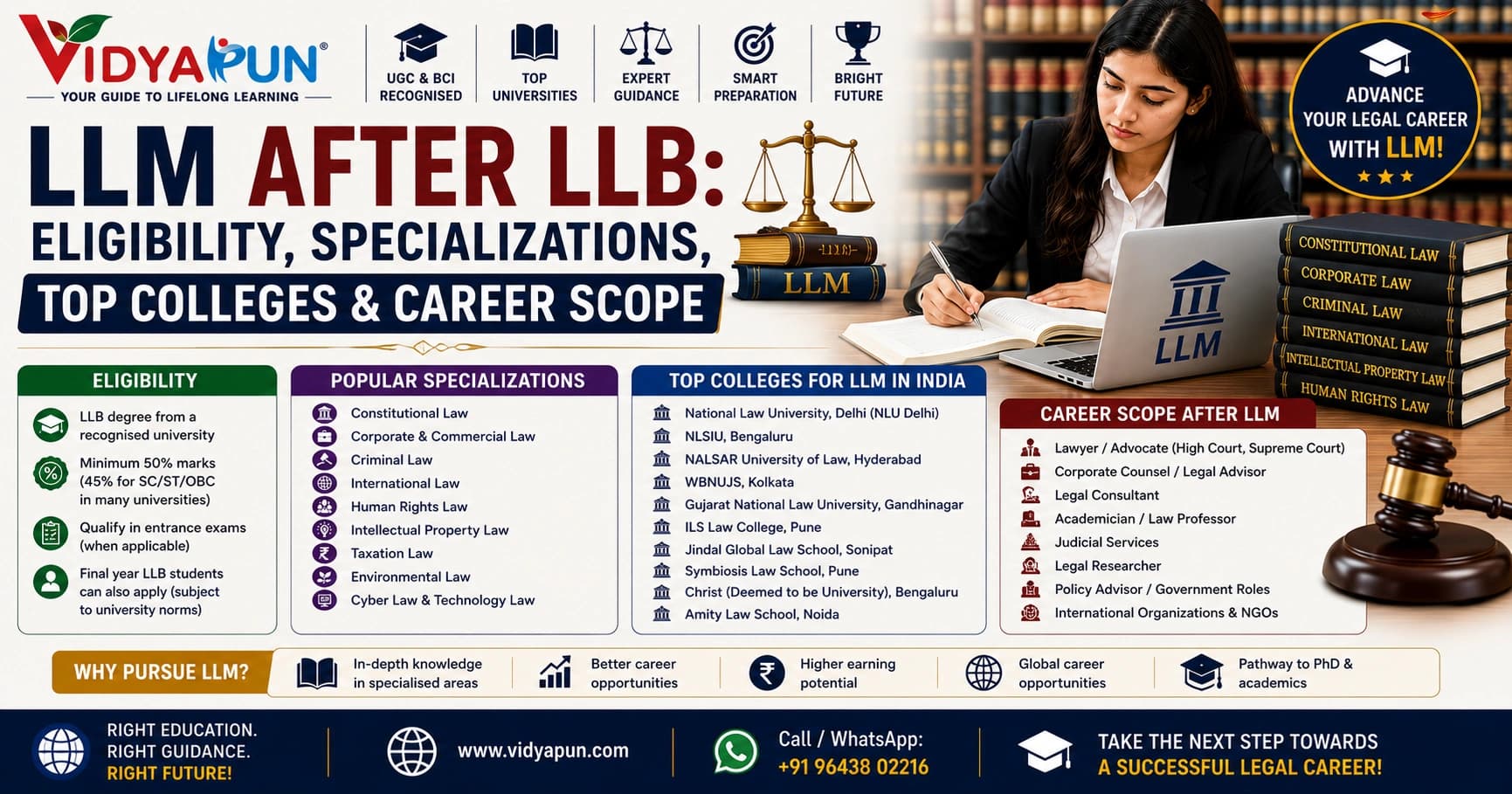
Once you've completed LLB, one of the biggest decisions ahead is whether to pursue LLM immediately, start practicing, or do both in some sequence. There's no universally correct answer — it depends on your career goals, financial situation, and how clear your specialization interests already are.
This guide brings together everything relevant to that decision: eligibility, specializations, India versus abroad, duration options, and an honest look at what LLM actually adds to your career.
Is Doing LLM After LLB Worth It?
This is worth answering honestly and specifically to your own situation, rather than assuming either way.
When LLM Genuinely Adds Value
LLM makes strong sense if you already have a clear specialization direction, are aiming for academia or research, want deeper expertise for corporate or niche practice areas, or are targeting international opportunities that value postgraduate legal qualifications.
When Starting Practice Immediately Makes More Sense
If you're still exploring general litigation broadly, or have a specific practice opportunity already lined up, gaining practical experience first — and pursuing LLM later once your interests are clearer — can be an equally valid, sometimes more efficient path.
LLM Eligibility Criteria After LLB
The baseline requirement is consistent, though specific criteria vary by institution.
Minimum Qualification and Marks
You need a completed LLB (3-year or 5-year integrated) from a recognized university, typically meeting a minimum aggregate around 50-55% for general category candidates, though this varies by institution and program selectivity.
Age and Category Considerations
Some universities apply an age limit (many have relaxed or removed this in recent years), and reserved category candidates typically receive relaxations in both marks and age where applicable. Confirm current criteria directly with each target university.
LLM Admission Process and Entrance Exams
Your specific admission route shapes your entire preparation timeline.
CLAT PG and Other National Exams
CLAT PG is the most widely used entrance exam for LLM, accepted by National Law Universities and several other institutions, testing postgraduate-level legal knowledge and reasoning.
Merit-Based and University-Specific Routes
Many universities also offer merit-based admission using your LLB percentage directly, or conduct their own separate entrance tests — check which route applies to each university on your shortlist before assuming CLAT PG is required everywhere.
Popular LLM Specializations to Choose From
Your specialization choice shapes your coursework, dissertation, and eventual career direction significantly.
Corporate and Constitutional Law
Corporate and Commercial Law suits those aiming for law firm or in-house counsel careers, while Constitutional Law suits those drawn to litigation, judiciary preparation, or public law careers.
International Law and Emerging Specializations
International Law, Human Rights Law, and newer areas like Cyber Law and Technology Law have grown in relevance, suiting students interested in international organizations, policy work, or the evolving intersection of law and technology.
LLM in India vs LLM Abroad
This decision involves genuinely different considerations around cost, recognition, and career direction.
Cost and Recognition Differences
LLM programs abroad generally involve significantly higher tuition and living costs when converted to Indian currency, though they can offer strong international recognition and networks, particularly for careers targeting international practice or organizations.
When Studying Abroad Makes Sense
Studying abroad tends to make the most sense if you're specifically targeting international law careers, foreign bar qualification, or have access to strong scholarship support that meaningfully offsets the higher cost, rather than as a default choice over Indian institutions.
Course Duration and Format Options
LLM programs vary in both length and delivery format across institutions.
One-Year vs Two-Year Programs
Most Indian LLM programs run for two years, though a smaller number of institutions offer a one-year format. The two-year route generally allows deeper specialization and a more substantial dissertation, while one-year programs offer a faster, more intensive pace.
Part-Time and Distance Options
Part-time and distance LLM formats exist at some universities, aimed at working professionals who want to continue their careers while studying, though workload expectations often remain similarly rigorous despite the flexible schedule.
Career Scope After LLM
Academia, Research, and Beyond Practice
Beyond specialized legal practice, LLM opens paths into academia and teaching, legal research roles, policy work, and international organizations — career directions that a standalone LLB alone typically doesn't position you for as strongly. That said, career outcomes depend heavily on how you use your specialization through research, internships, and networking during the program, not the degree alone.
How to Choose the Right LLM Path for You
A Simple Decision Framework
Ask yourself: Do I already have a clear specialization direction, or am I still exploring? Does my target career genuinely benefit from postgraduate specialization, or would practical experience serve me better right now? Can I realistically afford my preferred format (India or abroad, full-time or part-time) given my current situation? Honest answers to these questions point toward the right path more reliably than following a general assumption about what LLM is "supposed" to do for your career.
Frequently Asked Questions
1. Is doing LLM immediately after LLB worth it?
It depends on your situation — it's genuinely valuable if you have a clear specialization direction or are targeting academia, research, or international opportunities, but gaining practical experience first can be equally valid if your interests are still developing.
2. What is the eligibility for LLM after LLB?
A completed LLB from a recognized university, typically meeting a minimum aggregate around 50-55% for general category candidates, though this varies by institution.
3. Is CLAT PG compulsory for LLM admission?
No, many universities also offer merit-based admission using your LLB percentage or conduct their own separate entrance tests.
4. Which LLM specialization is best for career growth?
There's no universal "best" — it depends on your career goals. Corporate Law suits law firm careers, Constitutional Law suits litigation and judiciary paths, and International Law or Cyber Law suit more specialized or international directions.
5. Is LLM abroad better than LLM in India?
Not universally — it depends on your specific career goals and finances. LLM abroad generally costs significantly more but can offer strong international recognition for careers targeting international practice specifically.
6. How long does an LLM program take in India?
Most programs run for two years, though a smaller number of institutions offer a more intensive one-year format.
7. Can working professionals pursue LLM part-time?
Yes, part-time and distance LLM formats exist at some universities specifically for working professionals, though academic workload expectations remain largely similar to full-time programs.
8. Does LLM guarantee better career opportunities than practicing directly after LLB?
Not automatically — LLM opens certain paths (academia, research, specialized practice) that LLB alone typically doesn't, but actual career outcomes depend heavily on how you use the specialization through experience and networking.
Ready to plan your path after LLB? Explore the LLB Course page, review Law Admission guidance, or browse Best Colleges in India to compare LLM options.
Talk to an Admission Expert to plan your next step:
🌐 Website: www.vidyapun.com 📞 Call / WhatsApp: +91 96438 02216