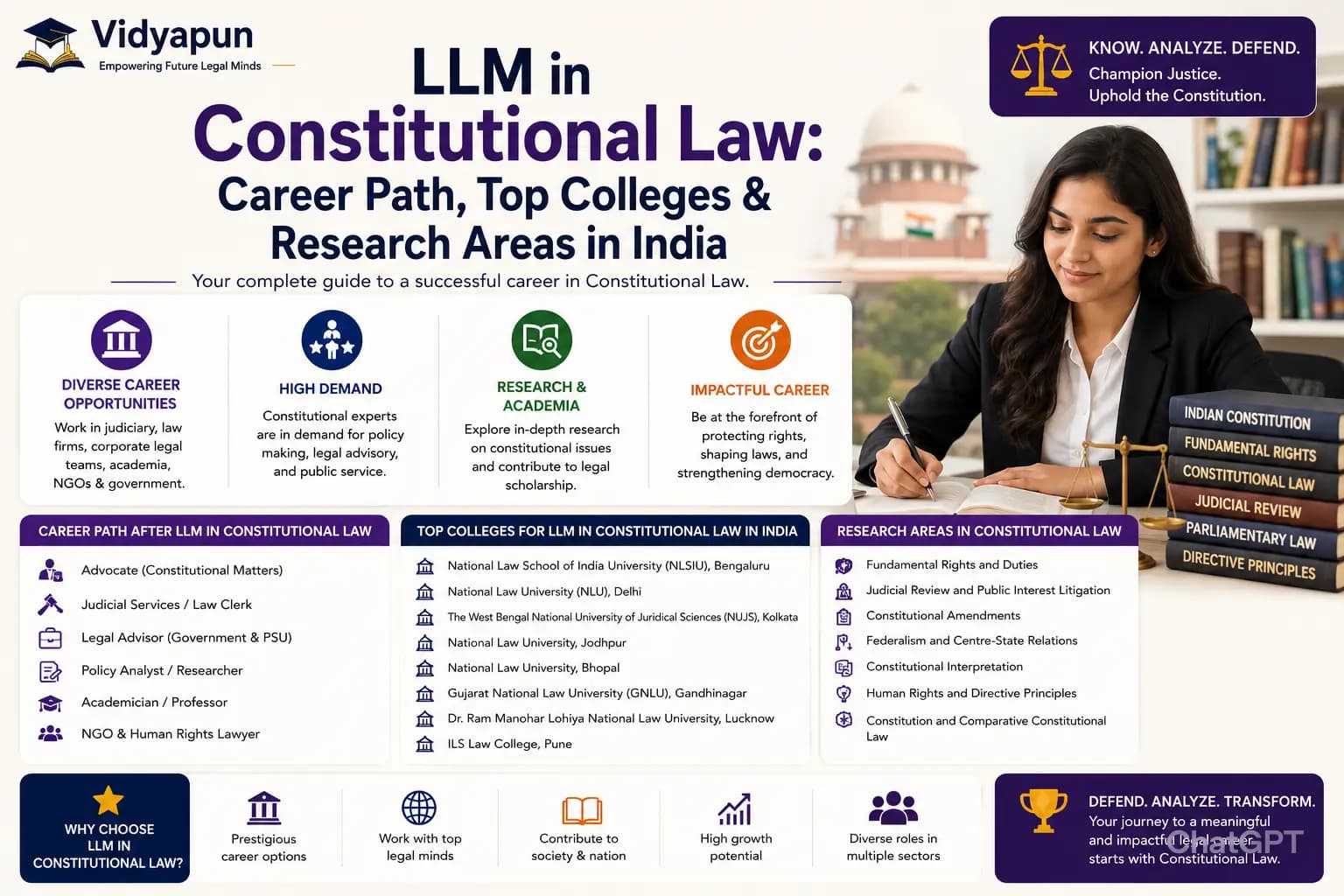
There's something deeply compelling about Constitutional Law. It sits at the very foundation of how a country governs itself — who holds power, what rights citizens have, and what happens when the two come into conflict. Every landmark Supreme Court verdict you've ever read about, every debate around fundamental rights, every question of federalism — Constitutional Law is at the heart of all of it.
If you've completed your LLB and you find yourself drawn to these big, foundational questions of governance and rights, an LLM in Constitutional Law in India might be exactly the right next step. This isn't the most glamorous specialisation in terms of immediate corporate salaries, but it's one of the most intellectually rich — and over time, it opens doors that very few other legal paths can.
This guide covers everything you need to know: what the degree involves, which colleges are genuinely worth considering, what research areas are shaping the field right now, and what kind of career you can realistically build.
What Is an LLM in Constitutional Law?
An LLM — Master of Laws — is a postgraduate law degree designed for students who want to go beyond the broad sweep of their undergraduate legal education and develop genuine expertise in one area. Constitutional Law as a specialisation focuses on the study of the Constitution of India, the principles that govern it, and how those principles are interpreted and applied by courts.
The curriculum typically covers:
- Fundamental Rights and Directive Principles — the tension between individual rights and state policy
- Constitutional interpretation and judicial review — how courts read and apply constitutional provisions
- Federalism and Centre-State relations — the distribution of powers in India's federal structure
- Separation of powers — the relationship between the legislature, executive, and judiciary
- Constitutional amendments — the scope and limits of Parliament's power to change the Constitution
- Comparative Constitutional Law — studying how other democracies handle similar challenges
- Public Interest Litigation (PIL) — one of India's most distinctive constitutional innovations
- Emergency provisions and constitutional morality
The degree typically runs for one year (full-time) or two years (part-time), and is open to anyone who holds a recognised LLB or BA LLB degree.
Why LLM in Constitutional Law Matters More Than Ever
You might wonder — why specialise in Constitutional Law specifically, when it's already a subject covered in undergraduate legal education? The answer is depth.
An LLB gives you an introduction. An LLM in Constitutional Law gives you the tools to work at the frontier of legal practice and scholarship in this area — and right now, that frontier is unusually active.
Courts Are Busier Than Ever
India's Supreme Court and High Courts are handling a growing volume of constitutionally significant cases — from questions around the right to privacy (the landmark Puttaswamy judgment) to the interpretation of Article 370, the validity of electoral bonds, and the boundaries of the Basic Structure Doctrine. Constitutional litigation is booming, and skilled constitutional lawyers are needed to argue these cases.
Democratic Institutions Under Scrutiny
Globally and in India, questions about the limits of executive power, the independence of constitutional institutions, and the rights of minorities are being tested in new ways. Lawyers and academics who deeply understand constitutional frameworks are being called upon to think through these challenges seriously.
Rights-Based Legal Practice Is Growing
Human rights organisations, civil liberties groups, NGOs, and legal aid bodies — all of these institutions are expanding their work. They need lawyers who don't just know Constitutional Law superficially but can use it strategically to protect and advance the rights of people who otherwise wouldn't have access to legal recourse.
Academia Needs Scholars
Constitutional Law is one of the most research-intensive areas of legal study. If you're inclined toward academic life, this specialisation gives you a strong foundation for doctoral research and eventual faculty positions.
The scope of LLM in Constitutional Law in India is genuinely broad — it's just that the rewards are often long-term rather than immediate.
Top Colleges for LLM in Constitutional Law in India
The institution you choose will shape your experience significantly. Here are the colleges that have established strong reputations for constitutional law education:
1. National Law School of India University (NLSIU), Bangalore
NLSIU is consistently ranked among the top law schools in India. Its LLM programme, with Constitutional Law as a specialisation, is rigorous and research-focused. The faculty includes some of India's leading constitutional scholars. If you can get in, this is the gold standard.
2. NALSAR University of Law, Hyderabad
NALSAR has a strong tradition of public law scholarship. The university's focus on rights-based lawyering makes it a particularly good fit for students who want to combine constitutional expertise with human rights practice.
3. National Law University, Delhi (NLU Delhi)
NLU Delhi's LLM programme is one of the most competitive in the country. Its proximity to the Supreme Court and Delhi High Court means students get exceptional exposure to ongoing constitutional litigation — an advantage that's hard to overstate.
4. Faculty of Law, University of Delhi
Delhi University's law faculty has a long history of producing excellent constitutional lawyers. The programme is academically strong, relatively affordable, and benefits enormously from Delhi's position as the epicentre of constitutional legal practice in India.
5. Banaras Hindu University (BHU), Faculty of Law
BHU has a well-regarded LLM programme with strong constitutional law components. It's a solid choice, particularly for students in North India looking for a government university option with good academic standing.
6. Jamia Millia Islamia, Faculty of Law
Jamia has built a reputation for public law and constitutional scholarship. Its environment tends to foster critical, socially engaged legal thinking — a good fit for students drawn to PIL and human rights constitutional work.
7. Gujarat National Law University (GNLU), Ahmedabad
GNLU has emerged as one of the stronger NLUs for LLM programmes. It has a structured research environment and reasonable placement support for students interested in constitutional and public law careers.
8. Symbiosis Law School, Pune
Among private institutions, Symbiosis offers a well-structured LLM with public law electives. It's a reasonable option if you're looking at private universities, with good infrastructure and industry connections.
What to look for beyond rankings: Check whether the college has faculty who are actively publishing in constitutional law, whether students have opportunities to participate in moot courts focused on constitutional arguments, and whether there's a connection to organisations that do constitutional litigation or policy work.
Key Research Areas in LLM Constitutional Law
One thing that makes this specialisation particularly rich is how many genuinely open research questions exist in Indian Constitutional Law. If you're considering an LLM with an eye toward academia or doctoral research, these are the areas generating the most scholarly interest right now:
1. The Basic Structure Doctrine First articulated in the Kesavananda Bharati case (1973), this doctrine holds that Parliament cannot amend the Constitution in ways that destroy its basic structure. But what exactly constitutes "basic structure" remains contested — and that contested space is rich ground for research.
2. Constitutional Morality vs. Popular Morality The Supreme Court's use of "constitutional morality" in judgments like Navtej Singh Johar (decriminalising homosexuality) and Sabarimala has sparked enormous academic debate. How should courts balance constitutional values against prevailing social norms? This is one of the liveliest debates in Indian constitutional scholarship.
3. Federalism and Cooperative Governance Centre-State tensions — particularly around GST, agricultural laws, and emergency provisions — have brought federalism back into sharp focus. Research in this area has significant policy relevance.
4. Judicial Accountability and Independence Questions around the collegium system, the transparency of judicial appointments, and the accountability of constitutional courts are increasingly important research territories.
5. Technology, Surveillance, and Fundamental Rights Post the right to privacy judgment, there's a growing body of work examining how constitutional protections apply to data collection, state surveillance, and algorithmic decision-making. This is an emerging and fast-moving area.
6. Comparative Constitutionalism Studying how India's constitutional approach compares with South Africa, Germany, the United States, and other democracies — particularly on rights adjudication — is a productive research direction with international relevance.
7. Social and Economic Rights Jurisprudence How the judiciary interprets and enforces Directive Principles, and the evolving relationship between fundamental rights and socio-economic entitlements, remains a rich area for both research and practice.
Career Path After LLM in Constitutional Law
The career paths available after an LLM in Constitutional Law are varied — and more practically useful than many people assume.
Constitutional Litigation Practice This is the most direct path. You join a law firm or build your own practice, working on cases that raise constitutional questions — writ petitions, challenges to legislation, PIL matters. Senior constitutional lawyers in India are among the most respected (and well-compensated) in the profession.
Judicial Services An LLM strengthens your candidacy for judicial services examinations. Constitutional law expertise is particularly valuable for higher judicial service exams, which test constitutional law heavily.
Legal Academia Teaching constitutional law at a law school — eventually pursuing a PhD and becoming a faculty member — is a natural path for those with strong research inclinations. Constitutional Law faculty positions are available across India's growing network of NLUs and private law schools.
Legal Journalism and Policy Writing There's a growing demand for people who can write about constitutional developments clearly and intelligently — for newspapers, think tanks, and policy organisations. An LLM in Constitutional Law equips you to do this with real authority.
NGOs and Human Rights Organisations Organisations working on civil liberties, freedom of speech, rights of marginalised communities, and access to justice need constitutional law expertise. The work is meaningful, though salaries in this sector tend to be modest compared to corporate or litigation careers.
Government and Legislative Drafting Constitutional expertise is valuable within government — for legislative drafting, advising on the constitutionality of proposed laws, and working with constitutional bodies like the Election Commission or the NHRC.
Salary Expectations After LLM in Constitutional Law in India
Salaries in constitutional law vary considerably depending on the path you choose:
| Career Path | Approximate Annual Salary (INR) |
|---|---|
| Junior Associate – Constitutional Law Firm | ₹4–8 LPA |
| Judicial Services (Entry Level) | ₹8–12 LPA |
| NGO / Human Rights Organisation | ₹3–7 LPA |
| Legal Academia (Assistant Professor) | ₹6–14 LPA |
| Senior Constitutional Litigator | ₹20–50 LPA+ |
| Government Legal Advisor | ₹8–18 LPA |
| Designated Senior Advocate (Supreme Court) | ₹1 Crore+ per year |
Constitutional law is one of those fields where the salary trajectory can be steep — but it takes time. The most successful constitutional lawyers in India earn extraordinarily well, but reaching that level requires years of building expertise, reputation, and a track record in significant cases.
FAQs: LLM in Constitutional Law in India
Q1. Is LLM in Constitutional Law a good career choice in India? Yes — especially if you're interested in litigation, academia, or human rights work. It's not the fastest route to a high salary, but it's one of the most intellectually rewarding specialisations, with strong long-term career prospects.
Q2. What entrance exams are required for LLM in Constitutional Law? Most National Law Universities accept CLAT PG scores. NLU Delhi uses its own AILET PG. Some universities conduct independent entrance tests. Check each institution's current admission requirements before applying.
Q3. Can I pursue LLM in Constitutional Law through distance learning? Some universities do offer distance or correspondence LLM programmes. However, for the quality of education, faculty access, and placement outcomes, a full-time programme from a recognised institution is strongly recommended.
Q4. What is the Basic Structure Doctrine and why is it important in constitutional law research? The Basic Structure Doctrine, established in Kesavananda Bharati v. State of Kerala (1973), holds that Parliament cannot amend the Constitution in ways that alter its fundamental character. It's one of India's most significant constitutional principles and a rich area of ongoing scholarly debate.
Q5. Is LLM in Constitutional Law useful for UPSC or judiciary preparation? Yes. The depth of constitutional understanding you gain during an LLM is directly useful for judicial service examinations and for UPSC papers covering constitutional law and governance.
Q6. What is the difference between Constitutional Law and Administrative Law at the LLM level? Constitutional Law focuses on the Constitution itself — fundamental rights, separation of powers, federalism. Administrative Law deals with how government agencies and bodies exercise power and how their actions are reviewed by courts. There is significant overlap, but they are distinct specialisations.
Q7. Which research area in constitutional law has the most scope for PhD students? Technology and fundamental rights — particularly around surveillance, data protection, and AI — is currently one of the most active and underdeveloped research areas in Indian constitutional scholarship. It also has strong international relevance.
Take the Next Step Toward a Constitutional Law Career
Constitutional Law shapes everything — how power is exercised, how rights are protected, and how a democracy holds itself accountable. If that's the kind of work that excites you, an LLM in Constitutional Law in India gives you the foundation, the credibility, and the network to participate in it meaningfully.
Start by identifying two or three colleges from this list that align with your interests and academic background. Look closely at their faculty research profiles — especially whether they're working in areas you care about. Reach out to current students or alumni if you can. And if you're considering the research path, think now about the constitutional questions you find most compelling, because your LLM dissertation can be the first serious step toward answering them.
The Constitution is a living document. The lawyers and scholars who understand it deeply are the ones who help keep it that way.
Have a specific question about college selection or the LLM application process for Constitutional Law? Leave it in the comments — we'll do our best to point you in the right direction.
Website: www.vidyapun.com
Call / WhatsApp: +91 96438 02216