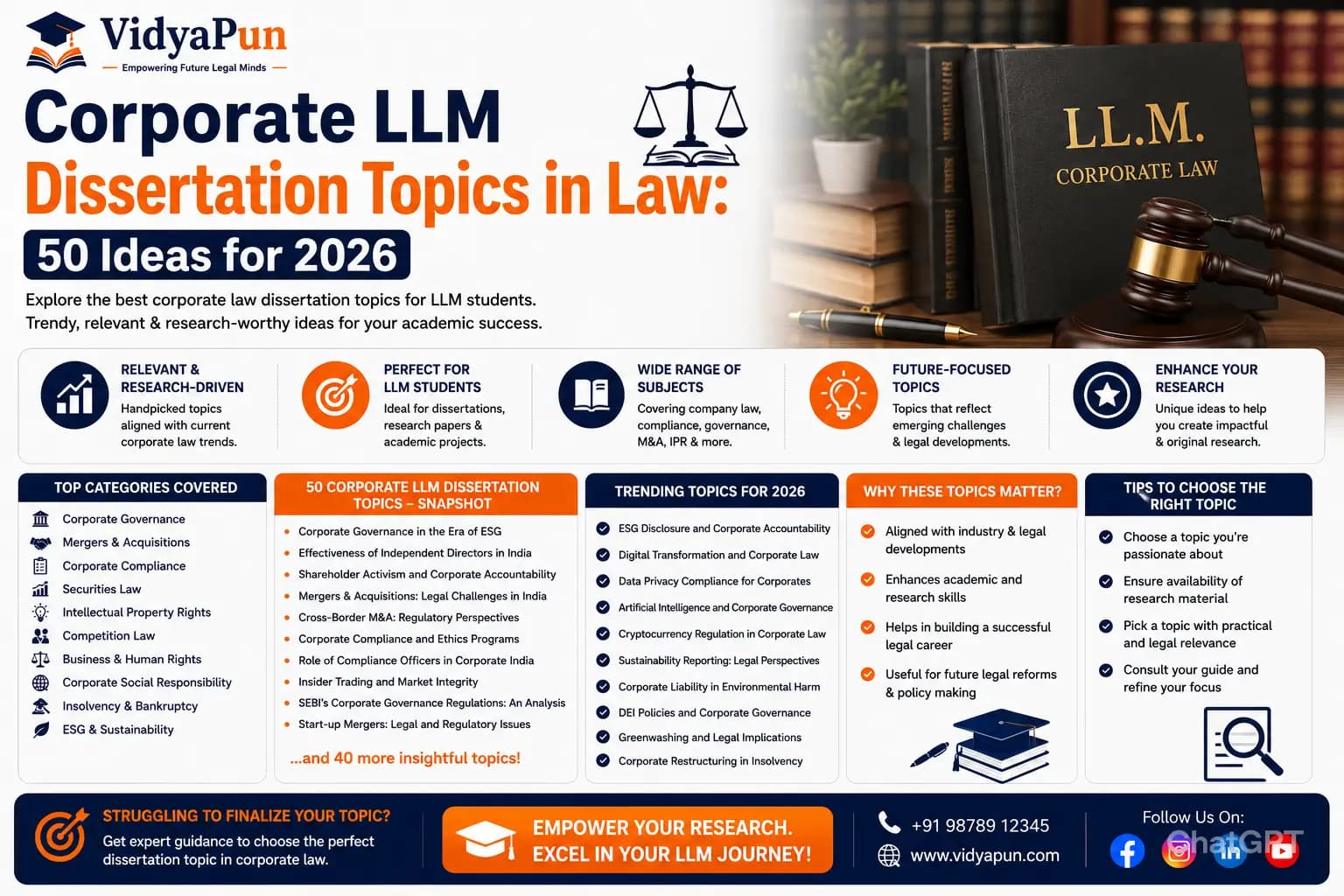
If you've reached the dissertation stage of your LLM, you already know the hard part isn't the writing — it's picking the right topic. The wrong choice can drain your motivation halfway through. The right one can genuinely shape the direction of your legal career.
Corporate law is one of the broadest and most dynamic areas of legal research right now. Between evolving ESG regulations, cross-border M&A disputes, startup governance challenges, and the rapid rise of fintech and crypto, there's no shortage of genuinely interesting and under-researched territory.
But here's the problem most LLM students face — they either pick something too broad ("Corporate Governance in India") or too narrow that there's barely enough literature to work with. Finding that sweet spot is exactly what this guide helps you do.
Below are 50 LLM dissertation topics in corporate law for 2026 — organized by theme, with enough context around each category so you can figure out which direction actually excites you.
How to Choose the Right LLM Dissertation Topic in Corporate Law
Before jumping into the list, a few things worth keeping in mind:
Originality matters more than complexity. Your dissertation doesn't need to reinvent corporate law. It needs to say something new — even if it's a fresh angle on an existing debate.
Pick something you can sustain interest in for months. Enthusiasm fades. If you're not genuinely curious about the topic by week three, you'll struggle through the research phase.
Check the availability of literature. Especially for Indian law dissertations — some emerging topics sound exciting but have very limited case law or academic writing to engage with. Make sure there's enough material to build a proper argument.
Consider your career direction. If you're heading toward M&A practice, a dissertation on merger control regulations will do more for your career than one on environmental liability — even if the latter is more "interesting" academically.
Now, let's get into the topics.
Section 1: Corporate Governance Dissertation Topics
Corporate governance remains one of the most researched yet perpetually relevant areas. The 2026 landscape — with SEBI's tightening of listing obligations and increasing shareholder activism — offers fresh angles even on classic themes.
- Independent directors in Indian listed companies — are they truly independent? A critical analysis of SEBI's independence criteria and their practical effectiveness.
- Shareholder activism in India: legal framework, limitations, and emerging trends post-2020
- Board diversity mandates under the Companies Act 2013 — impact assessment five years on
- Related party transactions in family-owned Indian businesses: governance gaps and regulatory response
- Executive compensation and pay ratio disclosure — a comparative study of India, UK, and USA
- The role of proxy advisory firms in corporate governance — should India regulate them more strictly?
- Nominee directors on startup boards — fiduciary duties, conflicts of interest, and legal accountability
- Dual-class share structures in India: should they be permitted for founder-led companies?
Section 2: Mergers, Acquisitions & Competition Law Topics
M&A law sits at the intersection of corporate law and competition regulation — and with CCI (Competition Commission of India) becoming increasingly active, there's rich material here.
- CCI's deal value threshold amendment — implications for digital sector M&A in India
- Earnout clauses in Indian M&A transactions — enforceability, disputes, and drafting best practices
- Material Adverse Change (MAC) clauses post-COVID: how Indian courts have interpreted force majeure in M&A
- Cross-border acquisitions by Indian companies — regulatory hurdles under FEMA, SEBI, and CCI
- Hostile takeovers in India — is the current Takeover Code adequate to protect minority shareholders?
- Gun-jumping violations in merger filings — a comparative analysis of India and EU enforcement
- Distressed M&A under the Insolvency and Bankruptcy Code — Section 29A and the chilling effect on resolution applicants
- Private equity exits in India: legal challenges in secondary sales and drag-along enforcement
Section 3: Startup Law and Venture Capital Topics
India's startup ecosystem is one of the fastest-growing in the world — and the law hasn't always kept pace. This gap makes it one of the most fertile areas for original LLM research.
- SAFE notes and convertible instruments in Indian startup funding — are they adequately regulated under FEMA?
- Anti-dilution provisions in term sheets — legal enforceability under Indian contract and company law
- Founder vesting agreements in India — gaps in legal protection and recommended frameworks
- DPIIT recognition and its limitations — does India's startup definition serve its policy goals?
- Legal challenges in down-round financing — rights of existing investors under Indian law
- Employee Stock Option Plans (ESOPs) in unlisted startups — taxation, valuation, and legal ambiguities
- Corporate governance failures in Indian unicorns — a case study approach
- Regulatory framework for angel investing in India — SEBI's Angel Fund regulations and their adequacy
Section 4: ESG, Sustainability & Corporate Social Responsibility
ESG is no longer a soft topic in corporate law — it's becoming hard law. SEBI's Business Responsibility and Sustainability Reporting (BRSR) framework and global developments make this a high-relevance area for 2026 dissertations.
- SEBI's BRSR framework — does it go far enough in mandating meaningful ESG disclosure?
- Corporate liability for environmental damage in India — the gap between law and enforcement
- Green bonds and sustainability-linked financing in India — legal framework and investor protection
- CSR under Section 135 of the Companies Act — from compliance to genuine impact: a critical review
- Supply chain due diligence obligations — should India adopt mandatory human rights due diligence legislation?
- ESG ratings in India — lack of regulation, conflicts of interest, and the case for oversight
- Climate-related financial disclosures — a comparative analysis of TCFD adoption in India vs UK
- Director liability for ESG non-compliance — emerging trends and the future of fiduciary duties
Section 5: Fintech, Cryptocurrency & Digital Corporate Law
This is where the most original dissertation work is being done right now — simply because the law is still catching up to technology.
- Legal status of cryptocurrency in India post-2022 — regulatory uncertainty and its impact on corporate adoption
- Decentralized Autonomous Organizations (DAOs) — can they be recognized as legal entities under Indian company law?
- Digital lending regulation in India — RBI's framework and its implications for fintech companies
- Smart contracts under Indian contract law — enforceability, liability, and evidentiary challenges
- Tokenization of securities in India — legal barriers and the path toward a regulatory framework
- Data fiduciary obligations under DPDP Act 2023 — implications for corporate compliance and liability
- Payment aggregators and corporate liability for fraud — analysis of RBI's regulatory approach
- Cross-border data transfer restrictions and their impact on Indian tech companies' corporate structure
Section 6: Insolvency, Restructuring & Corporate Rescue
The IBC (Insolvency and Bankruptcy Code) has completely transformed India's corporate rescue landscape since 2016 — and it's still evolving rapidly.
- Pre-packaged insolvency resolution for MSMEs — early assessment of effectiveness and limitations
- Personal guarantor insolvency under IBC — Supreme Court's interpretation and its corporate law implications
- Resolution plan approval and the commercial wisdom doctrine — has the NCLT abdicated its judicial role?
- Cross-border insolvency in India — when will we adopt the UNCITRAL Model Law fully?
- Fraudulent and preferential transactions under IBC — are avoidance provisions used effectively?
- Operational creditors vs financial creditors — is the IBC's differential treatment justified?
Section 7: Securities Law & Capital Markets
- Insider trading enforcement in India — SEBI's investigation powers and the adequacy of penalties
- SPAC listings in India — should SEBI introduce a regulatory framework for blank-check companies?
- Algorithmic trading and market manipulation — legal accountability gaps under SEBI regulations
- Foreign Portfolio Investor (FPI) regulations — impact of recent SEBI amendments on corporate capital structure
Tips for Structuring Your LLM Dissertation in Corporate Law
Picking the topic is step one. Here's a quick framework for structuring your dissertation once you've chosen:
Chapter 1 — Introduction: Define the research problem, state your research questions, explain why the topic matters in the current legal landscape, and outline your methodology.
Chapter 2 — Literature Review: Engage with existing academic writing, case law, and regulatory developments. Show where the gap is — that gap is your contribution.
Chapter 3 — Legal Framework Analysis: Walk through the relevant statutes, regulations, and judicial interpretations that govern your topic.
Chapter 4 — Critical Analysis / Comparative Study: This is the heart of your dissertation. Present your argument, compare with other jurisdictions if relevant, and analyze contradictions or inadequacies in the law.
Chapter 5 — Conclusion and Recommendations: Summarize your findings and offer concrete, realistic recommendations for legal reform or practice.
Most LLM dissertations in corporate law run between 15,000 and 25,000 words depending on university requirements. Always confirm the word limit and citation style (OSCOLA is standard for law) with your supervisor early.
FAQs — LLM Dissertation Topics in Corporate Law
Q1. How do I choose the best LLM dissertation topic in corporate law? Start with your career goals. If you're heading toward law firm practice, choose a topic relevant to transactions or regulatory compliance. If academia interests you, a more theoretical or comparative topic works better. Always check that enough literature exists before finalizing.
Q2. Can I choose an India-specific topic for my LLM dissertation? Absolutely. In fact, India-specific topics on IBC, SEBI regulations, startup law, and corporate governance often make for more original dissertations because there's less competition in the academic literature.
Q3. What are the most trending LLM dissertation topics in corporate law for 2026? ESG and sustainability law, fintech regulation, DAOs and blockchain-based corporate structures, cross-border insolvency, and digital securities regulation are among the hottest areas right now.
Q4. How long should an LLM dissertation in corporate law be? Most Indian universities require between 15,000 to 25,000 words. Foreign universities may vary. Always check your specific university's dissertation guidelines.
Q5. Can I do a comparative study for my LLM corporate law dissertation? Yes, and comparative dissertations are often stronger because they bring in multiple perspectives. Common comparisons for Indian law students include India vs UK, India vs USA, or India vs Singapore on topics like corporate governance, insolvency, or securities regulation.
Q6. Is it okay to choose a niche topic for LLM dissertation? Yes — in fact, niche topics often produce better dissertations because the research gap is clearer and your original contribution is more visible. Just make sure there's enough material to work with.
Q7. What citation style should I use for an LLM dissertation in India? Most Indian law universities accept OSCOLA (Oxford University Standard for the Citation of Legal Authorities) or a modified Bluebook style. Confirm with your supervisor or check your university handbook.
Final Thoughts
Choosing an LLM dissertation topic in corporate law is genuinely one of the most important academic decisions you'll make — not just for your grade, but for what it signals about your intellectual interests to future employers and academic institutions.
The 50 topics listed here aren't just random ideas. They reflect where corporate law is actually moving in 2026 — toward greater accountability, technological complexity, cross-border regulation, and sustainability. The best dissertations aren't the ones that describe the law as it is. They're the ones that question it, stress-test it, and suggest where it needs to go.
Pick a topic that keeps you up at night — not from anxiety, but from genuine curiosity. That energy will carry you through the long research nights and the endless citation checks.
Struggling to narrow down your dissertation topic or structure your research proposal?
You don't have to figure it out alone. Explore topic-specific research guides, sample dissertation outlines, and expert tips on corporate law research methodology — built specifically for LLM students in 2026.
Website: www.vidyapun.com
Call / WhatsApp: +91 96438 02216