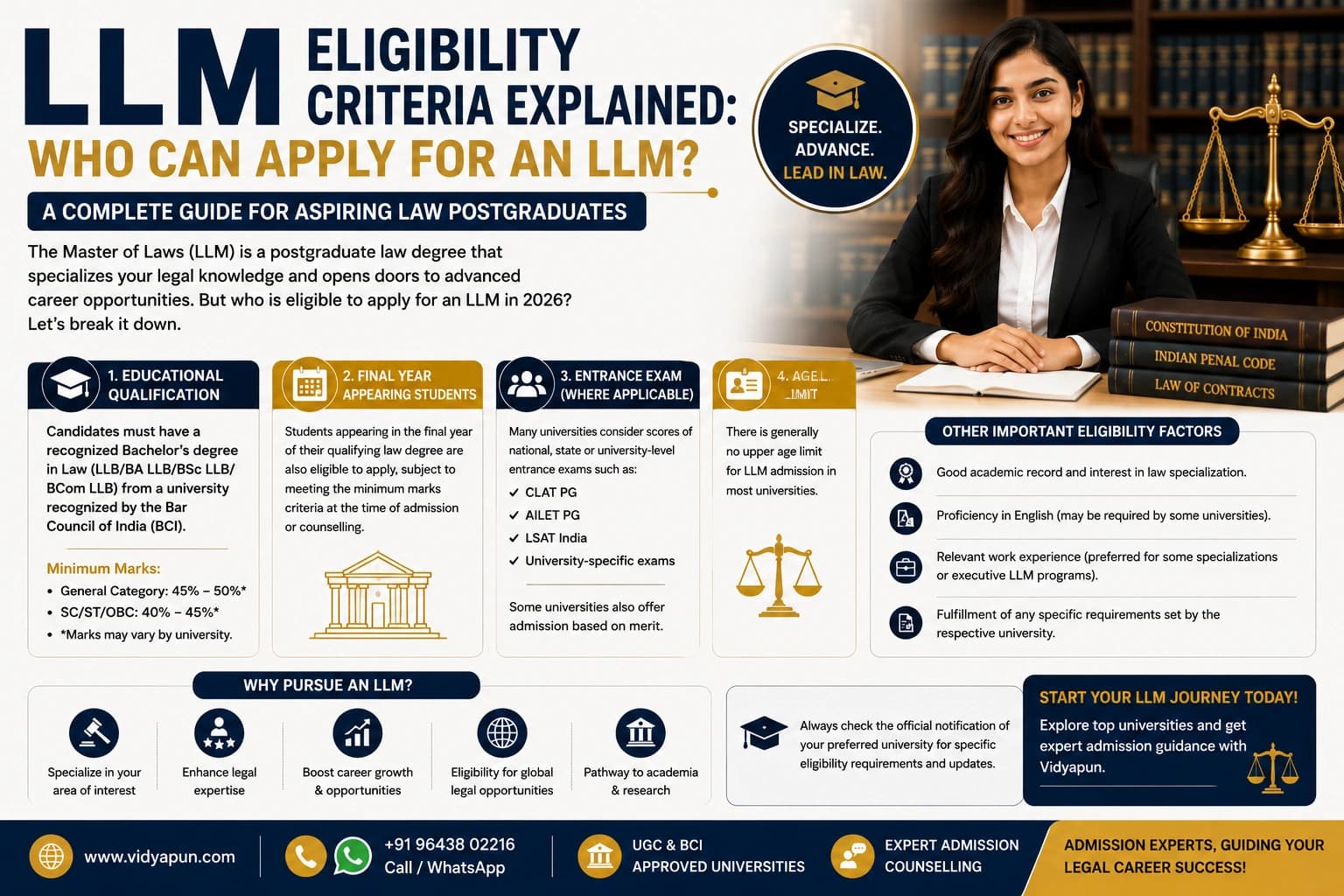
"Am I even eligible for an LLM?" is one of the first questions most final-year law students and recent LLB graduates ask — usually before they've even started shortlisting universities. And it's a fair question, because eligibility rules for a Master of Laws (LLM) aren't identical across every institution: your required marks, your degree type, and even your age can all play a role depending on where you apply.
This guide breaks down LLM eligibility criteria in full — from the basic degree requirement to the finer details that trip up otherwise well-prepared applicants.
Who Can Apply for an LLM? A Quick Overview
At a baseline level, anyone who holds a recognised law degree — whether a 3-year LLB after graduation or a 5-year integrated Bachelor of Laws (LLB) programme like BA LLB or BBA LLB — is eligible to apply for an LLM. Beyond that baseline, individual universities layer on their own requirements around marks, entrance exams, and sometimes work experience for specific specialisations.
Who Is Generally Not Eligible
Candidates without a recognised law degree, or whose LLB was awarded by an institution not approved by the Bar Council of India (BCI) or recognised by the UGC, are typically not eligible — regardless of how strong their academic record is otherwise.
Basic Educational Qualification for LLM
The non-negotiable requirement across virtually every LLM programme in India is a recognised undergraduate law degree.
3-Year LLB (After Graduation)
If you completed a general graduation degree (BA, BCom, BSc, etc.) followed by a 3-year LLB, you meet the basic educational qualification for LLM admission.
5-Year Integrated LLB
If you pursued a 5-year integrated programme — BA LLB, BBA LLB, BCom LLB, or similar — straight after Class 12, you're equally eligible. Integrated-degree holders sometimes have a slight edge in admission to research-intensive programmes, since their five years typically include more legal research exposure.
Minimum Marks Required for LLM Admission
Marks requirements vary, but most universities cluster around a similar range.
General Category Cut-Off
Most government and reputed private universities require a minimum of 50% aggregate marks across your LLB. Some highly ranked institutions, particularly for research-focused or dual-specialisation LLM programmes, push this closer to 55–60%.
Reserved Category Relaxation
For SC/ST/OBC (non-creamy layer), EWS, and PwD candidates, most universities offer a relaxation of 5 percentage points — typically bringing the requirement down to 45%. This mirrors the reservation policy applied to most other postgraduate law admissions.
Universities With Lower Cut-Offs
A number of private universities, and most distance/online LLM programmes, accept candidates with 45–50% aggregate regardless of category — useful to know if your LLB scorecard is on the lower side but you're still committed to pursuing an LLM.
LLM Eligibility for LLB vs Integrated Law Graduates
A common point of confusion is whether 3-year LLB and 5-year integrated LLB graduates are evaluated differently.
Equal Eligibility, Different Emphasis
Both paths meet the same basic eligibility bar. Where they sometimes diverge is in how selection committees weigh moot court experience, internships, and research exposure during interviews — integrated-degree students often have more of this by graduation simply because of the longer programme duration.
Eligibility for Diploma or Certificate Holders
Diploma or certificate courses in law do not meet LLM eligibility requirements — you need a full LLB degree, not a shorter legal-studies credential.
Age Limit and Eligibility for Working Professionals
Age is one of the most-searched eligibility questions, and the honest answer is: it depends on the university and the mode of study.
Full-Time LLM Programmes
Most full-time, on-campus LLM programmes at top universities no longer impose a strict upper age limit, though a small number of state-run universities and their entrance exams still do — always check the specific exam notification rather than assuming a blanket rule.
Distance and Online LLM Programmes
If you're a working professional, you'll generally find no meaningful age restriction on distance or online LLM programmes, which are specifically structured to accommodate people who are already working full-time.
Eligibility Criteria for Foreign Law Graduates
If you completed your law degree outside India and want to pursue an LLM in India, there's an additional step involved.
Equivalence Certificate Requirement
You'll typically need an equivalence certificate from the Bar Council of India or the Association of Indian Universities (AIU), confirming that your foreign law degree is equivalent to a recognised Indian LLB, before your LLM application will be considered complete.
Additional Documentation
Along with the equivalence certificate, most universities will ask for a detailed transcript, a translated and notarised copy of your degree (if not in English), and sometimes proof of English-language proficiency.
Eligibility for One-Year vs Two-Year LLM Programs
Not all LLM programmes are the same length, and eligibility can differ slightly between formats.
One-Year LLM Eligibility
One-year LLM programmes, offered by a handful of top-ranked universities, are generally more selective and often require either a higher minimum percentage, a qualifying entrance exam score, or (at some institutions) prior work experience.
Two-Year LLM Eligibility
Two-year LLM programmes — the more common format nationally — typically follow the standard eligibility criteria outlined above, without additional work-experience requirements.
Common Eligibility Mistakes That Get Applications Rejected
Even eligible candidates sometimes get their applications rejected — usually for avoidable reasons.
Submitting an Unrecognised Degree
Applying with a law degree from an institution not approved by the BCI is one of the most common (and most preventable) rejection reasons.
Missing the Category Certificate Validity Window
Reserved-category applicants sometimes submit an expired or outdated category certificate, which gets treated as ineligible documentation even though the candidate genuinely qualifies for the category.
Miscalculating Aggregate Percentage
Some universities calculate aggregate LLB percentage differently (all semesters vs. best-of semesters), so double-check the exact calculation method specified in the admission brochure before assuming you meet the cut-off.
Final Thoughts
LLM eligibility isn't as rigid as it might first appear — the baseline requirement (a recognised LLB and passing marks) is fairly universal, but the finer details around percentage cut-offs, age, and documentation vary enough between universities that it's worth checking each one individually rather than assuming a single national standard applies. If you're also weighing entrance exams as part of your eligibility planning, our LLM Entrance Exam Guide covers CLAT PG, AILET PG, and university-specific tests in detail.
Not sure if you meet the eligibility bar for your target universities? Talk to Admission Expert and get a personalised eligibility check before you apply.
Frequently Asked Questions
1. What is the minimum percentage required for LLM eligibility? Most universities require 50% aggregate in LLB for general category candidates, with a relaxation to around 45% for reserved categories.
2. Can I apply for an LLM after a 5-year integrated BA LLB? Yes. Both 3-year LLB (after graduation) and 5-year integrated LLB (BA LLB, BBA LLB, etc.) meet the eligibility requirement for LLM admission.
3. Is there an age limit for LLM admission? Most full-time LLM programmes no longer enforce a strict age limit, though a few state-run entrance exams still do. Distance and online LLM programmes generally have no age restriction.
4. Are foreign law graduates eligible for LLM in India? Yes, provided they obtain an equivalence certificate from the Bar Council of India or the Association of Indian Universities confirming their foreign degree is equivalent to a recognised Indian LLB.
5. Do one-year and two-year LLM programmes have the same eligibility criteria? Not always. One-year LLM programmes at select universities can be more selective, sometimes requiring a higher percentage or prior work experience, while two-year programmes generally follow standard eligibility norms.
6. Can a diploma in law be used to apply for an LLM? No. LLM eligibility requires a full LLB degree — a diploma or certificate course in law does not meet the requirement.
🌐 Website: www.vidyapun.com 📞 Call / WhatsApp: +91 96438 02216